


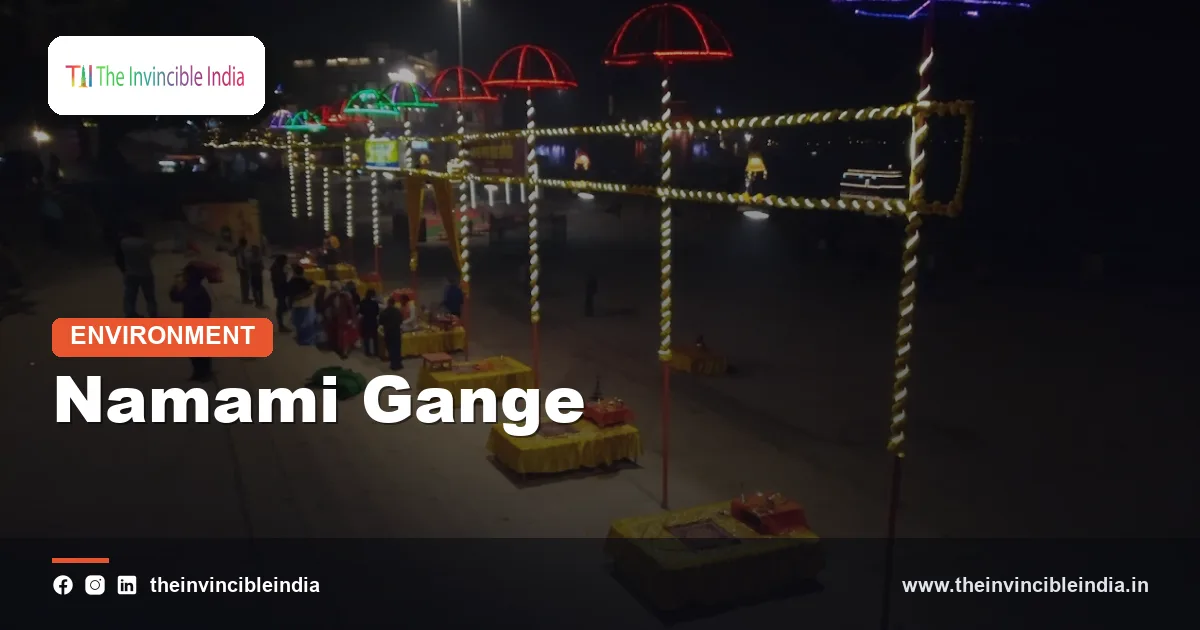
Namami Gange is the Government of India’s flagship programme to clean and rejuvenate the river Ganga, the country’s most revered and most heavily used river. Launched in 2014-15 as an Integrated Ganga Conservation Mission, it brings together sewage treatment, industrial pollution control, riverfront development, biodiversity protection, afforestation and community participation under a single umbrella.
The programme is implemented by the National Mission for Clean Ganga (NMCG) under the Ministry of Jal Shakti, with high-level oversight from the National Ganga Council. This explainer looks at why the Ganga matters, what has polluted it, how earlier efforts fared, how Namami Gange is organised, and where the mission stands today.
Quick Facts
| Item | Details |
|---|---|
| Programme | Namami Gange (Integrated Ganga Conservation Mission) |
| Launched | Announced in 2014 and rolled out as a flagship programme from 2014-15 |
| Implementing agency | National Mission for Clean Ganga (NMCG) |
| Nodal ministry | Ministry of Jal Shakti, Government of India |
| Apex body | National Ganga Council, chaired by the Prime Minister (constituted 2016) |
| River status | Declared India’s National River in 2008 |
| Main-stem states | Uttarakhand, Uttar Pradesh, Bihar, Jharkhand and West Bengal |
| Predecessor | Ganga Action Plan, launched in 1986 |
| Global recognition | Named among the UN’s top ecosystem-restoration flagships (2022) |
Why the Ganga Matters
The Ganga rises as the Bhagirathi from the Gangotri glacier at Gaumukh in Uttarakhand. At Devprayag it meets the Alaknanda, and from there it is known as the Ganga. It flows for roughly 2,500 kilometres through the northern and eastern plains before reaching the Bay of Bengal in the Sundarbans delta, shared with Bangladesh, where it merges with the Brahmaputra and Meghna systems.
A sacred river
For hundreds of millions of people the Ganga is not merely a river but a goddess, Ganga Maa. Pilgrimages, funeral rites, festivals and the great Kumbh gatherings are all tied to its banks. Cities such as Haridwar, Rishikesh, Prayagraj and Varanasi grew around its ghats and remain among the world’s oldest continuously inhabited places of worship.
A working lifeline
The river and its tributaries, including the Yamuna, Ghaghara, Gandak, Kosi and Son, drain a basin that covers roughly a quarter of India’s land area and supports a very large share of the country’s population. The fertile Gangetic plain produces cereals, sugarcane, pulses and oilseeds. The river also supplies drinking water, irrigation, fisheries, inland navigation and a rich riverine ecosystem. In November 2008 the Government of India declared the Ganga the National River of India, formally recognising its civilisational and ecological importance.
What Is Namami Gange?
The name Namami Gange loosely means “I bow to the Ganga”. The programme was announced in the Union Budget of July 2014 and approved by the Union Cabinet in 2015 as a flagship, centrally sponsored effort with a multi-year financial commitment far larger than any earlier river-cleaning scheme. It is designed as an integrated mission rather than a one-off construction drive.
Core objectives
- Abate pollution in the main stem of the Ganga and its tributaries.
- Conserve and rejuvenate the river’s ecology and biodiversity.
- Maintain adequate flow, often described as ecological flow or “e-flow”, so that the river can sustain itself.
- Involve people living along the basin as stakeholders rather than spectators.
Unlike earlier plans that concentrated on a few towns, Namami Gange looks at the whole river basin. It combines quick, visible measures such as cleaning ghats and skimming floating waste with long-term structural work such as building sewage treatment capacity and regulating industry.
How the Ganga Became Polluted
Pollution in the Ganga is the cumulative result of rapid urbanisation, industrial growth and rising population along its banks. Several sources are usually identified.
- Untreated domestic sewage: By common agreement this is the single largest source. Towns and cities along the river generate far more wastewater than existing treatment plants once handled, and drains often carry raw sewage straight to the river.
- Industrial effluents: Tanneries, distilleries, paper mills, sugar mills and textile units discharge wastewater that can contain organic load and chemicals, including chromium from leather processing.
- Solid waste: Household garbage, plastics and construction debris are dumped on banks and in drains that empty into the river.
- Agricultural runoff: Fertilisers and pesticides from farmland wash into the river during the monsoon.
- Religious and ritual offerings: Flowers, ash, idols and partly cremated remains add to the load, especially during festivals and mass bathing events.
Adding to these pressures, dams, barrages and canal diversions reduce the volume of water left in the river in many stretches, which lowers its natural ability to dilute and flush away pollutants.
Before Namami Gange: The Ganga Action Plan
Namami Gange was not India’s first attempt to clean the river. The Ganga Action Plan (GAP) was launched by Prime Minister Rajiv Gandhi at Varanasi in 1986 and became the country’s first major river-cleaning programme. It set out to intercept and divert sewage and to build treatment plants in towns along the river, and it was followed by a second phase in the 1990s. Its work was later folded into the broader National River Conservation Plan.
Why earlier efforts fell short
- Sewage treatment capacity was built for the population of the time, and demand outgrew it quickly.
- Many treatment plants worked below capacity because of power shortages, poor maintenance or weak operating arrangements.
- Industrial pollution and non-point sources were not tackled with the same seriousness.
- Responsibility was divided between agencies, and coordination between states was patchy.
- Public participation was limited, and long-term operation was under-funded once construction ended.
In 2009 the National Ganga River Basin Authority (NGRBA) was set up, and in 2011 the National Mission for Clean Ganga was registered as a society to serve as its implementing arm. These bodies set the institutional ground on which Namami Gange was built.
Institutional Structure of the Mission
Namami Gange works through a layered structure that runs from the national level to individual districts.
- National Ganga Council: Constituted in October 2016 under the Environment (Protection) Act, 1986, replacing the earlier NGRBA. It is chaired by the Prime Minister and provides overall guidance, with the Union Jal Shakti Minister and chief ministers of the concerned states among those associated with it.
- Empowered Task Force: A body chaired by the Union Minister of Jal Shakti to review progress and resolve inter-departmental issues.
- National Mission for Clean Ganga: The implementing agency, with a Governing Council and an Executive Committee that approve projects and release funds.
- State Programme Management Groups: State-level units that plan and monitor projects in the main-stem and basin states.
- District Ganga Committees: Local committees, usually headed by the district magistrate, that coordinate work on the ground.
The 2016 Ganga authorities order also gave the Central Pollution Control Board and state pollution control boards clearer powers to act against polluters in the river’s catchment.
The five main-stem states
The Ganga itself flows through Uttarakhand, Uttar Pradesh, Bihar, Jharkhand and West Bengal, and these states carry most of the programme’s projects. The wider basin also touches states such as Himachal Pradesh, Haryana, Rajasthan, Madhya Pradesh, Chhattisgarh and the National Capital Territory of Delhi through tributaries like the Yamuna.
The Pillars of Namami Gange
The programme rests on a set of “pillars” that combine immediate results with sustained work. The table below summarises them.
| Pillar | What it covers |
|---|---|
| Sewage treatment infrastructure | New sewage treatment plants (STPs), rehabilitation of old ones, sewer networks and interception and diversion of drains |
| Riverfront development | Ghats, crematoria, bathing facilities and public spaces in towns on the river |
| River surface cleaning | Trash skimmers and collection of floating waste, especially at busy ghats |
| Industrial effluent monitoring | Inspection of grossly polluting industries, online effluent monitoring, tannery regulation at Kanpur |
| Biodiversity conservation | Protection of the Gangetic dolphin, gharial, turtles and fish, plus habitat restoration |
| Afforestation | Planting native species on riverbanks and in the catchment to reduce erosion |
| Public participation | Ganga Praharis, Ganga Grams, awareness drives and school and community outreach |
| Ganga knowledge and monitoring | Water quality monitoring, research, and e-flow studies |
Sewage Treatment and the Hybrid Annuity Model
Because untreated sewage is the largest single source of pollution, sewage treatment is the heaviest component of Namami Gange in terms of work and spending. Projects include new STPs, upgrading old plants, laying sewer lines and intercepting drains that flow directly into the river.
A change in how plants are run
Earlier plants were often built and then handed to local bodies that lacked the money or expertise to run them. Namami Gange introduced two important ideas to solve this.
- Hybrid Annuity Model (HAM): A public-private partnership in which the government pays a portion of the project cost during construction, while the balance is paid in instalments over the operating period, linked to performance. A private operator is therefore committed to running the plant well over many years, typically about fifteen.
- One City One Operator: A single agency takes responsibility for treatment and sewerage services across a city, avoiding fragmented responsibility. Cities such as Varanasi and Haridwar were among the first to be taken up under these arrangements.
The programme has also promoted reuse of treated water for irrigation, industrial cooling and construction, in line with the goal of treating wastewater as a resource rather than as a burden on the river.
Industry, Ghats and River Surface Cleaning
Regulating industrial effluents
The mission focuses on grossly polluting industries along the main stem and tributaries, requiring them to install effluent treatment plants and to connect online continuous effluent monitoring systems that report data to pollution control boards. The most famous hotspot is the cluster of tanneries in the Jajmau area of Kanpur, where leather processing generates effluent with heavy organic and chromium load. Common effluent treatment plants, relocation efforts and stricter discharge norms have been central to the response, and inspections and closure notices have followed for defaulting units.
Ghats and riverfronts
Riverfront development covers construction and renovation of ghats, crematoria and changing rooms in towns along the river. Cleaner and better-managed ghats in places such as Varanasi, Haridwar and Prayagraj reduce the direct load of ritual waste and make the river more accessible to pilgrims and visitors. Modern crematoria, including electric and improved wood-based designs, aim to reduce the release of ash and partly burnt remains into the water.
Cleaning the surface
Trash skimmers and boats collect floating garbage, flowers and plastic from the river surface at high-footfall locations. While this work cannot solve the underlying pollution problem, it offers a visible daily improvement and keeps the main ghats presentable during festivals.
Biodiversity, Wildlife and Afforestation
A living river is judged not only by its water quality but by the species that depend on it. Namami Gange therefore includes a strong biodiversity component.
- Gangetic river dolphin: Declared India’s National Aquatic Animal in 2009, this nearly blind freshwater dolphin is an indicator of river health. Conservation efforts include monitoring populations, protecting habitat and raising awareness among fishing communities.
- Gharial: This fish-eating crocodilian, identified by the bulbous growth on the male’s snout, is critically endangered. Breeding and rehabilitation programmes and protected stretches of river are part of the effort.
- Turtles: Freshwater turtles help clean rivers by feeding on carrion and organic matter. Rescue, breeding and release programmes have been supported with partners.
- Fish and fisheries: Restoring native fish such as the hilsa and mahseer supports both ecology and livelihoods.
Planting trees along the river
The afforestation pillar promotes planting native species on riverbanks and in the wider catchment. Trees reduce soil erosion, filter runoff, help recharge groundwater and provide habitat. Scientific institutions such as the Forest Research Institute and the Wildlife Institute of India have been closely involved in technical planning.
People’s Participation: Ganga Praharis and Ganga Grams
Officials repeatedly stress that no river can be cleaned by government action alone. The programme therefore builds community roles into its design.
- Ganga Praharis: Volunteers, often trained by wildlife and environment institutions, who serve as the “sentinels” of the river, reporting pollution, spreading awareness and supporting conservation work locally.
- Ganga Grams: Villages on the river’s banks selected for improved sanitation, waste management, water conservation and sustainable livelihoods.
- Awareness campaigns: School programmes, cleanliness drives, festivals and quizzes that bring the message to children and pilgrims.
- Arth Ganga: A concept that links the river’s health with local economic activity, such as natural farming, tourism and livelihood opportunities for riverside communities.
Sanitation work under the Swachh Bharat Mission and the Jal Jeevan Mission supports the same goals in villages, since ending open defecation and improving waste handling directly reduce pollution loads.
Progress, Recognition and Continuing Challenges
What has been achieved
Since the mission began, hundreds of projects across the basin have been sanctioned, and a large number of them have been completed. Sewage treatment capacity along the main stem has increased substantially, and ghats and riverfronts in many towns have been upgraded. Real-time and periodic water-quality monitoring has expanded, and observers have reported clearer water and the return of dolphins and other species to several stretches. In December 2022 the United Nations recognised Namami Gange as one of the top ten World Restoration Flagships under the UN Decade on Ecosystem Restoration, a sign of international interest in the model.
What remains difficult
- A gap remains between the sewage that towns generate and the amount that is properly collected and treated, especially in fast-growing cities and in smaller towns and villages.
- Sewer networks, rather than treatment plants, are frequently the missing link, so plants may operate below capacity.
- Tributaries such as the Yamuna and others carry heavy pollution loads into the main stem.
- Maintaining minimum flow, given demands from irrigation, hydropower and cities, requires constant balancing.
- Long-term operation, monitoring and enforcement matter as much as construction.
Water quality varies by stretch and season. Upper reaches in Uttarakhand are generally in better condition, while stretches near large cities and industrial clusters remain under pressure, particularly in the lean season when flow is lower.
Conclusion
Namami Gange marks a shift in India’s approach to river conservation, moving from a narrow focus on treatment plants to a broad mission that connects sanitation, industry, ecology and community action. Its progress shows what coordinated investment and institutional clarity can achieve, and its remaining challenges show how deep and long-term the task is. The health of the Ganga will depend on sustained operation of the infrastructure being built and on the daily choices of the people who live along her banks.
Frequently Asked Questions
What is Namami Gange?
Namami Gange is the Government of India’s flagship programme to clean and rejuvenate the river Ganga. It was launched in 2014-15 as an Integrated Ganga Conservation Mission and covers sewage treatment, industrial pollution control, riverfront development, biodiversity conservation, afforestation and public participation.
Which agency implements Namami Gange?
The National Mission for Clean Ganga (NMCG) is the implementing agency, working under the Ministry of Jal Shakti. Overall guidance comes from the National Ganga Council, which is chaired by the Prime Minister and was constituted in 2016.
How is Namami Gange different from the Ganga Action Plan?
The Ganga Action Plan of 1986 concentrated mainly on intercepting sewage and building treatment plants in selected towns. Namami Gange takes a whole-basin, multi-pillar approach that adds industrial monitoring, biodiversity, afforestation and community participation, and introduces long-term operation contracts such as the Hybrid Annuity Model.
Which states does the Ganga main stem flow through?
The main stem of the Ganga flows through Uttarakhand, Uttar Pradesh, Bihar, Jharkhand and West Bengal. Its wider basin also includes parts of states such as Himachal Pradesh, Haryana, Rajasthan, Madhya Pradesh, Chhattisgarh and Delhi.
What are Ganga Praharis and Ganga Grams?
Ganga Praharis are trained volunteers who act as guardians of the river, spreading awareness and reporting problems. Ganga Grams are villages along the river’s banks that are developed with better sanitation, waste management and sustainable livelihoods.
Why is the Gangetic dolphin important to the mission?
The Gangetic river dolphin, India’s National Aquatic Animal since 2009, is an indicator species, so its presence reflects a healthy river. Protecting it means safeguarding water quality, flow and habitat, which benefits the entire ecosystem and the communities that depend on it.
{“@context”:”https://schema.org”,”@graph”:[{“@type”:”FAQPage”,”mainEntity”:[{“@type”:”Question”,”name”:”What is Namami Gange?”,”acceptedAnswer”:{“@type”:”Answer”,”text”:”Namami Gange is the Government of India’s flagship programme to clean and rejuvenate the river Ganga. It was launched in 2014-15 as an Integrated Ganga Conservation Mission and covers sewage treatment, industrial pollution control, riverfront development, biodiversity conservation, afforestation and public participation.”}},{“@type”:”Question”,”name”:”Which agency implements Namami Gange?”,”acceptedAnswer”:{“@type”:”Answer”,”text”:”The National Mission for Clean Ganga (NMCG) is the implementing agency, working under the Ministry of Jal Shakti. Overall guidance comes from the National Ganga Council, which is chaired by the Prime Minister and was constituted in 2016.”}},{“@type”:”Question”,”name”:”How is Namami Gange different from the Ganga Action Plan?”,”acceptedAnswer”:{“@type”:”Answer”,”text”:”The Ganga Action Plan of 1986 concentrated mainly on intercepting sewage and building treatment plants in selected towns. Namami Gange takes a whole-basin, multi-pillar approach that adds industrial monitoring, biodiversity, afforestation and community participation, and introduces long-term operation contracts such as the Hybrid Annuity Model.”}},{“@type”:”Question”,”name”:”Which states does the Ganga main stem flow through?”,”acceptedAnswer”:{“@type”:”Answer”,”text”:”The main stem of the Ganga flows through Uttarakhand, Uttar Pradesh, Bihar, Jharkhand and West Bengal. Its wider basin also includes parts of states such as Himachal Pradesh, Haryana, Rajasthan, Madhya Pradesh, Chhattisgarh and Delhi.”}},{“@type”:”Question”,”name”:”What are Ganga Praharis and Ganga Grams?”,”acceptedAnswer”:{“@type”:”Answer”,”text”:”Ganga Praharis are trained volunteers who act as guardians of the river, spreading awareness and reporting problems. Ganga Grams are villages along the river’s banks that are developed with better sanitation, waste management and sustainable livelihoods.”}},{“@type”:”Question”,”name”:”Why is the Gangetic dolphin important to the mission?”,”acceptedAnswer”:{“@type”:”Answer”,”text”:”The Gangetic river dolphin, India’s National Aquatic Animal since 2009, is an indicator species, so its presence reflects a healthy river. Protecting it means safeguarding water quality, flow and habitat, which benefits the entire ecosystem and the communities that depend on it.”}}]}]}