


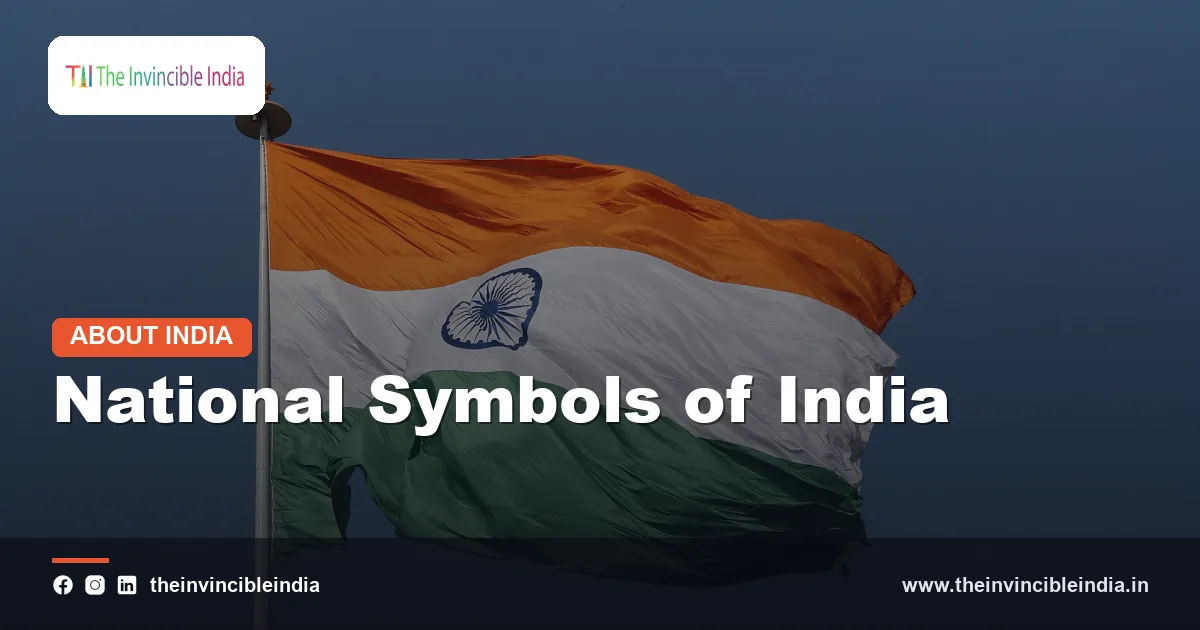
Every nation carries a set of images, sounds and living things that stand in for its identity. The national symbols of India are among the most recognisable in the world: the saffron, white and green Tiranga fluttering over Red Fort, the four-lion emblem stamped on every passport and currency note, the 52 seconds of “Jana Gana Mana” that make a whole stadium stand still, and the tiger, peacock and lotus that appear on stamps, coins and school textbooks.
This guide explains each of these symbols in plain language: what it is, where it came from, when it was officially adopted and what it is meant to represent. It also clears up several popular myths, because some things that many Indians assume to be “national” (a national sport, a national language) have never actually been declared by law. Updated: 30 September 2026.
| Symbol | Quick Fact |
|---|---|
| National Flag | Tiranga (tricolour) with the 24-spoke Ashoka Chakra; adopted 22 July 1947 |
| State Emblem | Adapted from the Lion Capital of Ashoka at Sarnath; adopted 26 January 1950 |
| National Motto | “Satyameva Jayate” (Truth Alone Triumphs), from the Mundaka Upanishad |
| National Anthem | “Jana Gana Mana” by Rabindranath Tagore; adopted 24 January 1950; about 52 seconds |
| National Song | “Vande Mataram” by Bankim Chandra Chatterjee; given equal honour on 24 January 1950 |
| National Calendar | Saka calendar; adopted for official use from 22 March 1957 |
| National Animal | Royal Bengal Tiger |
| National Bird | Indian Peafowl (peacock) |
| National Flower, Tree, Fruit | Lotus, Banyan, Mango |
What Counts as a National Symbol?
A national symbol is an object, image, animal, plant or piece of music that a country formally recognises as representing its heritage and values. Some symbols, such as the flag, the emblem and the anthem, are protected by specific laws and codes. Others, such as the national animal or flower, are recognised through government decisions and carry mostly cultural and conservation significance.
India’s symbols draw from very different layers of history. The emblem goes back to the Mauryan emperor Ashoka in the third century BCE. The lotus and banyan are rooted in ancient religious and literary traditions. The anthem and the song belong to the Indian freedom movement of the late nineteenth and early twentieth centuries. The rupee sign is a product of the twenty-first century. Together they tell a story of continuity: a modern republic that consciously borrows from its ancient past.
The National Flag: The Tiranga
The national flag of India is a horizontal tricolour of deep saffron at the top, white in the middle and India green at the bottom, in equal proportions. In the centre of the white band sits the Ashoka Chakra, a wheel in navy blue with 24 evenly spaced spokes. The ratio of the flag’s width to its length is 2:3.
What the colours and the wheel stand for
- Saffron represents courage, sacrifice and renunciation.
- White represents peace, truth and purity.
- Green represents faith, fertility and the prosperity of the land.
- The Ashoka Chakra represents the eternal wheel of law (dharma) and the idea that life lies in movement and stagnation is death.
How the flag evolved
Several flags were used during the freedom struggle. The design that most directly shaped the modern flag came from Pingali Venkayya, a freedom fighter from Andhra, who developed a tricolour with a spinning wheel (charkha) at its centre and presented it to Mahatma Gandhi in 1921. Over the following years the colours were reinterpreted and the charkha was eventually replaced by the Ashoka Chakra, taken from the Sarnath pillar, so that the flag would not appear to belong to any single party or movement.
The Constituent Assembly adopted the flag in its present form on 22 July 1947, a few weeks before independence. It was first flown as the flag of a free nation on 15 August 1947.
The Flag Code of India
Because the flag is treated as a symbol of national honour, its display is governed by rules. Today these are gathered in the Flag Code of India, 2002, which came into effect on 26 January 2002, along with the Prevention of Insults to National Honour Act, 1971. The Code has been amended from time to time, and older rules that limited private citizens’ right to fly the flag were relaxed after a Supreme Court ruling in the 2000s upheld it as a form of expression when done respectfully.
Core principles
- The flag must always be given a position of honour and must never touch the ground or water.
- When displayed with other flags, it should be placed higher than or at the extreme right of the others.
- It must never be used as a drape, a costume or a cover for objects, and it should not be defaced with writing.
- Damaged or soiled flags must be disposed of privately and with dignity, for instance by burning or burial, rather than being thrown away.
- Traditionally the flag was made of khadi; later amendments have permitted other materials such as cotton, polyester, wool and silk, with the rules on machine-made flags also being relaxed.
Flag manufacture in India follows specifications laid down by the Bureau of Indian Standards, covering colour shades, dimensions and the precise geometry of the chakra.
The State Emblem of India and “Satyameva Jayate”
The State Emblem of India is adapted from the Lion Capital of Ashoka, which stands at Sarnath near Varanasi, the place where the Buddha delivered his first sermon. The original sculpture, carved from polished sandstone in the third century BCE, shows four lions standing back to back, facing the four directions, on a circular abacus. The Government of India adopted the emblem on 26 January 1950, the day the Constitution came into force.
Features of the emblem
- Only three lions are visible in the two-dimensional version, since the fourth is hidden from view.
- The abacus carries a wheel (the Dharma Chakra) in the centre, with a bull on the right and a galloping horse on the left. Outlines of other wheels appear at the extreme edges. The elephant belongs to the original sculpture’s frieze and is not shown in the emblem.
- The bell-shaped lotus that supports the original capital is omitted.
- Below the abacus, the motto “Satyameva Jayate” is written in Devanagari script.
The motto
“Satyameva Jayate” means “Truth alone triumphs”. It is taken from the Mundaka Upanishad, one of the principal Upanishads of the Vedic tradition. The phrase was popularised in the freedom movement by Pandit Madan Mohan Malaviya. The emblem is the official seal of the Government of India and appears on official documents, currency notes, coins and passports. Its use by private persons or organisations is restricted under the Emblems and Names (Prevention of Improper Use) Act, 2005, and rules made under it.
The National Anthem: “Jana Gana Mana”
“Jana Gana Mana” was composed by Rabindranath Tagore, the poet who became the first non-European to win the Nobel Prize in Literature (1913). He wrote it originally in highly Sanskritised Bengali, under the title “Bharoto Bhagyo Bidhata”. It was first sung publicly on 27 December 1911 at the Calcutta session of the Indian National Congress. Tagore later prepared an English rendering, known as “The Morning Song of India”.
The Constituent Assembly accepted it as the national anthem on 24 January 1950, two days before the Constitution came into force, with a statement by its president, Dr Rajendra Prasad, that the wording could be modified by the government as circumstances required. The song has five stanzas, but the national anthem consists of the first stanza only.
Key facts about the anthem
- The full version takes about 52 seconds to play; a shorter version consisting of the first and last lines takes about 20 seconds.
- The lyrics speak of the “dispenser of India’s destiny” and mention regions and rivers such as Punjab, Sindh, Gujarat, Maratha, Dravida, Utkala and Banga, Yamuna and Ganga.
- People are expected to stand in respect when it is played or sung. Rules for its performance are laid down by the government and referred to in the Prevention of Insults to National Honour Act, 1971.
The National Song: “Vande Mataram”
“Vande Mataram”, meaning “I bow to the Mother”, was written by Bankim Chandra Chatterjee in the 1870s and appeared in his novel Anandamath (1882), set against the backdrop of the Sannyasi rebellion in Bengal. The poem, in Sanskritised Bengali, personifies the motherland as a nurturing and powerful goddess, praising her rivers, fruits, forests and strength.
It was sung by Tagore at the 1896 session of the Indian National Congress and became a rallying cry during the Swadeshi movement that followed the 1905 partition of Bengal. Sri Aurobindo later produced a well-known English translation.
In the Constituent Assembly on 24 January 1950, Dr Rajendra Prasad stated that “Vande Mataram”, having played a historic part in the struggle for freedom, would be honoured equally with “Jana Gana Mana” and would have equal status with it. The national song has no fixed set of rules like the anthem, but the first two stanzas are generally recognised for official use, and a rendition typically takes a little over a minute.
The National Calendar and the Rupee Symbol
The Saka calendar
India has many regional calendars, so the government set up a Calendar Reform Committee in 1952 under the astrophysicist Meghnad Saha. The committee recommended a unified, scientifically accurate calendar based on the Saka era, which counts from 78 CE. The Saka calendar was adopted for official use from 22 March 1957. It has 365 days in a normal year, begins with the month of Chaitra and follows the same leap-year pattern as the Gregorian calendar. Its first day generally falls on 22 March (or 21 March in a leap year). It is printed alongside the Gregorian date in gazette notifications and used by All India Radio for its broadcasts.
The rupee symbol
The symbol for the Indian rupee, ₹, was approved by the Union Cabinet on 15 July 2010. Designed by D. Udaya Kumar, it combines the Devanagari letter “र” (ra) with the Latin capital “R”, with two horizontal bars across the top that recall the tricolour and also suggest an equality sign. It was chosen through a national competition and made India one of a small group of countries with a distinct currency symbol. It is included in the Unicode standard and appears on modern keyboards.
National Animals of India
India recognises several animals for different reasons. Each choice reflects a mix of biology, culture and conservation policy.
The Royal Bengal Tiger
The tiger (Panthera tigris tigris) was declared the national animal in 1972, replacing the lion, which had been used earlier. It was picked for its strength, grace and power, and also to draw attention to its declining numbers. The following year, in 1973, the government launched Project Tiger, which created a network of dedicated tiger reserves. India today holds a large share of the world’s wild tigers.
The Gangetic dolphin
The Ganges river dolphin (Platanista gangetica), nearly blind and reliant on echolocation, was declared the national aquatic animal on 5 October 2009. It is an indicator of river health, found in the Ganga, Brahmaputra and their tributaries, and is protected under the Wildlife (Protection) Act, 1972.
The Indian elephant
The Indian elephant (Elephas maximus indicus) was designated the national heritage animal in 2010. It has deep roots in Indian religion, royal processions, art and literature, and the elephant-headed deity Ganesha is among the most widely worshipped gods in the country.
National Bird, Flower, Tree and Fruit
The Indian peacock
The Indian peafowl (Pavo cristatus) became the national bird in 1963. The male’s iridescent blue plumage and fan-like train, displayed during the monsoon dance, make it a familiar figure in folk art, textiles and mythology. It is closely associated with Lord Krishna and Kartikeya. It is protected under Schedule I of the Wildlife (Protection) Act, 1972.
The lotus
The lotus (Nelumbo nucifera) is the national flower. It rises pure and unstained from muddy water, and this has made it a symbol of spiritual purity and detachment in Hindu, Buddhist and Jain traditions. It is associated with the goddess Lakshmi, and with Vishnu and Brahma.
The banyan
The Indian banyan (Ficus benghalensis) is the national tree. It spreads through aerial prop roots that grow into new trunks, so a single tree can cover a vast area and survive for centuries. This has made it an emblem of longevity, shelter and the unity of a large family. Village councils traditionally met in its shade.
The mango
The mango (Mangifera indica) is the national fruit. It is native to the Indian subcontinent and has been cultivated for thousands of years. It appears in Sanskrit poetry, and its leaves are used as door garlands in festivals. India remains one of the largest producers of mangoes in the world.
The Ganga: India’s National River
The Ganga was declared India’s national river in November 2008. It rises from the Gangotri glacier in the Himalayas as the Bhagirathi, becomes the Ganga after joining the Alaknanda at Devprayag, and flows across the northern plains into the Bay of Bengal. Its basin supports a very large share of the country’s population, and its cities, such as Haridwar, Prayagraj and Varanasi, are among the most sacred pilgrimage centres in Hinduism.
The recognition brought institutional attention to the river’s pollution. In 2009 the National Ganga River Basin Authority was set up, and a large clean-up programme, Namami Gange, was launched in 2014. Alongside the dolphin, the river is now a focus of both cultural reverence and environmental policy.
All National Symbols of India at a Glance
| Category | Symbol | What it is |
|---|---|---|
| National Flag | Tiranga | Saffron, white and green with a navy-blue 24-spoke Ashoka Chakra; adopted 22 July 1947 |
| National Emblem | State Emblem of India | Adapted from the Sarnath Lion Capital; adopted 26 January 1950 |
| National Motto | Satyameva Jayate | “Truth alone triumphs”, from the Mundaka Upanishad |
| National Anthem | Jana Gana Mana | Written by Rabindranath Tagore; adopted 24 January 1950 |
| National Song | Vande Mataram | Written by Bankim Chandra Chatterjee; from Anandamath |
| National Calendar | Saka calendar | Based on the Saka era (78 CE); adopted 1957 |
| National Currency Symbol | Rupee (₹) | Designed by D. Udaya Kumar; approved 2010 |
| National Animal | Royal Bengal Tiger | Panthera tigris tigris; declared 1972 |
| National Aquatic Animal | Gangetic dolphin | Platanista gangetica; declared 2009 |
| National Heritage Animal | Indian elephant | Elephas maximus indicus; declared 2010 |
| National Bird | Indian peacock | Pavo cristatus; declared 1963 |
| National Flower | Lotus | Nelumbo nucifera |
| National Tree | Banyan | Ficus benghalensis |
| National Fruit | Mango | Mangifera indica |
| National River | Ganga | Declared in November 2008 |
Common Misconceptions: What Is Not Officially “National”
Many people assume India has an official national sport, language or similar symbol. In reality, several popular claims do not hold up.
- National sport: Hockey is often called India’s national game because of the country’s Olympic successes, but the government has stated that no sport has been officially declared the national sport. Hockey and cricket are hugely popular, yet neither has legal status as such.
- National language: India has no national language. Under Article 343 of the Constitution, Hindi in the Devanagari script is the official language of the Union, and English continues to be used for official purposes alongside it. The Eighth Schedule recognises 22 languages, and courts have observed that no language holds the status of a national language.
- National dress or food: There is no official national dress or dish. The sari, kurta and dhoti, or khichdi and other dishes, are widely popular but not formally designated.
- National currency vs symbol: The rupee is India’s currency, issued by the Reserve Bank of India, and the sign ₹ is its official symbol. It is not a separate “national symbol” in the same legal sense as the flag.
- National reptile or insect: Animals such as the king cobra are sometimes described as national reptiles, but no such official declaration has been made in the way it was for the tiger or the peacock.
Being aware of these distinctions matters, especially for students preparing for general knowledge examinations, where such questions frequently appear.
Conclusion
The national symbols of India work on several levels. The flag, emblem, anthem and song are formal expressions of sovereignty and freedom, drawn from the Mauryan past and the anti-colonial struggle. The animals, plants and river link the nation to its living landscape and remind citizens of the conservation work still to be done. Understanding what each symbol means, and when and why it was adopted, helps citizens treat them not as trivia but as a shared inheritance.
Frequently Asked Questions
What are the main national symbols of India?
The principal symbols are the national flag (Tiranga), the State Emblem with the motto “Satyameva Jayate”, the national anthem “Jana Gana Mana” and the national song “Vande Mataram”. India also recognises a national calendar, currency symbol, animal, aquatic animal, heritage animal, bird, flower, tree, fruit and river.
When was the Indian national flag adopted?
The Constituent Assembly adopted the flag in its present form on 22 July 1947. It is a horizontal tricolour of saffron, white and green with the navy-blue Ashoka Chakra of 24 spokes in the centre, and its design draws on the earlier work of Pingali Venkayya.
What does “Satyameva Jayate” mean and where is it from?
It means “Truth alone triumphs”. The phrase comes from the Mundaka Upanishad and is inscribed in Devanagari script below the State Emblem, which was adopted on 26 January 1950.
How long does the national anthem take to play?
The full version of “Jana Gana Mana”, which is its first stanza, takes about 52 seconds. A short version comprising only the first and last lines takes about 20 seconds. It was adopted as the national anthem on 24 January 1950.
Does India have a national language or national sport?
No. Hindi is an official language of the Union under Article 343, not a national language, and English is also used for official work. Likewise, no sport, including hockey, has been officially declared India’s national sport.
Why was the tiger chosen as India’s national animal?
The tiger was declared the national animal in 1972 because of its strength, majesty and wide presence in Indian forests, and also to draw attention to its declining numbers. Project Tiger, launched in 1973, followed as a major conservation effort.
{“@context”:”https://schema.org”,”@graph”:[{“@type”:”FAQPage”,”mainEntity”:[{“@type”:”Question”,”name”:”What are the main national symbols of India?”,”acceptedAnswer”:{“@type”:”Answer”,”text”:”The principal symbols are the national flag (Tiranga), the State Emblem with the motto “Satyameva Jayate”, the national anthem “Jana Gana Mana” and the national song “Vande Mataram”. India also recognises a national calendar, currency symbol, animal, aquatic animal, heritage animal, bird, flower, tree, fruit and river.”}},{“@type”:”Question”,”name”:”When was the Indian national flag adopted?”,”acceptedAnswer”:{“@type”:”Answer”,”text”:”The Constituent Assembly adopted the flag in its present form on 22 July 1947. It is a horizontal tricolour of saffron, white and green with the navy-blue Ashoka Chakra of 24 spokes in the centre, and its design draws on the earlier work of Pingali Venkayya.”}},{“@type”:”Question”,”name”:”What does “Satyameva Jayate” mean and where is it from?”,”acceptedAnswer”:{“@type”:”Answer”,”text”:”It means “Truth alone triumphs”. The phrase comes from the Mundaka Upanishad and is inscribed in Devanagari script below the State Emblem, which was adopted on 26 January 1950.”}},{“@type”:”Question”,”name”:”How long does the national anthem take to play?”,”acceptedAnswer”:{“@type”:”Answer”,”text”:”The full version of “Jana Gana Mana”, which is its first stanza, takes about 52 seconds. A short version comprising only the first and last lines takes about 20 seconds. It was adopted as the national anthem on 24 January 1950.”}},{“@type”:”Question”,”name”:”Does India have a national language or national sport?”,”acceptedAnswer”:{“@type”:”Answer”,”text”:”No. Hindi is an official language of the Union under Article 343, not a national language, and English is also used for official work. Likewise, no sport, including hockey, has been officially declared India’s national sport.”}},{“@type”:”Question”,”name”:”Why was the tiger chosen as India’s national animal?”,”acceptedAnswer”:{“@type”:”Answer”,”text”:”The tiger was declared the national animal in 1972 because of its strength, majesty and wide presence in Indian forests, and also to draw attention to its declining numbers. Project Tiger, launched in 1973, followed as a major conservation effort.”}}]}]}