


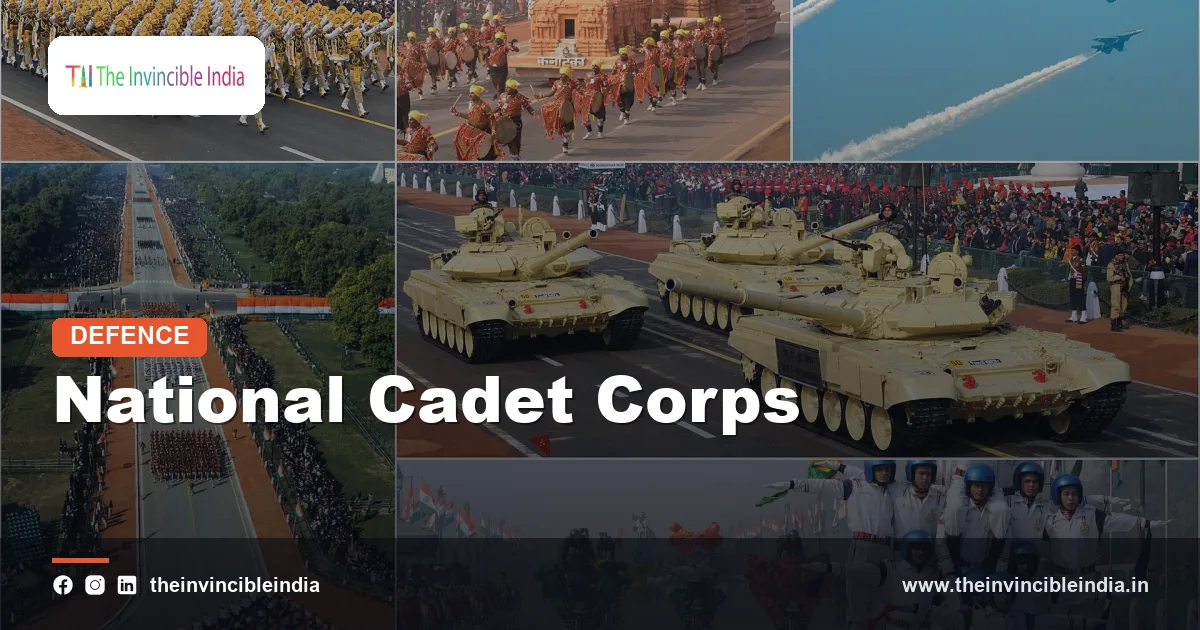
The National Cadet Corps is the youth wing of the Indian Armed Forces, a voluntary organisation that gives school and college students a taste of military discipline, adventure and public service. Its cadets march in olive green, navy blue or air force blue uniforms, learn drill and field craft, and spend part of every year in camps that stretch from the Himalayan foothills to the coastline. For generations of young Indians, the NCC has been the first place where they learned to lead a team, follow a command and put a common cause above personal comfort.
Yet the National Cadet Corps is often misunderstood. It is not a recruitment agency, and joining it does not guarantee a commission in the Army, Navy or Air Force. It is a character-building and citizenship movement, run under the Ministry of Defence, that also offers real advantages to those who later choose a uniformed career. This explainer covers its history, structure, certificates, training, camps and social work.
Quick Facts
| Full name | National Cadet Corps (NCC) |
|---|---|
| Raised on | 15 July 1948, under the National Cadet Corps Act, 1948 |
| Motto | Ekta aur Anushasan (Unity and Discipline) |
| Administered by | Ministry of Defence, Government of India |
| Head of organisation | Director General, a serving Army officer of Lieutenant General rank |
| Wings | Army Wing, Naval Wing and Air Wing |
| Divisions | Junior Division/Wing (schools) and Senior Division/Wing (colleges) |
| Certificates | A, B and C examinations |
| Nature of membership | Voluntary; open to both boys and girls |
What the National Cadet Corps Is and Why It Exists
The NCC is a tri-service organisation, meaning that it draws on the Army, Navy and Air Force together. Its purpose is to build a pool of disciplined, motivated and public-spirited young people who can contribute to the nation in any field, whether in uniform or out of it. The emphasis is on values such as self-discipline, teamwork, courage, a secular outlook and a spirit of adventure and sportsmanship.
The aims of the NCC can be summed up in a few ideas:
- Develop character, comradeship, discipline, leadership and a sense of service among youth.
- Create a trained human resource that can be tapped for national needs, including emergencies.
- Provide a healthy environment that motivates young people to consider careers in the armed forces.
- Encourage community service, national integration and environmental awareness.
Not a direct route to a commission
This point deserves emphasis. Being an NCC cadet does not make a person a soldier, and there is no automatic entry into the forces. A candidate who wants to become an officer must still clear the selection process like everyone else. What the NCC offers is preparation, familiarity with military life and certain concessions, which are described later in this article. Many cadets never join the forces at all and go on to become doctors, engineers, civil servants, teachers and entrepreneurs, carrying the habits of punctuality and leadership with them.
History: From University Corps to a National Movement
The idea of training young Indians in a military manner is older than Independence. During British rule, the University Corps was set up in the early twentieth century, and it later became the University Officers Training Corps (UOTC). The UOTC was small and largely meant for a limited section of students, so it did not create a broad reserve of trained youth. In the early 1940s the scheme was reorganised and the University Training Corps replaced it.
When India became independent, the government wanted a much wider youth organisation. A committee headed by the statesman Pandit Hriday Nath Kunzru studied the question in 1946 and recommended a national cadet organisation on the pattern of similar bodies abroad, open to school and college students. Following those recommendations, the National Cadet Corps Act was passed in 1948, and the NCC was formally raised on 15 July 1948.
Key milestones
- 1948: The NCC is raised under the National Cadet Corps Act, with Army, Navy and Air Force wings.
- 1949: The Girls Division is introduced, so that young women can join alongside boys.
- 1950s: The Air Wing and Naval Wing grow, and adventure training and camps become regular features.
- 1960s: After the 1962 conflict with China, NCC training was made compulsory for a period in colleges, before it returned to a voluntary basis.
- Later decades: The organisation expanded to almost every state and Union Territory, added international youth exchanges and gave greater weight to social service and adventure.
The NCC now marks its own day every year in November, when cadets take part in ceremonies, tributes and community programmes.
Motto, Ethos and Values
The motto of the NCC is “Ekta aur Anushasan”, which means Unity and Discipline. It was chosen because these two ideas were seen as the foundation of a young, diverse nation. Cadets come from every region, religion, language and social background, and they train side by side in the same uniform. The corps has long treated this mixing as one of its quiet strengths, since a boy from a hill village and a girl from a metropolitan city learn the same drill, eat in the same mess and sleep under the same canvas.
Discipline as a habit
Discipline in the NCC is not merely about obeying orders. Cadets learn to be on time, keep their kit in order, respect seniors and juniors alike, and finish a task even when it is tiring. Ranks within the corps, such as Lance Corporal, Corporal, Sergeant and Under Officer, give older cadets a chance to command their juniors and to understand responsibility early. That experience of giving and taking orders is one reason colleges and employers value NCC training.
National integration
National integration camps and exchange visits bring cadets from different states together, so that they encounter unfamiliar food, languages and customs. The idea is that unity is not learned from a textbook, but from shared work and shared hardship.
Structure and Administration
The NCC functions under the Ministry of Defence. Its headquarters are in New Delhi and it is headed by a Director General, who is a serving Army officer of Lieutenant General rank. The Director General is assisted by senior officers drawn from the three services. Below the headquarters, the organisation is arranged into state-level Directorates, each headed by an officer of Additional Director General rank, and these cover every state and Union Territory. Under each Directorate are Groups, and under the Groups are Battalions and units attached to schools and colleges.
Who trains the cadets
Training is delivered by a mix of regular armed forces personnel and teachers. Permanent Instructional Staff drawn from the forces handle drill and weapon training, while teachers and lecturers who hold NCC commissions serve as Associate NCC Officers in their institutions. Girl Cadet Instructors and Care Takers look after the needs of girl cadets in camps. This arrangement lets the corps work inside the ordinary school and college timetable without disturbing academics.
Voluntary enrolment
Joining is voluntary and depends on an institution having an NCC unit and vacancies being available. Over a million cadets are enrolled at any time, which makes the corps one of the largest uniformed youth organisations in the world. Cadets must meet medical and age criteria and commit to attending parades and camps regularly.
The Three Wings: Army, Navy and Air
The NCC has three wings, each linked to a service and each with its own flavour of training. A cadet joins one of them depending on which unit is attached to their school or college.
| Wing | Linked service | Focus of training | Signature camp or activity |
|---|---|---|---|
| Army Wing | Indian Army | Drill, weapon handling, map reading, field craft, trekking and mountaineering | Thal Sainik Camp |
| Naval Wing | Indian Navy | Seamanship, boat pulling, sailing, navigation and ship modelling | Nau Sainik Camp |
| Air Wing | Indian Air Force | Principles of flight, aero-modelling, gliding and airmanship | Vayu Sainik Camp |
Army Wing
This is the largest wing. Its cadets focus on the foundations of infantry life, including drill, discipline, firing with rifles at ranges, reading maps with a compass and surviving in the field.
Naval Wing
Naval cadets train in institutions that offer access to water, and they learn to row, sail and handle boats. They also learn the vocabulary and customs of a ship, from knots and signals to the etiquette of life at sea.
Air Wing
Air Wing cadets study aerodynamics, meteorology and aircraft recognition. They may get familiarisation flying on microlight aircraft or gliders, which sparks an early interest in aviation careers.
Junior and Senior Divisions
Besides wings, the NCC is divided by age and education level. The school-level branch is the Junior Division for boys and the Junior Wing for girls, and the college-level branch is the Senior Division for men and the Senior Wing for women. In everyday use, many people simply say Junior and Senior Wing for both.
- Junior Division/Wing: Open to school students in the senior classes. The training is lighter and stresses basic drill, general knowledge, first aid and simple camp life.
- Senior Division/Wing: Open to college and university students. Training here is more demanding and includes leadership tasks, weapon training, advanced camps and adventure activities.
A student who joins in school can continue into college, which makes the NCC one of the few youth programmes that can follow a person through several years of formative growth. Girl cadets have formed a larger and larger share of the corps over time, and women cadets take part in all major camps and ceremonies.
The A, B and C Certificates
Progress in the NCC is measured through certificate examinations. Cadets who complete the required years of training and attendance can sit for a written and practical test, and those who pass receive a certificate that carries weight in admissions and recruitment.
| Certificate | Generally associated with | What it shows |
|---|---|---|
| A Certificate | Junior Division/Wing (school stage) | Completion of the basic training syllabus at school level |
| B Certificate | Junior Division/Wing, with further training | A higher level of proficiency in drill, weapons, map reading and camp life |
| C Certificate | Senior Division/Wing (college stage) | Full training and camp participation over the college years; the most valuable of the three |
Benefits of the certificates
Certificate holders, especially those with a C Certificate, can enjoy several advantages, though the precise terms are set by the concerned authorities and may be revised from time to time. Broadly, these include:
- Preference or extra weightage in admission to some colleges and professional courses.
- Bonus marks or preference in certain government and state recruitment, including police forces in some states.
- A number of vacancies reserved for eligible NCC cadets in officer-entry schemes of the armed forces, where a qualifying grade in the C Certificate is required.
- Relaxation in the written examination and other concessions at the Services Selection Board (SSB) stage for eligible candidates in some entries.
Aspirants should always check the latest official notifications, because the exact grades, vacancies and concessions change over time.
Training: From Drill to Field Craft
The NCC syllabus is a mix of parade-ground routine, practical skills and classroom lessons. Training is spread across the academic year through weekly parades, with intensive work during camps.
Core subjects
- Drill: Marching, turns, saluting and ceremonial formations, which build coordination and pride.
- Weapon training: Safe handling of rifles, basic firing practice and range discipline under supervision.
- Map reading: Using maps and compasses to find directions and plan routes.
- Field craft and battle craft: Camouflage, movement, observation and camp-setting skills.
- First aid and health: Handling injuries, hygiene and fitness routines.
- Leadership and personality development: Public speaking, group tasks and decision-making.
- Disaster management and civil defence: Basic preparedness for floods, fires and other emergencies.
Adventure activities
Adventure is one of the most popular parts of NCC life. Cadets take part in trekking, rock climbing, mountaineering courses, river rafting, sailing, gliding, paragliding and parasailing. Expeditions and cycle or motorcycle rallies also test endurance. These activities are meant to build confidence, and they are open to cadets who meet the fitness and safety standards.
Camps: Learning by Living Together
Camps are the heart of NCC training. Cadets live together for days or weeks, follow a strict daily routine and take part in competitions.
Types of camps
- Annual Training Camps (ATC): Held every year at the unit or battalion level, and often the first experience of camp life for new cadets.
- Combined Annual Training Camps (CATC): Larger gatherings that bring several units together for a more intense programme.
- Thal Sainik Camp, Nau Sainik Camp and Vayu Sainik Camp: National-level camps for Army, Naval and Air Wing cadets respectively, where the best cadets from across the country compete in service-related skills.
- National Integration Camps: Cadets from different states meet, share cultures and take part in group activities.
- Leadership and specialised camps: Advanced courses for selected cadets, including adventure and sports camps.
Youth exchange
The NCC also runs a Youth Exchange Programme with friendly countries, in which cadets visit abroad and host visiting delegations. These exchanges broaden a cadet’s outlook and represent India’s youth on an international stage.
The Republic Day Camp and the PM’s Rally
The most prestigious event in the NCC calendar is the Republic Day Camp (RDC), held every January in New Delhi. Cadets are chosen through a demanding process that begins at the unit level, moves through group and directorate competitions, and ends with a small number of the best being selected to represent their state or Union Territory. Selection is a matter of great pride, and many cadets spend months preparing.
What happens at the camp
During the RDC, cadets from all directorates stay together for several weeks. They compete in drill, shooting, cultural programmes and tent-pitching. They also take part in visits, lectures, and meetings with senior leaders and dignitaries.
The Republic Day parade contingent
A highlight is the NCC contingent that marches in the Republic Day parade, one of India’s most watched national events. Boys’ and girls’ contingents march past, and their precision draws applause. Being part of that march is a lifetime memory for a cadet.
The PM’s Rally
The camp concludes with the Prime Minister’s Rally, in which the Prime Minister meets the cadets, takes the salute at a march past and addresses them. Awards for the best cadets and best directorates are also presented, and the rally is widely regarded as the culmination of the cadet year.
Social Service and Community Development
Alongside military training, the NCC places heavy emphasis on service to society. Cadets are encouraged to contribute to their communities as part of their training and not as an extra.
Common activities
- Blood donation drives: Cadets organise or take part in camps that help hospitals and blood banks.
- Tree plantation: Cadets plant saplings and look after them, supporting greening and environmental awareness.
- Swachh Bharat and cleanliness drives: Cadets clean public places, beaches, riverbanks and villages.
- Awareness campaigns: Road safety, anti-drug messages, health and hygiene, and voter awareness.
- Village and literacy drives: Cadets help with basic education and community projects.
Disaster relief
In floods, cyclones, earthquakes and other emergencies, NCC cadets have often assisted local authorities by helping with relief distribution, crowd management and first aid. They are not a replacement for professional disaster response forces, but their discipline and local presence make them a valuable support.
How the NCC Builds Future Leaders
The lasting value of the National Cadet Corps lies in what it does to a young person’s outlook. A cadet learns to get up early, take instructions, work in a group and take responsibility for others. Those habits are useful everywhere.
In military life
Cadets who go on to join the forces tend to settle into training quickly because they already know drill, discipline and camp routines. Many serving and retired officers speak fondly of their NCC days as their first taste of service.
In civilian life
Beyond the forces, NCC alumni are found in the civil services, police, medicine, sport, business, politics and the arts. The organisation’s stress on leadership, teamwork and public service produces citizens who are comfortable stepping forward when a community needs help. In a country as diverse as India, a corps that teaches young people from different backgrounds to march in step has a value that goes beyond its immediate training programme.
Conclusion
The National Cadet Corps is one of India’s most enduring youth institutions. Since 15 July 1948, it has combined military training with civic values, drawing together schoolchildren and college students under the motto of Unity and Discipline. It is not a guaranteed pathway into the armed forces, but it opens doors, builds character and gives young people an early sense of what it means to serve. Whether a cadet ends up in uniform or in a classroom, a hospital or a boardroom, the lessons of the parade ground tend to stay for life. 30 September 2026
Frequently Asked Questions
What is the National Cadet Corps (NCC)?
The National Cadet Corps is the youth wing of the Indian Armed Forces, open to school and college students on a voluntary basis. It was raised on 15 July 1948 under the National Cadet Corps Act, 1948, and works under the Ministry of Defence. Its aim is to build character, discipline, leadership and a spirit of service.
Does joining the NCC guarantee a job in the armed forces?
No. Membership is not a direct route to a commission or a job. However, cadets who hold the required certificate and grade can enjoy advantages such as reserved vacancies in some officer-entry schemes and certain concessions at the Services Selection Board stage, subject to the current rules.
What are the three wings of the NCC?
The NCC has an Army Wing, a Naval Wing and an Air Wing. Each is linked to the corresponding service and has its own training focus, such as field craft for the Army Wing, seamanship and sailing for the Naval Wing, and airmanship and gliding for the Air Wing.
What are the A, B and C certificates?
They are examinations that measure a cadet’s progress. The A and B certificates are generally linked to the Junior Division or Wing at school level, while the C certificate is generally linked to the Senior Division or Wing in college. The C certificate is the most valuable and is often the one asked for in admissions and recruitment benefits.
What is the Republic Day Camp?
The Republic Day Camp is a national gathering held every January in New Delhi, where selected cadets from all states and Union Territories compete and train together. It features drill, shooting and cultural competitions, an NCC contingent in the Republic Day parade and the Prime Minister’s Rally to conclude the camp.
Who heads the NCC and who can join it?
The NCC is headed by a Director General, who is a serving Army officer of Lieutenant General rank. Both boys and girls can join, as long as their school or college has an NCC unit and they meet the age and medical requirements.
{“@context”:”https://schema.org”,”@graph”:[{“@type”:”FAQPage”,”mainEntity”:[{“@type”:”Question”,”name”:”What is the National Cadet Corps (NCC)?”,”acceptedAnswer”:{“@type”:”Answer”,”text”:”The National Cadet Corps is the youth wing of the Indian Armed Forces, open to school and college students on a voluntary basis. It was raised on 15 July 1948 under the National Cadet Corps Act, 1948, and works under the Ministry of Defence. Its aim is to build character, discipline, leadership and a spirit of service.”}},{“@type”:”Question”,”name”:”Does joining the NCC guarantee a job in the armed forces?”,”acceptedAnswer”:{“@type”:”Answer”,”text”:”No. Membership is not a direct route to a commission or a job. However, cadets who hold the required certificate and grade can enjoy advantages such as reserved vacancies in some officer-entry schemes and certain concessions at the Services Selection Board stage, subject to the current rules.”}},{“@type”:”Question”,”name”:”What are the three wings of the NCC?”,”acceptedAnswer”:{“@type”:”Answer”,”text”:”The NCC has an Army Wing, a Naval Wing and an Air Wing. Each is linked to the corresponding service and has its own training focus, such as field craft for the Army Wing, seamanship and sailing for the Naval Wing, and airmanship and gliding for the Air Wing.”}},{“@type”:”Question”,”name”:”What are the A, B and C certificates?”,”acceptedAnswer”:{“@type”:”Answer”,”text”:”They are examinations that measure a cadet’s progress. The A and B certificates are generally linked to the Junior Division or Wing at school level, while the C certificate is generally linked to the Senior Division or Wing in college. The C certificate is the most valuable and is often the one asked for in admissions and recruitment benefits.”}},{“@type”:”Question”,”name”:”What is the Republic Day Camp?”,”acceptedAnswer”:{“@type”:”Answer”,”text”:”The Republic Day Camp is a national gathering held every January in New Delhi, where selected cadets from all states and Union Territories compete and train together. It features drill, shooting and cultural competitions, an NCC contingent in the Republic Day parade and the Prime Minister’s Rally to conclude the camp.”}},{“@type”:”Question”,”name”:”Who heads the NCC and who can join it?”,”acceptedAnswer”:{“@type”:”Answer”,”text”:”The NCC is headed by a Director General, who is a serving Army officer of Lieutenant General rank. Both boys and girls can join, as long as their school or college has an NCC unit and they meet the age and medical requirements.”}}]}]}