


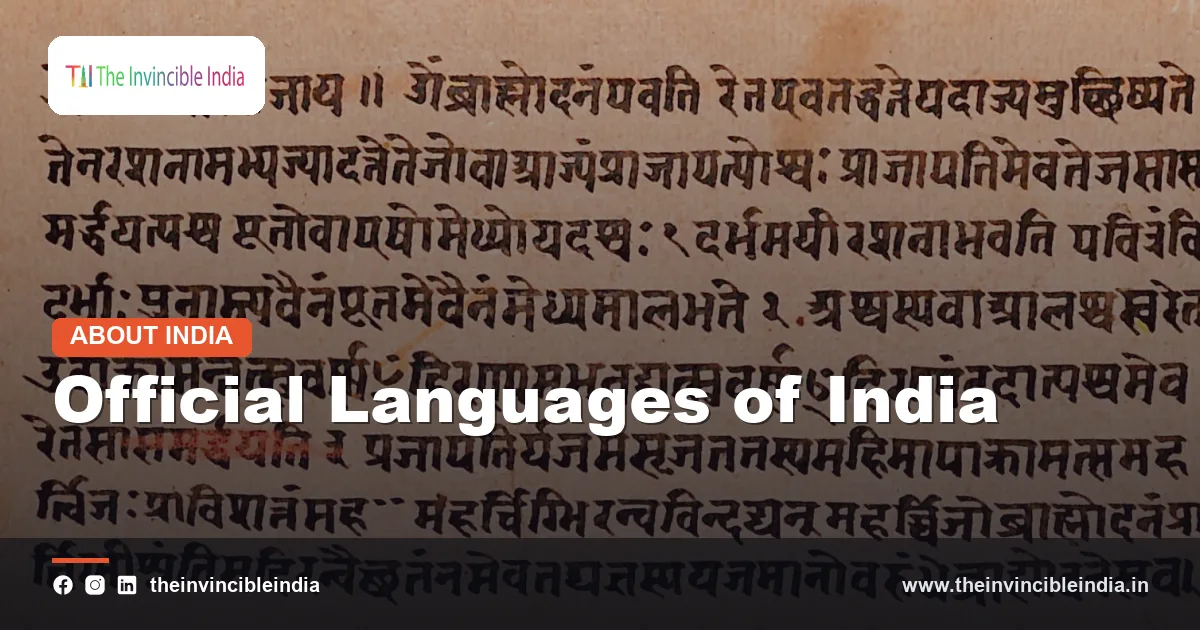
Few countries speak as many tongues as India does, and few have to think as carefully about which of them the state itself should use. The official languages of India are not defined by a single sentence in the Constitution but by a layered arrangement: one language for the Union government, another that continues alongside it, a long schedule of recognised languages, and a separate choice for every state and Union territory.
This guide explains how that system works, why India has no “national language” in the legal sense, what the Eighth Schedule actually does, how classical language status differs from official status, and why language remains one of the most sensitive subjects in Indian federalism. Everything here rests on the constitutional text and settled history, so it stays useful year after year.
Quick Facts
| Topic | Key Fact |
|---|---|
| Constitutional home | Part XVII, Articles 343 to 351 |
| Official language of the Union | Hindi in the Devanagari script (Article 343) |
| Additional / associate language | English, continued by the Official Languages Act, 1963 |
| National language | None is named in the Constitution |
| Eighth Schedule | 22 languages today; 14 in 1950 |
| State languages | Each state adopts its own under Article 345 |
| Classical languages | Eleven, from Tamil (2004) to the 2024 additions |
| Education policy | Three-language formula, recommended since the 1960s |
India Has Official Languages, Not a National Language
A common belief holds that Hindi is the “national language” of India. The Constitution says no such thing. It never uses the phrase “national language” for any tongue. What it does provide is an official language of the Union, meaning the language in which the central government conducts its business, together with provisions for English, for states and for a schedule of recognised languages.
This distinction is deliberate. When the Constituent Assembly debated the question in the late 1940s, members came from regions where Hindi, Tamil, Bengali, Marathi, Telugu, Urdu and dozens of other languages were the daily medium of life. Declaring any one of them the “national” language would have sent a message that the others were lesser. The framers instead chose the more modest and practical idea of official use.
The result is that every language in the Eighth Schedule enjoys constitutional recognition, and no citizen is required by law to speak any particular language to be considered fully Indian. Courts have also noted that the Constitution does not assign national-language status to any language.
Part XVII: The Constitutional Framework
Language is handled in Part XVII of the Constitution, titled “Official Language”, which runs from Article 343 to Article 351. It is divided into four chapters, each dealing with a distinct question.
What the articles cover
- Article 343: Hindi in the Devanagari script is the official language of the Union; the form of numerals is the international form of Indian numerals; English was to continue for fifteen years.
- Article 344: the President to set up a Commission, and a parliamentary committee, to review progress and recommend steps on official language use.
- Articles 345 to 347: official languages of states, communication between states and the Union, and special provisions for language spoken by a section of a state’s population.
- Article 348: the language of the Supreme Court, High Courts and of laws and bills.
- Articles 350, 350A and 350B: language of grievance petitions, instruction in the mother tongue at the primary stage, and a Special Officer for linguistic minorities.
- Article 351: a directive to promote the spread and development of Hindi so that it can serve as a medium of expression for the composite culture of India.
Read together, these articles show a balance: promote Hindi, protect everyone else.
Hindi in Devanagari and the Place of English
Article 343 declares Hindi in the Devanagari script to be the official language of the Union. It also says the numerals used for official purposes will be the international form of Indian numerals, which is why central documents use 1, 2, 3 rather than Devanagari digits.
The fifteen-year transition
The framers recognised that India could not switch its administration, courts and legislatures to Hindi overnight, especially in states where Hindi was not widely spoken. Article 343(2) therefore allowed English to continue for official purposes for fifteen years from the commencement of the Constitution on 26 January 1950. That period was due to expire on 26 January 1965, and Article 343(3) empowered Parliament to retain English beyond it by law.
A compromise that shaped the system
The arrangement grew out of intense debate in the Constituent Assembly and a compromise often linked to the names of K. M. Munshi and N. Gopalaswami Ayyangar. It gave Hindi the primary place on paper while accepting that English would remain in practical use. Hindi is also the most widely spoken mother tongue in the country, with over 40 per cent of Indians reporting it under the broad grouping used in recent censuses, which was one reason it was chosen.
The Official Languages Act, 1963 and the Anti-Hindi Agitations
As 1965 approached, concern grew in non-Hindi-speaking regions that English would be removed from central administration and exams, leaving their citizens at a disadvantage. Opposition was especially strong in Tamil Nadu, where earlier protests against compulsory Hindi in schools had already taken place in the late 1930s. In January 1965, around the date when Hindi was due to become the sole official language of the Union, large-scale agitations broke out across the state.
How the issue was settled
Parliament had already passed the Official Languages Act, 1963, which allowed English to continue in addition to Hindi for official purposes of the Union and for use in Parliament even after 1965. An amendment in 1967 strengthened this assurance, providing in effect that English would continue as long as the legislatures of the non-Hindi-speaking states wished it to. The result was a settlement that remains in force.
That is why India today operates with what is commonly described as a two-language Union arrangement: Hindi as the official language and English as an associate or additional official language. The Department of Official Language under the Ministry of Home Affairs oversees the promotion of Hindi in central offices.
The Eighth Schedule: India’s List of Scheduled Languages
The Eighth Schedule is a list at the end of the Constitution that names the languages recognised for certain constitutional purposes. It is referred to in Articles 344(1) and 351. When the Constitution came into force in 1950 it contained 14 languages; it now lists 22.
How the list grew
- 1950: Assamese, Bengali, Gujarati, Hindi, Kannada, Kashmiri, Malayalam, Marathi, Odia, Punjabi, Sanskrit, Tamil, Telugu and Urdu (14 languages).
- 1967: Sindhi added by the 21st Amendment.
- 1992: Konkani, Manipuri and Nepali added by the 71st Amendment.
- 2003: Bodo, Dogri, Maithili and Santhali added by the 92nd Amendment, bringing the total to 22.
Demands for the inclusion of further languages are raised regularly, and the question has been examined by expert committees over the years. The table below lists all 22 with their main region and script.
| Language | Main Region | Chief Script | Listed Since |
|---|---|---|---|
| Assamese | Assam | Assamese (Bengali-Assamese) | 1950 |
| Bengali | West Bengal, Tripura | Bengali | 1950 |
| Bodo | Assam (Bodoland area) | Devanagari | 2003 |
| Dogri | Jammu region | Devanagari | 2003 |
| Gujarati | Gujarat | Gujarati | 1950 |
| Hindi | Northern and central India | Devanagari | 1950 |
| Kannada | Karnataka | Kannada | 1950 |
| Kashmiri | Kashmir Valley | Perso-Arabic | 1950 |
| Konkani | Goa and the Konkan coast | Devanagari | 1992 |
| Maithili | Mithila region of Bihar | Devanagari | 2003 |
| Malayalam | Kerala, Lakshadweep | Malayalam | 1950 |
| Manipuri (Meitei) | Manipur | Meitei Mayek | 1992 |
| Marathi | Maharashtra | Devanagari | 1950 |
| Nepali | Sikkim, Darjeeling hills | Devanagari | 1992 |
| Odia | Odisha | Odia | 1950 |
| Punjabi | Punjab | Gurmukhi | 1950 |
| Sanskrit | Classical, pan-Indian | Devanagari (traditionally any script) | 1950 |
| Santhali | Jharkhand, Odisha, West Bengal | Ol Chiki | 2003 |
| Sindhi | Sindhi communities across India | Perso-Arabic and Devanagari | 1967 |
| Tamil | Tamil Nadu, Puducherry | Tamil | 1950 |
| Telugu | Andhra Pradesh, Telangana | Telugu | 1950 |
| Urdu | Widespread, notably in the north and Deccan | Perso-Arabic | 1950 |
What Inclusion in the Eighth Schedule Means
Being listed in the Eighth Schedule does not automatically make a language an official language of the Union or of any state. Its significance is of a different kind, and it is often misunderstood.
Practical effects of recognition
- Representation: the schedule is the reference point for the members of the Commission and committee on official language envisaged under Article 344.
- Enrichment of Hindi: Article 351 asks that Hindi draw its vocabulary and style primarily from Sanskrit and secondarily from other Indian languages, so scheduled languages feed into its development.
- Examinations: candidates in the Union Public Service Commission’s Civil Services Examination may, under its scheme, write the main papers in any of the Eighth Schedule languages, subject to the rules, which widens access for non-Hindi and non-English speakers.
- Institutional support: recognised languages gain visibility in literary academies, translation programmes, and government-funded promotion.
Because recognition brings prestige and tangible benefits, communities speaking languages that are not on the list frequently campaign for inclusion. Languages outside the schedule, such as Bhojpuri, Rajasthani or Tulu, are nonetheless spoken by many millions of people and may be used officially in a state if its legislature so decides.
Official Languages of the States
India is a federation, and language policy reflects that. Article 345 allows the legislature of a state to adopt any one or more of the languages in use in the state, or Hindi, as the language or languages for official purposes of that state. This is how each state builds its administration around the language of its people.
Examples across regions
- Tamil Nadu uses Tamil, Karnataka uses Kannada, Kerala uses Malayalam, and Maharashtra uses Marathi.
- Gujarat uses Gujarati, West Bengal uses Bengali, and Odisha uses Odia.
- Goa has Konkani as its official language, with provision for Marathi in certain uses.
- Several Hindi-speaking states, including Uttar Pradesh, Bihar, Madhya Pradesh and Rajasthan, use Hindi.
- Some north-eastern states, such as Nagaland and Arunachal Pradesh, use English for official work, which suits their many local tribal languages.
Linking states and the Union
Article 346 says the language for communication between one state and another, or between a state and the Union, is the official language of the Union. States may agree to use Hindi among themselves. Article 347 lets the President direct that a language spoken by a substantial proportion of a state’s population be officially recognised in that state, if there is a demand.
Language in the Courts and in Law-Making
Article 348 deals with a domain where English has stayed dominant. Until Parliament provides otherwise, all proceedings in the Supreme Court and the High Courts, and the authoritative texts of laws, rules and regulations, are in English.
There is some flexibility. The Governor of a state may, with the previous consent of the President, authorise the use of Hindi or the state’s official language in proceedings of its High Court, although judgments and orders generally remain in English unless otherwise provided. Several northern High Courts, such as those of Rajasthan, Uttar Pradesh, Madhya Pradesh and Bihar, have such authorisation for Hindi. State legislatures can pass laws in their own language, but an authoritative English translation is required.
The stability of English in law is partly practical, since the existing body of statutes, precedents and legal training developed largely in English. Efforts to make judicial material available in regional languages through translation have continued, and Article 350 separately guarantees citizens the right to submit representations for redress of grievances in any language used in the Union or a state.
Classical Languages: A Different Kind of Recognition
Classical language status is separate from official or scheduled status. It is a distinction granted by the Government of India to languages with exceptional antiquity and a rich, original literary heritage. The category was created in 2004, when Tamil became the first language to receive it.
The criteria
The criteria generally include a recorded history of early texts stretching back more than a thousand years, a body of ancient literature regarded as a valuable heritage by its speakers, an original literary tradition not borrowed from another community, and a classical form that is distinct from its modern descendants.
Benefits conferred
- International awards for scholars of eminence in the language.
- A Centre of Excellence for studies in classical languages.
- Professional chairs for the language in central universities, supported through the University Grants Commission.
| Language | Year Declared Classical |
|---|---|
| Tamil | 2004 |
| Sanskrit | 2005 |
| Telugu | 2008 |
| Kannada | 2008 |
| Malayalam | 2013 |
| Odia | 2014 |
| Marathi, Pali, Prakrit, Assamese, Bengali | 2024 |
Note that Pali and Prakrit are not in the Eighth Schedule, which shows that classical and scheduled status are independent categories.
The Three-Language Formula in Education
Language policy shapes classrooms as much as courtrooms. The three-language formula emerged from discussions in the 1950s and 1960s, was recommended by the Education Commission of 1964 to 1966, and was reflected in the National Policy on Education of 1968 and again in later policies, including the National Education Policy 2020.
The idea in outline
- The first language is the mother tongue or the regional language.
- The second is Hindi in non-Hindi-speaking states, and another modern Indian language, preferably from the south, in Hindi-speaking states.
- The third is English or another modern European language.
The goal was national integration, with students gaining familiarity with languages beyond their home region. Implementation has varied widely. Some states follow the scheme closely, others have modified it, and Tamil Nadu has followed a two-language policy of Tamil and English since the late 1960s. Because education is shared between the Centre and states, the formula is a guideline rather than an enforceable national rule, and the latest education policy states that no language will be imposed on any state.
Article 350A adds a further safeguard, urging states to provide facilities for instruction in the mother tongue at the primary stage for children of linguistic minority groups.
Language Politics and Federal Sensitivity
Language is not only a means of communication in India but also a marker of regional identity, literature, and history. That is why policy debates on it carry weight. In some southern and eastern states, there is long-standing wariness about any move that could be read as giving Hindi a privileged position, often described in public debate as a fear of “Hindi imposition.” In some northern states, supporters of Hindi point to its constitutional status and to its role as a link language for a large share of the population.
The constitutional design tries to hold these views together: Hindi is promoted under Article 351, English continues to bridge regions, states choose their own languages, and the Eighth Schedule recognises many literary traditions. Debates still arise in areas such as signage, examinations, official forms and school curricula, and they are typically resolved through consultation between the Centre and states.
Language and the map of India
Language even redrew the political map. After Potti Sriramulu’s fast unto death in 1952 for a separate Telugu-speaking state, Andhra State was created in 1953. The States Reorganisation Commission, headed by Fazl Ali, then recommended reorganisation largely on linguistic lines, leading to the States Reorganisation Act, 1956. Later changes included the 1960 division of Bombay State into Maharashtra and Gujarat and the 1966 creation of Haryana from Punjab. For more on this, see our explainer on the formation of states in India.
The Richness of India’s Languages and Scripts
Beyond the legal framework lies the living reality. Indian languages belong to several major families. The Indo-Aryan family includes Hindi, Bengali, Marathi, Gujarati and Punjabi. The Dravidian family includes Tamil, Telugu, Kannada and Malayalam. The Austroasiatic family includes Santhali, while Tibeto-Burman languages, such as Bodo and Manipuri, are spoken mainly in the north-east and Himalayan belt.
The census records hundreds of mother tongues, and well over a hundred languages are each spoken by 10,000 people or more. Many of them have no official status at all, yet they carry oral traditions, folk songs and proverbs of great value.
A country of many scripts
Writing systems are just as varied. Devanagari serves Hindi, Marathi, Nepali and others; Gurmukhi is used for Punjabi; and Tamil, Telugu, Kannada and Malayalam each have their own distinctive scripts. Urdu, Kashmiri and Sindhi use Perso-Arabic forms, while Santhali has its own Ol Chiki script and Manipuri uses Meitei Mayek. This diversity is a living reminder that India’s language question has never had a single answer, and the Constitution’s flexible approach has allowed multiple traditions to coexist.
Conclusion
The official languages of India are best understood as a framework of accommodation rather than a ranking. Hindi in Devanagari serves as the Union’s official language, English remains alongside it, 22 languages are listed in the Eighth Schedule, states choose their own languages, and classical status honours ancient literary heritage. For readers, the key takeaway is that India has no single national language, and that this is a feature of its constitutional design rather than an omission.
Frequently Asked Questions
Is Hindi the national language of India?
No. The Constitution does not name any national language. Hindi in the Devanagari script is the official language of the Union under Article 343, with English continuing as an additional official language. This is different from being a “national language”.
How many languages are in the Eighth Schedule?
There are 22 languages in the Eighth Schedule. It began with 14 in 1950 and grew with the addition of Sindhi in 1967, Konkani, Manipuri and Nepali in 1992, and Bodo, Dogri, Maithili and Santhali in 2003.
Why does English continue as an official language?
The Constitution allowed English for fifteen years from 1950. As that period ended, concerns in non-Hindi-speaking states led Parliament to pass the Official Languages Act, 1963, later strengthened in 1967, so English continues alongside Hindi for official purposes of the Union.
Can a state have its own official language?
Yes. Under Article 345, a state legislature may adopt one or more languages in use in the state, or Hindi, as its official language. Tamil Nadu, Karnataka, Maharashtra and many other states have done so, and some north-eastern states use English.
What is a classical language of India?
A classical language is one recognised by the Government of India for its great antiquity and original literary heritage. Tamil was the first in 2004, followed by Sanskrit, Telugu, Kannada, Malayalam and Odia, with Marathi, Pali, Prakrit, Assamese and Bengali added in 2024.
What is the three-language formula?
It is an education policy guideline suggesting students learn their mother tongue or regional language, Hindi or another Indian language, and English. States apply it differently, and Tamil Nadu follows a two-language approach of Tamil and English.
{“@context”:”https://schema.org”,”@graph”:[{“@type”:”FAQPage”,”mainEntity”:[{“@type”:”Question”,”name”:”Is Hindi the national language of India?”,”acceptedAnswer”:{“@type”:”Answer”,”text”:”No. The Constitution does not name any national language. Hindi in the Devanagari script is the official language of the Union under Article 343, with English continuing as an additional official language. This is different from being a “national language”.”}},{“@type”:”Question”,”name”:”How many languages are in the Eighth Schedule?”,”acceptedAnswer”:{“@type”:”Answer”,”text”:”There are 22 languages in the Eighth Schedule. It began with 14 in 1950 and grew with the addition of Sindhi in 1967, Konkani, Manipuri and Nepali in 1992, and Bodo, Dogri, Maithili and Santhali in 2003.”}},{“@type”:”Question”,”name”:”Why does English continue as an official language?”,”acceptedAnswer”:{“@type”:”Answer”,”text”:”The Constitution allowed English for fifteen years from 1950. As that period ended, concerns in non-Hindi-speaking states led Parliament to pass the Official Languages Act, 1963, later strengthened in 1967, so English continues alongside Hindi for official purposes of the Union.”}},{“@type”:”Question”,”name”:”Can a state have its own official language?”,”acceptedAnswer”:{“@type”:”Answer”,”text”:”Yes. Under Article 345, a state legislature may adopt one or more languages in use in the state, or Hindi, as its official language. Tamil Nadu, Karnataka, Maharashtra and many other states have done so, and some north-eastern states use English.”}},{“@type”:”Question”,”name”:”What is a classical language of India?”,”acceptedAnswer”:{“@type”:”Answer”,”text”:”A classical language is one recognised by the Government of India for its great antiquity and original literary heritage. Tamil was the first in 2004, followed by Sanskrit, Telugu, Kannada, Malayalam and Odia, with Marathi, Pali, Prakrit, Assamese and Bengali added in 2024.”}},{“@type”:”Question”,”name”:”What is the three-language formula?”,”acceptedAnswer”:{“@type”:”Answer”,”text”:”It is an education policy guideline suggesting students learn their mother tongue or regional language, Hindi or another Indian language, and English. States apply it differently, and Tamil Nadu follows a two-language approach of Tamil and English.”}}]}]}