


Pali is a Middle Indo-Aryan language, closely related to Sanskrit and to the Prakrits spoken across ancient India, that survives today chiefly as the liturgical and literary language of the Theravada Buddhist tradition. Rather than functioning as anyone’s native mother tongue in the modern era, Pali has been preserved for centuries through monastic education, textual transmission, and religious recitation across South and Southeast Asia. Its most significant body of literature is the Pali canon, the collected scriptures of Theravada Buddhism, which has shaped religious thought and practice across a wide geographic area. This combination of ancient linguistic roots and continued sacred use gives Pali an enduring, distinctive place among the classical languages associated with India.
Quick Facts
| Detail | Information |
|---|---|
| Language Family | Middle Indo-Aryan (Prakrit) |
| Primary Use | Liturgical and literary language of Theravada Buddhism |
| Key Text | The Pali canon (Tipitaka) |
| Writing System | No native script; written in various regional scripts |
| Modern Status | Studied as a scholarly and monastic language |
| Related Language | Closely related to Sanskrit and other Prakrits |
Origins as a Middle Indo-Aryan Language
Pali belongs to the Middle Indo-Aryan stage of linguistic development, sitting chronologically and structurally between Old Indo-Aryan languages such as Sanskrit and the later Modern Indo-Aryan languages spoken across South Asia today. It shares many grammatical features with other Prakrits of the period.
Scholars generally understand Pali to represent a literary standardisation of one or more spoken Prakrit dialects current in ancient India, refined over time for the specific purpose of preserving and transmitting Buddhist teaching in a clear, consistent linguistic form.
Relationship to Sanskrit
Pali shares a close linguistic relationship with Sanskrit, both belonging to the broader Indo-Aryan family, though Pali generally displays simplified consonant clusters and grammatical forms compared to the highly systematised structure of classical Sanskrit. This makes many Pali words recognisably related to Sanskrit equivalents.
This close kinship has made comparative study of Pali and Sanskrit a valuable tool for scholars researching the historical development of Indo-Aryan languages, as well as for those studying the doctrinal and linguistic history of early Buddhism.
Pali Among the Prakrits
Pali is generally classified as one among several Prakrit languages that flourished in ancient India, each associated with particular regions, religious communities, or literary purposes. Prakrits more broadly served as vernacular alternatives to the more formal register represented by Sanskrit.
While other Prakrits found use in Jain scripture and secular literature, Pali became specifically and enduringly associated with the Theravada Buddhist tradition, distinguishing its later historical role from that of its sibling Prakrit languages.
Pali and the Buddha's Teaching
Pali is traditionally understood within the Theravada tradition as closely connected to the language in which the Buddha’s discourses were originally transmitted and later committed to memory by his early followers. This association gives Pali particular religious significance.
Whether or not Pali precisely reflects the Buddha’s own spoken dialect, it became the standard medium through which Theravada communities preserved, studied, and transmitted his teachings across many centuries, cementing its central role in the tradition’s religious and intellectual life.
Oral Transmission and Memorisation
For a considerable period after the Buddha’s life, his teachings were preserved not through writing but through structured oral transmission, with monks memorising and reciting texts communally to ensure accuracy across generations. This oral method placed great emphasis on precise language and rhythm.
Communal recitation and periodic councils convened to confirm agreed versions of the teachings played a central role in this process, reflecting a broader ancient Indian tradition of oral preservation that predated and paralleled the eventual writing down of Pali scripture.
The Pali Canon and Its Structure
The Pali canon, also known as the Tipitaka, forms the core scriptural collection of Theravada Buddhism, traditionally organised into three broad divisions covering monastic discipline, the Buddha’s discourses, and more analytical philosophical material. This threefold structure gives the canon its name.
The canon represents one of the most extensive surviving bodies of early Buddhist literature, and its systematic organisation has made it a central reference point for Theravada doctrine, monastic practice, and scholarly study across many centuries.
Commentaries and Later Pali Literature
Beyond the canon itself, a substantial body of Pali commentarial literature developed over subsequent centuries, offering detailed explanation, interpretation, and elaboration of canonical texts for the benefit of monastic students and teachers. These commentaries remain important study aids.
Later Pali literature also includes historical chronicles, poetic works, and grammatical treatises, reflecting the language’s continued use as a medium for scholarly and literary composition well beyond its original scriptural core.
Pali Grammar and Structure
Pali grammar retains many features inherited from Old Indo-Aryan speech, including an elaborate case system for nouns and a rich set of verb conjugations, though generally in simplified form compared to classical Sanskrit. Word order tends to be relatively flexible.
This grammatical structure, while demanding for modern learners, has been carefully documented through centuries of traditional and academic grammatical study, allowing Pali’s linguistic features to be studied with considerable precision today.
No Native Script of Its Own
Unlike many other classical Indian languages, Pali has no script that developed specifically for it, and it has instead historically been written using whatever regional script was locally available to the Buddhist community recording it. This has led to considerable script diversity across Pali manuscripts.
Sinhala, Myanmar, Thai, Khmer, and Devanagari scripts have all been used at different times and places to write Pali texts, alongside a standardised Roman transliteration system widely used by modern scholars for comparative and academic purposes.
Spread Across South and Southeast Asia
Pali travelled well beyond its origins in the Indian subcontinent, becoming firmly established as the scriptural language of Theravada Buddhist communities in Sri Lanka, Myanmar, Thailand, Cambodia, and Laos. Each of these regions developed its own tradition of Pali study and manuscript preservation.
This wide geographic spread has made Pali a genuinely transnational scholarly and religious language, studied and recited by monastic communities across a broad swath of South and Southeast Asia despite having no single modern national home.
Monastic Education and Study
Pali remains a core subject of study within Theravada monastic education, with monks undertaking structured training in the language in order to read canonical texts and commentaries in their original form. This tradition of formal Pali study continues in monasteries across several countries.
Monastic universities and training centres often include examinations and qualifications in Pali scholarship, reflecting the language’s continued institutional importance within the structure of Theravada Buddhist religious education.
Pali in Chanting and Ritual
Beyond scholarly study, Pali continues to be used actively in Buddhist ritual life, with passages from the canon chanted during ceremonies, meditation sessions, and daily monastic observance across Theravada communities. This ritual use keeps the language in living, spoken practice.
The rhythmic, memorised chanting of Pali texts serves both devotional and mnemonic purposes, helping practitioners internalise core teachings while participating in a shared linguistic and religious tradition that spans many countries and centuries.
Modern Academic Study of Pali
Pali has attracted sustained academic interest from linguists, historians, and scholars of religion, particularly since the nineteenth century, when Western and Asian scholars began systematically editing, translating, and publishing Pali texts. This scholarly work greatly expanded access to the canon.
Universities and research institutions around the world continue to offer Pali language courses, supporting ongoing research into early Buddhist history, comparative Indo-Aryan linguistics, and the broader textual history of South Asian religious literature.
Pali's Revival Interest in Modern India
Modern India has seen renewed academic and cultural interest in Pali, connected to a broader interest in the country’s Buddhist heritage and historical sites associated with early Buddhism. Universities in India offer dedicated Pali studies programmes.
This renewed attention has helped connect contemporary Indian scholarship with the wider international community of Pali and Buddhist studies scholars, reinforcing Pali’s continued relevance to understanding India’s ancient religious and linguistic history.
Pali Text Society and Modern Publishing
The systematic editing and publishing of Pali texts expanded considerably from the nineteenth century onward, as dedicated scholarly societies and academic presses worked to produce reliable printed editions and translations of canonical and commentarial material. This work made Pali literature far more accessible than manuscript copies alone allowed.
Such publishing efforts have continued into the present day, supported by universities and Buddhist studies departments internationally, ensuring that Pali texts remain available in both traditional scripts and Roman transliteration for scholars and practitioners around the world.
Pali's Influence on Buddhist Terminology
Many key terms used in Buddhist philosophy and practice worldwide, including concepts describing meditation, ethical conduct, and doctrinal categories, derive directly from Pali vocabulary preserved in the canon. These terms have entered wider scholarly and popular discussion of Buddhism far beyond Theravada communities.
This terminological influence reflects the broader historical importance of Pali sources in shaping how Buddhism has been studied, translated, and understood internationally, even among traditions that do not use Pali as their primary scriptural language.
Pali Manuscripts and Archaeological Evidence
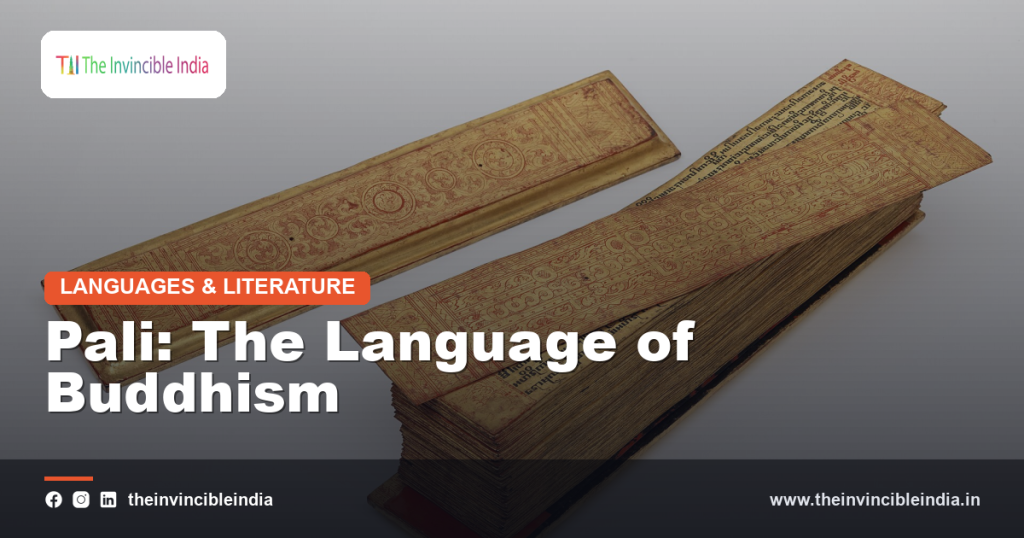
Surviving Pali manuscripts, preserved on palm leaf and later on paper across monasteries in South and Southeast Asia, provide valuable material evidence for the historical transmission of Buddhist texts across centuries. Conservation and cataloguing of these manuscripts remains an active area of scholarly work.
Alongside manuscript evidence, inscriptions and archaeological findings from historically Buddhist regions offer further insight into the spread and use of Pali and related languages, helping scholars piece together a fuller picture of early Buddhist textual history.
Pali and Comparative Linguistics
Pali holds a valuable place within comparative Indo-Aryan linguistics, offering scholars a documented snapshot of the Middle Indo-Aryan stage that connects the older forms represented by Sanskrit to the modern languages spoken across South Asia today. Its relatively well-preserved textual record aids this comparative study.
Linguists studying sound change, grammatical simplification, and vocabulary development across the Indo-Aryan family frequently draw on Pali evidence alongside other Prakrits, making the language an important reference point for understanding the broader historical evolution of Indian languages.
Pali Studies in Universities Worldwide
Universities across Asia, Europe, and North America offer dedicated courses and research programmes in Pali language and Buddhist studies, reflecting sustained international academic interest in the language and its canonical literature. These programmes train scholars capable of working directly with primary Pali sources.
Academic conferences, journals, and collaborative research projects continue to connect Pali scholars internationally, supporting ongoing translation, textual criticism, and historical research into early Buddhist literature and its wider linguistic and cultural context.
Pali Language Today
Pali today survives not as anyone’s everyday native language but as a carefully preserved scholarly and liturgical medium, sustained through monastic education, academic study, and continued ritual use across Theravada Buddhist communities. Its canon remains a foundational text for millions of practitioners.
As long as Theravada Buddhism continues to be practised and studied across South and Southeast Asia, Pali is likely to remain an actively used, carefully preserved language, bridging ancient Indian linguistic history with living religious tradition.
Sources & Further Reading
- Sahitya Akademi.
- Ministry of Culture, Government of India (indiaculture.gov.in).
Frequently Asked Questions
What kind of language is Pali?
Pali is a Middle Indo-Aryan language, historically a standardised Prakrit, closely related to Sanskrit and best known today as the liturgical language of Theravada Buddhism.
What is the Pali canon?
The Pali canon, also called the Tipitaka, is the core scriptural collection of Theravada Buddhism, traditionally divided into sections covering monastic discipline, the Buddha’s discourses, and philosophical analysis.
Does Pali have its own script?
No, Pali has no script of its own and has historically been written in various regional scripts, including Sinhala, Myanmar, Thai, and Devanagari, as well as Roman transliteration used by scholars.
Is Pali still spoken today?
Pali is not spoken as a native everyday language today, but it remains actively used in Theravada Buddhist monastic education, textual study, and ritual chanting across several countries.
How is Pali related to Sanskrit?
Pali and Sanskrit are both Indo-Aryan languages and share considerable vocabulary and grammatical similarity, though Pali generally has simplified consonant clusters and grammar compared to classical Sanskrit.