


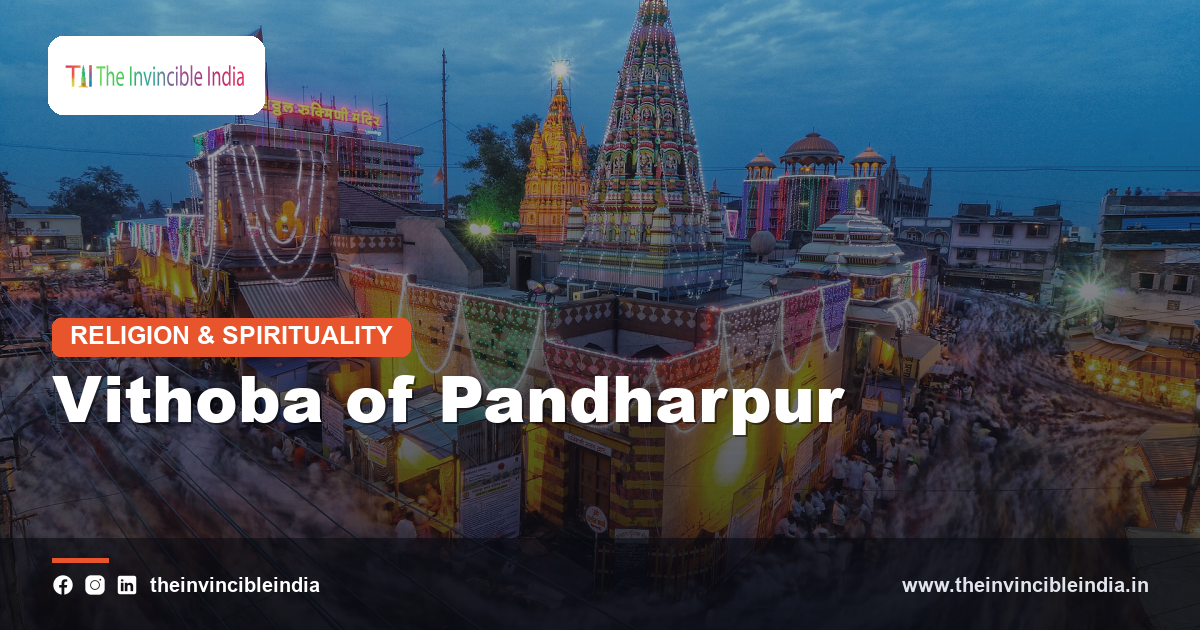
On the banks of the Bhima river, known locally as the Chandrabhaga, the town of Pandharpur in Maharashtra holds one of the most beloved sacred places in western India. Its presiding deity, Vithoba, also called Vitthal or Panduranga, is shown standing patiently on a brick with his hands resting on his hips, as though waiting for his devotees. Each year hundreds of thousands of pilgrims walk to his temple in an unbroken tradition of song, prayer and fellowship. His worship is closely bound up with the saint-poets of the Bhakti movement, whose devotional verses still shape the religious and cultural life of Maharashtra and neighboring regions today.
Quick Facts
| Detail | Information |
|---|---|
| Deity | Vithoba, Vitthal or Panduranga |
| Location | Pandharpur, Maharashtra |
| River | Bhima (Chandrabhaga) |
| Consort | Rukmini, called Rakhumai |
| Devotees | The Varkari community |
| Key Festivals | Ashadhi and Kartiki Ekadashi |
Pandharpur and Its Sacred Setting
Pandharpur lies in the Solapur district of Maharashtra, set along a crescent-shaped bend of the Bhima river that local tradition calls the Chandrabhaga because of its curved form. The river bank, lined with ghats, is a place of bathing, gathering and quiet reflection, and the town has grown around the temple and the devotional life centered upon it. Pandharpur is often described as the Dakshin Kashi, or southern Kashi, a title that reflects its importance as a destination for pilgrims from many parts of the Deccan. Its streets are filled with shops selling garlands, tulsi beads and devotional books, and its rhythm follows the festival calendar. In this setting the physical landscape, the flowing river and the shrine on its bank combine to form a place that devotees regard as among the most affectionate of all sacred sites.
Who Is Vithoba?
Vithoba is the presiding deity of Pandharpur and the central figure of devotion for the Varkari tradition. He is known by several affectionate names, including Vitthal, Panduranga and Pandurang, and in Marathi speech devotees often address him with the endearing title of Mauli, meaning mother. Most followers regard him as a form of Vishnu, and in particular as a form of Krishna who has come to stand among his devotees. Tradition holds that the deity is approachable rather than distant, and devotional poetry often addresses him as a friend, a parent and a patient companion. The sense of intimacy is a defining feature of the worship. Rather than inspiring fear, Vithoba is imagined as one who waits with open generosity, ready to receive anyone who comes to him with sincerity.
The Legend of Pundalik
The best-known story of the origin of the Pandharpur shrine centers on Pundalik, a devotee celebrated for his devotion to his parents. According to the tradition, the deity came to the riverbank to meet Pundalik, who was at that moment serving his mother and father. Pundalik, absorbed in his duty, tossed a brick toward the visitor and asked him to wait on it until the service was complete. The deity is said to have waited patiently on the brick, and that waiting pose is the origin of the image worshipped today. Pundalik is honored for placing filial duty first, and his shrine near the river is visited by pilgrims. Retellings differ in detail, but the moral remains clear, that sincere service to parents is itself a form of worship that draws the divine near.
The Image on the Brick
The icon at Pandharpur is distinctive and easily recognized. The deity stands upright on a brick with both hands placed on the waist, a posture that devotees read as one of patient waiting. The image is dark in color, and the figure is often adorned with a crown, garlands, a tulsi leaf offering and bright clothing, according to the ritual of the day. Unlike many temple images of Vishnu, Vithoba does not hold a conch, discus or lotus in his hands, and this simplicity is part of his appeal. In some accounts the standing form carries traces of Shaiva symbolism, which many devotees take as an expression of unity between devotional streams. The unadorned directness of the figure invites a personal response, as though the deity has no need for elaborate display. The brick under his feet remains the most powerful symbol of the tradition.
Rukmini and the Rakhumai Shrine
Beside Vithoba stands Rukmini, called Rakhumai in Marathi, who is honored as his consort. In the larger Krishna tradition Rukmini is the principal queen of Krishna, and at Pandharpur her presence adds a tender, domestic character to the sanctuary. The temple complex includes a separate shrine for her, and devotional songs speak of Vithoba and Rakhumai as a divine pair who care for their devotees like parents. A local story tells of her staying apart from the deity for some time and then rejoining him, a tale that is retold in affectionate, human terms. Pilgrims commonly offer prayers to both, and the pair together symbolize compassion and fidelity. This family-like imagery strengthens the sense that Pandharpur is a home to which devotees return, rather than only a distant place of formal worship.
The Temple Complex
The Vitthal Rukmini temple stands close to the riverbank in the heart of Pandharpur. It is a large complex built up over many generations, with entrance gateways, courtyards, mandapas and a series of smaller shrines dedicated to various deities and saints. Pilgrims move through a passage that leads toward the sanctum, and a long queue is a familiar sight during festival periods. A notable custom allows devotees to touch the feet of the deity, which is one of the features that makes the experience personal. At the temple entrance a stepping stone honors the saint Chokhamela, and the nearby Namdev Payari commemorates the saint Namdev. The temple is administered by a committee, and the surrounding precincts offer facilities for visitors. As described in the account of Hindu temple worship, such complexes combine architecture, ritual and community.
Daily Rituals and Worship
The daily life of the temple follows a sequence of rituals that begins in the early morning and continues through the day. The deity is awakened with song, bathed, dressed and offered food, and the day closes with a final ritual and a lullaby-like song at night. Priests of hereditary families, known by regional names such as Badve and Sevadhari, perform specific duties connected with the worship. Devotees offer tulsi leaves, flowers and sweets, and many place a tulsi garland near the deity. The singing of abhangas, the short devotional poems of the saints, forms an essential part of the atmosphere, with bhajan groups filling the courtyards. Worship at Pandharpur tends to be simple and heartfelt rather than elaborate, matching the character of the deity himself. This steady cycle of daily ritual keeps the temple vividly alive throughout the year.
The Varkari Tradition
The Varkaris are the devotees who follow the path of Vithoba, and their name is commonly linked with the Marathi word for a pilgrimage undertaken regularly, called wari. A Varkari typically wears a tulsi bead necklace, applies a simple mark on the forehead, lives a modest and ethical life and sings the praise of Vithoba. The movement stresses devotion, humility, honest work and equality among all people, and it avoids dependence on elaborate ritual. Its members often use the greeting of Ram Krishna Hari and sing in the company of cymbals and the single-stringed ektara. The tradition was shaped over centuries by the saint-poets of Maharashtra, whose verses supply its theology and its inspiration. Through these shared habits the Varkari community has preserved a living, participatory form of religion that cuts across social divisions.
The Saint-Poets of Maharashtra
The Varkari tradition is inseparable from the great saint-poets of Maharashtra, whose songs in the Marathi language made spiritual teaching accessible to ordinary people. Dnyaneshwar, remembered for his commentary on the Bhagavad Gita, is among the most revered of them, and Namdev, Eknath and Tukaram are likewise honored. Women such as Janabai and Muktabai, and saints from communities that were often marginalized, such as Chokhamela and Gora Kumbhar, form an important part of this heritage. Their short poems, called abhangas, speak of surrender, daily life, ethical conduct and joy in the name of Vithoba. Readers can learn more about individual saints in the guides to Sant Tukaram, Sant Namdev and Sant Eknath. Their combined legacy gives the tradition its depth and its warmth.
The Pandharpur Wari
The wari is the great pilgrimage on foot to Pandharpur, and it is one of the most remarkable devotional gatherings in India. Processions called dindis set out from many towns and villages, carrying the footwear of revered saints in decorated palanquins, and walk for days in the company of other pilgrims. The best-known processions begin from Alandi, associated with Dnyaneshwar, and from Dehu, associated with Tukaram, and they converge on the town for the festival. Along the way walkers sing abhangas, perform simple devotional games, share food and receive hospitality from villagers. Participants come from every background, and the shared journey dissolves social distinctions. The wari is both a physical discipline and a spiritual one, and many pilgrims return year after year. In this way the pilgrimage turns devotion into a collective experience of walking, singing and togetherness.
Ashadhi and Kartiki Ekadashi
Pandharpur is most closely associated with two major festival days, both falling on Ekadashi, the eleventh day of the lunar fortnight. Ashadhi Ekadashi, observed in the monsoon month of Ashadha, is the most important, and it is the culmination of the great wari when pilgrims converge from all directions. Kartiki Ekadashi, falling in the autumn month of Kartika, is the second large gathering, and it too draws a great number of devotees. On these occasions the town fills with pilgrims, and the temple conducts special rituals and ceremonial worship. Many devotees fast, take a ritual dip in the river and join the long queues for a glimpse of the deity. The festivals combine solemn devotion with festive joy, and the sound of devotional singing carries across the town. They mark the highest points of the yearly cycle of worship at Pandharpur.
Abhangas and the Music of Devotion
Music is the lifeblood of Vithoba devotion, and the abhanga is its characteristic form. These short compositions in Marathi, often built around a refrain, express the devotee’s longing, humility and trust. They are sung in congregational gatherings called bhajans and kirtans, usually accompanied by cymbals, the ektara and the pakhawaj drum. Kirtan, in which a performer narrates stories and moral lessons through song, is a particularly popular form in Maharashtra. The language of abhangas is simple and often uses images from daily life, such as farming, household work and trade, which makes the teaching immediate. Over generations these songs have been taught by memory and shared in homes, fields and temples. Their durability demonstrates how a musical tradition can serve as a vehicle for both spiritual teaching and cultural continuity.
Social Equality in the Vithoba Tradition
One of the most admired aspects of the Vithoba tradition is its emphasis on spiritual equality. The saints of the movement came from many communities, including potters, tailors, gardeners, weavers and others, and they taught that devotion matters more than birth or status. The wari reinforces this ideal in practice, since pilgrims walk, eat and sing together regardless of background. The temple itself is regarded as a place where all may seek the darshan of the deity, and its saint-shrines honor figures from different walks of life. Historians often note how this outlook gave ordinary people a voice in matters of religion, and how the use of Marathi rather than Sanskrit widened access. While social realities were complex in every period, the egalitarian spirit of Pandharpur remains central to how the tradition understands itself, and it continues to shape modern attitudes.
Vithoba and the Wider Bhakti Landscape
Though rooted in Maharashtra, devotion to Vithoba has links with a wider network of devotional traditions. In Karnataka the deity is known as Vithala, and the Haridasa singers of the region composed songs in his praise. The historic Vitthala temple at Hampi, associated with the Vijayanagara period, preserves another expression of this devotion. Telugu and Kannada devotional poets also engaged with the theme, and the figure of the waiting deity on the brick has traveled across the Deccan. Within Hindu thought, Vithoba is often placed within the broader Vaishnava family, as discussed in the account of Vaishnavism, while retaining a character that is distinctly his own. This blend of regional identity and wider devotion explains why Pandharpur attracts visitors from several states and language communities.
Pandharpur in Art, Literature and Culture
The image of Vithoba and the story of Pandharpur have inspired Marathi literature, music, theatre and the visual arts. The abhangas of the saint-poets form a major body of devotional poetry, and kirtan and bhajan traditions carry their message into everyday life. Painters and printmakers have depicted the deity on the brick, the pilgrims on the road and the saints at the riverbank. Marathi cinema and stage drama have drawn on the lives of the saints, and popular songs about Vithoba are known to many families regardless of formal religious practice. Classical and semi-classical singers have likewise performed abhangas to wide audiences. The result is a cultural heritage that extends well beyond the temple walls, touching language, folk art and communal memory. In this way the deity has become part of the identity of the Marathi-speaking world.
Visiting Pandharpur
Pandharpur welcomes visitors throughout the year, though the experience differs greatly between ordinary days and festival times. Outside the peak periods the temple is calmer, and visitors can walk the ghats, see the riverbank shrines and sit quietly in the courtyards. During Ashadhi and Kartiki Ekadashi the town becomes extremely crowded, and those who attend should be prepared for long queues and a bustling atmosphere. Visitors are expected to dress modestly, remove footwear before entering and follow the guidance of temple staff. Local accommodation, food stalls and transport are widely available, and many pilgrims arrive by road or rail. As with any active place of worship, respectful behavior and sensitivity to local custom are essential. A visit offers the chance to see a living devotional tradition that has been carried forward by ordinary people for many centuries.
Vithoba of Pandharpur Today
Vithoba of Pandharpur remains one of the most vital devotional figures in contemporary Indian religion. Each year the wari draws great numbers of walkers, many of them from rural communities, and urban devotees and visitors increasingly join in. Modern media, from television coverage to online streaming, carry the festival to people who cannot attend in person. The abhangas continue to be sung in homes, schools and concert halls, and scholars study the Varkari tradition as an example of enduring popular devotion. Concerns for cleanliness, safety and crowd management at the temple and on the river receive growing attention from the community and the authorities. Through all these changes, the central image endures, a patient deity on a brick, waiting for his devotees, and a tradition that unites faith, music and fellowship across generations.
Sources & Further Reading
- Ministry of Culture, Government of India (indiaculture.gov.in).
- Sahitya Akademi (sahitya-akademi.gov.in).
Frequently Asked Questions
Who is Vithoba of Pandharpur?
Vithoba, also called Vitthal or Panduranga, is the presiding deity of Pandharpur in Maharashtra and the central figure of the Varkari tradition. Devotees regard him as a form of Vishnu, and especially of Krishna.
Why does Vithoba stand on a brick?
According to tradition, the deity came to meet the devotee Pundalik, who was serving his parents and asked him to wait on a thrown brick. The standing pose on the brick commemorates that patient waiting.
What is the Pandharpur wari?
The wari is the annual pilgrimage on foot to Pandharpur, in which processions called dindis walk for days singing devotional songs. The best-known processions start from Alandi and Dehu and arrive for Ashadhi Ekadashi.
Who are the Varkaris?
The Varkaris are devotees of Vithoba who undertake regular pilgrimage to Pandharpur and follow a simple, ethical way of life. They draw inspiration from the Marathi saint-poets and emphasize devotion and equality.
When is the best time to visit Pandharpur?
Ashadhi and Kartiki Ekadashi are the main festival times and offer the richest atmosphere, but they are very crowded. Visitors who prefer a quieter experience often choose ordinary weekdays outside these festivals.