


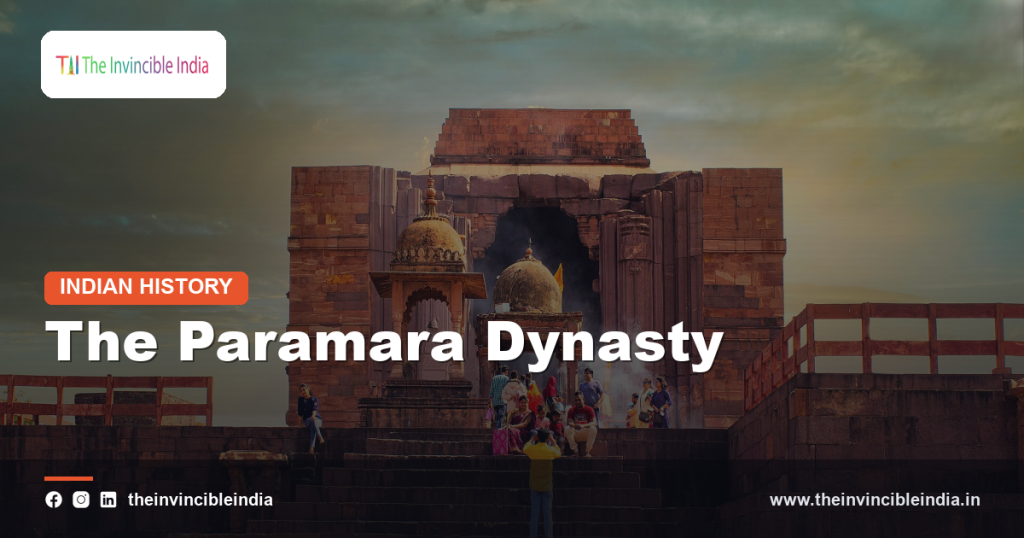
In the fertile uplands of Malwa in central India, a dynasty emerged whose fame rests as much on scholarship and learning as on military accomplishment. The Paramaras rose to prominence in the political vacuum that followed the wider fragmentation described in our guide to the Gupta empire’s successor states, building a regional kingdom centered on the city of Dhar that became a notable hub of Sanskrit scholarship, temple building, and courtly patronage. The dynasty’s reputation for learning reached its peak under a ruler remembered as much for his intellectual pursuits as for his rule, whose associations with astronomy, literature, and architecture left a distinctive mark on the region. This guide surveys the Paramara dynasty’s origins, governance, culture, and lasting influence on Malwa.
Quick Facts
| Detail | Information |
|---|---|
| Region | Malwa, present-day western Madhya Pradesh |
| Approximate Period | Roughly the 9th to the 14th century CE |
| Capital | Dhar (Dharanagari), with Ujjain as a major cultural center |
| Most Celebrated Ruler | Bhoja, remembered as a scholar-king and patron of learning |
| Signature Monument | The Bhojpur temple and associated Bhojshala |
| Religions Patronized | Hinduism, particularly Shaivism, alongside Jainism |
Origins in Malwa
The Paramara dynasty rose to prominence in the Malwa region of central India, an area of fertile plateau land long valued for its agricultural productivity and its position along important routes connecting northern and western India. Dynastic tradition traces the family’s origins to legendary accounts that, as with many medieval Indian ruling houses, blended local lore with claims intended to establish respectable lineage. Emerging initially as a subordinate power under larger regional overlords, the Paramaras gradually built an independent base of authority within Malwa during a period of broader political fragmentation across the subcontinent. Their consolidation of power in this strategically located region positioned the dynasty to play a significant role in the shifting politics of central India. This foundation set the stage for the flourishing of Paramara rule in the centuries that followed.
Rise to Regional Power
As Paramara strength grew, successive rulers extended their authority across Malwa, consolidating control through a combination of military campaigns, administrative organization, and strategic alliances with neighboring powers. Early rulers are credited with securing the dynasty’s core territory and establishing Dhar as a capital befitting an increasingly ambitious regional kingdom. The dynasty’s rise coincided with a broader period of competition among several regional powers across central and western India, each seeking to expand influence following the decline of larger imperial structures. Paramara rulers proved capable of holding their own in this competitive environment, steadily building a reputation for both military capability and cultural sophistication. This combination of political consolidation and growing cultural ambition would come to define the dynasty’s later golden age.
Extent of Paramara Territory
At its height, Paramara authority extended across the Malwa plateau and into adjoining areas of central India, a territory whose fertile agricultural base and central location gave the dynasty considerable economic and strategic advantages. Control over this region was periodically contested by neighboring powers, including rival dynasties to the north, south, and west, resulting in a frontier that expanded and contracted according to the fortunes of successive rulers. The dynasty’s central position meant that Malwa often served as a crossroads for trade and cultural exchange, connecting different regions of the subcontinent. This geographic centrality contributed significantly to Malwa’s prosperity and to the Paramaras’ ability to sustain an active and influential court. The dynasty’s territorial history thus reflects both the opportunities and challenges of ruling a strategically located but frequently contested region.
King Bhoja: The Scholar-King
Among all Paramara rulers, one figure stands out with particular prominence in later tradition and scholarship: a king remembered as an extraordinary patron of learning whose reputed personal interests spanned poetry, grammar, architecture, and the sciences. Later tradition credits this ruler with sponsoring numerous works of scholarship and with taking an active personal interest in fields ranging from literature to astronomy, reflecting an unusually broad conception of royal patronage. His court at Dhar became renowned as a center of learning, attracting scholars and poets whose works, in later centuries, were remembered as emblematic of a golden age of Sanskrit scholarship under royal patronage. While later legend has embellished many details associated with this ruler, the consistent theme across tradition and inscriptional evidence is of a court distinguished by sustained intellectual and artistic patronage. This reputation for learning remains the most enduring aspect of Paramara royal memory.
System of Governance
Paramara administration combined central royal authority with a system of provincial governance managed through appointed officials and feudatory chiefs who administered local affairs on behalf of the crown. Inscriptions recording land grants to temples, scholars, and religious institutions provide much of the surviving evidence for how the dynasty organized its revenue and administrative systems. This layered approach allowed the Paramaras to govern a territory of considerable size and agricultural variety without relying on an entirely centralized bureaucratic structure. Local customs and existing structures of authority were generally incorporated into the broader administrative framework rather than replaced outright. This pragmatic system of governance helped sustain Paramara rule across a lengthy period marked by both prosperity and periodic external pressure.
Dhar and Ujjain as Centers of Culture
The Paramara capital of Dhar developed into an important center of political administration and courtly culture, while the nearby ancient city of Ujjain continued to serve as a significant hub of learning, religious life, and astronomical study. Ujjain’s long-established reputation as a center of astronomical observation and calendrical calculation complemented the dynasty’s broader association with scholarship and intellectual patronage. Together, these two cities anchored a cultural landscape in which royal patronage, religious institutions, and scholarly activity reinforced one another. Visitors and scholars from other parts of India are understood to have been drawn to this cultural environment, contributing to Malwa’s reputation as a notable center of learning during the period. This concentration of political and intellectual life in Dhar and Ujjain gave the Paramara realm a distinctive cultural identity among its contemporaries.
Religious Patronage
Paramara rulers were active patrons of Hindu religious traditions, with particular support extended to Shaivism, while also providing meaningful patronage to Jain communities and institutions present within their territory. This pattern of broad religious support reflects a common approach among medieval Indian dynasties, in which rulers sought to secure legitimacy and social harmony by funding multiple religious traditions. Temple construction and endowment featured prominently among Paramara religious activities, with royal grants supporting the maintenance of shrines, priests, and associated institutions across the kingdom. Religious patronage under the Paramaras was also closely intertwined with support for scholarship, as many temples and associated institutions doubled as centers of learning and manuscript preservation. This combination of religious devotion and intellectual patronage is a distinctive feature of Paramara cultural life.
The Bhojpur Temple and Bhojshala
Among the most significant monuments associated with Paramara patronage is the temple complex at Bhojpur, an ambitious religious structure whose scale and architectural conception reflect the dynasty’s substantial resources and artistic ambition. Though never fully completed according to some accounts, the temple’s surviving structure and massive foundation stones convey the scope of the original architectural vision. The Bhojshala, a related institution associated with learning and traditionally linked to the scholarly reputation of the dynasty’s most celebrated ruler, further underscores the close connection between Paramara religious patronage and support for education. Together, these structures illustrate how architectural and intellectual patronage under the Paramaras often reinforced one another within a shared institutional framework. These monuments remain among the most studied physical legacies of Paramara rule in Malwa.
Literature and Sanskrit Scholarship
The Paramara court, particularly during its most celebrated period, became closely associated with Sanskrit literary and scholarly production, with works on poetry, grammar, architecture, and other subjects traditionally linked to royal patronage or personal authorship. This reputation for learning helped establish Malwa as one of the notable centers of Sanskrit scholarship in medieval India, attracting or inspiring works that continued to be studied and referenced long after the dynasty’s political decline. Court poets and scholars benefited from royal support, producing works that combined technical sophistication with the courtly conventions typical of the period’s Sanskrit literary tradition. This intellectual legacy extended beyond pure literature to encompass treatises addressing architecture, statecraft, and other practical subjects. The Paramara association with Sanskrit scholarship remains one of the dynasty’s most distinctive and enduring cultural contributions.
Architecture and Temple Building
Beyond the celebrated complex at Bhojpur, Paramara patronage supported the construction of numerous temples across Malwa, contributing to the broader development of central Indian temple architecture during the medieval period. These structures generally reflect the Nagara architectural tradition common to northern and central India, characterized by tall curvilinear towers and richly carved surfaces. Paramara-era temples often combined structural ambition with detailed sculptural programs, reflecting the dynasty’s broader association with artistic and intellectual sophistication. Regional architectural traditions under the Paramaras also influenced, and were influenced by, developments in neighboring kingdoms, reflecting a broader exchange of architectural ideas across medieval central India. This body of architectural work stands alongside literary and scholarly achievement as a core element of the Paramara legacy.
Economy and Trade
The Paramara economy rested on the agricultural productivity of the Malwa plateau, a region well suited to grain cultivation and supported by a network of towns engaged in craft production and regional trade. Malwa’s central location within the subcontinent placed it along routes connecting various regions of India, allowing the dynasty to benefit from the movement of goods and, to some extent, ideas between different parts of the country. Land grants recorded in inscriptions, directed toward temples, scholars, and religious institutions, provide evidence of a prosperous economy capable of supporting extensive royal patronage. This economic foundation underpinned the dynasty’s ability to sustain an active court, extensive temple building, and a reputation for scholarly patronage across multiple generations. Malwa’s agrarian and commercial prosperity thus formed the material basis for the Paramaras’ celebrated cultural achievements.
Society and Court Life
Paramara society was organized around agrarian villages and market towns, with brahmin scholars, artisans, and traders occupying important roles within the broader social and economic fabric of the kingdom. The royal court itself functioned as a hub of cultural activity, drawing scholars, poets, and religious teachers who benefited from sustained royal patronage and support. This concentration of learned individuals at court contributed to Malwa’s reputation as a center of intellectual life, distinguishing the Paramara kingdom from many contemporary regional powers focused primarily on military or administrative concerns. Descriptions preserved in later tradition emphasize the sophistication and cultural richness of the Paramara court, consistent with the scale of literary and architectural achievement associated with the dynasty. This picture of a culturally vibrant society underlies much of the enduring fascination with Paramara history.
Rivalries with Neighboring Dynasties
Throughout their history, the Paramaras engaged in recurring rivalries with neighboring powers, including the Chaulukyas of Gujarat and other regional dynasties whose territories bordered Malwa. Control of contested frontier regions and access to trade routes fueled much of this competition, with fortunes shifting according to the relative strength of successive rulers on each side. Periods of Paramara strength allowed the dynasty to extend influence into neighboring territories, while periods of weakness left Malwa vulnerable to incursions from ambitious rivals. This pattern of shifting rivalry and periodic conflict reflects the broader competitive political landscape of medieval central and western India. The Paramaras’ ability to endure across several centuries despite these pressures speaks to considerable underlying political and military resilience.
Decline of Paramara Power
Over time, sustained pressure from rival regional powers, combined with the cumulative strain of recurring conflicts, gradually weakened Paramara authority over Malwa. Internal succession difficulties and the loss of key territories to more assertive neighboring dynasties further eroded the kingdom’s cohesion in its later centuries. As central authority declined, Paramara territory came under increasing pressure from powers advancing from both the west and the emerging political forces reshaping northern India during this period. This gradual erosion of independence, rather than a single decisive event, characterized the dynasty’s later political history. The eventual eclipse of Paramara political power nonetheless left behind a substantial cultural and architectural legacy that would long outlast the dynasty’s independent rule.
Legacy in Indian History
The Paramara dynasty is remembered today chiefly for its association with learning and scholarship, exemplified by the enduring reputation of its most celebrated ruler as a patron of literature, architecture, and the sciences. This legacy has made the dynasty a frequent subject of study for historians interested in the relationship between royal patronage and intellectual life in medieval India. The temple complex at Bhojpur and the tradition of the Bhojshala continue to serve as physical reminders of the dynasty’s distinctive combination of religious and scholarly patronage. Malwa’s broader historical identity as a center of learning owes much to the cultural foundations laid during the Paramara period. This layered legacy secures the Paramaras an important and distinctive place within the broader narrative of medieval Indian history.
The Paramara Dynasty Today
Today, the legacy of the Paramara dynasty is preserved through the surviving monuments at Bhojpur and Dhar, which continue to attract scholars and visitors interested in medieval Indian architecture and the history of Sanskrit learning. Regional heritage authorities work to conserve these sites, recognizing their significance within the broader historical landscape of Malwa. The reputation of the dynasty’s most celebrated ruler as a scholar-king continues to be studied and referenced in discussions of the relationship between political power and intellectual patronage in medieval India. Ongoing scholarship draws on Paramara inscriptions and surviving literary references to refine understanding of the dynasty’s cultural and political history. Through both its monuments and its enduring reputation for learning, the Paramara dynasty remains a distinctive presence in the historical memory of central India.
Sources & Further Reading
- Ministry of Culture, Government of India (indiaculture.gov.in).
- Archaeological Survey of India (asi.nic.in).
Frequently Asked Questions
Who were the Paramaras?
The Paramaras were a medieval dynasty that ruled the Malwa region of central India from roughly the 9th to the 14th century CE, remembered especially for their patronage of learning and architecture.
What is the Paramara dynasty famous for?
The dynasty is best known for the scholarly reputation of its most celebrated ruler, traditionally associated with literature, architecture, and the sciences, and for the temple complex at Bhojpur.
Where was the Paramara capital located?
Dhar, also known as Dharanagari, served as the dynasty’s principal capital, with the ancient city of Ujjain functioning as a major center of culture and learning.
What religions did the Paramaras support?
Paramara rulers primarily patronized Hindu traditions, especially Shaivism, while also extending meaningful support to Jain communities and religious institutions within their territory.
What led to the decline of the Paramara dynasty?
Sustained pressure from rival regional powers, combined with internal succession difficulties, gradually weakened Paramara authority, leading to the eventual contraction of the kingdom.