


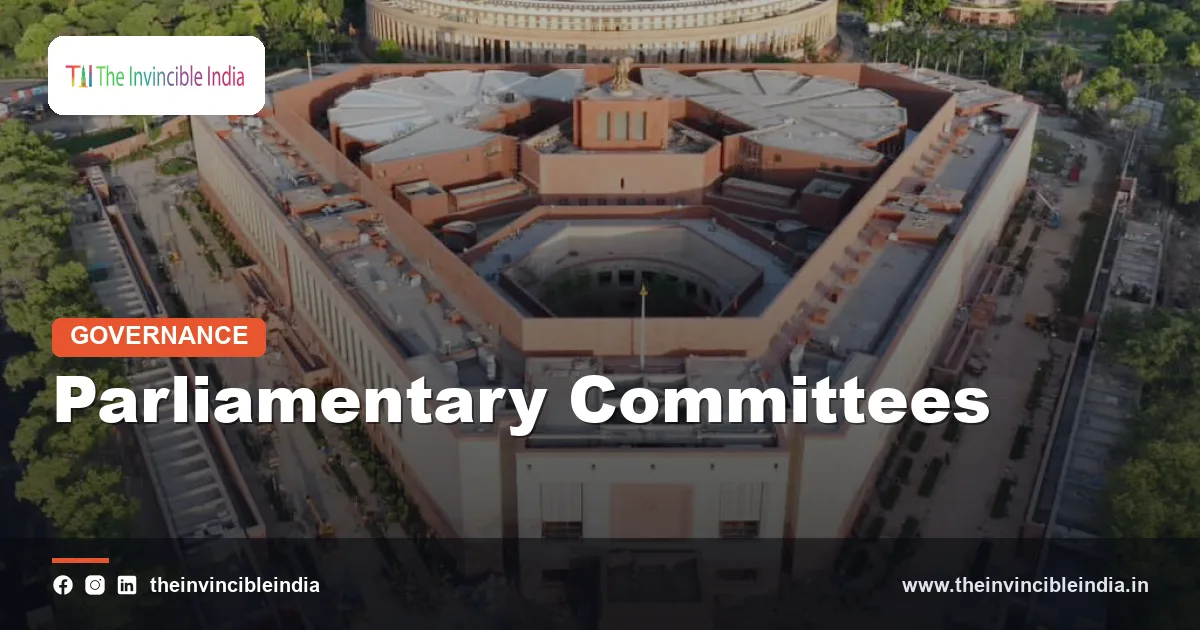
Every year, Parliament is asked to pass dozens of bills, approve the Union Budget and keep watch over the work of dozens of ministries. It cannot possibly do all of this in detail on the floor of the House. That is where parliamentary committees come in: small groups of Members of Parliament (MPs) who take up the detailed, technical and time-consuming work of examining bills, budgets, policies and administrative performance. Because they function like Parliament in miniature, they are often called “mini-Parliaments”.
Committees work in smaller rooms, usually away from television cameras and the heat of political slogans. MPs of different parties sit together, call officials and experts, ask hard questions and write reports. This article explains what parliamentary committees are, why they exist, how the main types differ, how they work and what the debate about strengthening them is all about.
Quick Facts
| Aspect | Detail |
|---|---|
| What they are | Small groups of MPs appointed or elected by a House (or nominated by the Presiding Officer) to examine specific matters |
| Constitutional roots | Article 105 (powers and privileges of Parliament) and Article 118 (rules of procedure) |
| Two broad types | Standing committees (permanent) and ad hoc committees (temporary) |
| Oldest financial committee | Public Accounts Committee, first constituted in 1921 |
| Subject committees | 24 Departmentally Related Standing Committees, introduced in 1993 (17 initially) |
| Chair of the PAC | By convention, a member of the Opposition (since the late 1960s) |
| Nature of reports | Advisory and persuasive, not legally binding on the government |
| Typical tenure | One year for most standing committees, which are reconstituted annually |
What Are Parliamentary Committees?
A parliamentary committee is a body of MPs that is appointed by the House or nominated by the Speaker of the Lok Sabha or the Chairman of the Rajya Sabha, works under the direction of the Presiding Officer and reports back to the House or to the Presiding Officer. The authority for this arrangement flows from Article 105, which deals with the powers and privileges of the Houses and their members, and Article 118, which allows each House to make rules for regulating its procedure and the conduct of its business.
The idea is not unique to India. Almost every modern legislature uses committees, because the volume and complexity of public business has grown far beyond what a House of hundreds of members can handle in plenary sittings. India inherited the practice from the British parliamentary tradition, and it has been adapted over the decades to local needs.
Key features
- Members are drawn from different parties roughly in proportion to their strength in the House.
- Each committee has a chairperson, appointed by the Speaker or the Chairman.
- Most proceedings are confidential, which encourages frank discussion.
- Findings are presented to the House as written reports.
Why Parliamentary Committees Matter
Parliament sits for a limited number of days every year, spread across the Budget, Monsoon and Winter sessions. Within those days, the House must handle legislation, questions, debates on national issues and financial business. Disruptions and adjournments eat further into the time available. A complicated bill on telecommunications, data protection or insolvency cannot receive clause-by-clause analysis in such conditions.
Committees solve this problem in several ways.
- Time: they can meet when Parliament is not in session and spend weeks or months on a subject.
- Expertise: they can hear from academics, industry bodies, civil society groups, regulators and senior officials, and can draw on specialist advice.
- Less partisan atmosphere: without public galleries and live broadcast, MPs are less likely to play to the audience and more likely to engage with the substance.
- Continuity: committees keep following a subject through the year, unlike a one-off floor debate.
- Accountability: they allow Parliament to check whether laws and budget allocations have actually produced results.
In a parliamentary democracy, the executive is answerable to the legislature. Committees give that answerability a practical form, because ministries must explain their decisions to MPs in a structured and recorded manner.
Two Broad Types: Standing and Ad Hoc
The committee system is usually divided into two categories, based on how long a committee lasts.
Standing committees
Standing committees are permanent in nature. They are constituted afresh, usually every year or at set intervals, and carry out continuing work. Examples include the financial committees, the Departmentally Related Standing Committees, the Business Advisory Committee, the Committee on Privileges and the Committee on Petitions.
Ad hoc committees
Ad hoc committees are temporary. They are created for a specific purpose and cease to exist once they submit their report. The best-known examples are the Select Committees and Joint Committees appointed to examine particular bills, and committees formed to inquire into a particular matter.
| Feature | Standing committees | Ad hoc committees |
|---|---|---|
| Duration | Permanent; reconstituted periodically | Temporary; end with the report |
| Purpose | Continuing scrutiny of finances, ministries and procedure | A specific task, such as a particular bill or inquiry |
| Examples | PAC, Estimates Committee, DRSCs, Committee on Privileges | Select and Joint Committees on bills, inquiry committees |
| Membership | Fixed numbers set by rules | Decided by the motion creating the committee |
The Financial Committees
Three committees are devoted to keeping a check on public money. Together they form the backbone of Parliament’s financial oversight.
Public Accounts Committee (PAC)
The Public Accounts Committee examines the audit reports of the Comptroller and Auditor General (CAG), which are laid before Parliament under Article 151. It checks whether money granted by Parliament has been spent as authorised, whether it was spent economically and whether any waste, loss or extravagance has occurred. The committee has 22 members, 15 from the Lok Sabha and 7 from the Rajya Sabha, and a minister cannot be a member. The PAC was first set up in 1921 under the reforms associated with the Government of India Act, 1919, and in its early years it was chaired by the Finance Member of the government. Since the late 1960s, it has been the convention that the chairperson belongs to the Opposition.
Estimates Committee
The Estimates Committee, with 30 members drawn only from the Lok Sabha, examines the budget estimates and suggests economies, improvements in organisation and alternative policies. It was set up in 1950 following a suggestion by John Mathai, the then Finance Minister, and is sometimes described as a “continuous economy committee” because it can work throughout the year.
Committee on Public Undertakings (COPU)
Established in 1964 on the recommendation of the Krishna Menon Committee, the COPU examines the reports and accounts of public sector undertakings and the CAG reports on them. It has 22 members, 15 from the Lok Sabha and 7 from the Rajya Sabha, and checks whether these enterprises are being run efficiently and on sound business principles.
| Committee | Members | Main role |
|---|---|---|
| Public Accounts Committee | 22 (15 LS + 7 RS) | Examines CAG audit reports and appropriation accounts |
| Estimates Committee | 30 (all LS) | Examines estimates and suggests economy and efficiency |
| Committee on Public Undertakings | 22 (15 LS + 7 RS) | Examines public sector undertakings |
Departmentally Related Standing Committees (DRSCs)
Parliament’s most visible modern reform in this area was the creation of Departmentally Related Standing Committees. Three such committees (on agriculture, science and technology, and environment and forests) were set up on an experimental basis in 1989. In 1993, the system was expanded to 17 committees covering the major ministries, and in 2004 it was extended to the present 24.
Each DRSC is attached to a group of related ministries and departments, so that every ministry falls under some committee. Each has 31 members, 21 from the Lok Sabha and 10 from the Rajya Sabha. Of the 24 committees, 16 function under the Lok Sabha Speaker and 8 under the Rajya Sabha Chairman. A minister cannot be a member, and a member who is appointed a minister must leave the committee.
What they do
- Examine the Demands for Grants of the ministries they oversee and report to the House.
- Examine bills referred to them by the Speaker or the Chairman.
- Consider annual reports of the ministries.
- Study national basic long-term policy documents presented to the House.
The DRSCs do not look into day-to-day administration, and they do not examine matters of detailed technical decision-making. Their focus is on policy, budgets and legislation. Chairpersons are distributed among parties, and the committees produce thematic reports on topics ranging from railway safety to higher education to health infrastructure.
Other Important Committees
Beyond the financial and subject committees, Parliament has several other standing committees that look after specific areas of its own functioning.
- Business Advisory Committee: recommends the time to be allotted for different items of business in the House. In the Lok Sabha it is headed by the Speaker.
- Committee on Privileges: examines cases of breach of privilege of the House or its members.
- Ethics Committee: examines complaints of unethical conduct by members. The Rajya Sabha set up its Ethics Committee in 1997, and the Lok Sabha made its Ethics Committee permanent in 2015.
- Rules Committee: considers matters of procedure and conduct of business and recommends amendments to the rules.
- Committee on Petitions: examines petitions on bills and matters of general public interest.
- Committee on Subordinate Legislation: checks whether rules, regulations and bye-laws framed by the executive remain within the powers delegated by Parliament.
- Committee on Government Assurances: follows up promises and undertakings that ministers make on the floor of the House.
- Committee on Papers Laid on the Table: checks whether documents have been laid before the House according to the law.
- Committee on the Welfare of Scheduled Castes and Scheduled Tribes: reviews the working of constitutional and statutory safeguards for these communities.
- Committee on Empowerment of Women: set up in 1997 to look at measures for gender equality and the status of women.
- House Committee, Library Committee and General Purposes Committee: deal with housekeeping, facilities and the welfare of members.
Select and Joint Committees on Bills
When a bill is complex or controversial, the House can send it to a Select Committee (of one House) or a Joint Committee (of both Houses) for detailed examination. A bill may also be referred to a DRSC by the Presiding Officer. The committee studies each clause, hears evidence, receives memoranda from the public, and then reports with suggested amendments. The bill returns to the House, where debate continues on the basis of the committee’s version.
Joint Parliamentary Committees (JPCs) are also formed to investigate matters of public concern, and several have drawn wide attention. Well-known examples include the JPC on the Bofors contracts in 1987, the committee on the securities and banking scam in the early 1990s, the committee on the stock market scam in 2001, the committee on pesticide residues in soft drinks in 2003, and the committee on the 2G spectrum allocation in 2011. A JPC on the Personal Data Protection Bill was constituted in 2019.
Composition of a joint committee
In a joint committee, the Lok Sabha usually has twice as many members as the Rajya Sabha. The chairperson is appointed from the Lok Sabha members by the Speaker. The motion to constitute a JPC is adopted by one House and the concurrence of the other is sought. Joint committees are given a deadline for reporting, which is sometimes extended.
How a Parliamentary Committee Works
The general working pattern of committees follows a recognisable path.
- Constitution: members are either elected by the House using proportional representation by the single transferable vote (as for the financial committees), or nominated by the Speaker or Chairman.
- Selection of subject: a committee takes up a matter on its own, or a matter is referred by the House or the Presiding Officer.
- Evidence: ministries and departments submit written notes. Officials, experts and stakeholders are called to depose, and committees may undertake study visits.
- Deliberation: members discuss the findings in closed meetings. The party whip does not bind members in the same way as on the floor of the House, so cross-party agreement is easier to reach.
- Report: the committee adopts a report and presents it to the House or the Presiding Officer. It is then made public.
- Follow-up: the government must respond with an action taken note on the recommendations accepted, usually within a few months. Committees then prepare an Action Taken Report assessing implementation.
The reports of committees are advisory and carry persuasive moral and political weight. The government is not legally compelled to accept them, but ignoring a unanimous report from a respected committee carries a reputational cost.
Value, Concerns and the Case for Reform
The value of the committee system
Supporters of strong committees argue that they improve both the quality of laws and the quality of governance. The reasons usually cited are the following.
- Depoliticised scrutiny: MPs often work across party lines in committee rooms. Many committee reports are unanimous even when the parties are bitterly opposed in the House.
- Better legislation: clause-by-clause study improves drafting, exposes unintended consequences and brings in public opinion.
- Stakeholder access: citizens, experts and affected groups can place views before MPs directly.
- Continuity of oversight: the ministries are watched through the year, not only during the Budget session.
- Training of members: MPs gain subject knowledge, which improves the level of debate on the floor.
- Accountability: the PAC and COPU reports on audit findings have repeatedly brought issues of financial irregularity into public view.
Concerns and calls for reform
Despite their importance, the committee system faces several criticisms.
Fewer bills are being referred
Referral of bills to committees is not mandatory. It depends on the discretion of the Presiding Officers, and often on the wishes of the government. Studies of Parliament’s work, such as those by PRS Legislative Research, show that a large majority of bills were referred to committees during the 15th Lok Sabha (2009 to 2014), but the proportion fell sharply in later Lok Sabhas. Many important bills have been passed with limited or no committee scrutiny.
Attendance and capacity
Attendance at committee meetings is sometimes low, and members may be unavailable because of other commitments. Committees also have small research teams compared with their workload, and the one-year term of many committees limits how much continuity can be built up. Frequent changes in membership can make it harder to follow long inquiries.
Non-binding recommendations
Because recommendations are advisory, governments can accept them selectively or not at all. Action taken reports can arrive late, and there is no strong mechanism to press for implementation.
Suggested remedies
- Make referral of major bills to committees the norm rather than the exception.
- Extend the tenure of committees beyond one year, so that members develop expertise.
- Provide committees with stronger research and technical support.
- Require timely and public responses from ministries to committee recommendations.
- Publish attendance records and encourage greater participation.
How India Compares with the US Congress
In the United States, committees are far more powerful. They are the real engine of legislation. Bills are introduced and then go to the relevant committee, which can rewrite them, hold public hearings and decide whether the bill ever reaches the floor. Committees can subpoena witnesses and documents, and the Senate committees play a major part in confirming appointments. Chairs are generally from the majority party, and the system has traditionally been shaped by seniority.
In India’s parliamentary system, the government is formed from the majority in the Lok Sabha and controls the legislative agenda. Committees therefore play a more advisory role, and the executive can accept or reject their recommendations. India’s committees are also more consensus-oriented, and key panels such as the PAC are headed by the Opposition. Both systems share the same underlying principle that detailed work in small groups improves legislative scrutiny.
Conclusion
Parliamentary committees are the quiet workhorses of Indian democracy. They do the detailed reading, questioning and checking that a crowded House cannot, and they provide a space where MPs of rival parties can work on shared problems. From the PAC examining audit paragraphs to the DRSCs studying the demands of ministries, they strengthen the accountability of the government to Parliament. The challenge going forward is to make their use more regular, their recommendations harder to ignore and their work better known to the public. That is the real test of whether Parliament remains a place of careful deliberation and not only of rapid decision-making. Last reviewed: 1 October 2026.
Frequently Asked Questions
What are parliamentary committees in India?
Parliamentary committees are small groups of MPs from one or both Houses who examine bills, budgets, policies and the working of ministries in detail. They are appointed by the House or nominated by the Presiding Officer, and they report to the House. They are often called mini-Parliaments.
What is the difference between standing and ad hoc committees?
Standing committees are permanent bodies that are reconstituted periodically, such as the Public Accounts Committee and the Departmentally Related Standing Committees. Ad hoc committees are temporary and are created for a specific task, such as a Select or Joint Committee on a particular bill, and they end when they submit their report.
Who chairs the Public Accounts Committee?
By convention, the chairperson of the Public Accounts Committee is a member of the Opposition. The committee examines the reports of the Comptroller and Auditor General and checks whether public money has been spent as Parliament authorised. It has 22 members, 15 from the Lok Sabha and 7 from the Rajya Sabha.
How many Departmentally Related Standing Committees are there?
There are 24 Departmentally Related Standing Committees. The system was introduced in 1993 with 17 committees and expanded to 24 in 2004. Each has 31 members, 21 from the Lok Sabha and 10 from the Rajya Sabha, and examines the demands for grants, bills and annual reports of the ministries assigned to it.
Are the recommendations of parliamentary committees binding on the government?
No. The recommendations of committees are advisory and not legally binding. The government is expected to respond with an action taken note, and committees follow up with action taken reports, but it can accept, modify or reject the suggestions.
Why is there concern about the committee system?
The main concerns are that a smaller share of bills is now being referred to committees, attendance at meetings can be low, committees have limited research support and their reports are not binding. Reform proposals include making referral of major bills routine and extending committee tenures.
{“@context”:”https://schema.org”,”@graph”:[{“@type”:”FAQPage”,”mainEntity”:[{“@type”:”Question”,”name”:”What are parliamentary committees in India?”,”acceptedAnswer”:{“@type”:”Answer”,”text”:”Parliamentary committees are small groups of MPs from one or both Houses who examine bills, budgets, policies and the working of ministries in detail. They are appointed by the House or nominated by the Presiding Officer, and they report to the House. They are often called mini-Parliaments.”}},{“@type”:”Question”,”name”:”What is the difference between standing and ad hoc committees?”,”acceptedAnswer”:{“@type”:”Answer”,”text”:”Standing committees are permanent bodies that are reconstituted periodically, such as the Public Accounts Committee and the Departmentally Related Standing Committees. Ad hoc committees are temporary and are created for a specific task, such as a Select or Joint Committee on a particular bill, and they end when they submit their report.”}},{“@type”:”Question”,”name”:”Who chairs the Public Accounts Committee?”,”acceptedAnswer”:{“@type”:”Answer”,”text”:”By convention, the chairperson of the Public Accounts Committee is a member of the Opposition. The committee examines the reports of the Comptroller and Auditor General and checks whether public money has been spent as Parliament authorised. It has 22 members, 15 from the Lok Sabha and 7 from the Rajya Sabha.”}},{“@type”:”Question”,”name”:”How many Departmentally Related Standing Committees are there?”,”acceptedAnswer”:{“@type”:”Answer”,”text”:”There are 24 Departmentally Related Standing Committees. The system was introduced in 1993 with 17 committees and expanded to 24 in 2004. Each has 31 members, 21 from the Lok Sabha and 10 from the Rajya Sabha, and examines the demands for grants, bills and annual reports of the ministries assigned to it.”}},{“@type”:”Question”,”name”:”Are the recommendations of parliamentary committees binding on the government?”,”acceptedAnswer”:{“@type”:”Answer”,”text”:”No. The recommendations of committees are advisory and not legally binding. The government is expected to respond with an action taken note, and committees follow up with action taken reports, but it can accept, modify or reject the suggestions.”}},{“@type”:”Question”,”name”:”Why is there concern about the committee system?”,”acceptedAnswer”:{“@type”:”Answer”,”text”:”The main concerns are that a smaller share of bills is now being referred to committees, attendance at meetings can be low, committees have limited research support and their reports are not binding. Reform proposals include making referral of major bills routine and extending committee tenures.”}}]}]}