


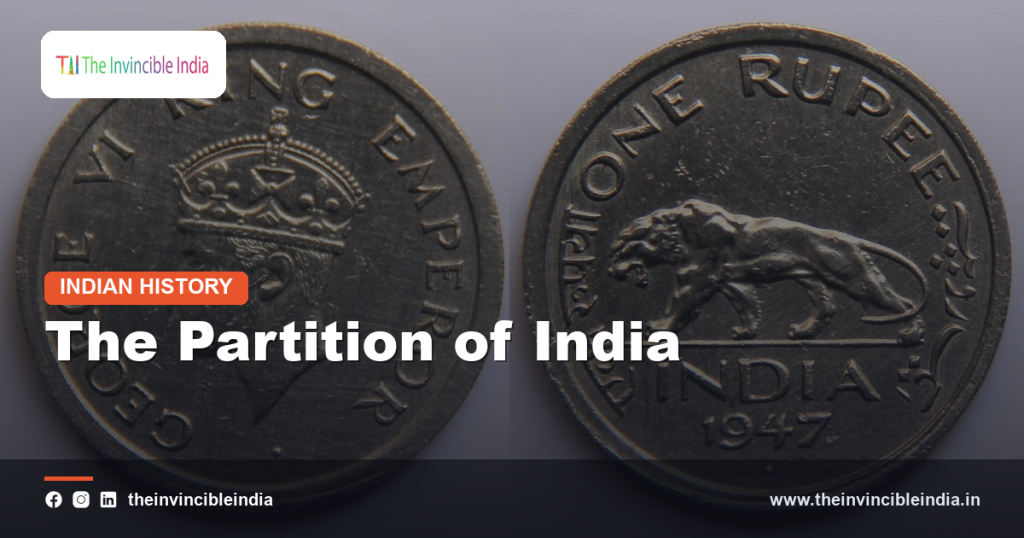
The Partition of India in 1947 stands as one of the most consequential and painful events in modern South Asian history, dividing British India into two independent dominions along religious lines at the very moment colonial rule ended. It closed out a subcontinental political order whose roots stretched back through centuries of shared history, including the long era of the Mughal Empire, and it followed decades of nationalist negotiation over how that shared inheritance would be governed once colonial rule ended. Partition brought both the joy of freedom and immense human upheaval, as millions crossed new borders amid widespread violence and loss. This guide examines the political background that led to partition, how the new boundaries were drawn, the scale of migration and hardship that followed, and the long shadow the event continues to cast over the subcontinent.
Quick Facts
| Detail | Information |
|---|---|
| Event | Partition of British India |
| Year | 1947 |
| Outcome | Creation of India and Pakistan as separate dominions |
| Key Process | Boundary demarcation and mass population transfer |
| Human Impact | Large-scale migration and communal violence |
| Related Region | Punjab and Bengal most directly affected |
A Subcontinent Under Colonial Rule
By the early twentieth century, British India encompassed a vast and religiously diverse population living under a single colonial administration, with Hindus, Muslims, Sikhs, Christians, and other communities sharing towns, provinces, and economic life across the subcontinent. Colonial administrative practices, including certain forms of representation based on religious community, gradually sharpened distinctions between groups in the political sphere even where social life remained closely intertwined. As nationalist political activity grew, questions arose about how a future self-governing India would represent its religious diversity and safeguard minority interests. These underlying tensions, present for decades before the actual division took place, formed the essential backdrop against which the demand for partition would later emerge. Understanding this long colonial context is essential to grasping how the events of 1947 came about.
Rise of Communal Political Organization
Alongside the broader nationalist movement, distinct political organizations emerged over the early twentieth century to represent the interests of particular religious communities, most notably a Muslim political organization founded to articulate the concerns of Muslims within the colonial political system. Initially focused on securing safeguards and representation within a united India, such organizations gradually developed more distinct political identities as constitutional negotiations progressed. Differing visions of India’s political future, some favoring a strong unified center and others emphasizing communal or provincial autonomy, became increasingly difficult to reconcile through ordinary negotiation. The growth of separate communal political organizations alongside the broader nationalist movement set the stage for the divergent demands that would dominate the final phase of colonial rule. This organizational development was a gradual process rather than a sudden shift.
Separate Electorates and Deepening Divisions
Colonial constitutional reforms introduced separate electorates for different religious communities in various legislative bodies, a measure intended to guarantee minority representation but one that also institutionalized religious identity as a primary category of political organization. Over subsequent decades, this framework shaped how political parties campaigned and how legislative seats were contested, reinforcing communal identity within the formal structures of governance. Nationalist leaders across the political spectrum debated the merits and drawbacks of this system, with some viewing it as a necessary protection for minorities and others as an obstacle to unified nationalist politics. The persistence and expansion of separate electorates through successive constitutional reforms contributed to a political landscape in which religious community became an increasingly central axis of representation. This structural feature had lasting consequences for the negotiations that followed.
Wartime Politics and the Demand for Pakistan
The period surrounding the Second World War saw a significant hardening of political positions, as the Muslim League formally articulated a demand for a separate state for Muslims in regions where they formed a majority, a position that gained growing political traction over the following years. Wartime conditions, including the arrest of Congress leadership during the Quit India movement, created space for the League to expand its organizational reach and present itself as the principal voice of Muslim political opinion. Efforts at compromise between the Congress and the League repeatedly foundered over questions of representation, provincial autonomy, and the structure of any future constitution. By the war’s end, the political gap between advocates of a united India and proponents of a separate Muslim state had widened considerably. This entrenched division set the stage for the final, difficult negotiations of the transfer of power.
The Cabinet Mission and Failed Compromise
In the mid-1940s, a British delegation proposed a constitutional framework intended to keep India united through a loose federal structure granting significant autonomy to provincial groupings, an attempt to satisfy both Congress and League concerns without resorting to outright division. Initial acceptance of the plan by major parties raised hopes that partition might yet be avoided, but differing interpretations of the proposal’s provisions and continuing mutual distrust soon caused the fragile agreement to collapse. The breakdown of this compromise proved a pivotal moment, after which political leaders increasingly treated some form of division as a realistic, if regrettable, possible outcome. Subsequent negotiations focused less on preserving unity and more on managing the terms of an eventual separation. This failed compromise is widely regarded as the last serious attempt to prevent the partition of the subcontinent.
Direct Action and Rising Communal Tension
In the aftermath of the collapsed compromise, calls for direct political action led to serious outbreaks of communal violence in several major cities, marking a grim escalation in tensions between communities that had previously coexisted for generations. These episodes of violence, deeply distressing to contemporaries, hardened political attitudes on all sides and intensified fears about the safety of minority communities under any future political arrangement. News of violence in one region often triggered anxiety and retaliatory tension elsewhere, creating a cycle that further undermined confidence in a peaceful, unified transition. Political leaders faced mounting pressure to reach a settlement quickly, even at the cost of dividing the country, in hopes of restoring order. This period of escalating unrest significantly accelerated the final push toward a decision on partition.
The Decision to Partition
Faced with an increasingly urgent security situation and the breakdown of efforts to preserve a united India, British and Indian political leaders ultimately agreed to a plan for transferring power that involved dividing British India into two separate dominions. The decision reflected a judgment, however painful, that continued negotiation over a single unified state had become untenable within the available time and political circumstances. Congress and League leadership, despite deep reservations on various sides, accepted the plan as the only realistic path to a swift transfer of power. The timeline for implementation was notably compressed, leaving limited time for the practical arrangements that so consequential a division would require. This decision set in motion the rapid sequence of events that would define the following months.
Drawing the Boundary Lines
The task of determining the precise borders between the new dominions fell to boundary commissions tasked with dividing the provinces of Punjab and Bengal, regions with deeply intermixed populations, based primarily on district-level religious demographics. Working under severe time pressure and with limited on-the-ground information, the commissions produced boundary lines that, in numerous cases, split communities, agricultural land, and infrastructure in ways that took little account of local social and economic realities. The boundaries were not publicly announced until after the formal transfer of power had already taken place, leaving many communities uncertain of their new national affiliation in the immediate aftermath of independence. This method of demarcation, however well-intentioned in its criteria, could not adequately address the complexity of a genuinely intermixed population. The resulting borders became a central factor in the massive population movements that followed.
Independence Day and the Two Dominions
In August 1947, British colonial rule formally ended with the establishment of two independent dominions, marking both the fulfillment of decades of nationalist struggle and the formal beginning of a new and deeply challenging chapter. Celebrations of independence in the new dominions were held alongside profound uncertainty and anxiety in the border regions, where the practical consequences of division were only beginning to unfold. National leaders addressed their respective new nations with messages emphasizing hope, unity, and the responsibilities of self-governance, even as reports of unrest and displacement began arriving from Punjab and Bengal. The coincidence of jubilant independence celebrations with the onset of a humanitarian crisis remains one of the most striking and sobering features of this period. This dual character continues to shape how the moment is remembered in the historical memory of the subcontinent.
Mass Migration Across New Borders
In the weeks and months following partition, an extraordinary number of people crossed the newly drawn borders in both directions, as Hindus and Sikhs moved toward India and Muslims moved toward Pakistan, driven by fear, violence, and uncertainty about their safety in areas that had suddenly become foreign territory. This movement of population, among the largest of its kind in modern history, occurred largely on foot, by rail, and in makeshift convoys, often under extremely difficult and dangerous conditions. Families frequently left behind homes, land, and possessions accumulated over generations, facing an uncertain future in unfamiliar surroundings. Refugee camps sprang up on both sides of the new border to accommodate the enormous influx of displaced people. The sheer scale and speed of this migration overwhelmed the administrative capacity of both new nations in the crucial early months of independence.
Communal Violence During Partition
The period surrounding partition was marked by severe and widespread communal violence, particularly in the divided provinces of Punjab and Bengal, resulting in immense human suffering and loss of life among all communities involved. Trains, convoys, and villages became sites of attacks as law and order broke down in many areas during the chaotic transition of authority. Accounts from this period describe scenes of extraordinary cruelty alongside instances of individuals and communities risking their own safety to protect neighbors of a different faith. The exact scale of the violence and displacement remains a subject of historical study, but its profound and tragic impact on the affected populations is universally acknowledged. This violence represents one of the darkest chapters associated with the transfer of power and remains central to how partition is remembered.
Princely States and the Question of Accession
Beyond the directly administered provinces of British India, several hundred princely states, ruled by hereditary monarchs under British paramountcy, faced their own decision about whether to join India, join Pakistan, or seek an independent status as colonial rule came to an end. Most states acceded relatively quickly to one dominion or the other, guided by geographic location, population composition, and negotiation with the new national governments. A small number of states presented more complex cases, requiring extended negotiation or, in certain instances, direct intervention before their status was resolved. The integration of the princely states into the two new dominions was a substantial administrative undertaking that unfolded alongside the more visible upheavals of partition itself. This process ultimately reshaped the political map of the subcontinent as significantly as the drawing of the international boundary.
Punjab's Partition Experience
Punjab, a province with a richly intermixed population of Hindus, Muslims, and Sikhs, experienced some of the most severe consequences of partition, as the boundary line divided the province roughly down the middle and triggered enormous population movement in both directions. Long-established communities, agricultural lands, and extended family networks were abruptly separated by the new border, with many families losing ancestral homes and livelihoods virtually overnight. The Sikh community, concentrated heavily in central Punjab, was particularly affected by the division, given the significant displacement experienced on both sides of the new line. Punjab’s experience is frequently cited as emblematic of partition’s human cost, given both the intensity of the violence and the scale of the displacement involved. The province’s shared cultural heritage prior to 1947 makes its subsequent division especially poignant in historical memory.
Bengal's Partition Experience
Bengal, like Punjab, was divided along religious demographic lines, separating the province into two parts that would eventually become part of different nations, with consequences that unfolded somewhat differently from those in the west. While large-scale displacement and communal tension also affected Bengal, migration in this region occurred over a more extended period rather than the acute, concentrated upheaval seen in Punjab. The division disrupted long-standing economic and cultural ties between the two halves of the province, including trade networks and shared literary and cultural traditions. Calcutta, as a major urban center, absorbed significant numbers of displaced people in the years following partition, straining housing and civic infrastructure. Bengal’s partition experience, while less immediately violent in its initial phase than Punjab’s, produced its own profound and lasting social consequences.
Refugee Rehabilitation and Resettlement
In the aftermath of partition, both new governments faced the immense task of resettling millions of displaced people, requiring the rapid construction of housing, allocation of land, and provision of basic services to refugee populations arriving with little more than what they could carry. Newly built towns and neighborhoods were established specifically to accommodate refugees, and various government schemes sought to provide compensation, employment, and property in exchange for what had been left behind across the new border. This rehabilitation effort, though imperfect and prolonged, gradually enabled displaced communities to rebuild their lives and contribute significantly to the economic and cultural development of their new home regions. Refugee communities in many cases became closely associated with particular trades, neighborhoods, or cultural institutions in the cities where they resettled. The scale of this rehabilitation effort remains a significant, if often understated, achievement of the early independence period.
Long-Term Consequences for the Subcontinent
Partition’s consequences extended well beyond the immediate months of migration and violence, shaping the political, social, and diplomatic relationship between India and Pakistan for decades that followed. Disputes over territory and resources arising from the division contributed to recurring tension between the two nations in the years after independence. Within India itself, partition influenced policy approaches to secularism, minority rights, and border security, as the new nation sought to build a pluralistic democracy in the shadow of the division’s violence. Families separated by the new border often retained connections across generations, even as political relations between the two countries fluctuated. The long-term social and political legacy of partition remains a subject of ongoing historical and public discussion across South Asia.
Partition in Memory Today
Partition continues to occupy a central place in the historical memory of the subcontinent, commemorated through museums, oral history projects, literature, and film that seek to preserve the experiences of those who lived through the division. Personal accounts and family histories passed down through generations remain an important source for understanding the human dimension of events that official records alone cannot fully convey. Scholars and communities alike continue to examine partition’s causes and consequences, seeking a fuller and more nuanced understanding of this pivotal moment. Public commemorations and educational efforts on both sides of the border increasingly emphasize shared human experience alongside historical fact. This ongoing engagement with partition’s memory reflects its enduring significance in shaping the identities of the nations that emerged from it.
Sources & Further Reading
- National Archives of India (nationalarchives.nic.in).
- Ministry of Culture, Government of India (indiaculture.gov.in).
Frequently Asked Questions
What was the Partition of India?
The Partition of India was the 1947 division of British India into two independent dominions, India and Pakistan, carried out largely along religious demographic lines as colonial rule came to an end.
Why did the Partition of India happen?
Partition resulted from decades of political negotiation and communal politics, culminating in a demand for a separate Muslim-majority state and the failure of efforts to preserve a united, independent India.
How were the new borders decided?
Boundary commissions divided the provinces of Punjab and Bengal primarily on the basis of district-level religious demographics, producing borders that were announced only after the formal transfer of power.
How many people were affected by Partition?
Partition triggered one of the largest mass migrations in modern history, with enormous numbers of people crossing the new borders amid widespread displacement and communal violence.
What was the impact of Partition on Punjab and Bengal?
Both provinces were divided by the new border, disrupting communities, families, and economic ties, with Punjab experiencing especially intense and concentrated violence and displacement.