


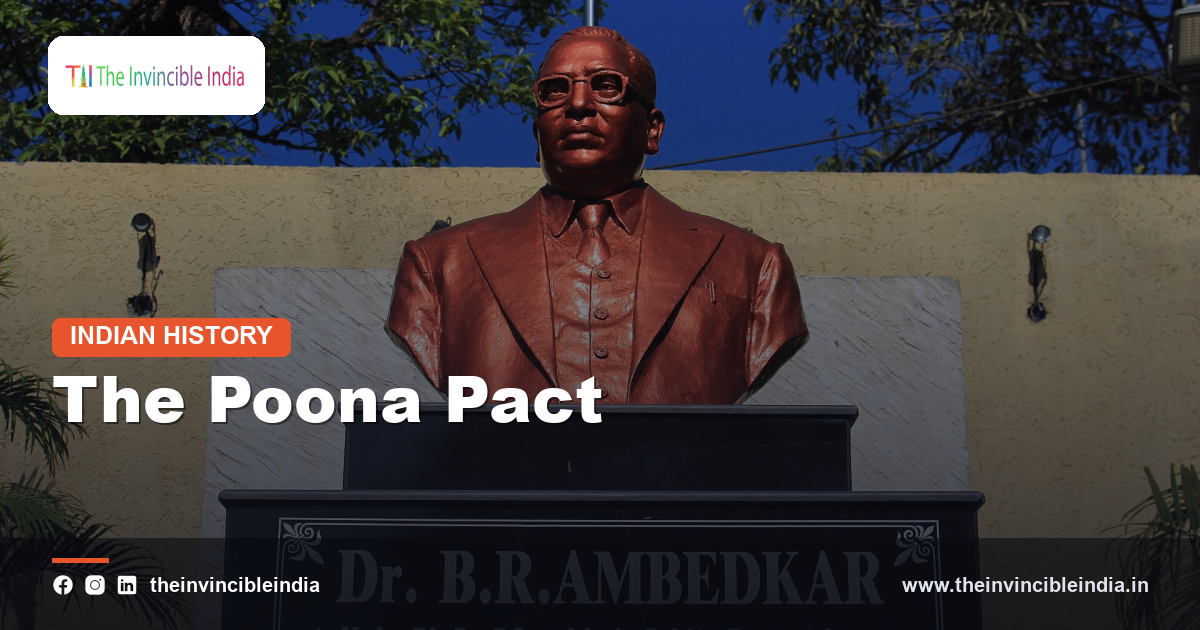
Few agreements in modern Indian history have generated as much reflection, debate and lasting influence as the Poona Pact. Concluded in 1932 after intense negotiation, it settled a bitter disagreement between Mahatma Gandhi and Dr B. R. Ambedkar over how the Depressed Classes, today described as Scheduled Castes, should be represented in legislatures. The accord arose at a moment when the nation was deeply engaged in the struggle described in our guide to the Indian independence movement, and it tested the movement’s commitment to social equality. Its terms continue to shape the system of reserved seats in Indian political life.
Quick Facts
| Detail | Information |
|---|---|
| Year | 1932 |
| Place | Yerwada Central Jail and the city of Poona (Pune) |
| Main Parties | Mahatma Gandhi and Dr B. R. Ambedkar, with other leaders |
| Background | The Communal Award announced by the British Prime Minister |
| Core Outcome | Reserved seats within the general electorate instead of separate electorates |
| Long-term Legacy | Foundation for reservation in legislatures under the Constitution |
Social Background and the Question of Representation
The Poona Pact cannot be understood without recognising the deep social inequalities of the caste system, which had for centuries excluded large communities from temples, schools, public wells and equal participation in civic life. Communities then described as the Depressed Classes suffered from the practice of untouchability, which denied them dignity and opportunity. As British constitutional reforms opened limited avenues for legislative representation, the question arose of how these communities could make their voice heard. Reformers, activists and political leaders offered differing answers. The matter combined questions of justice, political strategy and national unity. This social background explains why a dispute over electoral arrangements carried such emotional weight and historic significance.
Early Reform Movements Against Untouchability
Long before 1932, social reformers had challenged caste discrimination through movements for education, temple entry and public dignity. Figures such as Jyotirao Phule, Narayana Guru and Shahu Maharaj worked in different regions to uplift excluded communities and question hereditary hierarchy. Christian missions, reformist organisations and local associations also ran schools and welfare efforts. Within the national movement, Mahatma Gandhi spoke against untouchability and urged caste Hindus to reform their practices, calling those affected Harijans, a term later questioned by many. Alongside these efforts, leaders from the excluded communities organised themselves and demanded rights on their own terms. This wider current of reform formed the intellectual and moral setting in which the question of representation was debated.
Dr B. R. Ambedkar and His Mission
Dr Bhimrao Ramji Ambedkar rose from a community that faced severe discrimination to become one of India’s most accomplished scholars, lawyers and social thinkers. Educated in India and abroad, he returned determined to secure civil and political rights for the excluded. He organised campaigns for access to public water and temples and argued that political safeguards were essential for communities long denied power. His writing and speeches made a rigorous case that social reform could not wait for political independence alone. Ambedkar’s leadership gave the Depressed Classes a forceful and articulate voice in national debates. By the time of the constitutional discussions of the early 1930s, he was widely recognised as their foremost representative.
The Round Table Conferences
In the early 1930s, the British government convened a series of Round Table Conferences in London to discuss India’s constitutional future. Representatives of Indian political groups, princely states and various communities attended, and Mahatma Gandhi participated in a later session as the Congress representative. The question of minority representation was among the most contentious topics, with communities seeking assurances about their political position. Ambedkar argued for special provisions for the Depressed Classes, while Gandhi maintained that they should remain within the Hindu electorate and that reform of society was the proper remedy. The conferences did not produce agreement among Indian participants, and the decision was ultimately left to the British government. This failure to agree set the stage for the announcement of the Communal Award.
The Communal Award
In the absence of agreement, the British Prime Minister announced an arrangement known as the Communal Award, which set out how seats in provincial legislatures would be distributed among communities. It extended the principle of separate electorates, under which members of a community voted only for candidates of that community, to the Depressed Classes as well. Supporters saw this as a means of guaranteeing authentic representation, since candidates would depend on the votes of their own communities. Critics within the national movement feared it would divide Hindu society and weaken the drive for unity against colonial rule. The award therefore provoked strong reactions on both sides. It created the dilemma that led directly to the confrontation resolved by the Poona Pact.
Gandhi's Objections
Mahatma Gandhi objected strongly to separate electorates for the Depressed Classes, believing they would permanently separate these communities from the rest of Hindu society. In his view, the real remedy lay in removing untouchability through the moral and social transformation of caste Hindus, not in creating distinct political identities. He was also concerned that the British strategy of dividing communities politically would deepen fragmentation in the national movement. These convictions were sincerely held and rooted in his larger vision of social reform and unity. At the same time, his position was questioned by those who felt that political safeguards were necessary because reform alone had been too slow. The disagreement thus reflected two serious and differing approaches to the same problem.
The Fast in Yerwada Jail
Gandhi was held in Yerwada Central Jail near Poona at the time, and he announced a fast unto death in protest against separate electorates for the Depressed Classes. The announcement stirred the whole country, since Gandhi’s health and life were now at stake, and leaders from many backgrounds responded with urgency. Public meetings, temple openings and expressions of concern followed as people sought a way out of the crisis. The fast placed heavy moral pressure on all involved, including Ambedkar, who was asked to consider a compromise in order to save Gandhi’s life. The situation was painful for everyone, because it linked the fate of a revered leader to a deeply sensitive question of justice. Negotiations began quickly in this atmosphere of tension.
The Negotiations in Poona
Intense discussions took place among several prominent figures, including Madan Mohan Malaviya, M. C. Rajah, Rajendra Prasad, Tej Bahadur Sapru and others who worked to find common ground. Ambedkar participated in the talks while under great pressure, balancing his responsibility to his community with the urgency of the moment. The negotiators explored alternative arrangements that could provide meaningful representation without separate electorates. Meetings moved between the jail and other locations in Poona as drafts were revised and discussed. Eventually an understanding was reached, and the agreement was signed by representatives of the different groups. The negotiations are remembered as a rare instance of rapid constitutional compromise achieved under extraordinary circumstances and through extensive dialogue.
The Terms of the Pact
The Poona Pact abandoned separate electorates for the Depressed Classes and replaced them with reserved seats within the general electorate. Importantly, it allotted a substantially larger number of reserved seats in provincial legislatures than the Communal Award had offered. It also provided for a system of primary elections, in which members of the Depressed Classes would first select a panel of candidates, from whom the final representatives would be chosen in the general election. Further clauses addressed representation in central legislative bodies and pledged that members of these communities would receive fair access to public services and educational grants. The terms thus combined a compromise on method with an expansion of representation, which Ambedkar’s side secured through negotiation.
The Panel System Explained
The panel system was one of the most distinctive and debated features of the agreement. Under it, only voters belonging to the Depressed Classes took part in the first stage, choosing a small group of candidates for each reserved seat. The second stage brought in the full general electorate, which then voted among the shortlisted candidates. Supporters argued that this approach kept the principle of a joint electorate while ensuring that candidates had genuine roots in their own communities. Critics later contended that the need to win votes from the wider electorate could weaken the independence of elected representatives. The debate illustrates the genuine tension between inclusion within a common political body and the desire for authentic, autonomous representation.
Reactions and Criticism
The pact was welcomed with relief by many, who saw it as having averted a tragedy and preserved national unity. Gandhi ended his fast after the agreement received the necessary assent, and the moment was marked by public celebration. At the same time, the settlement drew criticism from various quarters. Some among the Depressed Classes felt that the compromise had been reached under moral duress and gave up an important political safeguard. Others in the wider Hindu community objected to the reserved seats for different reasons. Ambedkar himself later expressed reservations about aspects of the arrangement, particularly the primary election system. These varied reactions show that the agreement was a negotiated compromise rather than a perfect solution.
The Campaign Against Untouchability After the Pact
The pact was followed by intensified public efforts to combat untouchability within the national movement. Gandhi gave the campaign new prominence, and an organisation devoted to the welfare of the excluded communities was established to promote temple entry, education and the removal of discriminatory practices. Activists travelled widely to urge social change, and the issue moved closer to the centre of public life. Yet progress was uneven, and many of the communities concerned felt that attitudes changed only slowly. Ambedkar continued his own movement, emphasising self-respect, political organisation and the need for lasting legal guarantees. The period after 1932 therefore saw both hopeful initiatives and continuing struggle against entrenched social prejudice.
The Pact and the Government of India Act of 1935
The principles of the Poona Pact found practical expression in the Government of India Act of 1935, which provided for reserved seats for the Scheduled Castes in provincial legislatures. This was the term used for the communities formerly called the Depressed Classes, and the Act drew up lists of castes eligible for such representation. Elections held under the new arrangements allowed the system to be tested in practice. The experience showed both the value of guaranteed representation and the challenges of the panel system. The legal framework created at this time laid the administrative groundwork for later constitutional provisions. The Act thus carried the compromise reached at Poona from negotiated agreement into the structure of governance.
From the Pact to the Constitution
When independent India drafted its Constitution, Ambedkar served as chairman of the Drafting Committee and helped shape guarantees of equality and social justice. The Constitution abolished untouchability and prohibited discrimination, and it provided for reserved seats for Scheduled Castes and Scheduled Tribes in legislative bodies, along with safeguards in education and public employment. The system adopted was one of joint electorates with reserved seats, echoing the central principle of the Poona Pact but without the panel procedure. This continuity shows the lasting influence of the 1932 agreement on the framework of Indian democracy. The constitutional provisions were intended as instruments for correcting historic injustice and ensuring meaningful participation in national life.
Historical Debates and Interpretations
Historians and political thinkers continue to interpret the Poona Pact in different ways. Some view it as a pragmatic compromise that protected unity while securing greater representation for the Depressed Classes. Others see it as a moment when moral pressure limited the choices available to Ambedkar and his supporters. Discussions also consider how the different philosophies of Gandhi and Ambedkar, one focused on moral reform within society and the other on legal and political guarantees, shaped the movement for social justice. These debates are carried out with serious attention to evidence and a recognition that both leaders acted from conviction. The range of interpretation keeps the subject alive as a matter of ongoing scholarly and public reflection.
The Poona Pact Today
The Poona Pact remains a touchstone in discussions of caste, democracy and representation in India. Yerwada, where Gandhi’s fast took place, and the wider city of Pune are remembered as the setting of this historic negotiation, and the agreement is studied in schools, universities and public forums. The system of reserved seats that descends from it continues to shape elections to legislatures at several levels. Conversations about its meaning remain lively, reflecting the importance of social justice in the nation’s life. Commemorations of both Gandhi and Ambedkar often return to the lessons of this episode, which combined moral urgency, hard bargaining and compromise. The pact endures as a landmark in the struggle to make political equality a reality.
Sources & Further Reading
- Ministry of Culture, Government of India (indiaculture.gov.in).
- National Archives of India (nationalarchives.nic.in).
Frequently Asked Questions
What was the Poona Pact?
The Poona Pact was a 1932 agreement between Mahatma Gandhi and B. R. Ambedkar, along with other leaders, on the political representation of the Depressed Classes. It replaced separate electorates with reserved seats inside the general electorate.
Why did Gandhi fast at Yerwada?
Gandhi opposed the separate electorates granted to the Depressed Classes under the Communal Award, fearing they would divide Hindu society. He began a fast unto death in Yerwada Jail, which led to urgent negotiations and the signing of the pact.
What did the pact change compared with the Communal Award?
It gave up separate electorates but allotted a substantially larger number of reserved seats in provincial legislatures. It also introduced a primary election panel system for selecting candidates.
How is the Poona Pact linked to the Constitution?
Its principle of reserved seats in joint electorates influenced later arrangements, including the Government of India Act of 1935 and the Constitution’s provisions for Scheduled Castes. Ambedkar chaired the committee that drafted the Constitution.
Is the Poona Pact still debated?
Yes, historians and political thinkers continue to discuss its fairness, its circumstances and its long-term effects. Views differ, but it is widely regarded as a landmark in the history of political representation in India.