


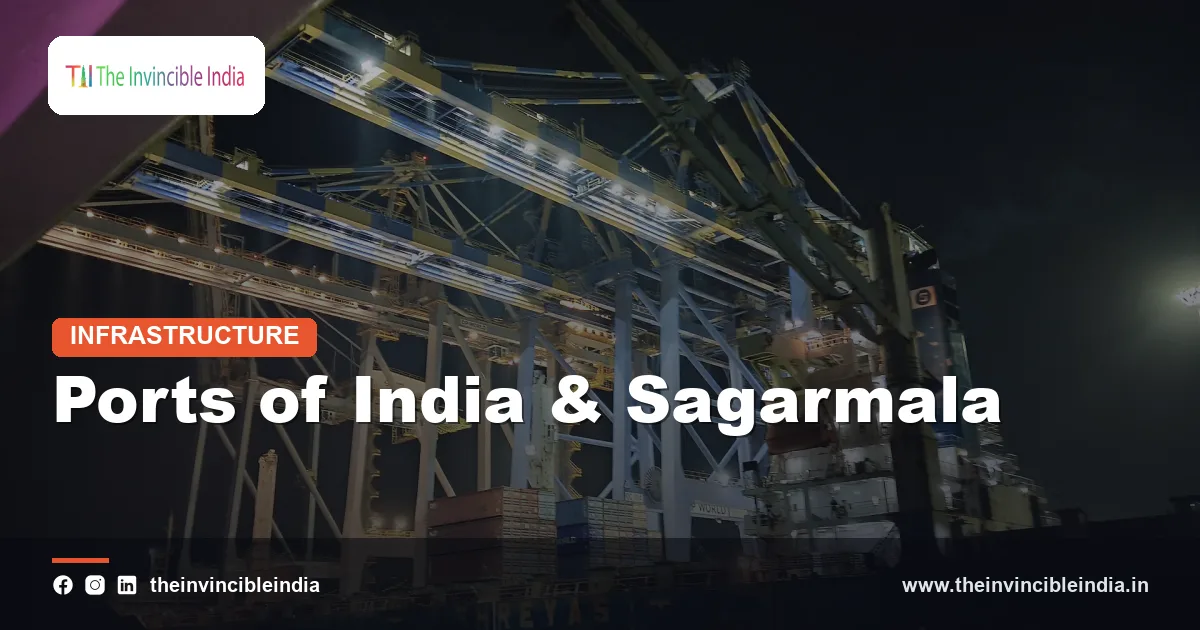
The ports of India are the quiet engines behind the country’s economy. Every day, ships carrying crude oil, coal, fertiliser, machinery, textiles, pharmaceuticals and thousands of containers of consumer goods dock along a coastline that stretches roughly 7,500 kilometres, including island territories. By most estimates, around 95 per cent of India’s trade by volume and about 70 per cent by value travels by sea, which makes harbours less a matter of shipping alone and more a question of national economic security.
This explainer walks through how the Indian port system is organised, the difference between major and non-major ports, how cargo is handled and measured, and what the Sagarmala programme is trying to change. It also looks at related ideas such as Maritime India Vision 2030, transshipment hubs, coastal shipping and inland waterways, the persistent challenges, and the strategic importance of the Indian Ocean. Figures are approximate and dated, because port statistics change every year.
Quick Facts
| Item | Detail |
|---|---|
| Coastline | About 7,500 km, including island territories |
| Share of trade moved by sea | Around 95% by volume and about 70% by value (approximate) |
| Major ports | 12 operating ports under the Union government, with a new port at Vadhavan, Maharashtra, in development |
| Governing law for major ports | Major Port Authorities Act, 2021 |
| Non-major ports | Over 200 minor and intermediate ports managed by coastal state governments |
| Largest container port | Jawaharlal Nehru Port (Nhava Sheva), Navi Mumbai, opened in 1989 |
| Largest commercial port by cargo | Mundra, Gujarat, developed and operated by Adani Ports |
| Sagarmala programme | Approved in 2015 under the Ministry of Ports, Shipping and Waterways |
| Long-term plan | Maritime India Vision 2030, released in 2020 |
Why the Ports of India Matter
A country’s prosperity is closely tied to how cheaply and reliably it can move goods. For India, the sea remains by far the cheapest way to carry bulk cargo over long distances, and the geography helps. The Indian peninsula juts deep into the Indian Ocean, sitting close to the busiest east-west shipping lanes that connect the Persian Gulf, the Suez Canal and the Strait of Malacca. Few large economies are so naturally placed along a global trade artery.
What flows through the harbours
- Imports of crude oil, liquefied gas, coal, fertiliser, edible oils, gold and electronics.
- Exports of refined petroleum products, iron ore, agricultural goods, gems and jewellery, engineering goods and pharmaceuticals.
- Containerised manufactured goods moving to and from Europe, the Middle East, East Asia and North America.
Why it counts for the economy
Ports are not only gates; they are also clusters of employment and industry. Refineries, power plants, steel mills and fertiliser factories are often built near a harbour so that raw materials can be unloaded at the doorstep. Because exporters compete globally, every extra day a container waits at a terminal adds cost and risk. This is why policymakers connect port efficiency directly to India’s logistics costs and to the competitiveness of Indian manufacturing.
The Structure of the Indian Port System
India’s maritime infrastructure is managed under a layered framework. The Constitution places major ports in the Union List, while other ports fall under the Concurrent List, meaning the Centre and the states share responsibility. In practice, this produces two broad categories: major ports and non-major ports.
Major ports
Major ports are owned and administered by the Union government. Each has a port authority, and since 2021 they have operated under the Major Port Authorities Act, 2021, which replaced the older Major Port Trusts Act of 1963. The new law aimed to give these ports greater operational and financial autonomy and to simplify decision-making through professional boards, while keeping them in public ownership.
Non-major ports
Non-major ports, also called minor or intermediate ports, are managed by state maritime boards. There are more than 200 of them, though only a fraction handle significant traffic. Gujarat, Maharashtra, Andhra Pradesh, Odisha and Tamil Nadu have been especially active in developing such harbours, often through private participation.
A shifting balance
For decades, the major ports handled most of India’s cargo. Over the last twenty years, the balance has shifted considerably, and non-major ports now account for a large and growing share of total traffic. The rise of privately developed ports in Gujarat and on the east coast is a major reason.
The Major Ports at a Glance
India’s twelve operating major ports are spread almost evenly across both coasts. Some are centuries old, while others were built after Independence to relieve congestion or serve specific industries. The table below summarises them.
| Port | State or Union Territory | Coast | Notable feature |
|---|---|---|---|
| Deendayal (Kandla) | Gujarat | West | Developed after Partition as a replacement for Karachi |
| Mumbai | Maharashtra | West | One of the oldest natural harbours, with a strong passenger and bulk role |
| Jawaharlal Nehru Port (Nhava Sheva) | Maharashtra | West | India’s largest container port |
| Mormugao | Goa | West | Historically linked to iron ore exports |
| New Mangalore | Karnataka | West | Handles petroleum, fertiliser and edible oil |
| Cochin | Kerala | West | Home to an international container transshipment terminal and a major shipyard nearby |
| V.O. Chidambaranar (Tuticorin) | Tamil Nadu | East | Key southern container and coal port |
| Chennai | Tamil Nadu | East | An artificial harbour with a long colonial history |
| Kamarajar (Ennore) | Tamil Nadu | East | India’s first corporatised major port, focused on coal and energy |
| Visakhapatnam | Andhra Pradesh | East | Deep natural harbour with large bulk and steel-related traffic |
| Paradip | Odisha | East | Major coal, iron ore and crude oil handler |
| Syama Prasad Mookerjee (Kolkata-Haldia) | West Bengal | East | A river port system on the Hooghly, among the oldest in the country |
The Vadhavan project near Dahanu in Maharashtra, approved in 2024, is intended to become a large deep-draft container port, and is commonly described as the thirteenth major port.
Mundra and the Rise of Private Ports
No account of the ports of India is complete without Mundra. Located on the Gulf of Kutch in Gujarat, it began as a modest private venture in the late 1990s and grew into the country’s largest commercial port by cargo handled. It is run by Adani Ports and Special Economic Zone and combines container, bulk, crude and coal terminals with an adjoining special economic zone and strong rail links.
Why Gujarat leads
- A long coastline with natural depth in several creeks and bays.
- A state maritime board with a track record of inviting private developers.
- Close proximity to the industrial belt and to the northern hinterland through rail corridors.
Other well-known non-major ports include Pipavav, Hazira, Dahej and Sikka in Gujarat, Krishnapatnam and Gangavaram in Andhra Pradesh, and Dhamra in Odisha. The model of a state-awarded concession to a private developer, supported by a state maritime board, has proved effective at quickly adding capacity, especially for bulk and container trade.
How Ports Handle Cargo and How They Are Measured
Understanding port performance requires a little vocabulary. Cargo comes in different forms, each needing specialised berths and equipment.
- Container cargo: goods packed in standard steel boxes, measured in twenty-foot equivalent units (TEUs), and handled by gantry cranes.
- Dry bulk: coal, iron ore, bauxite and fertiliser, usually moved by conveyors and grabs.
- Liquid bulk: crude oil, petroleum products, chemicals and edible oils, moved through pipelines and tanks.
- Break bulk and project cargo: steel, machinery and oversized equipment.
Key performance indicators
Cargo throughput, expressed in million tonnes per year, is the headline figure. Others are just as telling. Turnaround time is the period a vessel spends in port from arrival to departure, and a shorter figure means lower costs for shipping lines. Draft refers to the depth of water available at the berth and in the approach channel, which decides how large a ship can enter. Dwell time measures how long a container sits in the yard before it is moved out.
Why draft matters so much
The newest container ships are enormous and sit deep in the water when fully loaded. A port with a shallow channel cannot serve them without expensive and repeated dredging. That is why depth, more than sheer berth length, is increasingly the deciding factor in where the biggest ships choose to call.
The Sagarmala Programme Explained
Sagarmala, a Sanskrit word meaning “garland of the sea”, is the flagship initiative for port-led development. The Union Cabinet approved it in March 2015, and it is overseen by the Ministry of Ports, Shipping and Waterways. The central idea is that harbours should not be isolated facilities. They should be integrated with industry, transport networks and coastal communities so that cargo reaches the sea faster and at lower cost.
The National Perspective Plan
A National Perspective Plan released in 2016 laid out the framework. It identified hundreds of projects across the four themes described below, ranging from terminal upgrades to rail connections and fishing harbour improvements. Many projects are implemented by port authorities, state governments, railways and highway agencies, with funding drawn from several sources, including private investors and a dedicated Sagarmala Development Company created to support viable projects.
The aims
- Reduce the cost and time of moving exim (export-import) and domestic cargo.
- Develop industry along the coast so that goods are made near the water.
- Improve livelihoods for fishing and other coastal communities.
The Four Pillars of Sagarmala
The programme rests on four interlinked pillars, which are summarised below.
| Pillar | What it covers | Typical examples |
|---|---|---|
| Port modernisation and new ports | Upgrading existing terminals, mechanisation, deepening channels, and building new ports | Capacity additions, new berths, greenfield deep-water ports |
| Port connectivity enhancement | Linking harbours to the hinterland by rail, road, coastal shipping and inland waterways | Dedicated rail links, last-mile road connections, pipelines |
| Port-led industrialisation | Creating industrial clusters and coastal economic zones near harbours | Coastal Economic Regions, manufacturing and export hubs |
| Coastal community development | Skilling and livelihood support for fishing and coastal communities | Fishing harbours, cold chains, skill programmes |
Connecting the dots
Each pillar is meaningless without the others. A deeper port with poor road access merely moves the traffic jam inland, while an industrial cluster without a competitive harbour cannot export cheaply. Sagarmala’s design attempts to plan these elements together rather than one by one.
Hinterland Connectivity and Dedicated Corridors
The last mile and the “first mile” of cargo movement often decide whether a port performs well. A port that can discharge a ship quickly but cannot clear the containers by train or truck will clog regardless of its quay length.
Rail and road links
Rail is the preferred mode for moving heavy loads over long distances because it is cheaper per tonne and cleaner than trucks. The Dedicated Freight Corridors, particularly the Western one that runs towards Jawaharlal Nehru Port, were designed to carry double-stacked container trains. Port-specific rail projects, such as additional lines to Paradip, Visakhapatnam and Kandla, and connecting roads to Mundra and others, are routinely included under Sagarmala.
Why it matters
- Faster evacuation of cargo reduces yard congestion and dwell time.
- Rail-based movement reduces road traffic, fuel use and emissions.
- Better links expand the area a port can serve, widening its hinterland.
Maritime India Vision 2030 and the Blue Economy
Where Sagarmala is a programme, the Maritime India Vision 2030 is a broader roadmap. Released in 2020, it sets out targets and recommended initiatives for the entire maritime sector over a decade. It covers port capacity and efficiency, shipbuilding and repair, ship ownership and registration, inland waterways, cruise tourism and ocean-related industries.
Key themes
- Raising capacity at ports and improving their efficiency indicators.
- Encouraging domestic shipbuilding, repair and recycling.
- Promoting digital platforms for port and logistics processes, so that paperwork and clearances happen faster.
- Encouraging cruise tourism and lighthouse tourism.
- Promoting sustainability, including greener fuels and shore power.
The vision also fits within the idea of a blue economy, which means sustainable use of ocean resources for growth, jobs and ecosystem health. The ministry’s name, expanded in 2020 to include “Ports, Shipping and Waterways”, reflects this wider remit.
Transshipment Hubs: Vizhinjam and Galathea Bay
A transshipment port is one where cargo is moved from a large mother vessel onto smaller feeder ships heading to other destinations. For years, a significant share of the containers going to and from Indian ports was transshipped at foreign hubs such as Colombo, Singapore and Jebel Ali. This added both time and cost, and it meant that value-added services and revenue were earned abroad.
Vizhinjam, Kerala
Vizhinjam, near Thiruvananthapuram, is India’s first deep-water container transshipment port. It sits only a short distance from the main east-west shipping route and has a naturally deep seabed, which lets it host very large vessels with limited dredging. Built through a public-private partnership model with Adani, it began operations in 2024. The hope is that it will recover a significant share of cargo that currently goes to Colombo.
Great Nicobar and Galathea Bay
The proposed Galathea Bay project on Great Nicobar Island aims to build an international container transshipment terminal even closer to the Strait of Malacca, one of the world’s busiest chokepoints. It is a large and long-term proposal that has also drawn environmental and social scrutiny, so timelines and design have been debated.
Other efforts
Existing terminals such as Cochin’s International Container Transshipment Terminal and the planned deep-draft port at Vadhavan form part of the wider strategy of strengthening Indian gateways.
Coastal Shipping and Inland Waterways
Moving goods along the coast or on rivers is cheaper and greener per tonne-kilometre than road transport, and often cheaper than rail for suitable cargo. India has historically used these modes far less than countries such as China or those in Europe, so there is substantial room for growth.
Coastal shipping
Coastal shipping involves vessels carrying cargo between Indian ports, for example coal from Odisha to power plants in Tamil Nadu or Gujarat. Its attraction lies in lower fuel use per tonne and reduced pressure on roads and railways. Reforms to cabotage rules and incentives for coastal vessels, along with Sagarmala’s focus on connectivity, aim to push more traffic onto this route.
Inland waterways
The National Waterways Act, 2016, declared 111 national waterways. The best known is National Waterway 1 on the Ganga from Haldia to Varanasi, followed by National Waterway 2 on the Brahmaputra. Cargo vessels, container barges and passenger services have started operating on these routes, although depth, navigation aids and terminals remain works in progress.
- Lower logistics cost for bulk cargo such as coal, fly ash, fertiliser and grain.
- Lower emissions compared with heavy trucking.
- Additional options for the landlocked and eastern regions.
Key Challenges Facing Indian Ports
Despite steady improvement, Indian harbours face real constraints. Understanding them helps explain why so much policy attention goes into this sector.
Turnaround time and efficiency
Average ship turnaround times at Indian ports have fallen considerably over the past decade, but they are still generally longer than at the very best global hubs such as Singapore. Differences in equipment, labour practices, yard planning and documentation all play a part.
Depth and draft
Many Indian ports have limited natural depth, so the largest container ships cannot call fully loaded. Dredging is costly and has to be repeated because silt returns, especially at river-based ports such as Kolkata.
Hinterland connectivity and cost
Congested roads, single-track rail lines and fragmented last-mile links can erase the gains made at the quay. Logistics costs in India are often estimated as a higher share of GDP than in the most efficient economies, although estimates vary by method.
Competition and capacity
- Strong regional rivals, including Colombo, Singapore, Jebel Ali and Chittagong, compete for the same cargo.
- Land acquisition, environmental clearances and coastal regulation can slow new projects.
- Shipping lines often prefer ports that offer deeper berths, faster clearances and frequent connections.
The Strategic Angle: Maritime Security and the Indian Ocean
Ports are also instruments of strategy. India sits at the centre of the Indian Ocean, which carries a very large share of the world’s oil and container traffic. Protecting sea lanes, tackling piracy and maintaining a presence across the region are all linked to how ports are placed and managed.
SAGAR and its successors
In 2015, India articulated the vision known as SAGAR, which stands for “Security and Growth for All in the Region”. It emphasised cooperation among littoral states, maritime safety, sustainable development of the blue economy and respect for international law. The vision was later broadened in public messaging and has continued to guide India’s approach to the wider Indian Ocean Region.
Connectivity beyond borders
- India has worked with partners on port projects abroad, with Chabahar in Iran being a widely cited example linking India to Afghanistan and Central Asia.
- The Andaman and Nicobar Islands give India a forward position near the Malacca Strait.
- Naval bases, coastal radar chains and the Indian Navy and Coast Guard complement the commercial network.
Conclusion
The ports of India are doing far more than loading and unloading ships. They shape how competitive Indian factories can be, how cheaply farmers and manufacturers can reach global buyers, and how securely the country can protect its maritime interests. Sagarmala and Maritime India Vision 2030 reflect a recognition that harbours must be planned together with railways, highways, industry and coastal livelihoods.
The next decade will test whether capacity additions, deeper berths such as at Vizhinjam, better rail links and a stronger coastal and inland waterway network can bring turnaround times, costs and reliability closer to the best in the world. Whatever the pace, the direction is clear: India’s economic future will continue to be tied to the sea. Figures in this article are approximate and were current at the time of writing, on 1 October 2026.
Frequently Asked Questions
How many major ports does India have?
India has 12 operating major ports, which are administered by the Union government under the Major Port Authorities Act, 2021. They include Jawaharlal Nehru Port, Mumbai, Deendayal (Kandla), Mormugao, New Mangalore, Cochin, Tuticorin, Chennai, Kamarajar (Ennore), Visakhapatnam, Paradip and Kolkata-Haldia. A new port at Vadhavan in Maharashtra is being developed and is often described as the thirteenth.
What is the difference between major and non-major ports?
Major ports are owned and administered by the Union government through port authorities. Non-major ports, also called minor ports, are managed by state maritime boards and are often developed with private investment. Non-major ports such as Mundra now handle a large share of India’s cargo.
What is the Sagarmala programme?
Sagarmala is a flagship port-led development programme approved in 2015 under the Ministry of Ports, Shipping and Waterways. It focuses on four pillars: port modernisation and new ports, port connectivity enhancement, port-led industrialisation through coastal economic zones, and coastal community development. Its goal is to lower logistics costs and boost trade-driven growth.
Which is India’s largest port?
Jawaharlal Nehru Port at Nhava Sheva near Mumbai is India’s largest container port, and among the major ports it is the leading container gateway. Mundra in Gujarat, run by Adani Ports, is generally regarded as the largest commercial port by overall cargo handled.
Why is Vizhinjam port important?
Vizhinjam in Kerala is India’s first deep-water container transshipment port. Its natural depth and closeness to the main international shipping route allow it to serve very large vessels, with the aim of capturing cargo that was previously transshipped at foreign hubs such as Colombo and Singapore.
What is Maritime India Vision 2030?
Maritime India Vision 2030 is a ten-year roadmap released in 2020 for the country’s maritime sector. It covers port capacity and efficiency, shipbuilding, inland waterways, coastal shipping, cruise tourism, digitisation and sustainability, and complements the projects under Sagarmala.
{“@context”:”https://schema.org”,”@graph”:[{“@type”:”FAQPage”,”mainEntity”:[{“@type”:”Question”,”name”:”How many major ports does India have?”,”acceptedAnswer”:{“@type”:”Answer”,”text”:”India has 12 operating major ports, which are administered by the Union government under the Major Port Authorities Act, 2021. They include Jawaharlal Nehru Port, Mumbai, Deendayal (Kandla), Mormugao, New Mangalore, Cochin, Tuticorin, Chennai, Kamarajar (Ennore), Visakhapatnam, Paradip and Kolkata-Haldia. A new port at Vadhavan in Maharashtra is being developed and is often described as the thirteenth.”}},{“@type”:”Question”,”name”:”What is the difference between major and non-major ports?”,”acceptedAnswer”:{“@type”:”Answer”,”text”:”Major ports are owned and administered by the Union government through port authorities. Non-major ports, also called minor ports, are managed by state maritime boards and are often developed with private investment. Non-major ports such as Mundra now handle a large share of India’s cargo.”}},{“@type”:”Question”,”name”:”What is the Sagarmala programme?”,”acceptedAnswer”:{“@type”:”Answer”,”text”:”Sagarmala is a flagship port-led development programme approved in 2015 under the Ministry of Ports, Shipping and Waterways. It focuses on four pillars: port modernisation and new ports, port connectivity enhancement, port-led industrialisation through coastal economic zones, and coastal community development. Its goal is to lower logistics costs and boost trade-driven growth.”}},{“@type”:”Question”,”name”:”Which is India’s largest port?”,”acceptedAnswer”:{“@type”:”Answer”,”text”:”Jawaharlal Nehru Port at Nhava Sheva near Mumbai is India’s largest container port, and among the major ports it is the leading container gateway. Mundra in Gujarat, run by Adani Ports, is generally regarded as the largest commercial port by overall cargo handled.”}},{“@type”:”Question”,”name”:”Why is Vizhinjam port important?”,”acceptedAnswer”:{“@type”:”Answer”,”text”:”Vizhinjam in Kerala is India’s first deep-water container transshipment port. Its natural depth and closeness to the main international shipping route allow it to serve very large vessels, with the aim of capturing cargo that was previously transshipped at foreign hubs such as Colombo and Singapore.”}},{“@type”:”Question”,”name”:”What is Maritime India Vision 2030?”,”acceptedAnswer”:{“@type”:”Answer”,”text”:”Maritime India Vision 2030 is a ten-year roadmap released in 2020 for the country’s maritime sector. It covers port capacity and efficiency, shipbuilding, inland waterways, coastal shipping, cruise tourism, digitisation and sustainability, and complements the projects under Sagarmala.”}}]}]}