


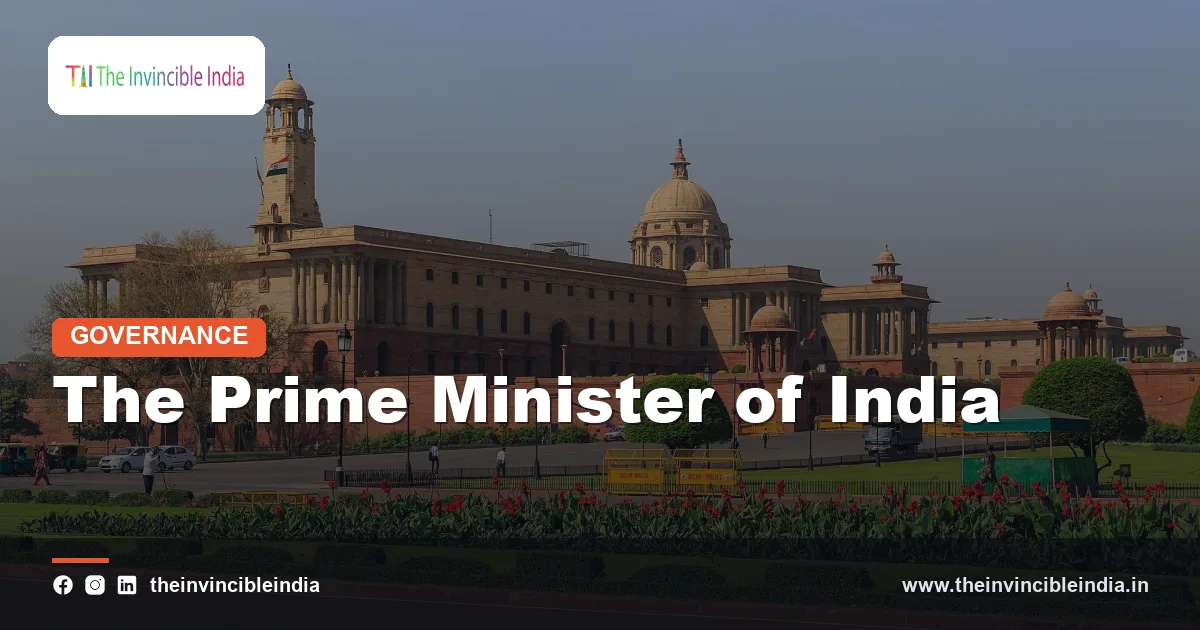
The Prime Minister of India is the head of the government and the most powerful executive figure in the country’s parliamentary democracy. Although the Constitution vests executive power formally in the President, it is the Prime Minister who leads the Council of Ministers, steers the legislative agenda, represents the country’s policy positions at home and abroad, and is answerable to the Lok Sabha for everything the government does.
This guide explains how the office works in practice: where its authority comes from in the Constitution, how a Prime Minister is chosen and removed, what the powers and functions actually are, how the Cabinet system operates, and how the office relates to the President and to the Chief Ministers of the states. Everything here is evergreen constitutional detail, last reviewed on 29 September 2026.
Quick Facts
| Feature | Detail |
|---|---|
| Office type | Real head of the Union executive (head of government) |
| Constitutional basis | Articles 74 and 75 of the Constitution |
| Appointed by | The President of India |
| Usually the leader of | The majority party or coalition in the Lok Sabha |
| Membership requirement | Must be a member of either House of Parliament, or become one within six months |
| Accountable to | The Lok Sabha (collective responsibility, Article 75(3)) |
| Term | No fixed term; continues while enjoying the confidence of the Lok Sabha |
| First Prime Minister | Jawaharlal Nehru (from 15 August 1947) |
| First woman Prime Minister | Indira Gandhi (from 1966) |
The Prime Minister as the Real Executive
India follows the Westminster-style parliamentary model, in which there are two executives: a nominal one and a real one. Article 53 says the executive power of the Union is vested in the President and is exercised either directly or through officers subordinate to the President. In practice, that power is exercised by the Council of Ministers led by the Prime Minister. The President is the constitutional head of state; the Prime Minister is the head of government.
Why the distinction matters
The framers of the Constitution consciously chose a parliamentary system over a presidential one. They wanted a government that is continuously answerable to the elected House, and one that can be removed by it without waiting for a fixed term to end. The President therefore serves as a symbol of national unity and continuity, while the Prime Minister carries the political responsibility for decisions.
What “real” executive means
- Policy is initiated, debated and decided by the Prime Minister and the Cabinet, not by the President.
- Laws are introduced in Parliament by ministers, and the government commands the majority needed to pass them.
- Every major executive order, ordinance, treaty and appointment is, in effect, the government’s decision, formalised in the President’s name.
The office of the Prime Minister of India is therefore best understood as the centre of gravity of the whole political system, even though the word “Prime Minister” appears only in a handful of constitutional provisions.
Constitutional Basis: Articles 74 and 75
Two articles in Part V of the Constitution create the framework for the office. Article 74 provides that there shall be a Council of Ministers with the Prime Minister at the head to aid and advise the President, who shall, in the exercise of functions, act in accordance with that advice. The 42nd and 44th Amendments refined this: the President may ask the Council to reconsider its advice once, but must act on the advice given after reconsideration. Article 74(2) also says that courts cannot enquire into what advice, if any, was tendered by ministers to the President.
Article 75 deals with the ministers themselves. It lays down the following:
- The Prime Minister is appointed by the President, and other ministers are appointed by the President on the advice of the Prime Minister.
- Ministers hold office during the pleasure of the President, which in practice means as long as they have the Prime Minister’s confidence.
- The Council of Ministers is collectively responsible to the House of the People (Lok Sabha).
- Before entering office, each minister takes an oath of office and of secrecy administered by the President.
- A minister who is not a member of Parliament for six consecutive months ceases to be a minister.
The 91st Amendment (2003) added a cap: the total number of ministers, including the Prime Minister, cannot exceed 15 per cent of the strength of the Lok Sabha. It also strengthened the anti-defection provisions relating to ministerial office.
Two further articles complete the picture. Article 77 provides for the conduct of the government’s business in the President’s name, and Article 78 sets out the Prime Minister’s duties towards the President, which are explained later in this article.
How the Prime Minister Is Chosen
The Constitution says only that the President shall appoint the Prime Minister. It does not prescribe an election for the post. Instead, convention and the logic of parliamentary democracy do the work. After a general election to the Lok Sabha, the President invites the leader of the party or alliance that commands a majority in the House to form the government.
The majority requirement
A working majority means the support of more than half of the elected members of the Lok Sabha. The number is measured on the floor of the House, not at the Presidential palace. Where one party wins a clear majority, its parliamentary leader is elected by the party’s own members and becomes the Prime Minister. Where no party has a majority, coalitions are formed and the President has to judge who can command the most support.
Hung Houses and the President’s role
In a fractured verdict, the President exercises a limited discretion in deciding whom to invite first. Constitutional practice has generally favoured the leader who can demonstrate majority support, with the invitee being asked to prove that support through a vote of confidence within a set time.
Membership of Parliament
The Prime Minister must be a member of one of the two Houses. A person who is not yet a member can be appointed but must get elected or nominated to Parliament within six months. Some Prime Ministers have belonged to the Rajya Sabha rather than the Lok Sabha, though political accountability still runs to the Lok Sabha.
The oath
The Prime Minister takes two oaths in the format of the Third Schedule: the oath of office and the oath of secrecy. Both are administered by the President, usually at a public swearing-in ceremony at Rashtrapati Bhavan.
Powers and Functions of the Prime Minister
The powers of the Prime Minister flow partly from the Constitution and partly from statute, convention and the Rules of Business of the Government of India. They can be grouped by the roles the officeholder plays.
Leader of the Council of Ministers
- Recommends the names of ministers to the President and decides who is in or out of the government.
- Allocates and reshuffles portfolios among ministers.
- Presides over meetings of the Cabinet and sets its agenda.
- Can seek the resignation of a minister or advise the President to dismiss one.
- If the Prime Minister resigns or dies in office, the entire Council of Ministers ceases to exist, since the Council is formed around the Prime Minister.
Principal link with the President
Under Article 78, it is the duty of the Prime Minister to communicate to the President all decisions of the Council of Ministers relating to the administration of the Union and proposals for legislation. The Prime Minister must also furnish any information the President calls for, and submit for the Council’s consideration any matter on which a minister has decided without consulting it, if the President so requires.
Leader of the House
As the leader of the majority in the Lok Sabha (or in the Rajya Sabha if a member of that House), the Prime Minister guides the legislative programme, answers questions on major policy and advises the President on summoning, proroguing and dissolving the Lok Sabha.
Chief spokesperson
The Prime Minister is the government’s chief spokesperson, at Parliament, in press engagements and on international platforms, and is the face through which the government’s policy positions are presented to the public.
Foreign policy, defence and national security
Although the Ministry of External Affairs carries out the day-to-day work of diplomacy, the direction of foreign policy has, since independence, rested substantially with the Prime Minister. Nehru held the External Affairs portfolio himself for much of his tenure, setting a precedent that a Prime Minister’s personal engagement in foreign affairs is normal, not exceptional.
Where the Prime Minister leads
- Represents India at summits such as the G20, BRICS, the Commonwealth and bilateral visits.
- Guides decisions on treaties and strategic partnerships, which are then formalised through the executive.
- Heads the Cabinet Committee on Security, which takes decisions on defence, strategic and internal-security matters.
- Is advised by the National Security Adviser, a post that reports directly to the Prime Minister, and works with the National Security Council system.
The President is the Supreme Commander of the armed forces under Article 53(2), but the operational authority and the responsibility for national defence policy are exercised through the government led by the Prime Minister.
Chairing Key Bodies and Appointment Committees
A significant part of the Prime Minister’s real authority comes from chairing committees and institutions that shape policy and appointments.
Policy bodies
- NITI Aayog: The Prime Minister is its Chairperson, and the Governing Council brings together Chief Ministers and Lieutenant Governors. It replaced the Planning Commission in 2015, which the Prime Minister also used to head.
- Inter-State Council: Set up under Article 263 to coordinate Centre-State matters, with the Prime Minister as chairperson.
- Atomic Energy and Space: By long convention, the Prime Minister has been in charge of the Departments of Atomic Energy and of Space.
Appointment committees
The Prime Minister sits on several selection committees whose composition is set by the Constitution or by statute. These include the Appointments Committee of the Cabinet, which approves the top civil, defence and diplomatic postings, and the committees that recommend the heads of bodies such as the Central Bureau of Investigation, the Central Vigilance Commission, the Lokpal and the Chief Information Commissioner. In many of these, the Leader of the Opposition and a senior judicial or other member sit alongside the Prime Minister, so that the choice is not made unilaterally.
The Prime Minister also plays the central role in advising the President on the appointment of the Chief Justice of India and other key constitutional functionaries, consistent with the Constitution and judicial rulings on the process.
The Cabinet System and Collective Responsibility
People often use the terms “Council of Ministers” and “Cabinet” interchangeably, but they are not the same. The Council of Ministers is the wider body of all ministers. The Cabinet is its inner core of the most senior ministers, which meets regularly and takes the real decisions. The word “Cabinet” appeared in the Constitution’s text only with the 44th Amendment of 1978, which inserted it in Article 352.
Cabinet vs Council of Ministers
| Aspect | Cabinet | Council of Ministers |
|---|---|---|
| Composition | Senior Cabinet-rank ministers heading major ministries | Cabinet ministers, Ministers of State (independent charge and otherwise) and, in some periods, Deputy Ministers |
| Size | Smaller and compact | Larger, within the 15 per cent cap |
| Meetings | Meets frequently, usually weekly | Rarely meets as a full body |
| Role | Takes policy decisions and coordinates work | Implements decisions and assists the Cabinet |
| Presided by | The Prime Minister | The Prime Minister |
Collective responsibility
Article 75(3) says the Council of Ministers is collectively responsible to the Lok Sabha. This means that a decision of the Cabinet is the decision of all ministers, whether or not each agreed with it in private. A minister who cannot support a Cabinet decision is expected to resign. It also means that the government stands or falls together: if the Lok Sabha withdraws its confidence, the entire Council must go.
Alongside collective responsibility there is individual responsibility. Each minister answers to the Prime Minister and to Parliament for the work of the ministry under their charge.
Cabinet Committees
Much of the Cabinet’s business is handled in committees, such as those on economic affairs, political affairs, security and parliamentary affairs. These are constituted by the Prime Minister, who normally chairs the most important ones, and their decisions carry the authority of the Cabinet.
The Prime Minister’s Office (PMO)
The Prime Minister is supported by a dedicated administrative machinery, the Prime Minister’s Office. It has grown from a small secretariat in the early years of independence into a major institutional presence, and it was formally styled the PMO in the 1970s.
What the PMO does
- Assists the Prime Minister in the day-to-day discharge of duties, including the scheduling of meetings and coordination with ministries.
- Handles matters where the Prime Minister needs advice that cuts across ministries, such as major policy initiatives, long-pending projects or public grievances.
- Maintains liaison with the President, Chief Ministers, foreign governments and constitutional authorities.
- Works closely with the Cabinet Secretariat, which is under the Prime Minister’s charge and services the Cabinet and its committees.
Who leads it
The PMO is headed by a Principal Secretary, a senior officer of the civil service, and staffed by other secretaries, advisers and officers on deputation from various services. The Prime Minister may also choose to appoint advisers and special envoys. Because the PMO sits so close to the centre of power, its size and influence have periodically been discussed in public debate, but it has no constitutional standing of its own. Its authority is entirely derivative of the Prime Minister’s.
Term, Tenure and Removal
The Constitution does not fix a term for the Prime Minister. Article 75 provides only that ministers hold office during the President’s pleasure, and convention makes clear that this pleasure is exercised in line with the Lok Sabha’s confidence.
No term limit
There is no limit on how many times a person can be Prime Minister or how long they can serve, provided they continue to command the confidence of the Lok Sabha. The Lok Sabha itself has a five-year term unless it is dissolved earlier, and the Prime Minister continues in office until a successor is appointed.
Ways in which a Prime Minister leaves office
- Loss of confidence: A defeat on a no-confidence motion or a confidence motion moved by the government itself requires the government to resign.
- Loss of majority: Withdrawal of support by coalition partners or defections can end a government even without a formal vote.
- Resignation: The Prime Minister may resign at any time by submitting the resignation to the President.
- Death in office: In such cases the President appoints an interim or new Prime Minister, usually a senior minister, until the ruling party chooses a leader.
- Dissolution and elections: After a general election, the outgoing Prime Minister carries on until the new government is sworn in.
Since the President acts on the Prime Minister’s advice, the President cannot dismiss a Prime Minister who commands the House. Removal comes only through the Lok Sabha, and this is what makes the office so directly answerable to the elected representatives of the people.
The Prime Minister, the President and the Chief Ministers
The Prime Minister and the President
The relationship between the two offices is one of the most misunderstood aspects of the Indian system. The President is the head of state, appointed through an indirect election by an electoral college, while the Prime Minister holds power through the Lok Sabha. The two are complementary, not competing.
| Feature | President | Prime Minister |
|---|---|---|
| Role | Constitutional head of state | Head of government |
| Executive power | Nominal; exercised on advice | Real; exercised through the Council of Ministers |
| How chosen | Elected indirectly by an electoral college | Appointed by the President as leader of the Lok Sabha majority |
| Term | Fixed five years | No fixed term; depends on majority |
| Accountable to | The Constitution (impeachment by Parliament) | The Lok Sabha |
| Bound by advice | Yes, on the advice of the Council of Ministers | Gives the advice |
The President does retain a few areas of situational discretion. These include inviting a leader to form a government in a hung Lok Sabha, asking the Council to reconsider its advice once, and withholding assent to certain bills in specific circumstances. Still, the overwhelming weight of constitutional practice is that the President acts on the advice of the Prime Minister and the Council.
Under Article 78, the Prime Minister has a duty to keep the President informed. By convention, Prime Ministers call on the President regularly to brief them on important matters, which gives the President an opportunity to advise, encourage and warn, in the words of a well-known constitutional formulation.
The Prime Minister and the state Chief Ministers
India is a federal Union, and the Prime Minister has to work with the elected governments of the states, each headed by its own Chief Minister. The Prime Minister does not appoint or dismiss Chief Ministers; they owe their position to the legislature of their state. Yet the two levels of government have to cooperate on a vast range of subjects.
Institutions of cooperation
- NITI Aayog’s Governing Council: Chaired by the Prime Minister and attended by all Chief Ministers, it is a forum to align national and state priorities.
- Inter-State Council: A constitutional body under Article 263 that can be convened to discuss subjects of common interest.
- Chief Ministers’ conferences: Held from time to time on issues such as internal security, disaster response and development.
Where friction arises
Because the Union and the states can be governed by different parties, disagreements over finances, the use of central agencies, or the role of Governors are part of the political landscape. The Constitution also contains emergency and President’s Rule provisions, which are exercised on the Union Cabinet’s advice, but the courts have laid down strict limits on their use. In normal times, cooperative federalism relies on regular consultation between the Prime Minister and Chief Ministers.
Evolution of the Office
The office has changed shape over the decades, even though the constitutional text has stayed largely intact. Its story can be summarised in a short historical timeline.
| Period | Development |
|---|---|
| 15 August 1947 | Jawaharlal Nehru becomes the first Prime Minister of independent India |
| 26 January 1950 | The Constitution comes into force, formalising Articles 74 and 75 |
| 1947 to 1964 | Nehru serves as Prime Minister without a break, the longest continuous tenure in the history of the office |
| 1966 | Indira Gandhi becomes the first woman Prime Minister |
| 1977 | The first non-Congress government at the Centre takes office after the general election |
| 1978 | 44th Amendment introduces the term Cabinet in the Constitution |
| Late 1980s to 1990s | Era of coalition and minority governments begins to reshape the office |
| 2003 | 91st Amendment caps the size of the Council of Ministers |
Nehru and the founding model
Jawaharlal Nehru set many of the conventions that survive today. He treated the Cabinet as the main decision-making body, respected Parliament’s role in debate, and established the practice of Prime Ministerial leadership in foreign policy. He was also the longest-serving Prime Minister, holding office from independence until 1964.
Indira Gandhi and centralisation
Indira Gandhi’s entry in 1966 made her the first woman to lead the government. Her period is remembered in political science for the concentration of authority in the Prime Minister’s Office and for constitutional debates, which in turn led to reforms such as the 44th Amendment, to protect institutional checks.
The coalition era
From the late 1980s, hung Houses and multi-party alliances became more common. Prime Ministers of coalition governments had to negotiate with allies, and the office adapted to a more consultative style, before periods of single-party majorities returned. In each phase the constitutional structure remained the same; what changed was the political context in which it operated.
Checks and balances on the office
Despite its central position, the office of Prime Minister is hedged in by many constitutional and institutional checks. This is often overlooked when the office is described as all-powerful.
- Parliament: Question Hour, debates, committees, adjournment motions and no-confidence motions hold the government to account every session.
- The Judiciary: Courts can review executive decisions and strike down unconstitutional actions, and the basic structure doctrine limits even constitutional amendments.
- The President: Can ask the Council to reconsider advice and has a duty to be informed on major affairs.
- Constitutional bodies: The Election Commission, the Comptroller and Auditor General and the Union Public Service Commission operate independently of the executive.
- The Federal structure: States have their own constitutional space, and Rajya Sabha represents states in Parliament.
- Free press and public opinion: A vigorous media and regular elections keep political accountability alive.
These checks, working together, ensure that the Prime Minister’s power is exercised within the Constitution and remains subject to periodic renewal through elections.
Conclusion
The Prime Minister of India holds an office that is defined in only a few lines of the Constitution but carries enormous weight in practice. Article 74 makes the Prime Minister the head of the Council of Ministers that aids and advises the President, and Article 75 makes that Council collectively responsible to the Lok Sabha. Around those two articles has grown a rich structure of conventions, committees, the PMO and federal practice. Understanding the office means understanding the parliamentary system itself: power that is real but conditional, held only as long as the elected House gives its confidence.
Frequently Asked Questions
Who appoints the Prime Minister of India?
The President of India appoints the Prime Minister under Article 75(1) of the Constitution. In practice, the President invites the leader of the party or coalition that commands a majority in the Lok Sabha. The Prime Minister then recommends the other ministers, who are appointed by the President on that advice.
Does the Prime Minister have to be a member of the Lok Sabha?
No. The Prime Minister must be a member of either House of Parliament, but does not have to be in the Lok Sabha specifically. A person who is not a member when appointed must be elected or nominated to Parliament within six months, otherwise they cannot continue as a minister. The government remains answerable to the Lok Sabha regardless.
What is the difference between the Cabinet and the Council of Ministers?
The Council of Ministers is the entire body of ministers, including Cabinet ministers and Ministers of State. The Cabinet is the smaller, inner group of senior ministers that takes the major policy decisions and meets regularly. Both are led by the Prime Minister, and both are collectively responsible to the Lok Sabha under Article 75(3).
How can a Prime Minister be removed from office?
The Constitution has no impeachment procedure for the Prime Minister. A Prime Minister leaves office by resigning, by losing the confidence of the Lok Sabha through a defeat on a no-confidence or confidence motion, by losing the majority in the House, or by death. When a Prime Minister resigns, the whole Council of Ministers goes with them.
Is there a limit on how long a person can be Prime Minister?
There is no constitutional limit on the number of terms or the length of service. A Prime Minister continues as long as the Lok Sabha’s confidence is retained and the party or coalition keeps its majority. Jawaharlal Nehru, the first Prime Minister, was also the longest-serving one, holding the post from 1947 until 1964.
What is the Prime Minister’s Office?
The Prime Minister’s Office (PMO) is the administrative body that assists the Prime Minister in carrying out their duties. It is headed by a Principal Secretary, coordinates with ministries and the Cabinet Secretariat, and supports the Prime Minister on policy, communication and liaison. It has no independent constitutional powers and works entirely under the Prime Minister’s direction.
{“@context”:”https://schema.org”,”@graph”:[{“@type”:”FAQPage”,”mainEntity”:[{“@type”:”Question”,”name”:”Who appoints the Prime Minister of India?”,”acceptedAnswer”:{“@type”:”Answer”,”text”:”The President of India appoints the Prime Minister under Article 75(1) of the Constitution. In practice, the President invites the leader of the party or coalition that commands a majority in the Lok Sabha. The Prime Minister then recommends the other ministers, who are appointed by the President on that advice.”}},{“@type”:”Question”,”name”:”Does the Prime Minister have to be a member of the Lok Sabha?”,”acceptedAnswer”:{“@type”:”Answer”,”text”:”No. The Prime Minister must be a member of either House of Parliament, but does not have to be in the Lok Sabha specifically. A person who is not a member when appointed must be elected or nominated to Parliament within six months, otherwise they cannot continue as a minister. The government remains answerable to the Lok Sabha regardless.”}},{“@type”:”Question”,”name”:”What is the difference between the Cabinet and the Council of Ministers?”,”acceptedAnswer”:{“@type”:”Answer”,”text”:”The Council of Ministers is the entire body of ministers, including Cabinet ministers and Ministers of State. The Cabinet is the smaller, inner group of senior ministers that takes the major policy decisions and meets regularly. Both are led by the Prime Minister, and both are collectively responsible to the Lok Sabha under Article 75(3).”}},{“@type”:”Question”,”name”:”How can a Prime Minister be removed from office?”,”acceptedAnswer”:{“@type”:”Answer”,”text”:”The Constitution has no impeachment procedure for the Prime Minister. A Prime Minister leaves office by resigning, by losing the confidence of the Lok Sabha through a defeat on a no-confidence or confidence motion, by losing the majority in the House, or by death. When a Prime Minister resigns, the whole Council of Ministers goes with them.”}},{“@type”:”Question”,”name”:”Is there a limit on how long a person can be Prime Minister?”,”acceptedAnswer”:{“@type”:”Answer”,”text”:”There is no constitutional limit on the number of terms or the length of service. A Prime Minister continues as long as the Lok Sabha’s confidence is retained and the party or coalition keeps its majority. Jawaharlal Nehru, the first Prime Minister, was also the longest-serving one, holding the post from 1947 until 1964.”}},{“@type”:”Question”,”name”:”What is the Prime Minister’s Office?”,”acceptedAnswer”:{“@type”:”Answer”,”text”:”The Prime Minister’s Office (PMO) is the administrative body that assists the Prime Minister in carrying out their duties. It is headed by a Principal Secretary, coordinates with ministries and the Cabinet Secretariat, and supports the Prime Minister on policy, communication and liaison. It has no independent constitutional powers and works entirely under the Prime Minister’s direction.”}}]}]}