


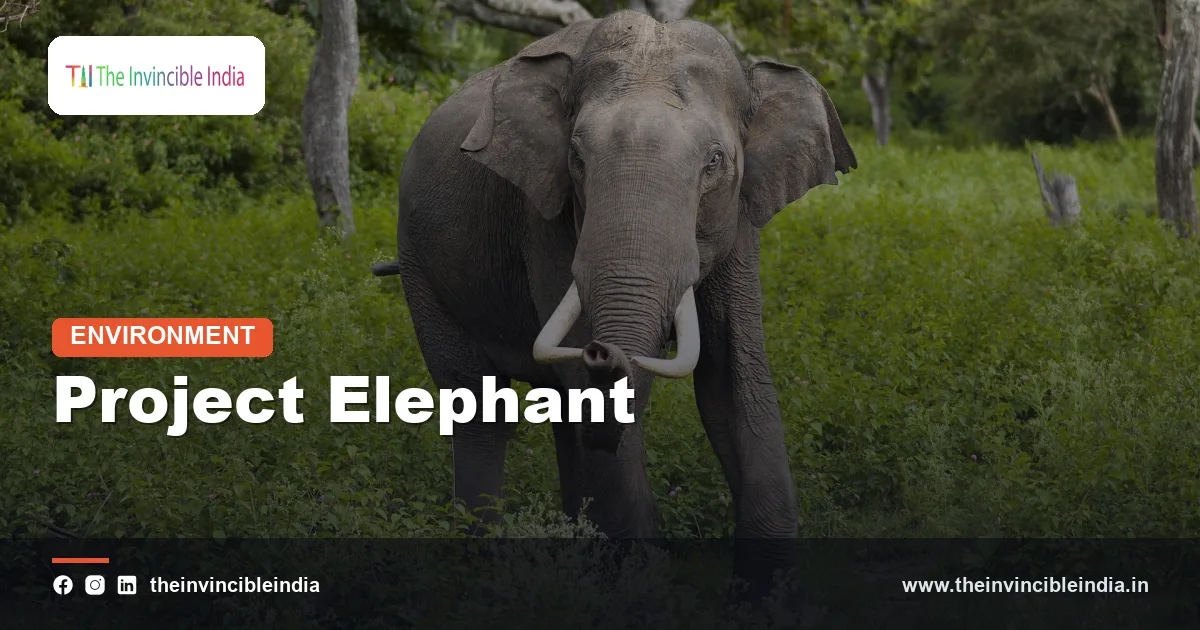
Project Elephant is a centrally sponsored scheme launched by the Government of India in 1992 to protect the Asian elephant, its habitats and the migratory routes it has followed for centuries. Rather than concentrating on a single park, the scheme looks at the whole landscape, covering forests, grasslands, rivers and the narrow strips of land that let herds travel between them. It works alongside the states that hold elephant populations and supports them with funds, technical guidance and policy direction.
The Indian elephant was declared the National Heritage Animal of India in 2010, recognising a bond that stretches from ancient scriptures and royal processions to village festivals today. India is home to well over half of the world’s wild Asian elephants, which makes the country’s choices decisive for the species. This explainer covers how the scheme works, why elephants matter, the network of reserves and corridors, the main threats, and what the way forward looks like. Facts are given as stable, approximate and dated figures rather than live numbers.
| Feature | Details |
|---|---|
| Launched | 1992, as a centrally sponsored scheme |
| Administered by | Project Elephant Division, Ministry of Environment, Forest and Climate Change |
| Species covered | Asian (Indian) elephant, Elephas maximus indicus |
| National status | National Heritage Animal of India, declared in 2010 |
| Legal protection | Schedule I of the Wildlife (Protection) Act, 1972 |
| Wild population | Around 30,000 animals, according to recent national estimates |
| Habitat network | Over thirty notified Elephant Reserves across the elephant-range states |
| Awareness day | World Elephant Day, observed every year on 12 August |
Origins of Project Elephant
By the late twentieth century, India’s elephants faced steady pressure. Forests were being cleared for farms, mines, roads and dams, and herds that once moved freely across large territories found their old paths cut into pieces. Poaching for ivory added to the strain, and conflicts with farmers were growing. The Government of India responded in 1992 with Project Elephant, echoing the approach taken by Project Tiger in 1973.
The scheme was designed to help the states that hold wild elephants rather than take their forests away from them. Forests are largely a state subject in practice, so the centre offers financial and technical support while state forest departments carry out the field work.
Why a landscape approach
Elephants need enormous ranges. A herd may travel many kilometres in a day and use different areas across seasons for water, fodder and shelter. A small protected island cannot hold them for long, so Project Elephant treats the reserve, the surrounding forests and the connecting corridors as a single system.
Why Elephants Matter: A Keystone Species
Ecologists call the elephant a keystone species because its presence shapes the health of the whole ecosystem. It is often described as the gardener of the forest, and the description is fair.
What elephants do for the forest
- Seed dispersal: Elephants eat fruit and pass seeds, sometimes over long distances, helping many tree species regenerate.
- Opening the canopy: By pushing over trees and breaking branches, they let sunlight reach the ground, which supports grasses and young plants.
- Creating water sources: In dry seasons they dig into riverbeds for water, and other animals use these holes.
- Trails and clearings: The paths they wear through dense vegetation are used by smaller animals.
Because an adult elephant eats a very large quantity of vegetation each day and needs a wide home range, protecting elephants also protects the many species that share their habitat. Conservationists therefore call the elephant an umbrella species as well. Saving its forests shelters countless other plants and animals along with it.
A Cultural Heritage and National Heritage Animal Status
Few animals are as closely woven into Indian life as the elephant. In Hindu tradition, Ganesha, the elephant-headed deity, is worshipped as the remover of obstacles and is invoked at the start of new ventures. Airavata, the white elephant who carries Indra, and the guardian elephants of the cardinal directions appear in ancient texts and temple sculpture. Gajalakshmi, the image of the goddess Lakshmi flanked by elephants, is a familiar symbol of prosperity.
Elephants are also part of the wider religious landscape. In Buddhist tradition, a white elephant appears in the story of the Buddha’s conception. Across the country, elephants feature in coins, temple friezes, royal armies and folk art.
Festivals and temple elephants
In parts of southern India, particularly Kerala, decorated elephants take centre stage at temple festivals such as the Thrissur Pooram. Captive elephants are kept by many temples and private owners, and this has raised serious questions about their welfare, working conditions and transport. Balancing tradition with animal welfare is one of the quieter but important parts of the conservation debate, and Project Elephant explicitly includes the welfare of captive elephants among its concerns.
National Heritage Animal Status, 2010
In 2010, the Indian elephant was given the status of National Heritage Animal. The decision followed the recommendation of a specially constituted Elephant Task Force, which reviewed the state of elephants in the country and produced a report titled Gajah. The move was symbolic in nature, but it raised the profile of the species and reinforced the argument that elephants are part of the nation’s identity.
The task force also urged stronger protection for corridors, better handling of human-elephant conflict and improved monitoring. Many of these ideas have shaped the direction of the scheme since then.
- It is a signal of national pride, similar to how the tiger and other species are treated as national symbols.
- It helps rally public and political support for habitat protection.
- It sits on top of a strong legal foundation rather than replacing it.
Objectives of Project Elephant
The scheme has a broad mandate. Its stated aims can be grouped under a handful of practical goals, and they explain why the work reaches beyond forest boundaries into farmland and villages.
- Protect elephants, habitats and corridors: Maintain and restore ranges so that herds can survive and move safely.
- Address human-elephant conflict: Reduce damage to crops and property, and prevent loss of human and elephant lives.
- Look after captive elephants: Improve the welfare and management of domesticated elephants.
- Prevent poaching: Guard against the illegal killing of elephants for ivory and the trade in their parts.
- Support research and monitoring: Track populations, movements and threats using scientific methods.
- Promote awareness and eco-development: Involve communities living near elephant habitats in conservation.
The scheme provides financial and technical support to the elephant-range states. Its priorities are fixed by the central government, while day-to-day implementation lies with forest departments and local staff who know the terrain.
Elephant Reserves and the Range States
Elephant Reserves are large landscapes notified by state governments to conserve elephant populations. Unlike a national park, an elephant reserve can include forest land, revenue land and even areas used by people, because elephants do not respect neat administrative boundaries. India has over thirty such reserves, spread across the elephant-range states. The first, Singhbhum in Jharkhand, was notified in 2001.
India’s elephants are found in four broad regions: the north-east, eastern and central India, southern India and the north-western foothills of the Himalaya. Karnataka has long been counted among the states with the largest populations, and the Western Ghats hold some of the country’s biggest connected elephant landscapes.
Some notable reserves
| Elephant Reserve | State | Region |
|---|---|---|
| Singhbhum | Jharkhand | Eastern India |
| Mayurbhanj | Odisha | Eastern India |
| Kaziranga-Karbi Anglong | Assam | North-east |
| Nilgiri | Tamil Nadu, Kerala, Karnataka | South |
| Wayanad | Kerala, Karnataka, Tamil Nadu | South |
| Anamalai | Tamil Nadu, Kerala | South |
| Periyar | Kerala | South |
| Shivalik | Uttarakhand | North-west |
The list is only illustrative. Reserve boundaries and the total number of reserves can change as states notify new landscapes, so official notifications should be checked for the current position.
Elephant Corridors: Connecting Fragmented Habitats
A corridor is a strip of land that links two larger habitats and allows elephants to move between them. Some are wide forested belts, and others are narrow passages squeezed between villages, highways, canals and railway lines. Surveys have identified roughly a hundred such corridors across the country, many of them in the north-east, east and south.
Corridors matter because fragmentation is the greatest long-term danger to elephants. When herds are cut off, they cannot reach food and water, breeding groups become isolated and the animals may turn to farmland instead. Genetic health also suffers when populations cannot mix.
Securing passages
- Mapping the corridors and recording how herds actually use them.
- Working with communities, and in some cases voluntarily relocating villages out of vital passages with fair compensation.
- Building underpasses and overpasses where roads or railways cut through.
- Regulating mining, construction and land use in and near corridors.
Reports such as Right of Passage, prepared by conservation groups and government agencies, helped bring these routes into policy discussions. Protecting them is often more practical, and cheaper, than dealing with the problems that follow when they are lost.
Population and Monitoring
India holds the majority of the world’s wild Asian elephants. The most recent national estimates, from the last elephant census, put the population at around 30,000 animals. This figure is approximate and dated, and counts vary between surveys because elephants are difficult to count in dense forest.
Counts have been carried out at intervals of about five years using a mix of methods. Forest staff have relied on direct sightings, dung-based estimates and, more recently, DNA-based approaches and camera traps to improve accuracy.
Why the data matters
- It tells managers whether populations are stable, growing or declining in a given range.
- It helps identify areas with high conflict.
- It guides decisions on corridors, reserve management and funding.
The numbers should be read carefully. A national total can hide local declines, and a stable total does not mean every population is safe. Some small, isolated groups remain highly vulnerable even when the overall estimate looks steady.
MIKE, Gaj Yatra and World Elephant Day
Project Elephant is linked to global efforts as well. The MIKE programme, short for Monitoring the Illegal Killing of Elephants, was set up under the international wildlife trade convention CITES to track poaching and the effectiveness of protection. India takes part as an Asian range country, and data from MIKE sites helps show trends in unnatural elephant deaths.
The elephant is also listed under the strictest protection in the Wildlife (Protection) Act, 1972, and international trade in its parts is heavily restricted.
Awareness campaigns
- World Elephant Day: Observed on 12 August each year, it draws public attention to threats facing elephants worldwide.
- Gaj Yatra: A nationwide awareness campaign, run around World Elephant Day, that took the message of elephant conservation to elephant-range states.
- Haathi Mere Saathi: A campaign launched in partnership with conservation groups, aimed at building empathy and support for elephants among people living near them.
These campaigns matter because conservation works best when communities see elephants as a shared asset, not merely as a nuisance.
Institutions and How Project Elephant Complements Project Tiger
At the national level, Project Elephant is handled by the Project Elephant Division in the environment ministry. It coordinates with state forest departments, whose chief wildlife wardens and field staff carry out most of the work. Expert bodies and the National Board for Wildlife also influence decisions that affect habitats.
Project Tiger, launched in 1973, focuses on tiger reserves and is overseen by the National Tiger Conservation Authority. The two schemes are complementary rather than competing. Many forests hold both species, so protecting a tiger reserve often protects elephants in the same landscape, and vice versa.
Key differences
- Tiger reserves are typically compact core zones with buffer areas, while elephant reserves are much larger and include mixed-use land.
- Elephants are highly mobile, so connecting corridors are central to their protection.
- Elephants are more likely to come into direct conflict with farmers, making community engagement essential.
Major Challenges Facing India’s Elephants
Despite decades of effort, elephants continue to face pressure from several directions, and these threats often interact with each other.
| Threat | What it involves |
|---|---|
| Habitat loss and fragmentation | Forests cleared for agriculture, mining, roads and development; corridors blocked |
| Human-elephant conflict | Crop raiding, damage to property, and deaths of both people and elephants |
| Railway accidents | Collisions where tracks cross elephant paths, especially at night |
| Electrocution | Contact with low-hanging power lines or illegal electric fences |
| Poaching | Killing of tuskers for ivory; only males of the Asian species typically carry large tusks |
| Captivity issues | Welfare problems in temples, private ownership and tourism |
Human-elephant conflict
Conflict is the most visible problem. Herds raid fields of paddy, sugarcane and banana, and the losses can be devastating for small farmers. Several hundred people are killed by elephants across India in a typical year, and a significant number of elephants also die as a result of conflict, whether through electrocution, retaliation or accidents. These are approximate figures, and they vary between years and states.
Trains, wires and poaching
Railway lines through forests have caused repeated fatalities, and mitigation measures such as speed limits, sensors and better alignment of tracks have been discussed and tried. Electrocution from sagging wires and improvised fences is another leading cause of unnatural death. Poaching is lower than in some past decades in India, but selective killing of tusked males can distort the sex ratio of a population.
Conservation Successes and Lessons
The picture is not entirely bleak. India has kept a large wild elephant population in one of the most densely populated countries on earth, and that in itself is a significant achievement. Several factors have helped.
- Legal protection: The elephant’s Schedule I status and international trade controls have reduced open ivory trade.
- Large protected landscapes: The reserve system has kept major habitats intact, particularly in the Western Ghats and parts of the north-east.
- Community participation: Local groups and village-level response teams in several states have helped reduce conflicts.
- Cultural respect: Widespread reverence for the animal often supports tolerance, even when crops are lost.
Lessons from the field are increasingly practical. Compensation for crop and property damage needs to be quick and fair, or resentment builds. Solutions that work in one district may not work in another, so approaches must suit local conditions.
Conservation Successes and the Way Forward
The future of Project Elephant will depend on how well India balances development with the needs of wildlife. Experts and forest managers point to a set of priorities that are practical and achievable.
Priorities
- Secure corridors: Legally protect the most important passages and integrate them into land-use planning.
- Early-warning systems: Use sensors, alerts, camera traps and mobile messages to warn villagers when elephants approach.
- Safer infrastructure: Insulate or raise power lines, build crossing structures and manage train speeds in elephant zones.
- Livelihood support: Offer alternatives such as crop insurance, non-palatable crops and quick compensation.
- Better welfare for captive animals: Improve rules, veterinary care and transport standards.
- Science and monitoring: Keep counts and studies updated so decisions rest on evidence.
Awareness efforts such as Haathi Mere Saathi remain important, since people who live near elephants decide, in practice, whether conservation succeeds. Last updated: 29 September 2026.
Conclusion
Project Elephant recognises that saving the elephant means protecting entire landscapes, connecting fragmented forests and helping people who share space with these large animals. Its history since 1992 shows both progress and unfinished work. India still shelters the largest share of the world’s wild Asian elephants, and the National Heritage Animal status reflects how deeply the species is valued. Keeping it that way will require sustained effort from governments, scientists and communities.
Frequently Asked Questions
When was Project Elephant launched and what is its purpose?
Project Elephant was launched in 1992 as a centrally sponsored scheme of the Government of India. Its purpose is to protect elephants, their habitats and migratory corridors, reduce human-elephant conflict and improve the welfare of captive elephants.
Why was the Indian elephant declared the National Heritage Animal?
The Indian elephant was declared the National Heritage Animal in 2010 in recognition of its deep cultural, religious and ecological importance. The declaration followed the work of an Elephant Task Force and was meant to raise the profile of conservation.
How many wild elephants does India have?
India has around 30,000 wild elephants according to the most recent national census estimates, which is well over half of the world’s wild Asian elephants. The figure is approximate, and counts differ between surveys and states.
What is an elephant corridor?
An elephant corridor is a strip of land that connects two or more elephant habitats, allowing herds to move between them for food, water and breeding. Protecting corridors prevents habitat fragmentation and reduces conflict with people.
What is the difference between Project Elephant and Project Tiger?
Project Tiger, launched in 1973, focuses on tiger reserves, while Project Elephant, launched in 1992, focuses on elephants and their much larger ranges and corridors. The two schemes complement each other because many forests support both species.
What is World Elephant Day and when is it observed?
World Elephant Day is observed every year on 12 August to raise awareness of the threats facing elephants and the need to protect them. In India it is often marked with campaigns such as Gaj Yatra and Haathi Mere Saathi.
{“@context”:”https://schema.org”,”@graph”:[{“@type”:”FAQPage”,”mainEntity”:[{“@type”:”Question”,”name”:”When was Project Elephant launched and what is its purpose?”,”acceptedAnswer”:{“@type”:”Answer”,”text”:”Project Elephant was launched in 1992 as a centrally sponsored scheme of the Government of India. Its purpose is to protect elephants, their habitats and migratory corridors, reduce human-elephant conflict and improve the welfare of captive elephants.”}},{“@type”:”Question”,”name”:”Why was the Indian elephant declared the National Heritage Animal?”,”acceptedAnswer”:{“@type”:”Answer”,”text”:”The Indian elephant was declared the National Heritage Animal in 2010 in recognition of its deep cultural, religious and ecological importance. The declaration followed the work of an Elephant Task Force and was meant to raise the profile of conservation.”}},{“@type”:”Question”,”name”:”How many wild elephants does India have?”,”acceptedAnswer”:{“@type”:”Answer”,”text”:”India has around 30,000 wild elephants according to the most recent national census estimates, which is well over half of the world’s wild Asian elephants. The figure is approximate, and counts differ between surveys and states.”}},{“@type”:”Question”,”name”:”What is an elephant corridor?”,”acceptedAnswer”:{“@type”:”Answer”,”text”:”An elephant corridor is a strip of land that connects two or more elephant habitats, allowing herds to move between them for food, water and breeding. Protecting corridors prevents habitat fragmentation and reduces conflict with people.”}},{“@type”:”Question”,”name”:”What is the difference between Project Elephant and Project Tiger?”,”acceptedAnswer”:{“@type”:”Answer”,”text”:”Project Tiger, launched in 1973, focuses on tiger reserves, while Project Elephant, launched in 1992, focuses on elephants and their much larger ranges and corridors. The two schemes complement each other because many forests support both species.”}},{“@type”:”Question”,”name”:”What is World Elephant Day and when is it observed?”,”acceptedAnswer”:{“@type”:”Answer”,”text”:”World Elephant Day is observed every year on 12 August to raise awareness of the threats facing elephants and the need to protect them. In India it is often marked with campaigns such as Gaj Yatra and Haathi Mere Saathi.”}}]}]}