


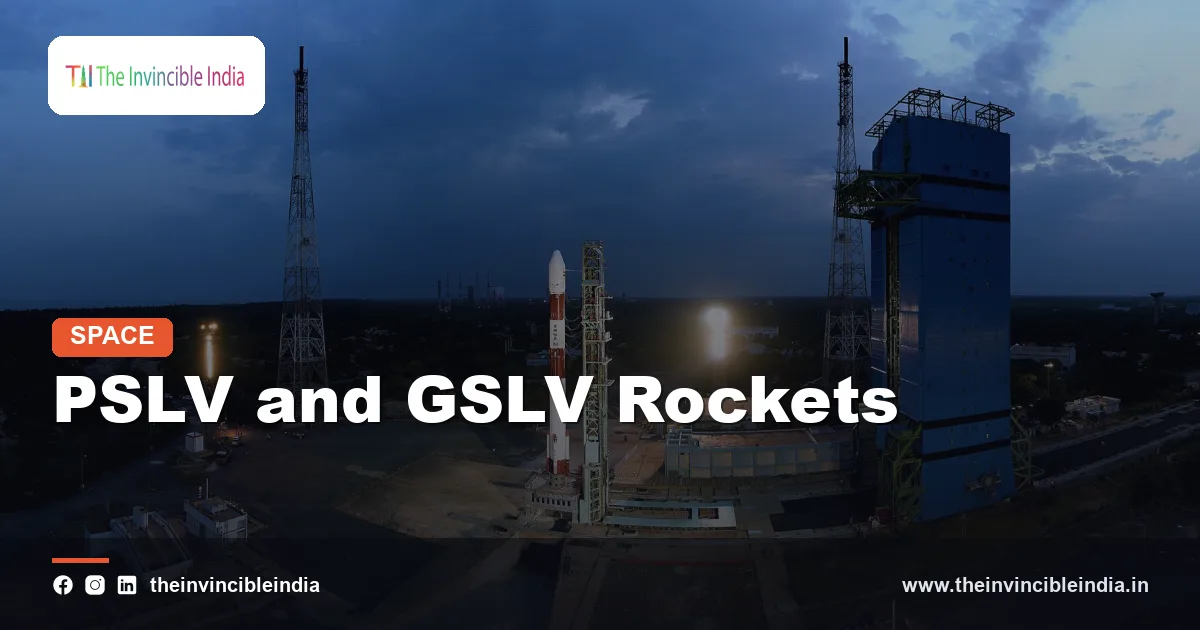
Every satellite that watches India’s crops, forecasts its cyclones or beams its television signals had to be carried into space by a rocket first. For more than three decades the rocket that has done most of this lifting is the PSLV, the Polar Satellite Launch Vehicle, a four-stage vehicle that ISRO’s engineers affectionately call the “workhorse” of the Indian space programme. Alongside it stand the GSLV, built for heavier communication satellites, and the LVM3, the muscular launcher that carried Chandrayaan-3 to the Moon.
Together these rockets form a complete family, each designed for a different job, orbit and payload weight. This guide explains how India’s launch vehicles evolved from the modest SLV-3 of 1980, how the PSLV, GSLV, LVM3 and SSLV differ from one another, why mastering cryogenic engines was such a long struggle, and how a spaceport on a narrow island in Andhra Pradesh became a launch address known across the world.
Quick Facts
| Item | Details |
|---|---|
| First Indian satellite launcher to reach orbit | SLV-3, 18 July 1980 (Rohini satellite) |
| Project director of SLV-3 | A.P.J. Abdul Kalam |
| Workhorse rocket | PSLV (Polar Satellite Launch Vehicle), operational since the mid-1990s |
| Rocket for heavier communication satellites | GSLV (Geosynchronous Satellite Launch Vehicle), first flown in 2001 |
| Heaviest Indian launcher | LVM3 (earlier called GSLV Mk III), first orbital flight in 2017 |
| Small satellite launcher | SSLV (Small Satellite Launch Vehicle), first flown in 2022 |
| Launch site | Satish Dhawan Space Centre, Sriharikota, Andhra Pradesh |
| World record by the PSLV | 104 satellites in a single launch, 15 February 2017 |
| Commercial arms | Antrix Corporation (since 1992) and NewSpace India Limited, NSIL (since 2019) |
The Beginnings: SLV-3 and the ASLV
India’s story of building its own launchers began in the 1970s, when the space programme was still young and every component had to be learnt from scratch. The result was the Satellite Launch Vehicle-3, or SLV-3, a small four-stage, all-solid-fuel rocket. After an unsuccessful first attempt in 1979, SLV-3 flew successfully on 18 July 1980 and placed the Rohini satellite into orbit. That flight made India one of a small group of nations able to launch satellites on their own rockets. The project director was A.P.J. Abdul Kalam, who later became President of India.
The Augmented Satellite Launch Vehicle
The next step was the Augmented Satellite Launch Vehicle, or ASLV, flown in the late 1980s and early 1990s. ASLV added strap-on solid boosters to the SLV-3 design so that it could lift a heavier payload, and it served as a testing ground for technologies such as strap-on boosters, closed-loop guidance and a bulbous heat shield. Its early flights ended in failure, but ASLV did succeed in later launches and taught ISRO valuable lessons.
Why these small rockets mattered
- They trained a generation of engineers in propulsion, guidance and launch operations.
- They proved that India could build, test and fly a complete orbital rocket.
- They exposed weaknesses early, which shaped the design of the far more capable PSLV.
Neither rocket could carry a satellite big enough for serious remote sensing or communication, so ISRO moved on to a much more ambitious plan.
PSLV: The Workhorse of Indian Space
The Polar Satellite Launch Vehicle was conceived in the 1980s to give India a dependable way of launching Earth-observation satellites into polar, sun-synchronous orbits. Its first launch, in September 1993, did not reach orbit, but the vehicle flew successfully in October 1994 and became fully operational in the mid-1990s. Since then it has built one of the most reliable records of any rocket in its class.
How a PSLV is built
The PSLV is a four-stage rocket that deliberately alternates between solid and liquid propulsion.
- First stage: a very large solid-fuel motor, one of the biggest solid boosters in the world, assisted in most versions by strap-on solid motors.
- Second stage: a liquid-fuelled stage powered by the Vikas engine, an Indian development of a licensed French design.
- Third stage: another solid-fuel motor that provides a high-thrust push at altitude.
- Fourth stage: a liquid stage with twin small engines, which fine-tunes the final orbit and releases the satellites.
This alternating arrangement balances the raw thrust of solid motors with the control and restart-friendly nature of liquid engines, and it is a large part of the PSLV’s reliability.
What it is used for
The PSLV typically carries payloads of about one to two tonnes into low Earth and sun-synchronous orbits. Such orbits suit satellites that must pass over the same place at the same local time every day, which is ideal for mapping, agriculture, forestry, disaster monitoring and defence imaging. The Cartosat, Resourcesat, RISAT and Oceansat series have all flown on the PSLV.
PSLV Variants and Famous Missions
One reason the PSLV has lasted so long is that ISRO has tuned it for different payload sizes by changing the number and size of the strap-on boosters. The common versions are listed below.
| Variant | Strap-on boosters | Typical use |
|---|---|---|
| PSLV-G (generic) | Six smaller boosters | Early missions and standard payloads |
| PSLV-CA (core alone) | None | Lighter satellites and multiple small payloads |
| PSLV-XL | Six larger, more powerful boosters | Heavier missions, including the Moon, Mars and Sun |
| PSLV-DL | Two boosters | Intermediate payloads |
| PSLV-QL | Four boosters | Intermediate payloads |
Missions that made the PSLV famous
- Chandrayaan-1 (October 2008): India’s first lunar mission, launched by a PSLV-XL, which later helped confirm the presence of water molecules on the Moon.
- Mangalyaan, the Mars Orbiter Mission (November 2013): carried by a PSLV-XL, it made India the first country to reach Mars orbit on its first attempt.
- AstroSat (2015): India’s first dedicated multi-wavelength space observatory.
- Aditya-L1 (September 2023): India’s first solar observatory, sent towards the Sun-Earth Lagrange point 1.
- Navigation satellites: the satellites of the NavIC regional navigation system were also launched on the PSLV.
It is remarkable that a rocket designed for Earth-observation satellites could also be stretched to reach the Moon, Mars and the Sun.
The 104-Satellite Record and Commercial Success
On 15 February 2017 a PSLV-XL lifted off from Sriharikota carrying 104 satellites, one Indian Earth-observation satellite along with 103 small foreign and Indian nano satellites, and placed all of them into orbit within minutes. At that time it was the largest number of satellites deployed on a single rocket, and it put ISRO on the global map of low-cost launch services.
A trusted ride for other countries
The PSLV’s first commercial launch for a foreign customer came in 1999, when it carried satellites from Germany and South Korea together with an Indian satellite. Since then it has launched satellites for numerous countries across Europe, North America, Asia, the Middle East and Africa. Many of these were small satellites flying as “co-passengers” alongside a primary Indian payload, which allows universities and start-ups to reach orbit at a fraction of the usual price.
Why customers choose it
- Reliability: a long run of successful flights since the mid-1990s.
- Cost: Indian engineering and manpower costs keep prices competitive.
- Flexibility: the rocket can deploy many satellites into slightly different orbits during a single mission.
- Heritage: a long flight history gives insurers and customers confidence.
The PSLV has also served as a platform for experiments in orbit, using its spent fourth stage as a small laboratory for scientific payloads, and in recent years it has been used to test technologies such as satellite docking.
GSLV: Reaching for Geosynchronous Orbit
The PSLV is superb for low orbits, but India also needed to place heavy communication and broadcasting satellites high above the equator. These satellites are first dropped into a Geosynchronous Transfer Orbit, or GTO, and then use their own engines to settle into a geostationary orbit about 36,000 kilometres above the Earth, where they appear fixed over one spot. That requires a much more powerful rocket with a high-energy upper stage, and ISRO designed the Geosynchronous Satellite Launch Vehicle, or GSLV, for the purpose.
Structure of the GSLV
The GSLV is a three-stage vehicle. Its first stage is a large solid motor surrounded by four liquid strap-on boosters using the Vikas engine. The second stage is liquid-fuelled, and the third is a cryogenic upper stage. The rocket first flew in April 2001, initially using a cryogenic stage bought from Russia.
What it carries
The GSLV Mk II can lift payloads in the range of about two tonnes to GTO. It has launched communication satellites in the GSAT series, weather and navigation satellites, and in recent years Earth-observation missions. Its record in the early years was uneven, and the rocket picked up a nickname that reflected its occasional failures before it settled into reliable service.
The Long Struggle for the Cryogenic Engine
A cryogenic engine burns liquid hydrogen as fuel and liquid oxygen as oxidiser. Both must be stored at extremely low temperatures, roughly minus 253 degrees Celsius for hydrogen and minus 183 degrees Celsius for oxygen. In exchange, the engine produces much more thrust for every kilogram of propellant than ordinary fuels, which is exactly what a rocket needs at the top of its flight to reach GTO.
The denial of technology
In the early 1990s India agreed to buy cryogenic stages and the related technology from Russia. The United States objected, arguing that the deal violated the Missile Technology Control Regime, a group created to restrict the spread of missile-related technology. Under this pressure the agreement was revised, and Russia agreed to supply a limited number of ready-made cryogenic stages without transferring the technology to make them.
Choosing to build it at home
The setback pushed ISRO to develop its own cryogenic engine. This was a hard task. Handling liquid hydrogen needs special materials, tiny tolerances in the turbo-pumps and expertise in insulation, and the first indigenous attempt in April 2010 failed. ISRO kept working, and on 5 January 2014 the GSLV flew successfully with the Indian-built cryogenic upper stage. India thereby became one of only a handful of countries to have mastered this technology.
- Early GSLV flights used Russian-made cryogenic stages.
- The indigenous stage flew in 2010 without success and then succeeded in 2014.
- The same cryogenic knowledge later powered the upper stage of the LVM3.
LVM3: India’s Heaviest Launcher
The LVM3, once known as GSLV Mk III, is a very different rocket from the GSLV Mk II despite the similar name. It is a three-stage vehicle with two huge solid strap-on boosters, a liquid core stage powered by two Vikas engines, and a cryogenic upper stage. It stands over forty metres tall and is India’s most powerful operational rocket.
Capacity and development
The LVM3 can carry roughly four tonnes to GTO and about eight tonnes to low Earth orbit. An experimental flight in December 2014 tested the vehicle and also a crew-module re-entry capsule, and its first full orbital launch took place in June 2017 with the GSAT-19 communication satellite.
Missions of national pride
- Chandrayaan-2 (22 July 2019): an orbiter, lander and rover sent towards the Moon.
- Chandrayaan-3 (14 July 2023): the mission whose lander touched down near the Moon’s south polar region on 23 August 2023, making India the fourth country to land on the Moon.
- Commercial launches: the LVM3 has also carried batches of broadband satellites for a foreign customer, showing that it can compete in the global market.
Human-rated for Gaganyaan
For India’s human spaceflight programme, Gaganyaan, the rocket is being modified into a human-rated version with a stronger structure, additional safety systems and a crew escape system. This makes the LVM3 the vehicle expected to carry Indian astronauts into orbit.
SSLV: A Rocket for the Small-Satellite Market
A new era of small satellites, built by universities and start-ups, needed a cheaper and more flexible ride than the PSLV. ISRO’s answer was the Small Satellite Launch Vehicle, or SSLV. It is a compact three-stage solid-fuel rocket, topped by a liquid velocity trimming module, designed to carry payloads of up to about 500 kg into low Earth orbit.
Why a separate small rocket
- It can be assembled quickly with fewer people and less testing between launches.
- It allows “launch on demand” for customers who do not want to wait for a larger rocket.
- It lowers the cost per mission for small satellites.
The first SSLV flight in August 2022 did not fully achieve its orbit, but later flights, starting with February 2023, were successful. The SSLV is also meant to open the way for private industry to take part in building and launching rockets, a goal supported by the reforms that created NSIL and the independent regulator for private space activity.
Sriharikota: India’s Gateway to Space
Every one of these rockets lifts off from the Satish Dhawan Space Centre, popularly called Sriharikota or SHAR, on a barrier island off the coast of Andhra Pradesh. It was renamed in honour of Satish Dhawan, the scientist who led ISRO after Vikram Sarabhai and who played a major role in the programme’s growth.
Why Sriharikota is a good spaceport
- Latitude: its position close to the equator gives rockets a free speed boost from the Earth’s rotation when launched eastward.
- Safety: launches go out over the Bay of Bengal, away from populated areas.
- Space and facilities: the island has room for launch pads, assembly buildings, solid-propellant plants, tracking stations and mission control.
The centre has more than one launch complex, with separate pads used for the PSLV, GSLV and LVM3 families and a vehicle assembly building to speed up launch campaigns. A second spaceport at Kulasekarapattinam in Tamil Nadu has been planned, mainly with small launchers in mind.
Choosing the Right Rocket: PSLV, GSLV and LVM3 Compared
Which rocket flies depends on the satellite’s weight and where it must go. A satellite for sun-synchronous orbit is usually launched by the PSLV, a heavy communication satellite for GTO by the GSLV or LVM3, and a tiny satellite by the SSLV. The table below summarises the main differences. The payload figures are approximate and vary with the orbit and the version of the rocket.
| Feature | PSLV | GSLV Mk II | LVM3 |
|---|---|---|---|
| Full name | Polar Satellite Launch Vehicle | Geosynchronous Satellite Launch Vehicle | Launch Vehicle Mark 3 (GSLV Mk III) |
| Stages | Four (solid, liquid, solid, liquid) | Three (solid, liquid, cryogenic) | Three (solid, liquid, cryogenic) |
| Approximate payload | 1 to 2 tonnes to low orbits | About 2 tonnes to GTO | About 4 tonnes to GTO, about 8 tonnes to LEO |
| Main orbit | Polar and sun-synchronous | Geosynchronous Transfer Orbit | GTO and low Earth orbit |
| Notable launches | Chandrayaan-1, Mangalyaan, Aditya-L1, 104 satellites | Communication and navigation satellites | Chandrayaan-2, Chandrayaan-3, Gaganyaan crew missions |
The orbits in simple terms
- Low Earth orbit: a few hundred kilometres up, used for imaging and many small satellites.
- Sun-synchronous polar orbit: passes over the poles at a steady local time, ideal for mapping.
- Geosynchronous or geostationary orbit: about 36,000 km up, ideal for communication and weather satellites.
Why India’s Launch Vehicles Matter
These rockets are not just engineering achievements; they are strategic assets. Having its own reliable launchers means India does not depend on other countries to put satellites into orbit, and a country that controls its own access to space can plan communication, navigation, weather and defence systems with confidence.
A commercial space power
India’s reputation for reliable and economical launches has made it a significant player in the global market. Antrix Corporation, ISRO’s commercial arm created in 1992, markets launch services, and NewSpace India Limited, set up in 2019, handles the commercialisation of technologies developed by ISRO.
Powering national missions
- Lunar exploration with Chandrayaan.
- Mars exploration with Mangalyaan.
- Solar studies with Aditya-L1.
- Human spaceflight with Gaganyaan.
- Earth observation, communication and navigation for everyday life.
Each success builds the skills, supply chains and confidence needed for the next, and the shift towards private industry taking a larger role in manufacturing is expected to speed up the launch rate in the years ahead.
Conclusion
From the little SLV-3 of 1980 to the powerful LVM3, India’s launch vehicles trace a steady climb in ambition. The PSLV proved that careful design could deliver reliability and commercial appeal. The GSLV, born from the frustration of denied technology, showed that India could master the cryogenic engine on its own. The LVM3 turned that mastery into the muscle for lunar landings and human spaceflight. Together with the SSLV and the spaceport at Sriharikota, they form the backbone of India’s presence in space, and they will continue to carry the country’s missions for years to come.
Frequently Asked Questions
What does PSLV stand for and what is it used for?
PSLV stands for Polar Satellite Launch Vehicle. It is ISRO’s reliable workhorse rocket, mainly used to place Earth-observation and remote-sensing satellites into polar and sun-synchronous orbits. It has also launched Chandrayaan-1, Mangalyaan and Aditya-L1, and many satellites for other countries.
What is the difference between PSLV and GSLV?
The PSLV is a four-stage rocket for lighter payloads in low Earth and sun-synchronous orbits. The GSLV is a three-stage rocket with a cryogenic upper stage, built to carry heavier communication satellites to Geosynchronous Transfer Orbit. Both are powered in part by the Vikas liquid engine.
Why was the cryogenic engine so important to India?
A cryogenic engine, using liquid hydrogen and liquid oxygen, gives far more thrust per kilogram of fuel and is needed to carry heavy satellites to high orbits. Russia was pressured in the 1990s not to transfer the technology to India, so ISRO developed its own engine, which flew successfully in January 2014.
Which rocket launched Chandrayaan-3?
Chandrayaan-3 was launched by the LVM3, India’s heaviest launcher, on 14 July 2023 from Sriharikota. Its lander touched down near the Moon’s south polar region on 23 August 2023. The LVM3 is also being human-rated to carry astronauts under the Gaganyaan programme.
How many satellites did the PSLV launch in one go in 2017?
On 15 February 2017 a PSLV-XL placed 104 satellites into orbit in a single launch, a world record at the time. One was an Indian Earth-observation satellite and the other 103 were small nano satellites, most of them from foreign customers.
Where are ISRO’s rockets launched from?
They lift off from the Satish Dhawan Space Centre at Sriharikota, an island on the coast of Andhra Pradesh. Its location near the equator and the open sea to the east make it well suited for launching satellites safely and efficiently.
{“@context”:”https://schema.org”,”@graph”:[{“@type”:”FAQPage”,”mainEntity”:[{“@type”:”Question”,”name”:”What does PSLV stand for and what is it used for?”,”acceptedAnswer”:{“@type”:”Answer”,”text”:”PSLV stands for Polar Satellite Launch Vehicle. It is ISRO’s reliable workhorse rocket, mainly used to place Earth-observation and remote-sensing satellites into polar and sun-synchronous orbits. It has also launched Chandrayaan-1, Mangalyaan and Aditya-L1, and many satellites for other countries.”}},{“@type”:”Question”,”name”:”What is the difference between PSLV and GSLV?”,”acceptedAnswer”:{“@type”:”Answer”,”text”:”The PSLV is a four-stage rocket for lighter payloads in low Earth and sun-synchronous orbits. The GSLV is a three-stage rocket with a cryogenic upper stage, built to carry heavier communication satellites to Geosynchronous Transfer Orbit. Both are powered in part by the Vikas liquid engine.”}},{“@type”:”Question”,”name”:”Why was the cryogenic engine so important to India?”,”acceptedAnswer”:{“@type”:”Answer”,”text”:”A cryogenic engine, using liquid hydrogen and liquid oxygen, gives far more thrust per kilogram of fuel and is needed to carry heavy satellites to high orbits. Russia was pressured in the 1990s not to transfer the technology to India, so ISRO developed its own engine, which flew successfully in January 2014.”}},{“@type”:”Question”,”name”:”Which rocket launched Chandrayaan-3?”,”acceptedAnswer”:{“@type”:”Answer”,”text”:”Chandrayaan-3 was launched by the LVM3, India’s heaviest launcher, on 14 July 2023 from Sriharikota. Its lander touched down near the Moon’s south polar region on 23 August 2023. The LVM3 is also being human-rated to carry astronauts under the Gaganyaan programme.”}},{“@type”:”Question”,”name”:”How many satellites did the PSLV launch in one go in 2017?”,”acceptedAnswer”:{“@type”:”Answer”,”text”:”On 15 February 2017 a PSLV-XL placed 104 satellites into orbit in a single launch, a world record at the time. One was an Indian Earth-observation satellite and the other 103 were small nano satellites, most of them from foreign customers.”}},{“@type”:”Question”,”name”:”Where are ISRO’s rockets launched from?”,”acceptedAnswer”:{“@type”:”Answer”,”text”:”They lift off from the Satish Dhawan Space Centre at Sriharikota, an island on the coast of Andhra Pradesh. Its location near the equator and the open sea to the east make it well suited for launching satellites safely and efficiently.”}}]}]}