


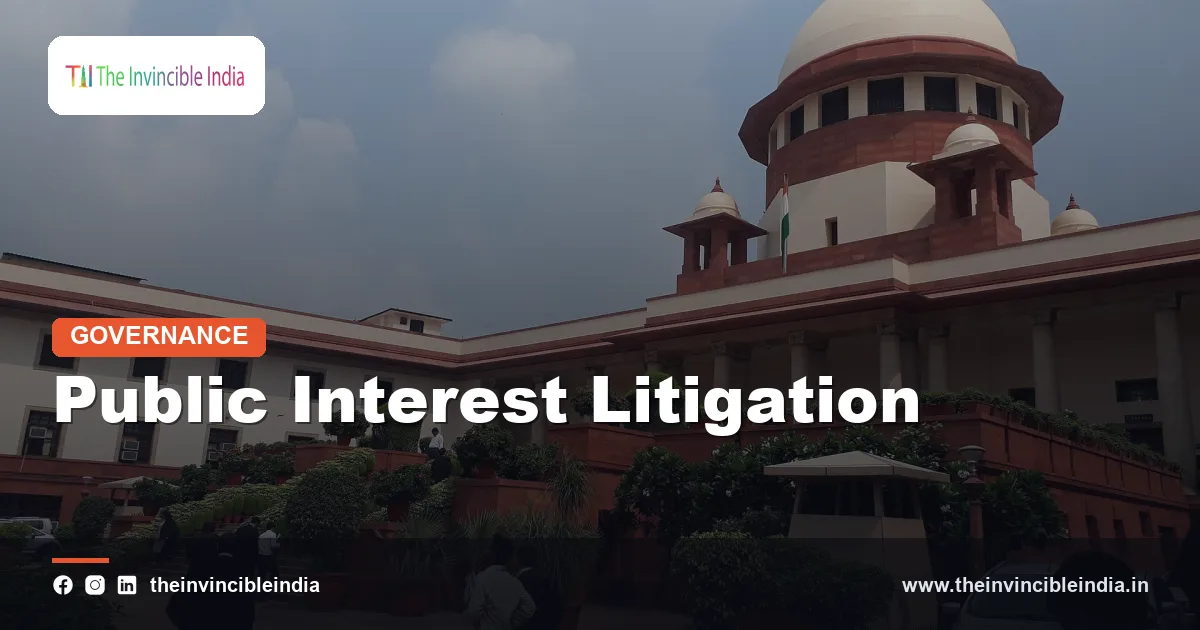
Public Interest Litigation, popularly shortened to PIL, is one of the most distinctive contributions of the Indian judiciary to constitutional practice. It allows a public-spirited individual, a non-governmental organisation or a group of citizens to approach a court on behalf of people who cannot do so themselves, whether because of poverty, illiteracy, social exclusion or sheer lack of access. Instead of insisting that only the person whose right has been violated may sue, the courts agreed to hear anyone who acts in good faith for the benefit of the public.
The idea took shape in the late 1970s and early 1980s, when a handful of reform-minded judges decided that justice could not remain the privilege of those who could afford lawyers and court fees. Over the following decades PIL reshaped the law on prisoners’ rights, bonded labour, pollution, workplace harassment, housing and much else. This explainer traces how PIL began, how it works, the landmark cases that defined it, and why it is both celebrated and criticised. It is written as a general guide, not as legal advice.
Quick Facts
| Aspect | Details |
|---|---|
| Full form | Public Interest Litigation (PIL), also called Social Action Litigation |
| Origin | Late 1970s to early 1980s, developed by the Supreme Court of India |
| Pioneering judges | Justice P.N. Bhagwati and Justice V.R. Krishna Iyer |
| Constitutional basis | Article 32 (Supreme Court) and Article 226 (High Courts) |
| Key legal shift | Relaxation of the traditional rule of locus standi |
| Formal recognition | S.P. Gupta v. Union of India (1981), the Judges’ Transfer case |
| Early landmark case | Hussainara Khatoon v. State of Bihar (1979) on undertrial prisoners |
| Special feature | Epistolary jurisdiction: letters and postcards treated as writ petitions |
| Most invoked right | Article 21, the right to life and personal liberty |
What Is Public Interest Litigation?
In ordinary litigation, a dispute is a contest between two parties, each with a personal stake. A tenant sues a landlord, a worker challenges a dismissal, a citizen contests a tax demand. Public Interest Litigation works differently. The petitioner is usually not the victim. The petition is brought for a group, a community or the public at large, and the relief sought benefits many people rather than one.
The Supreme Court itself has described PIL as a strategic tool for delivering justice to the poor and disadvantaged, and as a way of enforcing the rule of law against public authorities that neglect their duties. A PIL may concern a prison that holds people far beyond a lawful term, a factory that poisons a river, a state agency that ignores a statutory duty, or a government policy that denies a basic entitlement.
Key characteristics
- The petitioner need not be personally injured; a genuine concern for the public good is enough.
- The proceedings are less adversarial and more inquisitorial, with the court often seeking facts itself.
- Relief is frequently collective, forward-looking and administrative in character, such as guidelines or directions to authorities.
- Technical rules of pleading and procedure are relaxed to keep the doors of the court open.
The Rule of Locus Standi and Why It Was Relaxed
The Latin phrase locus standi means “place to stand”. Under the traditional common-law rule that India inherited, only a person whose own legal right or interest had been directly affected could invoke the jurisdiction of a court. A stranger to the dispute, however well-meaning, would have been turned away at the threshold.
This rule worked tolerably for private disputes but failed badly where the injured were poor, scattered or voiceless. A bonded labourer in a remote quarry has no means of hiring a lawyer and travelling to Delhi. An undertrial prisoner in a district jail may not even know that a right to bail exists. If only the victim could sue, such wrongs would simply never reach a judge.
Constitutional encouragement.
Several features of the Constitution supported a wider approach. The Directive Principles promise social and economic justice, and Article 39A, added by the 42nd Amendment in 1976, directs the State to secure equal justice and free legal aid. Reports on legal aid in the 1970s, associated with Justice Krishna Iyer and Justice Bhagwati, also argued that the system had to reach the weak. Against this background, judges began to read standing generously, holding that where a legal wrong is done to a person or class unable to approach the court, any member of the public acting bona fide may do so on their behalf.
Origins: Judges Who Opened the Doors
The Indian story of PIL is inseparable from the Emergency and its aftermath. After 1977 the higher judiciary, conscious that it had been criticised for timidity during the Emergency, sought to rebuild public trust by becoming more responsive to ordinary people. The earlier expansion of Article 21 in Maneka Gandhi v. Union of India (1978), which held that procedure affecting liberty must be fair, just and reasonable, gave judges a powerful conceptual tool.
Justice V.R. Krishna Iyer
Justice Krishna Iyer, a former minister and lawyer before he joined the Supreme Court, argued consistently that the law must serve social justice. In cases such as Sunil Batra v. Delhi Administration, he entertained a prisoner’s letter complaining of inhuman treatment in jail, treating it as a petition and issuing directions to improve prison conditions.
Justice P.N. Bhagwati
Justice Bhagwati articulated the philosophy most fully. He wrote that the poor had to be able to claim their constitutional rights, that the court could adapt its procedures to make this possible, and that the State could not shelter behind technicalities when basic human dignity was at stake. His judgments in the early 1980s turned scattered experiments into a recognised branch of jurisprudence.
It is worth noting that the term “public interest litigation” also has roots in the United States, where public interest law movements of the 1960s used the courts for civil rights and consumer causes. India borrowed the label but developed a far broader and more active version of the practice.
Epistolary Jurisdiction: Justice by Postcard
One of the most striking features of Indian PIL is what scholars call epistolary jurisdiction. Under this approach a simple letter or postcard addressed to a judge can be converted into a writ petition. The petitioner does not need to hire a lawyer, pay court fees or follow the formal drafting conventions of a petition.
The Supreme Court now maintains arrangements to examine such letters, and many High Courts do the same. A letter reporting custodial violence, a news report about the plight of migrant workers or a complaint about an unsafe public facility may be taken up as a petition, particularly when it discloses a violation of fundamental rights.
The court takes the initiative.
In some cases courts have gone further and acted on their own motion, known as suo motu cognisance, based on newspaper reports or other material. Supporters see this as the court living up to its role as a guardian of rights. Critics ask whether judges should be originating cases rather than deciding the ones brought to them. The debate continues, but the epistolary route remains a symbol of how far Indian courts were willing to depart from tradition.
Constitutional Roots: Article 32 and Article 226
PIL is not a creature of a special statute. It flows from the existing writ jurisdiction of the higher courts, as understood in a liberal manner.
Article 32 and the Supreme Court
Article 32 guarantees the right to move the Supreme Court for the enforcement of fundamental rights, and the Court may issue directions, orders or writs including habeas corpus, mandamus, prohibition, certiorari and quo warranto. Dr B.R. Ambedkar famously called it the heart and soul of the Constitution. Because the right to approach the Court is itself a fundamental right, the Court has treated it as a duty to remove procedural barriers where public wrongs are alleged.
Article 226 and the High Courts
Article 226 empowers the High Courts to issue writs for the enforcement of fundamental rights and also “for any other purpose”. This wider language makes High Courts a natural home for many PILs, since they can address violations of ordinary legal duties as well as constitutional rights. In practice, a large share of PIL activity occurs in High Courts, which are closer to the people and the local administration.
Landmark PIL Cases
A few cases decided between 1979 and 1997 explain how PIL gained its reputation. The table below summarises the most frequently cited ones.
| Case | Year | Issue | Significance |
|---|---|---|---|
| Hussainara Khatoon v. State of Bihar | 1979 | Undertrial prisoners held for years without trial | Right to speedy trial recognised as part of Article 21; release of thousands of prisoners |
| S.P. Gupta v. Union of India | 1981 | Transfer and appointment of judges | Formally recognised broad standing for public-spirited persons |
| Olga Tellis v. Bombay Municipal Corporation | 1985 | Eviction of pavement and slum dwellers | Right to livelihood held to be part of the right to life |
| Rural Litigation and Entitlement Kendra v. State of U.P. | 1985 | Limestone quarrying in the Doon valley | Early judicial protection of ecological balance |
| Bandhua Mukti Morcha v. Union of India | 1984 | Bonded labour in stone quarries | Right to live with human dignity; directions to identify and rehabilitate labourers |
| M.C. Mehta cases | 1980s onwards | Ganga pollution, Taj Trapezium, vehicular pollution | Principles of absolute liability and sustained environmental oversight |
| Vishaka v. State of Rajasthan | 1997 | Sexual harassment at the workplace | Binding guidelines issued in the absence of legislation |
Hussainara Khatoon and the Plight of Undertrials
The case that is often described as the first major PIL began with newspaper reports of the conditions of prisoners in Bihar. A lawyer, Kapila Hingorani, filed a petition on behalf of men and women who had been in jail for years awaiting trial, some for longer than the maximum sentence the offence could have attracted. Many had never seen a lawyer.
The Supreme Court held that a speedy trial is an essential element of a fair procedure under Article 21, and it ordered the release of large numbers of undertrial prisoners on personal bonds. The judges also stressed that free legal aid is a constitutional necessity for an accused who cannot afford a lawyer. The litigant in whose name the case is known, Hussainara Khatoon, was herself one of the prisoners, yet the case was brought by an outsider, which is what made it a pioneering example of PIL.
S.P. Gupta and the Formal Recognition of PIL
In 1981 a seven-judge bench of the Supreme Court decided S.P. Gupta v. Union of India, commonly called the Judges’ Transfer case. The central dispute concerned the independence of the judiciary and the executive’s role in appointing and transferring judges. Although that part of the ruling was later revisited in the Second Judges case of 1993, the decision remains a cornerstone of PIL law for another reason.
Justice Bhagwati held that where a legal wrong or injury is caused to a person or class of persons who, because of poverty, disability or a socially or economically disadvantaged position, cannot approach the court, any member of the public acting bona fide can maintain an application for relief. The Court also noted that the relaxation of standing should not become a licence for busybodies. This single passage gave PIL its doctrinal charter and is still quoted in courtrooms today.
Bonded Labour, Livelihood, Environment and Workplace Rights
Bandhua Mukti Morcha
The Bandhua Mukti Morcha case arose from a letter by an organisation working for the release of bonded labourers in stone quarries near Faridabad. The Supreme Court appointed commissioners to visit the sites and report, accepted that forced labour violates Article 21 and Article 23, and gave directions for identification, release and rehabilitation of workers.
Olga Tellis
In Olga Tellis, journalists and pavement dwellers in Bombay challenged eviction from their makeshift homes. The Court held that the right to life includes the right to livelihood, since a person deprived of the means of earning cannot live. It did not bar eviction altogether, but required fair procedure and reasonable notice.
M.C. Mehta and the environment
The environmental lawyer M.C. Mehta filed a series of petitions that transformed environmental law. In the Ganga pollution matters, the Court ordered tanneries and other polluters to install treatment systems or shut down. In the Taj Trapezium case it directed industries around Agra to adopt cleaner fuel or relocate to protect the monument. In the Delhi vehicular pollution litigation, orders over the late 1990s and after led to the shift of public transport towards compressed natural gas. In the Oleum gas leak case the Court spoke of absolute liability for hazardous industries, a principle stricter than the older English rule.
Vishaka and the Court as Rule-Maker
In 1997, a group of women’s organisations and social activists filed a petition after the gang rape of Bhanwari Devi, a social worker in Rajasthan, who had been attacked in the course of her work against child marriage. The petition asked for effective measures against sexual harassment of women at the workplace.
At the time India had no specific law on the subject. Relying on Articles 14, 15, 19 and 21, and on international conventions such as the Convention on the Elimination of All Forms of Discrimination against Women, the Supreme Court laid down binding guidelines that employers had to follow. These became known as the Vishaka Guidelines. They remained the operating framework until Parliament passed the Sexual Harassment of Women at Workplace (Prevention, Prohibition and Redressal) Act in 2013. Vishaka is often cited as the clearest example of the Court filling a legislative gap, and also as the case that sparks the strongest debate about the limits of that role.
Expanding Article 21: Life With Dignity
PIL did more than provide a new route to court. It gradually enlarged what the Constitution means by life and liberty. Once Maneka Gandhi had established that Article 21 protects more than bare survival, PIL petitions asked the Court to spell out what a dignified life requires.
Rights read into Article 21
- The right to a speedy trial and free legal aid, from Hussainara Khatoon and later cases.
- The right to live with human dignity, from Bandhua Mukti Morcha and related decisions.
- The right to livelihood, from Olga Tellis.
- The right to a healthy environment, including clean air and water, recognised in decisions such as Subhash Kumar v. State of Bihar (1991).
- The right to health and medical care in emergencies, developed in several cases involving public hospitals.
- Protection from custodial violence and inhuman treatment in prisons and other institutions.
Later developments, including the recognition of the right to education as a fundamental right through the 86th Amendment of 2002, drew on this accumulated line of reasoning. The result was that the Court became a forum where socio-economic expectations could be argued in the language of fundamental rights.
How a PIL Works in Practice
Although procedures vary between courts, the general journey of a PIL follows a recognisable pattern.
Filing and screening
A petition is filed in the Supreme Court under Article 32 or in a High Court under Article 226, or a letter is forwarded for consideration. Courts look for a clear public interest, accurate facts and a petitioner acting in good faith. Many High Courts have framed rules requiring the petitioner to disclose their credentials and any personal interest, and to show that they have approached the authorities first where practicable.
Tools the court uses
- Notice and affidavits: the government and other respondents are asked to explain their position.
- Amicus curiae: a senior lawyer is appointed as a “friend of the court” to assist with complex or technical questions.
- Commissions and expert committees: the court sends commissioners to inspect sites, interview affected people and report. The Central Empowered Committee in forest matters and the commissioners in the right to food litigation are well-known examples.
- Continuing mandamus: instead of a single order, the court keeps the case alive, issues periodic directions and monitors compliance. The forest conservation litigation begun by T.N. Godavarman Thirumulpad and the Vineet Narain matter on investigation of corruption cases are classic instances.
Costs and consequences
Courts may impose costs on petitioners who file frivolous or publicity-driven petitions, and they can also direct authorities to pay compensation where rights have been violated.
Benefits of Public Interest Litigation
Supporters argue that PIL has made the Constitution real for people who might otherwise have been bystanders in their own legal system.
- Access to justice: prisoners, bonded labourers, slum dwellers and other marginalised groups gained a voice without needing money or legal expertise.
- Accountability of government: public authorities have been compelled to explain inaction, comply with the law and answer for failures in administration.
- Environmental protection: litigation has driven pollution control, forest protection and the recognition of principles such as polluter pays and sustainable development.
- Human rights progress: rights of women, children, prisoners, workers and persons with disabilities have been strengthened in the absence of or ahead of legislation.
- Public awareness: court hearings and media coverage bring neglected issues into public debate.
Concerns and Criticisms
PIL has also drawn sustained criticism, including from judges themselves. The Supreme Court has repeatedly cautioned that the tool must not be abused.
Misuse and frivolous petitions
Critics describe a drift towards “publicity interest litigation”, “private interest litigation” or even “political interest litigation”, where petitions are filed to gain attention, settle scores or pursue a commercial or political agenda. Such cases consume court time in a system already burdened with heavy pendency. In State of Uttaranchal v. Balwant Singh Chaufal (2010) the Supreme Court issued detailed directions to curb misuse, stressing the need to check the credentials and motives of petitioners.
Judicial overreach
Another concern is that courts, in their zeal, may enter areas that the Constitution assigns to the legislature and the executive. Orders on urban planning, public transport, resource allocation or administrative appointments raise questions about the separation of powers and about whether judges have the expertise and accountability to manage such matters. Continuing mandamus, in particular, can blur the line between adjudication and governance.
Practical limits
Courts may find it hard to monitor compliance over years, and sweeping orders can have unintended consequences for people not before the court, such as workers in industries ordered to close. These challenges explain why the judiciary has tried to refine, rather than abandon, the PIL framework.
Benefits and Concerns at a Glance
| Theme | Benefit | Concern |
|---|---|---|
| Access | Open doors for the poor and voiceless | Flood of petitions can crowd out genuine cases |
| Accountability | Holds authorities to their legal duties | Risk of courts substituting their judgment for that of experts |
| Rights | Expanded meaning of life and dignity | Law-making by judges without democratic mandate |
| Environment | Pollution control and protected ecosystems | Economic and livelihood costs for affected groups |
| Procedure | Flexible, informal and quick access | Weak screening of petitioners’ motives |
Guardrails Developed by the Courts
To keep PIL credible, the courts have developed a set of informal guardrails over time. Judges look for good faith and a real public concern, and they discourage petitions based on half-baked newspaper clippings or unverified claims. Petitions that are really private grievances in disguise, or that are aimed at publicity, are dismissed, sometimes with heavy costs. Matters of pure policy, such as the wisdom of an economic decision, are generally left to the government unless a clear violation of law or rights is shown.
Courts have also stressed that PIL is not a substitute for other remedies where those exist, such as service matters or contractual disputes. In many High Courts, specific PIL rules require petitioners to give details about themselves, state whether any similar case is pending and disclose any personal interest. These measures try to balance openness with discipline, so that the PIL stays a tool for the weak, not a weapon for the powerful.
Significance for Indian Democracy
PIL sits at the point where law, politics and society meet. For a country with deep inequalities, it gave an institutional response to the question of how rights can matter to those who have the least power. It encouraged the growth of civil society organisations, public interest lawyers and a culture of rights-based advocacy. Alongside the Right to Information Act of 2005, it created new ways for citizens to demand answers from the State.
At the same time, it forces a continuing conversation about the proper roles of Parliament, the executive and the judiciary in a constitutional democracy. The healthiest view may be that PIL works best when it prods other institutions into action rather than replacing them, and when it is used sparingly for genuine cases of public injury.
Conclusion
From a postcard written by a prisoner to a detailed judgment on pollution or workplace safety, PIL has widened the meaning of access to justice in India. Its origins in the work of Justice Bhagwati and Justice Krishna Iyer, its roots in Articles 32 and 226 and its landmark decisions from Hussainara Khatoon to Vishaka show a judiciary willing to innovate for the sake of the vulnerable. Its critics remind us that innovation needs limits. Both views are part of the story, and together they explain why PIL remains central to discussions about rights and governance in India. Information on this page was last reviewed on 1 October 2026.
Frequently Asked Questions
What is Public Interest Litigation in simple terms?
Public Interest Litigation is a petition filed in a court to protect the rights or interests of the public or of a disadvantaged group, not just the personal rights of the petitioner. Any public-spirited person or organisation acting in good faith can bring it. The aim is to make justice accessible to those who cannot approach the courts themselves.
Where can a PIL be filed in India?
A PIL can be filed in the Supreme Court under Article 32 for violations of fundamental rights, or in a High Court under Article 226, which covers fundamental rights as well as other legal rights and duties. In some situations a letter addressed to the Chief Justice or a judge is treated as a petition under epistolary jurisdiction.
Who started PIL in India?
PIL developed in the late 1970s and early 1980s through the work of Justice P.N. Bhagwati and Justice V.R. Krishna Iyer of the Supreme Court. Early cases such as Hussainara Khatoon (1979) and S.P. Gupta (1981) established the principles, including the relaxation of locus standi.
Can a PIL be filed for any issue?
No. A PIL must raise a genuine matter of public concern, such as violation of fundamental rights, environmental harm or neglect of a public duty. Courts normally do not entertain petitions that are really private disputes, that seek publicity or that challenge pure matters of policy without showing a violation of law.
What happens if someone misuses a PIL?
If a court finds that a petition is frivolous, motivated or intended for publicity, it can dismiss it and impose costs on the petitioner. The Supreme Court has also laid down guidelines, notably in State of Uttaranchal v. Balwant Singh Chaufal (2010), to check the credentials of petitioners and prevent misuse.
Why is PIL important for Indian democracy?
PIL has given marginalised people a voice, strengthened accountability of public authorities and expanded the meaning of rights under Article 21, covering areas such as environment, livelihood and dignity. At the same time, its debates about judicial overreach remind citizens that courts, legislatures and the executive must each stay within their roles.
{“@context”:”https://schema.org”,”@graph”:[{“@type”:”FAQPage”,”mainEntity”:[{“@type”:”Question”,”name”:”What is Public Interest Litigation in simple terms?”,”acceptedAnswer”:{“@type”:”Answer”,”text”:”Public Interest Litigation is a petition filed in a court to protect the rights or interests of the public or of a disadvantaged group, not just the personal rights of the petitioner. Any public-spirited person or organisation acting in good faith can bring it. The aim is to make justice accessible to those who cannot approach the courts themselves.”}},{“@type”:”Question”,”name”:”Where can a PIL be filed in India?”,”acceptedAnswer”:{“@type”:”Answer”,”text”:”A PIL can be filed in the Supreme Court under Article 32 for violations of fundamental rights, or in a High Court under Article 226, which covers fundamental rights as well as other legal rights and duties. In some situations a letter addressed to the Chief Justice or a judge is treated as a petition under epistolary jurisdiction.”}},{“@type”:”Question”,”name”:”Who started PIL in India?”,”acceptedAnswer”:{“@type”:”Answer”,”text”:”PIL developed in the late 1970s and early 1980s through the work of Justice P.N. Bhagwati and Justice V.R. Krishna Iyer of the Supreme Court. Early cases such as Hussainara Khatoon (1979) and S.P. Gupta (1981) established the principles, including the relaxation of locus standi.”}},{“@type”:”Question”,”name”:”Can a PIL be filed for any issue?”,”acceptedAnswer”:{“@type”:”Answer”,”text”:”No. A PIL must raise a genuine matter of public concern, such as violation of fundamental rights, environmental harm or neglect of a public duty. Courts normally do not entertain petitions that are really private disputes, that seek publicity or that challenge pure matters of policy without showing a violation of law.”}},{“@type”:”Question”,”name”:”What happens if someone misuses a PIL?”,”acceptedAnswer”:{“@type”:”Answer”,”text”:”If a court finds that a petition is frivolous, motivated or intended for publicity, it can dismiss it and impose costs on the petitioner. The Supreme Court has also laid down guidelines, notably in State of Uttaranchal v. Balwant Singh Chaufal (2010), to check the credentials of petitioners and prevent misuse.”}},{“@type”:”Question”,”name”:”Why is PIL important for Indian democracy?”,”acceptedAnswer”:{“@type”:”Answer”,”text”:”PIL has given marginalised people a voice, strengthened accountability of public authorities and expanded the meaning of rights under Article 21, covering areas such as environment, livelihood and dignity. At the same time, its debates about judicial overreach remind citizens that courts, legislatures and the executive must each stay within their roles.”}}]}]}