


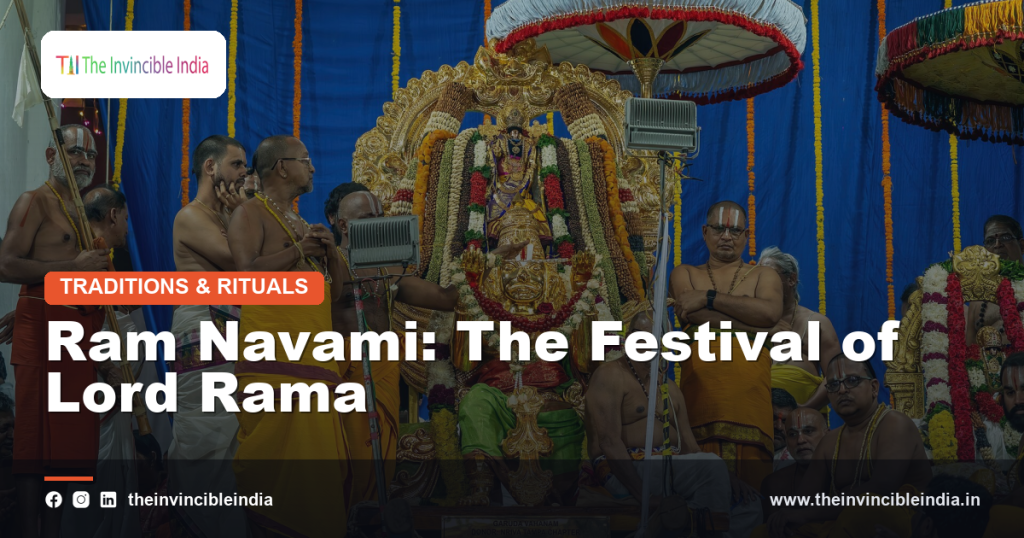
Ram Navami is celebrated as the birth anniversary of Lord Rama, the seventh avatar of Vishnu and the central figure of the epic Ramayana. Falling toward the end of the spring Navratri period, it is observed through temple worship, recitation of the Ramayana, and processions in many parts of the country. Much like Janmashtami, which marks the birth of another Vishnu avatar, Ram Navami combines devotional storytelling with communal celebration. Ayodhya, regarded in tradition as Rama’s birthplace, becomes a particular focus of pilgrimage during this period. This guide surveys the festival’s meaning, rituals and regional character.
Quick Facts
| Detail | Information |
|---|---|
| Also Known As | Birthday of Lord Rama |
| Dedicated To | Lord Rama, seventh avatar of Vishnu |
| Type of Observance | Hindu religious festival |
| General Timing | Shukla Paksha Navami of Chaitra (March-April) |
| Key Practices | Ramayana recitation, temple worship, fasting, processions |
| Region of Prominence | Observed nationwide, with special focus on Ayodhya |
Meaning and Significance
Ram Navami marks the day traditionally regarded as the birth of Lord Rama, celebrated as an embodiment of righteousness, duty and moral conduct in Hindu tradition. The festival falls on the ninth day of the bright fortnight of Chaitra, at the conclusion of the spring observance of Navratri, giving it a natural place within a wider stretch of springtime devotion.
For many devotees, the day is an occasion to reflect on the values Rama is understood to represent, including honesty, self-restraint and devotion to duty, alongside the more festive elements of worship and celebration. This combination of moral reflection and communal joy is part of what gives the festival its distinct character.
Rama in the Ramayana
Rama is the central figure of the Ramayana, one of the two great epics of ancient India, traditionally attributed to the sage Valmiki. The epic recounts his life, including his exile, his marriage to Sita, the abduction of Sita, and his eventual return to rule as king, a narrative that has been retold across generations in numerous regional languages and traditions.
Because the Ramayana exists in many versions across India and Southeast Asia, with regional retellings such as the Tamil Kamba Ramayanam and the Awadhi Ramcharitmanas, Rama’s story is understood as a shared cultural inheritance rather than a single fixed text, and Ram Navami celebrations often draw on this diversity of retellings.
Position in the Hindu Calendar
Ram Navami falls on the ninth day of the bright half of the lunar month of Chaitra, generally corresponding to March or April in the Gregorian calendar. It marks the culmination of Chaitra Navratri, a nine-day spring observance dedicated to the goddess, giving the final day a dual devotional significance in many households.
As with other festivals based on the lunar calendar, the precise Gregorian date shifts annually, and devotees consult regional almanacs to confirm the exact day. The placement at the close of a nine-day devotional period is often noted as lending the festival an additional sense of culmination and fulfilment.
Temple Worship and Rituals
On Ram Navami, temples dedicated to Rama, as well as many general Vishnu and Hanuman temples, hold special prayers and decorate their sanctums elaborately for the occasion. Devotees offer flowers, fruits and sweets, and priests conduct rituals invoking blessings associated with Rama’s qualities of righteousness and protection.
Many households also set up small shrines or decorated cradles representing Rama’s birth, particularly at the time of day traditionally associated with the event, around midday. This moment is often marked with the ringing of bells and the singing of devotional songs, echoing the celebratory tone found in birth-related observances across Hindu tradition.
Ramayana Recitation and Katha
A central feature of Ram Navami is the recitation or reading of the Ramayana, often organised as continuous multi-day readings culminating on the festival day. These recitations, known variously as Ramayana path or Ram Katha, are conducted in homes, temples and community halls, drawing audiences who listen to the epic’s episodes retold by priests or scholars.
In many regions, dramatic retellings known as Ramlila are also staged around this period, presenting key scenes from Rama’s life through performance. These recitations and performances serve both a devotional and an educational purpose, transmitting the epic’s narrative and values to new generations.
Fasting Customs
Many devotees observe a fast on Ram Navami, ranging from a complete fast to one permitting fruits, milk and specific non-grain foods, similar in structure to fasting practices observed during Navratri. The fast is typically broken after the midday rituals associated with Rama’s traditional birth hour have been completed.
As with other Hindu fasting traditions, the practice is understood as an act of discipline and devotion rather than mere abstinence, intended to focus the mind on prayer and reflection. Special dishes prepared for the day, often free of grains and using ingredients permitted during the fast, form part of many households’ festival routine.
Ayodhya and Pilgrimage
Ayodhya, on the banks of the river Sarayu in Uttar Pradesh, is traditionally regarded as the birthplace of Rama and holds special importance during Ram Navami. Pilgrims travel to the city in large numbers for the festival, participating in ritual bathing in the river and visiting temples associated with Rama’s life and legacy.
The city’s religious significance has made it a long-standing centre of pilgrimage well beyond the festival period, but Ram Navami sees a particular concentration of devotional activity, with processions, recitations and public celebrations forming a prominent part of the city’s calendar during this time.
Processions and Shobha Yatra
Many cities and towns mark Ram Navami with processions, often called shobha yatras, in which images or tableaux representing Rama and his companions are carried through the streets accompanied by devotional music. Participants frequently dress as characters from the Ramayana, and the processions draw large numbers of onlookers along their route.
These public celebrations extend the festival’s devotional character into shared civic space, turning streets and public squares into sites of temporary festivity. The scale and style of these processions vary considerably from one region to another, reflecting local traditions of public celebration.
Regional Variations Across India
While Ram Navami is observed nationally, its expression varies by region. In North India, particularly around Ayodhya and other parts of the Hindi belt, Ramlila performances and large public gatherings are especially prominent. In South India, the festival is often observed alongside Sita Kalyanam, a ritual re-enactment of the marriage of Rama and Sita, particularly popular in Andhra Pradesh and Telangana.
In Maharashtra and other western states, household worship and community readings tend to be the primary mode of observance, generally with less emphasis on large public processions. These regional differences reflect the broader pattern seen across Indian festivals, in which a shared occasion takes on distinct local forms.
Sita Kalyanam and the Ideal Marriage
In several South Indian traditions, Ram Navami includes a ceremonial re-enactment of the wedding of Rama and Sita, known as Sita Kalyanam, conducted with the same rituals traditionally used in Hindu weddings. Temples stage elaborate versions of this ceremony, complete with decorated mandapas and priestly rites, drawing large congregations.
The pairing of Rama and Sita is frequently held up in devotional literature as a model of marital devotion and mutual respect, and the ceremonial re-enactment allows devotees to participate symbolically in this ideal. The practice illustrates how mythological narrative and lived ritual can intersect within a single festival.
Music, Bhajans and Devotional Arts
Devotional music plays a significant role in Ram Navami celebrations, with bhajans and kirtans praising Rama sung in temples, homes and community gatherings throughout the festival period. Compositions drawn from regional devotional poetry, including works associated with poet-saints who wrote extensively about Rama, remain popular during this season.
Classical and folk performing arts traditions in various regions also incorporate Ramayana themes into festival-time programming, from classical dance recitals to folk theatre. This artistic dimension reinforces the festival’s role not only as a religious observance but also as an occasion for cultural expression rooted in a shared epic tradition.
Charitable and Community Activities
Community service and charitable giving are commonly associated with Ram Navami, with many temples and organisations arranging free meals, medical camps or distribution of essentials to those in need around the festival period. This charitable dimension is often linked to Rama’s portrayal as a just and compassionate ruler in traditional narratives.
Community kitchens, known in various regions by different names, serve prasad to visiting devotees at major temples during the festival, reflecting a broader pattern in Indian religious life where personal devotion is paired with collective generosity toward the wider community.
Rama as a Cultural and Moral Symbol
Beyond his religious significance, Rama occupies a prominent place in Indian cultural life as a symbol of ideal conduct, often referenced in discussions of duty, governance and personal ethics. The concept of Ram Rajya, an idealised just rule associated with his reign, is frequently invoked in general cultural and political discourse as shorthand for good governance.
This broader cultural resonance means Ram Navami carries significance for many people beyond strictly religious observance, functioning also as an occasion to reflect on values that have long been part of India’s shared moral vocabulary, independent of any one interpretation of the epic.
Rama in Art and Iconography
Rama is a recurring subject in Indian sculpture, painting and temple architecture, typically depicted holding a bow, often alongside Sita, his brother Lakshmana and the devoted Hanuman. Temple carvings and manuscript illustrations across many regions and periods have depicted key episodes from his story, reflecting its long-standing hold on artistic imagination.
During Ram Navami, temples and homes often feature specially decorated images or idols of Rama, sometimes accompanied by depictions of his companions. This visual tradition, spanning centuries and regions, complements the festival’s oral and textual traditions, giving devotees multiple ways to engage with the narrative.
Ram Navami and Interfaith Observance
Given Rama’s broad cultural resonance, Ram Navami is marked with public and civic participation in many towns and cities, extending beyond strictly religious congregations to include cultural programmes, school events and community gatherings. Public spaces are often decorated, and local associations organise recitations and processions open to the wider public.
This wide participation reflects the way many Indian festivals move fluidly between the religious and the civic, becoming occasions for shared community identity as much as acts of individual worship, a pattern echoed in numerous major festivals across the Indian calendar.
Ram Navami Today
In present-day India, Ram Navami continues to be marked by the practices long associated with it, including temple worship, Ramayana recitation, fasting and public processions, even as some elements have adapted to contemporary life. Live broadcasts of major temple rituals and digital recitations now allow participation from those unable to attend in person.
Ayodhya in particular has seen renewed attention as a pilgrimage centre in recent years, drawing growing numbers of visitors during the festival. Despite these changes in scale and format, the festival’s core focus, honouring Rama’s birth and the values associated with his story, remains consistent with its long tradition.
Sources & Further Reading
- Ministry of Culture, Government of India (indiaculture.gov.in).
- Sangeet Natak Akademi (sangeetnatak.gov.in).
Frequently Asked Questions
What is Ram Navami?
Ram Navami is a Hindu festival celebrating the birth of Lord Rama, observed through temple worship, fasting and recitation of the Ramayana.
When does Ram Navami fall?
It falls on the ninth day of the bright fortnight of the lunar month of Chaitra, generally in March or April, marking the end of Chaitra Navratri.
Why is Ayodhya important to Ram Navami?
Ayodhya is traditionally regarded as the birthplace of Rama, making it a major pilgrimage destination where large crowds gather for the festival.
What is Sita Kalyanam?
Sita Kalyanam is a ceremonial re-enactment of the wedding of Rama and Sita, performed in many South Indian temples as part of Ram Navami celebrations.
Is fasting observed on Ram Navami?
Many devotees observe a fast, ranging from a complete fast to one permitting fruits and milk, typically broken after midday rituals conclude.