


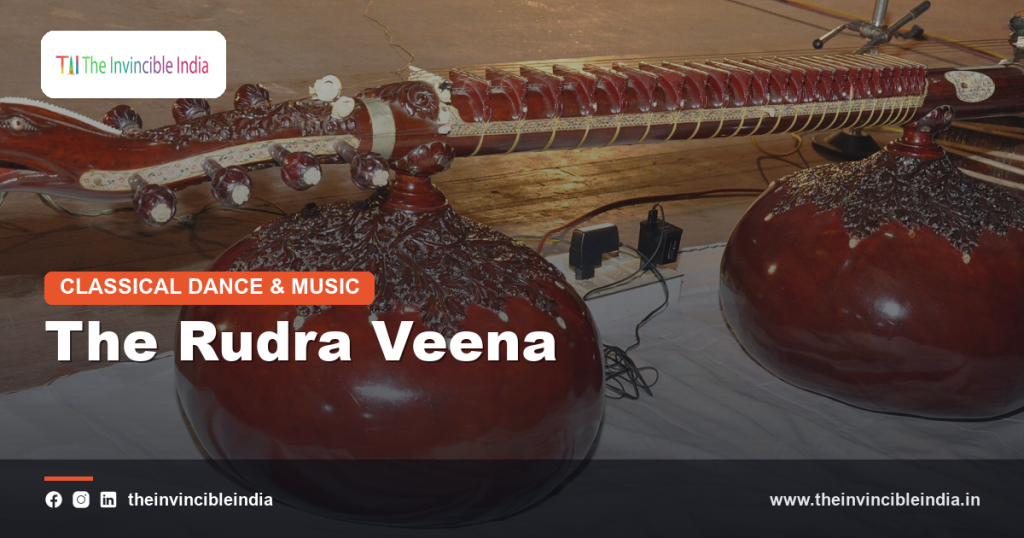
Among the oldest and most austere of India’s string instruments stands the rudra veena, a deep-voiced stick zither whose solemn, resonant tone once dominated the courts and temples of North India before giving way, over time, to more popular instruments such as the sitar. Related to the wider veena family of instruments, it is built from a long hollow wooden or bamboo tube fitted with two large gourd resonators, and it produces a profound, sustained sound especially suited to the slow, meditative unfolding of dhrupad, India’s most ancient surviving vocal tradition. Though rare today, played by only a small number of dedicated musicians, the rudra veena retains a special prestige among connoisseurs of classical music. This guide explores its structure, history, playing technique and its close bond with dhrupad.
Quick Facts
| Detail | Information |
|---|---|
| Type | An ancient stick zither with two gourd resonators |
| Also known as | The been, an older name for the same instrument |
| Association | Closely tied to the dhrupad vocal tradition |
| Sound | Deep, sustained and solemn in character |
| Status | Rare today, played by only a small number of specialists |
| Construction | A long hollow tube with frets and twin gourds |
What Is the Rudra Veena
The rudra veena is one of the oldest stringed instruments still played within Indian classical music, a long stick zither built for a deep, austere and highly sustained sound rather than for rapid melodic ornamentation. Unlike lutes with a rounded body such as the sitar, the rudra veena consists essentially of a long hollow tube, fretted along its length, with two large gourd resonators attached near either end to amplify and enrich its tone. Historically closely associated with the courts and temples of North India, it became particularly prized as the preferred instrument for accompanying and echoing the solemn, unhurried style of dhrupad singing. Though now rare, the rudra veena continues to be recognised as one of the most dignified and historically significant instruments in the entire Hindustani classical tradition, treasured by a small but devoted circle of practitioners and scholars.
The Been: An Older Name
Before the name rudra veena became common, the instrument was widely known simply as the been, a term still used by some musicians and in older writings on Indian music. This older name reflects a long history in which the instrument’s identity gradually shifted and narrowed, as the broader term veena, once applied to many different stringed instruments, came to be associated more specifically with this particular ancient stick zither in North Indian practice. Some contemporary players and scholars continue to prefer the term been, regarding it as the instrument’s more traditional and historically rooted designation, while others favour rudra veena, which carries a more overtly devotional association. Both names refer to the same instrument, and an interested listener is likely to encounter either term used interchangeably in discussions of Hindustani classical music history.
Structure and Construction
The body of the rudra veena is dominated by a long, hollow cylindrical tube, traditionally made of wood or bamboo, that runs the full length of the instrument and carries a set of broad, raised frets fixed along its surface. Two large, rounded gourds are attached beneath the tube, one near each end, serving as the instrument’s principal resonating chambers and giving it both its imposing appearance and its deep, sustained tone. This distinctive construction, quite unlike the single-bodied lutes more familiar to modern audiences, reflects an older and simpler approach to string instrument design, emphasising resonance and sustain above compactness or portability. The considerable size and weight of a full rudra veena demand a sturdy build and careful craftsmanship, since the instrument must support real tension from its strings across a long, unsupported span.
The Twin Gourd Resonators
The two gourd resonators of the rudra veena play a crucial role in shaping its distinctive sound, each contributing to the instrument’s depth, sustain and overall tonal balance. Selecting gourds of the right size, shape and thickness is an important part of building a fine instrument, since resonators that are too thin or unevenly shaped can produce a thin or uneven tone rather than the rich, even resonance prized in a good rudra veena. The symmetrical placement of the two gourds, one beneath each end of the long tube, also affects how the player must balance and support the instrument while seated, since its considerable overall length and weight are distributed between these two points. This twin-gourd design, unusual among Indian instruments, is one of the most immediately recognisable features that identifies a rudra veena at a glance.
Strings and Frets
The rudra veena is strung with a number of strings, including both the primary strings used for melody and additional strings used to maintain rhythm and drone, set across broad frets that allow the player to bend pitch considerably by pressing and pulling the strings sideways. This fretting technique, similar in principle to that used on other Indian fretted lutes, permits the smooth glides between notes that are essential to the expressive character of Indian classical melody. The relatively wide spacing between frets on the rudra veena, suited to its large scale, requires the player to develop considerable strength and reach in the fretting hand. Mastery of this technique, combined with careful control of the plucking hand, allows a skilled player to reproduce the slow, weighty ornamentation characteristic of dhrupad on this ancient instrument.
The Sound of the Rudra Veena
The sound of the rudra veena is often described as deep, solemn and unusually sustained, qualities well suited to the grave, meditative character of the music it is most closely associated with. Its low pitch range and the resonant amplification provided by its twin gourds give it a weighty, almost ceremonial presence quite different from the brighter, more agile tone of instruments such as the sitar or sarod. This deep sound is not intended for rapid, ornamented passages but rather for the slow, dignified unfolding of a raga’s character, note by note, in keeping with the ancient and austere musical style with which the rudra veena has always been paired. Listeners familiar with its sound often describe an almost meditative quality unique among Indian instruments.
The Rudra Veena and Dhrupad
The rudra veena’s closest and most defining association is with dhrupad, the oldest continuously performed style of Hindustani vocal music, known for its slow, weighty and highly disciplined exploration of a raga without the more ornamented flourishes found in later vocal styles. The instrument’s deep, sustained tone and its capacity for smooth, gradual glides between notes make it an ideal vehicle for translating the dhrupad aesthetic into instrumental form, echoing the vocal style’s grave dignity rather than its opposite. Historically, rudra veena players and dhrupad singers shared closely related training and repertoire, and many rudra veena compositions closely mirror the structure and mood of dhrupad vocal pieces. This intimate bond between voice and instrument remains central to how the rudra veena is understood and valued today.
Playing Technique
Playing the rudra veena demands a distinctive technique quite different from that used on other Indian lutes, involving considerable pressure applied to the strings against the wide frets in order to bend pitch and produce the instrument’s characteristic slow glides. The plucking hand employs a small number of careful, deliberate strokes, since the deep, sustained tone of the rudra veena rewards patience and clarity far more than rapid or busy playing. Considerable physical strength is required in the fretting hand to achieve accurate pitch bending across the instrument’s wide frets, and this demanding technique takes many years of practice to develop fully. The overall approach favours a slow, weighty unfolding of melody, in keeping with the instrument’s close association with the dhrupad style.
Seated Posture and Handling
Because of its considerable size and unusual twin-gourd construction, playing the rudra veena requires a particular seated posture, with the long tube resting diagonally across the player’s body and the two gourds positioned near the shoulder and near the floor or the player’s lap. Balancing and supporting such a large instrument while simultaneously executing precise fretting and plucking technique demands both physical stability and years of practised familiarity with the instrument’s particular proportions. This distinctive posture, quite different from that used with smaller or differently shaped instruments, is itself part of what students must learn early in their training. Correct handling of the instrument’s weight and balance is considered essential before more advanced playing technique can be developed with confidence.
Historical Prominence
In earlier centuries, the rudra veena, then more commonly known as the been, held a position of considerable prominence at royal courts and among serious students of classical music across North India, valued as a dignified and technically demanding instrument befitting formal court performance. It was closely linked with the dhrupad style then dominant in courtly music, and accomplished rudra veena players were held in high esteem alongside leading dhrupad vocalists of their time. This historical prestige reflects a period in which dhrupad and its associated instruments represented the height of serious classical performance, before newer vocal styles and instruments gradually rose to greater popularity in subsequent generations. The instrument’s history is therefore closely bound up with the broader historical fortunes of the dhrupad tradition itself.
A Gradual Decline
As musical tastes and court patronage shifted over time, and as newer vocal styles and instruments such as the sitar rose to wider popularity, the rudra veena gradually receded from mainstream concert life, becoming an increasingly specialised and rarely heard instrument. Its demanding technique, considerable size and close association with the more austere dhrupad style, itself less commonly performed than newer, more ornamented vocal forms, all contributed to its narrowing circle of practitioners. By more recent times, the number of musicians actively performing and teaching the rudra veena had become quite small, concentrated within a few dedicated families and lineages committed to preserving its distinctive tradition. This gradual decline mirrors the broader historical trajectory of dhrupad itself within the wider landscape of Hindustani classical music.
Surviving Lineages and Teachers
Despite its decline in wider popularity, the rudra veena has been preserved through a small number of dedicated musical lineages and hereditary traditions, whose members have maintained its technique and repertoire across generations through direct teacher-to-student transmission. These custodians of the tradition have often combined performance with serious teaching, striving to pass on not merely the mechanics of playing but the deeper aesthetic sensibility that connects the rudra veena to dhrupad’s grave, meditative style. Their efforts have ensured that the instrument, though rare, has never entirely disappeared from Indian classical music, remaining a living, if specialised, tradition rather than a purely historical curiosity. Their continuing dedication is widely credited with keeping the instrument and its associated musical style alive into the present day.
Craftsmanship of the Instrument
Building a rudra veena is a specialised and increasingly rare craft, requiring careful selection of suitable wood or bamboo for the long tube, matched gourds of appropriate size and shape for the twin resonators, and precise placement of broad frets to allow accurate pitch bending. Because so few musicians play the instrument today, the number of craftsmen skilled in building it well has also diminished considerably, making a well-made rudra veena difficult to obtain and highly valued by the musicians who do seek one out. Maintaining an instrument of this size and construction likewise requires particular care, including protection of its gourds and wooden tube from humidity and physical damage. This scarcity of skilled makers adds further weight to the instrument’s status as a rare and precious element of India’s musical heritage.
Learning the Rudra Veena Today
Learning the rudra veena today generally requires seeking out one of the small number of dedicated teachers who continue to maintain the tradition, often within family lineages that have preserved the instrument’s technique and repertoire for generations. Students must first develop considerable physical strength and control in the fretting hand, essential to the pitch-bending technique the instrument demands, before progressing to the slow, deliberate melodic style associated with dhrupad performance. Because the instrument and its music emphasise patience, restraint and depth over speed or ornamentation, training on the rudra veena is often considered a particularly demanding discipline, requiring years of sustained commitment before a student can perform its grave, meditative repertoire convincingly. This rigorous apprenticeship reflects the instrument’s continued association with the most serious and austere strand of Hindustani classical music.
Efforts at Revival
In more recent years, cultural institutions, dedicated musicians and scholars have taken an active interest in supporting and documenting the rudra veena tradition, recognising its historical importance and the risk of its further decline. Efforts have included recording performances, supporting surviving teachers and encouraging a new generation of interested students to take up serious study of the instrument alongside dhrupad vocal training. While the rudra veena remains a specialised pursuit rather than a widely popular one, such efforts have helped raise awareness of its significance among broader audiences interested in Indian classical music history. These initiatives reflect a wider recognition that instruments such as the rudra veena represent an irreplaceable link to the earliest surviving layers of India’s classical musical heritage.
The Rudra Veena Today
Today the rudra veena survives as a rare but cherished instrument, sustained by a small circle of dedicated musicians who continue to study and perform it alongside the ancient dhrupad tradition it has long accompanied. Though it can no longer claim the widespread popularity it once held at royal courts, its deep, solemn tone and its unbroken connection to one of India’s oldest musical styles ensure it remains an object of considerable respect among serious students of classical music. Continued teaching, careful instrument making and growing scholarly interest all contribute to keeping the rudra veena a living tradition rather than a historical memory alone. As one of the most ancient instruments still played in India today, the rudra veena endures as a quiet but profound testament to the depth of the country’s classical musical heritage.
Sources & Further Reading
- Sangeet Natak Akademi, national academy for music, dance and drama, on rare and historical Indian instruments (sangeetnatak.gov.in).
- Ministry of Culture, Government of India, on the preservation of India’s classical music heritage (indiaculture.gov.in).
Frequently Asked Questions
What is a rudra veena?
The rudra veena is an ancient Indian stick zither with two large gourd resonators, valued for its deep, sustained tone and its close historical association with dhrupad, the oldest surviving style of Hindustani classical vocal music.
Is the rudra veena the same as the been?
Yes, been is an older name for the same instrument, and the two terms are used interchangeably to refer to this ancient stick zither, though rudra veena has become the more commonly used name in recent times.
Why is the rudra veena rare today?
The rudra veena declined in popularity as newer instruments and vocal styles rose to prominence, and its demanding technique, large size and close ties to the less widely performed dhrupad tradition narrowed the number of musicians willing to specialise in it.
What kind of music is the rudra veena used for?
The rudra veena is used almost exclusively for the slow, austere and highly disciplined dhrupad style of Hindustani classical music, whose grave character suits the instrument’s deep, sustained sound particularly well.
Can the rudra veena still be learned today?
Yes, though only a small number of dedicated teachers, often within specific family lineages, continue to teach the instrument, and interested students generally must seek out these specialists directly.