


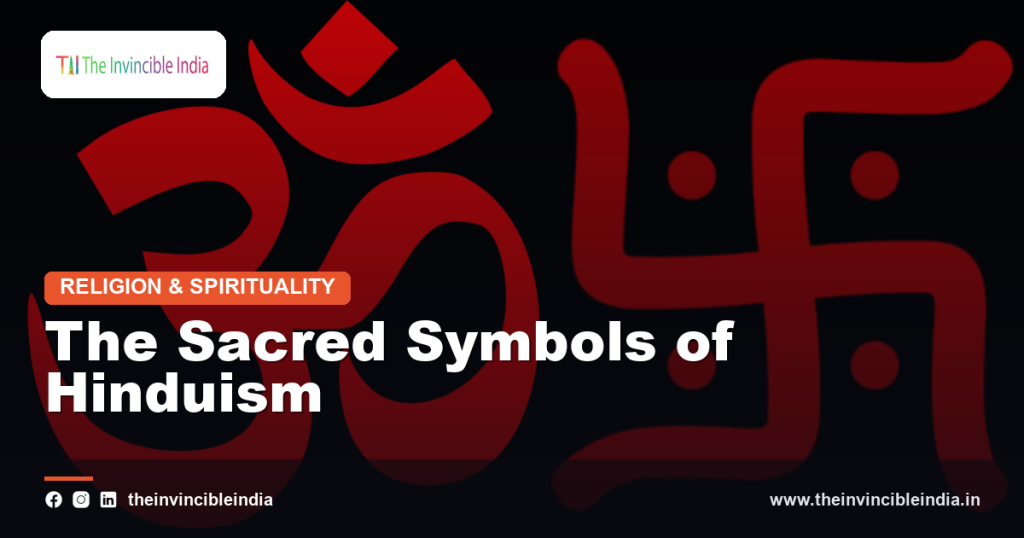
Hinduism expresses many of its central ideas through visual symbols rather than through doctrine alone, and these images appear everywhere from temple walls to household shrines. A single syllable, a flower, or a simple mark on the forehead can carry layers of meaning built up over centuries of practice, as explored in this broader overview of Hinduism. Understanding these symbols offers a way into the tradition’s worldview, since each one distills abstract philosophical concepts into a form that can be seen, touched, or worn. This guide introduces the most widely recognised sacred symbols of Hinduism, describing their general meaning and the everyday and ritual contexts in which they continue to appear across India.
Quick Facts
| Detail | Information |
|---|---|
| Best-Known Symbol | Om (Aum) |
| Common Marking | Tilak on the forehead |
| Sacred Flower | Lotus |
| Sacred Thread | Yajnopavita |
| Sacred Beads | Rudraksha |
| Typical Setting | Temples and home shrines |
Origins and Meaning of Hindu Symbolism
Symbolism occupies a central place in Hindu religious life because many of the tradition’s core ideas, such as the nature of the divine or the structure of the cosmos, are considered difficult to express through words alone. Visual and sonic symbols offer a way to point toward these ideas in a form that can be seen, recited, or worn on the body. Over a long history, certain shapes, sounds, and objects came to be associated with particular deities, values, or states of mind, and these associations were passed down through worship, art, and oral teaching.
Because Hinduism encompasses many regional and philosophical traditions, symbols are often shared broadly even where their interpretation varies slightly from one community to another. A single image, such as a lotus or a trident, may carry both a widely recognised general meaning and additional layers of significance within a specific lineage or region, reflecting the tradition’s diversity.
The Om (Aum) Symbol
Om, often written as Aum, is widely regarded as the most fundamental sound and symbol in Hindu tradition. It is described in various texts as a primal sound representing the totality of existence, and it is chanted at the beginning and end of prayers, mantras, and meditation sessions. The written symbol for Om, composed of curved and crescent forms topped by a dot, is displayed in temples, on household altars, and in art and jewellery throughout India.
Beyond its role in ritual, Om is also used as a point of focus in meditation, where practitioners repeat or visualise the syllable to steady the mind. Its presence at the start of many Sanskrit texts and prayers reflects its status as a unifying symbol that is recognised across different Hindu philosophical schools and, in adapted forms, in Buddhism and Jainism as well.
The Swastika as a Symbol of Auspiciousness
In Hindu tradition, the swastika is an ancient symbol of auspiciousness, well-being, and good fortune, formed by a cross with arms bent at right angles. It is drawn on doorways, account books, wedding invitations, and ritual items, particularly during festivals and new beginnings such as moving into a new home or starting a business. The symbol is considered to invite positive energy and is often accompanied by dots or decorative borders in rangoli art.
It is important to distinguish this ancient and continuing use of the swastika in Hindu, Buddhist, and Jain contexts from its unrelated twentieth-century appropriation in Europe, since the symbol’s meaning and history in Indian religious practice long predate that period and remain entirely separate from it. Within Indian tradition, it continues to be viewed simply as a mark of blessing and welcome.
The Lotus Flower
The lotus is one of the most widely used symbols across Hindu, Buddhist, and Jain art, valued for the way it grows up through muddy water to bloom clean and untouched above the surface. This quality has made it a symbol of purity, spiritual growth, and the possibility of rising above difficult circumstances. Several deities are depicted seated or standing on a lotus, or holding one in their hands, reinforcing its association with the sacred and the transcendent.
The lotus also appears in yogic and meditative traditions, where the heart or crown is sometimes described using lotus imagery to convey the unfolding of awareness. In temple architecture and sculpture, lotus motifs decorate ceilings, pillars, and pedestals, extending the symbol’s presence from religious texts into the everyday visual environment of worship spaces.
The Trishula (Trident)
The trishula, or trident, is most closely associated with the deity Shiva and is depicted as his characteristic weapon and emblem. With three prongs rising from a single staff, the trishula is often interpreted as representing sets of three important to Hindu thought, such as creation, preservation, and dissolution, or the three qualities described in some philosophical texts. It appears in temple iconography, on flags outside Shiva temples, and in devotional art.
Beyond its association with a single deity, the trident has become a broader emblem of spiritual authority and protection, carried in some ascetic and monastic traditions as a mark of renunciation. Its presence outside a temple or shrine typically signals the site’s dedication to Shiva, making it one of the most immediately recognisable symbols in the Hindu visual repertoire.
The Shivalinga
The shivalinga is an aniconic, or non-figurative, representation of Shiva found in temples and shrines throughout India, typically shown as a smooth, rounded column set within a circular base. It is understood by devotees as a symbol pointing toward the formless, infinite aspect of the divine rather than as a literal image of a deity. Worship of the shivalinga generally involves offerings of water, milk, and flowers, and it forms the focal point of many Shiva temples.
Interpretations of the shivalinga’s symbolism vary across schools of thought, with some emphasising its connection to cosmic energy and others to the union of complementary principles. Regardless of interpretation, it remains one of the oldest and most widespread forms of Hindu devotional symbolism, continuing a tradition of abstract representation that stretches back many centuries.
The Conch Shell (Shankha)
The conch shell, or shankha, holds an important place in Hindu ritual as both a musical instrument and a sacred object. Its sound, produced by blowing through a hollowed shell, is used to mark the beginning of temple ceremonies, festivals, and important rituals, and is believed to carry auspicious and purifying qualities. The shankha is particularly associated with the deity Vishnu, who is often depicted holding one.
Beyond its ceremonial sound, the conch shell is also displayed as a decorative and symbolic object in homes and temples, sometimes filled with water for ritual use. Its spiral form has additionally been read as a symbol of infinity and the cyclical nature of existence, adding a further layer of meaning to an object that is, at heart, a call to sacred attention.
Tilak and Sacred Markings
The tilak, a mark applied to the forehead, is one of the most visible symbols of Hindu religious identity and practice. Made from sandalwood paste, vermilion, ash, or other materials, the shape and colour of the tilak can indicate a person’s particular devotional tradition or the deity they especially honour. It is applied during worship, festivals, and important life events as a sign of blessing and spiritual focus.
The forehead is traditionally regarded as a significant point of the body in yogic and meditative thought, and the tilak is often described as marking this point to encourage concentration and awareness during prayer. Beyond religious contexts, the tilak has also become a broader cultural symbol, applied as a mark of respect and good wishes at weddings and celebrations.
The Sacred Thread (Yajnopavita)
The sacred thread, known as the yajnopavita or janeu, is a cord traditionally worn across the body from the left shoulder in certain Hindu communities, most notably following a coming-of-age ceremony known as upanayana. Composed of several twisted strands, the thread is understood as a symbol of a formal commitment to religious study and disciplined conduct, marking a significant transition in a person’s spiritual life.
Wearing the sacred thread is accompanied by an expectation of daily prayer and adherence to certain ritual practices, and the thread itself is periodically renewed. While its use is specific to particular communities and is not universal across all Hindus, it remains an important symbol of initiation and continuity within the traditions that observe it.
Rudraksha Beads
Rudraksha are the dried seeds of a particular tree, valued in Hindu practice for their distinctive segmented surface and their long association with the deity Shiva. Strung into bracelets or full malas of prayer beads, rudraksha are worn by devotees and ascetics alike, and are used to count repetitions during mantra recitation, a practice known as japa. The number of natural segments on a given seed is sometimes used to classify it for particular devotional purposes.
Beyond their use in counting prayers, rudraksha beads are widely regarded as objects that support calm and focus during meditation. Their continued popularity, from temple markets to modern wellness contexts, reflects the way a simple natural object can become deeply embedded in the symbolic vocabulary of a religious tradition.
The Kalasha (Sacred Pot)
The kalasha is a metal or clay pot, usually filled with water and topped with mango leaves and a coconut, that serves as an auspicious symbol at the start of rituals, weddings, and housewarming ceremonies. It is understood to represent abundance, fertility, and the presence of the divine, and its careful arrangement is considered an important part of preparing a sacred space for worship.
The kalasha is often placed at the entrance to a ceremony or installed on a raised platform during a puja, acting as a focal point for invocation. Its recurring presence across very different types of Hindu ceremonies, from temple consecrations to domestic rites, illustrates how a simple household object can be elevated into a lasting symbol of welcome and blessing.
Symbols in Temple Architecture
Hindu temple architecture is built around layers of symbolism, from the overall structure of the building to the smallest carved details. The rising tower, or shikhara, above the main sanctum is often understood as representing a sacred mountain, connecting the earthly space of worship to the cosmic order. Doorways, pillars, and ceilings are frequently decorated with lotus motifs, guardian figures, and geometric patterns that carry their own devotional meaning.
The layout of a temple, moving from an open outer area toward a smaller, darker inner sanctum, is itself symbolic, guiding a worshipper’s journey from the everyday world toward a more intimate encounter with the divine. This architectural symbolism, developed over many centuries and varying by region, turns the temple itself into a physical expression of Hindu cosmology.
Color Symbolism in Hindu Practice
Colour carries significant symbolic weight in Hindu ritual and daily life, with particular shades associated with specific deities, festivals, and states of mind. Saffron, for instance, is widely linked to renunciation, spiritual fire, and sacrifice, and is worn by many ascetics and used prominently in religious flags and clothing. Red is commonly associated with auspiciousness and marital status, seen in the vermilion applied during weddings and festivals.
Other colours carry their own associations, such as white with purity and simplicity, and yellow with learning and prosperity. These associations influence choices in clothing, decoration, and offerings during festivals and ceremonies, showing how colour functions as another layer of symbolic language running alongside images, sounds, and objects in Hindu religious expression.
Animal Symbolism (Vahanas)
Many Hindu deities are depicted alongside a particular animal companion, or vahana, which serves both as a mode of transport in mythology and as a symbol reinforcing aspects of the deity’s character. The bull Nandi accompanies Shiva, the elephant-headed Ganesha rides a mouse, and the goddess Durga is shown astride a lion or tiger, each pairing carrying its own layer of traditional meaning.
These animal figures are not simply decorative; shrines dedicated to Nandi, for example, are found facing Shiva temples and are themselves objects of reverence. The tradition of vahanas reflects a broader Hindu tendency to weave the natural world into religious symbolism, treating animals as meaningful participants in the sacred narrative rather than incidental details.
Symbols in Ritual and Everyday Life
Beyond temples and formal ceremonies, sacred symbols are woven into the fabric of everyday Hindu life. Rangoli patterns drawn at doorways each morning, small clay lamps lit during evening prayer, and the Om symbol displayed above a doorway all extend religious symbolism into the domestic sphere. These practices allow households to maintain a continuous, low-key connection to sacred meaning outside of major festivals or temple visits.
Symbols also mark personal milestones, from the sacred thread ceremony to the application of tilak during a wedding. This everyday presence of symbolism means that Hindu religious meaning is not confined to specialised ritual settings but is instead distributed throughout ordinary life, visible in small gestures repeated across generations.
Sacred Symbols Today
Sacred Hindu symbols continue to be actively used today, appearing not only in traditional worship but also in contemporary art, fashion, and design, both within India and among diaspora communities worldwide. Symbols such as Om and the lotus have become widely recognised well beyond strictly religious contexts, often associated more broadly with meditation and wellness practices.
At the same time, these symbols retain their original devotional significance for practising Hindus, continuing to appear in temples, home shrines, and rites of passage much as they have for generations. This dual presence, at once ancient and current, reflects the enduring adaptability of Hindu symbolism as a living visual and spiritual language.
Sources & Further Reading
- Ministry of Culture, Government of India (indiaculture.gov.in).
- Sahitya Akademi.
Frequently Asked Questions
What is the most important symbol in Hinduism?
Om, also written as Aum, is generally regarded as the most fundamental symbol and sound in Hindu tradition, representing the totality of existence and used at the start of most prayers and mantras.
What does the swastika mean in Hinduism?
In Hindu tradition, the swastika is an ancient symbol of auspiciousness and good fortune, drawn on doorways and ritual items to invite blessing, and it is unrelated to its later, unconnected use in twentieth-century Europe.
Why is the lotus flower sacred in Hindu tradition?
The lotus grows clean through muddy water, making it a symbol of purity and spiritual growth, and several deities are shown seated on or holding a lotus in Hindu art.
What does a tilak mark signify?
A tilak applied to the forehead signals devotion, blessing, and spiritual focus, with its shape and colour sometimes indicating the wearer’s particular devotional tradition.
Are rudraksha beads used in meditation?
Yes, rudraksha beads are commonly strung into malas and used to count mantra repetitions during meditation, and they are closely associated with devotion to Shiva.