


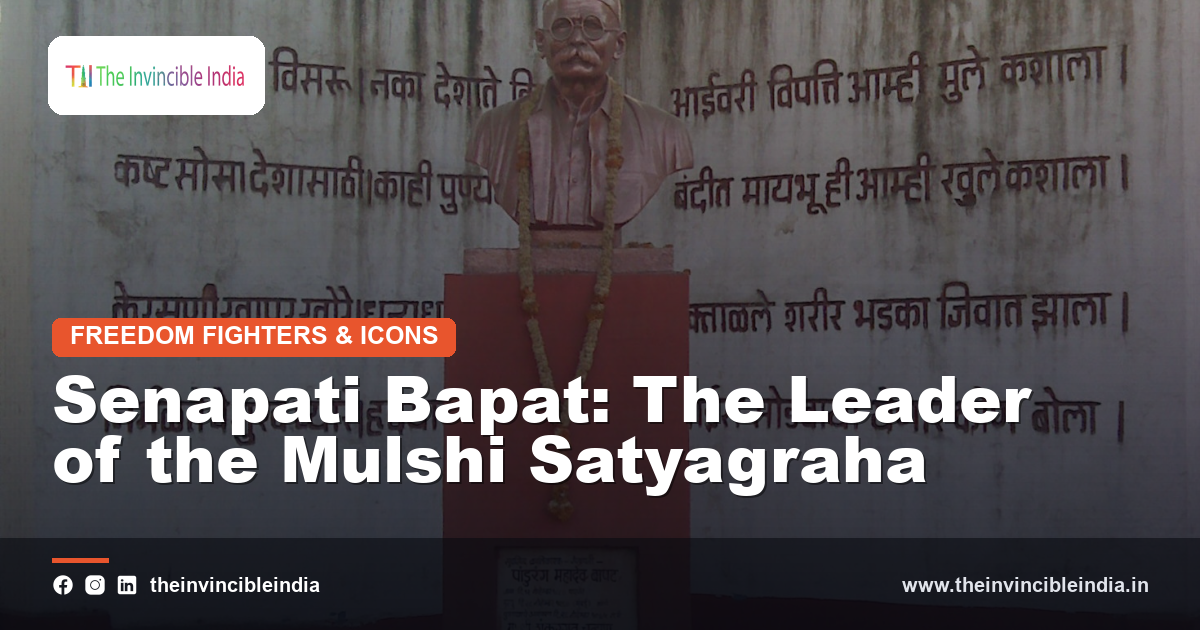
Among the many regional leaders who shaped India’s long struggle for independence, Senapati Bapat occupies a distinctive place for the manner in which he combined technical training, personal sacrifice, and grassroots organizing. Born Pandurang Mahadev Bapat, he became known across Maharashtra by the honorific “Senapati,” meaning commander, a title earned through his leadership of the Maharashtra freedom movement’s lesser-known but deeply significant Mulshi Satyagraha. Rather than fighting for independence alone, Bapat also fought for the rights of ordinary farmers whose lands and livelihoods were threatened by a large hydroelectric project, making his activism an early and important example of resistance rooted in both nationalism and social justice. His life illustrates how the freedom movement drew strength from countless local struggles across the country.
Quick Facts
| Detail | Information |
|---|---|
| Full Name | Pandurang Mahadev Bapat |
| Known As | Senapati Bapat (“the Commander”) |
| Region | Maharashtra, India |
| Famous For | Leading the Mulshi Satyagraha |
| Movement | Indian independence movement |
| Legacy | Roads, memorials, and institutions named in his honor across Maharashtra |
Early Life and Education
Pandurang Mahadev Bapat was born into a Maharashtrian family during a period when Indian society was increasingly engaging with questions of self-rule and national identity. From an early age, he displayed academic promise, and his schooling reflected the disciplined, rigorous style of education common among aspiring professionals of his generation. He eventually pursued higher studies in engineering, a field that was seen as both practically useful and prestigious, and this technical training would later distinguish him from many of his contemporaries in the freedom movement, who came primarily from legal or literary backgrounds. His years of study, including time spent abroad, exposed him to new political currents circulating among Indian students overseas, who were increasingly drawn to questions of national self-determination. This combination of scientific training and political awakening shaped the analytical yet deeply committed temperament for which he would later become known.
Formative Influences and the Turn to Nationalism
Like many young Indians of his era who studied in Britain, Bapat encountered a vibrant community of expatriate students and thinkers who debated the future of India with great intensity. These circles introduced him to a wide spectrum of nationalist thought, ranging from constitutional reform to more assertive calls for self-rule. The experience of living abroad, observing how other nations governed themselves, sharpened his conviction that India, too, deserved the right to determine its own path. On returning home, he carried with him not only technical qualifications but also a firm resolve to contribute to the national cause. This period of formation was crucial, as it set him apart from purely academic engineers and positioned him instead as someone determined to apply his skills and energy toward public service and the freedom struggle, a commitment that would only deepen in the years that followed.
Early Public Life and Activism
In the years following his return to India, Bapat gradually became involved in public affairs, aligning himself with the broader currents of the nationalist movement that were gaining momentum across the country. He was known for his willingness to engage directly with ordinary people rather than remain within elite political circles, a trait that would later prove essential to his role as a grassroots organizer. His engineering background gave him a practical understanding of infrastructure projects and their social consequences, an understanding that would become directly relevant when he later confronted a major hydroelectric development. During this formative period, he built a reputation as a sincere, disciplined, and approachable figure, willing to live simply and work closely with the communities he sought to represent. This grounding in everyday realities distinguished his activism from more abstract political theorizing.
The Origins of the Mulshi Dam Project
The Mulshi Satyagraha, the event most closely associated with Bapat’s name, arose from a large dam and hydroelectric project planned in the Mulshi region near Pune. The project was designed to generate electricity for the growing industrial needs of the area, reflecting the broader push toward modern infrastructure during the colonial period. However, its construction required the submergence of extensive agricultural land, displacing farming communities who had cultivated the region for generations. For these families, the project represented not progress but the loss of ancestral homes, fields, and a way of life that had sustained them for a long time. The dispute that followed became emblematic of a recurring tension in the era: the clash between large-scale development schemes and the rights of rural communities who bore the direct cost of those schemes without a meaningful voice in the decisions that affected them.
Farmers' Grievances and the Call for Resistance
As word spread of the impending displacement, the affected farmers sought ways to voice their opposition to the project and the manner in which it was being implemented. Their grievances centered on inadequate compensation, the loss of fertile land that could not easily be replaced, and the feeling that their interests had been disregarded in favor of industrial priorities. Bapat, moved by the plight of these communities, chose to align himself directly with their cause, lending his organizational skills and moral conviction to their struggle. He recognized that the farmers’ fight was not merely a local land dispute but part of a larger pattern in which colonial-era development often proceeded without adequate regard for those who would be displaced. By taking up their cause, he helped transform a local grievance into a wider symbol of resistance against unjust treatment of ordinary citizens.
Organizing the Mulshi Satyagraha
Drawing on the philosophy of satyagraha, or truth-force, that had become central to the Indian nationalist movement, Bapat helped organize a sustained campaign of nonviolent resistance against the dam project. This involved mobilizing affected villagers, coordinating peaceful demonstrations, and maintaining discipline among participants even in the face of provocation. Organizing such a movement required considerable logistical skill, patience, and the ability to sustain morale over an extended period, qualities that Bapat’s engineering background and calm temperament suited him well for. The satyagraha drew attention from nationalist leaders and the wider public, who saw in it a powerful demonstration of how rural communities could assert their rights through disciplined, nonviolent means. It became one of the more notable instances of localized resistance within the broader tapestry of the Indian freedom movement.
Methods of Nonviolent Protest
The Mulshi Satyagraha employed classic methods of nonviolent civil resistance, including peaceful marches, sit-ins, and the deliberate, open defiance of orders meant to halt construction activity. Participants accepted arrest and imprisonment rather than resort to violence, a discipline that lent the movement significant moral authority. Bapat himself set an example through his personal conduct, emphasizing restraint and dignity even as tensions with authorities escalated. This adherence to nonviolence reflected the broader influence of Gandhian thought on the freedom movement during this period, even in a struggle that was as much about land and livelihood as it was about national self-rule. The satyagraha thus stood as a practical demonstration of how nonviolent methods could be applied not only to explicitly political demands but also to defend the economic rights of vulnerable rural populations.
Arrest and Imprisonment
As with many satyagrahis of his generation, Bapat’s activism came at a significant personal cost, and he was arrested and imprisoned on multiple occasions by the colonial authorities for his role in organizing resistance. Prison terms were a common consequence for nationalist leaders who openly defied government orders, and Bapat bore these periods of incarceration with the same steadiness that characterized his public conduct. Rather than deterring him, these experiences appear to have reinforced his commitment to the causes he had taken up, both the farmers’ struggle and the wider fight for national independence. His willingness to accept the consequences of civil disobedience, including extended time away from his family and public life, was consistent with the broader ethic of sacrifice that defined the freedom movement and earned him respect among his fellow activists and the communities he served.
The Meaning of the Title "Senapati"
The honorific “Senapati,” meaning commander or general, was bestowed upon Bapat in recognition of the leadership he displayed during the Mulshi Satyagraha and his broader contributions to the nationalist cause. The title reflected the esteem in which he was held by fellow activists and ordinary participants, who saw in him qualities of resolve, organizational capability, and personal courage befitting a commander, albeit one who led a nonviolent campaign rather than a military one. Over time, the name Senapati Bapat effectively replaced his birth name in popular memory, illustrating how deeply his identity became tied to the movement he had led. This naming tradition, common among Indian freedom fighters who earned honorific titles through their deeds, underscores the symbolic importance that communities attached to acts of principled leadership during the independence struggle.
Connection to the Wider Freedom Movement
While the Mulshi Satyagraha remained rooted in a specific regional dispute, it was never entirely separate from the larger currents of the Indian independence movement. Bapat maintained connections with prominent nationalist figures and drew inspiration from the broader philosophy of civil disobedience that was reshaping Indian politics during this period. His activism demonstrated how local struggles for land and livelihood could reinforce, rather than distract from, the national push for self-rule, since both shared a common critique of colonial governance and its disregard for the interests of ordinary Indians. In this way, Bapat’s work in Maharashtra contributed to a broader national narrative in which the freedom movement was understood not merely as a political campaign but as a struggle encompassing economic justice, dignity, and the right of communities to shape their own futures.
Gandhian Principles in Bapat's Work
The influence of Mahatma Gandhi’s philosophy of nonviolence and constructive work is evident throughout Bapat’s public life, from his conduct during the Mulshi Satyagraha to his later social engagements. He embraced the idea that means and ends were inseparable, believing that a just cause had to be pursued through just methods. This commitment placed him firmly within the Gandhian strand of the nationalist movement, even as he also maintained sympathies with more socially oriented and reformist ideas current in his time. His approach emphasized discipline, self-restraint, and a willingness to suffer personal hardship rather than inflict harm on opponents, principles that resonated strongly with the wider satyagraha campaigns unfolding across India during the same decades. This blending of practical activism with ethical conviction remains one of the defining features of his public legacy.
Ideological Outlook and Social Concerns
Beyond his role in the Mulshi Satyagraha, Bapat was known for a broader concern with social and economic issues affecting ordinary Indians, particularly the rural poor. He engaged with ideas that emphasized self-reliance, community welfare, and the dignity of manual labor, themes that were common among socially conscious nationalists of his generation. His engineering training gave him a distinctive vantage point from which to critique development projects that prioritized industrial output over human welfare, and he remained attentive throughout his life to the ways in which technological progress could either serve or harm ordinary communities. This outlook placed him among a group of nationalist leaders who saw India’s freedom struggle as inseparable from questions of social equity, ensuring that his activism carried a dimension of economic justice alongside its explicitly political aims.
Later Public Engagements
In the years following the Mulshi Satyagraha, Bapat continued to remain active in public life, lending his voice and experience to various causes connected with social welfare and national development. Even as the political landscape shifted with the approach of independence, he remained committed to the values that had guided his earlier activism, including nonviolence, service to the underprivileged, and vigilance against unjust exercises of power. His continued engagement reflected the broader pattern among veteran satyagrahis, who often transitioned from direct anti-colonial resistance to constructive social work as the movement matured. This sustained commitment over decades illustrates the depth of his dedication, showing that his activism was never merely a single dramatic episode but part of a lifelong orientation toward public service.
Role After Indian Independence
Following India’s independence, Bapat, like many veteran freedom fighters, redirected his energies toward the challenges of nation-building rather than seeking formal political office. He remained a respected public figure whose opinions on social and civic matters continued to carry weight, particularly in Maharashtra, where his role in the Mulshi Satyagraha had already made him a well-known name. His post-independence years were marked by continued engagement with issues of social welfare, reflecting the same concerns that had animated his earlier activism. This trajectory was common among many satyagrahis of his generation, who viewed independence not as an endpoint but as the beginning of a longer process of building a just and equitable society, a process to which they continued to contribute in various capacities.
Honors and Recognition
In recognition of his decades of service to the nation, Bapat received public honors in his later years, reflecting the esteem in which he was held by both the government and the wider public. Such recognition was consistent with the broader practice of honoring veteran freedom fighters whose contributions, though sometimes regional in scope, had played an important part in the larger struggle for independence. Beyond formal honors, his enduring reputation is reflected in the continued use of his honorific title, “Senapati,” which remains closely associated with his name to this day. This lasting recognition underscores how his particular blend of technical competence, moral conviction, and grassroots leadership left a distinctive and respected mark on the history of the Indian freedom movement.
Memorials and Commemoration in Maharashtra
Today, Bapat’s legacy is preserved through various memorials, public spaces, and institutions across Maharashtra that bear his name, particularly in and around Pune, the region closest to the site of the Mulshi Satyagraha. Statues, roads, and public squares named in his honor serve as everyday reminders of his contributions, ensuring that new generations encounter his story even outside formal history lessons. Local historical and cultural organizations occasionally highlight his role in commemorative events, situating him within the broader narrative of Maharashtra’s contribution to the national freedom struggle. These forms of commemoration reflect the enduring regional pride associated with his leadership, while also linking his story to the wider, shared history of India’s path to independence.
Senapati Bapat Today
Senapati Bapat’s story continues to resonate today as an example of how the Indian freedom movement was built not only through prominent national leaders but also through determined regional figures who confronted specific injustices with courage and discipline. His leadership of the Mulshi Satyagraha remains a notable case study in how nonviolent resistance could be mobilized in defense of displaced farmers, linking questions of land, livelihood, and dignity to the broader struggle against colonial rule. His life offers a reminder that the path to independence was paved by countless such local struggles, each contributing its own chapter to the larger story. Remembered today through memorials across Maharashtra and through his enduring honorific title, Bapat remains an important figure in the collective memory of India’s freedom struggle.
Sources & Further Reading
- Ministry of Culture, Government of India (indiaculture.gov.in).
- National Archives of India (nationalarchives.nic.in).
Frequently Asked Questions
Who was Senapati Bapat?
Senapati Bapat, born Pandurang Mahadev Bapat, was an Indian freedom fighter from Maharashtra best known for leading the Mulshi Satyagraha, a nonviolent movement against a hydroelectric dam project that displaced local farmers.
What was the Mulshi Satyagraha?
The Mulshi Satyagraha was a nonviolent protest movement organized against a large dam project near Pune that threatened to submerge agricultural land and displace farming communities in the Mulshi region.
Why is he called "Senapati"?
“Senapati,” meaning commander, was an honorific title given to him in recognition of the leadership and organizational skill he displayed while guiding the Mulshi Satyagraha and other public causes.
What methods did the Mulshi Satyagraha use?
Participants relied on classic satyagraha methods, including peaceful marches, sit-ins, and deliberate nonviolent defiance of construction orders, accepting arrest rather than resorting to violence.
How is Senapati Bapat remembered today?
He is remembered through statues, roads, and public spaces named in his honor across Maharashtra, and his story remains a respected part of the regional and national history of India’s freedom movement.