


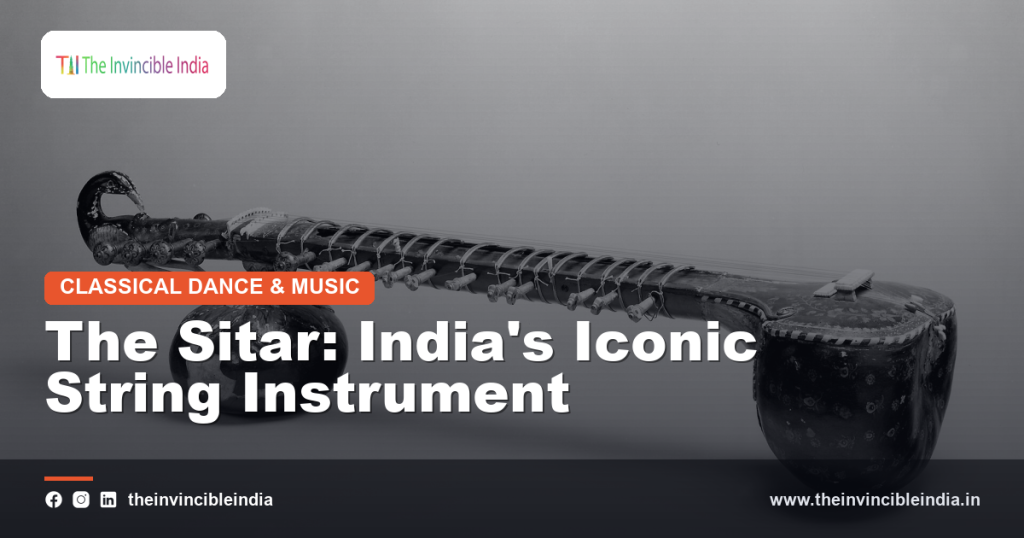
The sitar is the most famous and recognisable string instrument of India, celebrated around the world for its shimmering, resonant sound and its central place in Hindustani classical music. A long-necked plucked lute with a gourd body, movable frets and a wealth of strings, it is capable of the sliding notes and delicate ornaments that give Indian music its distinctive voice. In the hands of a master, the sitar can unfold a raga with breathtaking beauty, from a slow, meditative opening to a thrilling, fast-paced climax. Carried to global fame in the twentieth century, it has become an emblem of Indian music itself. This guide explores the sitar’s structure, sound, playing technique, great masters and worldwide influence.
Quick Facts
| Detail | Information |
|---|---|
| Type | A long-necked plucked string instrument (lute) |
| Tradition | Central to Hindustani classical music of North India |
| Body | A large gourd resonator with a long, hollow neck |
| Strings | Playing strings, drone strings and sympathetic strings |
| Signature sound | Shimmering and resonant, with sliding notes (meend) |
| Global fame | Popularised worldwide in the twentieth century |
The Voice of Indian Music
For many people around the world, the sound of the sitar is the sound of India itself. Its shimmering, resonant tone, rich with overtones and capable of expressive slides between notes, has come to symbolise Indian classical music in the global imagination. Within the Hindustani tradition, the sitar is one of the leading melodic instruments, used to perform ragas with a depth and subtlety that rival the human voice. Its distinctive sound arises from its unique construction, with its many strings and its special bridge, and its capacity for both meditative beauty and dazzling virtuosity has made it one of the most beloved and iconic instruments in all of music.
The Structure of the Sitar
The sitar is a large and elegant instrument, built around a resonating chamber made from a hollowed gourd, from which rises a long, broad, hollow wooden neck. A second, smaller gourd is often attached near the top of the neck to add resonance. Along the neck run the frets, and above them the strings stretch from the tuning pegs down to the bridge on the main body. The instrument’s considerable size and its many strings give it its deep, full sound and its wide range. Beautifully crafted, often decorated with intricate ornamentation, the sitar is as pleasing to the eye as to the ear.
The Strings
Much of the sitar’s magic lies in its strings, which fall into three groups. There are the main playing strings, on which the melody is played, including a string used for the drone and rhythmic strumming; there are additional strings used for the drone and to mark rhythm; and, crucially, there is a set of sympathetic strings, called tarab, which run beneath the frets and are not played directly. These sympathetic strings vibrate on their own in response to the notes played above, creating the shimmering halo of resonance that gives the sitar its characteristic sound. The rich interplay of played and sympathetic strings is essential to the instrument’s distinctive and beautiful voice.
The Movable Frets
The frets of the sitar are curved metal bars tied onto the neck with thread, and, unusually, they can be moved. This allows the player to adjust the exact position of the notes to suit the particular raga being performed, since Indian music uses subtle intervals that differ from raga to raga. The arched shape of the frets, raised above the neck, also allows the player to pull the string sideways across the fret to bend its pitch, producing the sliding notes that are so central to Indian music. This system of movable, arched frets is one of the sitar’s most distinctive and important features, enabling both its tuning flexibility and its expressive slides.
The Jawari and Its Sound
The characteristic buzzing, shimmering timbre of the sitar comes in large part from its bridge, and from the subtle craft known as jawari. The bridge has a broad, gently curved surface over which the strings pass, and the precise shaping of this surface causes the strings to buzz against it in a controlled way, producing the rich, sustained, overtone-laden tone for which the sitar is famous. Maintaining and shaping the jawari is a specialised skill, and the quality of the jawari greatly affects the beauty of the instrument’s sound. This distinctive resonance, at once bright and complex, is central to the sitar’s unmistakable voice.
Playing the Sitar
The sitar is played sitting down, with the instrument held at an angle across the body. The strings are plucked with a wire plectrum, called a mizrab, worn on the index finger of the playing hand, while the other hand presses and slides along the strings on the frets to produce the notes and their ornaments. A central technique is the meend, the pulling of the string sideways to bend its pitch, which allows the player to glide smoothly between notes in the manner so essential to Indian music. Mastering the plucking, the fretting and above all the expressive slides and ornaments requires great skill and long practice.
Performing a Raga
On the sitar, a raga is typically unfolded in a structured sequence that mirrors the shape of Indian classical performance. It begins with the alap, a slow, free exploration of the raga without rhythm, in which the player gradually reveals its notes, phrases and mood. This leads into the jor, where a pulse emerges, and the jhala, a fast, exciting section of rhythmic strumming. Then comes the gat, a composition set to a tala and accompanied by the tabla, within which the player improvises, building to a thrilling climax. This progression, from meditative opening to virtuosic finale, allows the sitar to reveal the full depth and beauty of a raga.
The Sitar and the Tabla
In the composed, rhythmic portion of a performance, the sitar is joined by the tabla, and the interplay between the two is a highlight of Hindustani instrumental music. Once the gat begins, the tabla keeps the tala and enters into a lively dialogue with the sitar, the two instruments answering and challenging one another, trading rhythmic phrases and building together towards exciting climaxes on the sam, the first beat of the cycle. This partnership of melody and rhythm, of sitar and tabla, is central to the excitement of a concert, and the rapport between the two players can lift a performance to great heights of energy and inspiration.
Origins and Development
The sitar developed in North India over the past several centuries, evolving within the tradition of Hindustani classical music. Its name derives from a Persian term, reflecting the Persian influence on North Indian music, and the instrument is related to earlier long-necked lutes of the region and of Central Asia. As with several Indian instruments, tradition associates its development with the medieval poet-musician Amir Khusrau, though its form as known today emerged later. Over time the sitar was refined into the sophisticated instrument of the present, with its full complement of sympathetic strings and its distinctive bridge, becoming one of the pre-eminent melodic instruments of the Hindustani tradition.
The Great Masters
The sitar has been graced by a line of great masters whose artistry raised it to the heights of classical music and, in the twentieth century, carried it to the world. These virtuosos developed the technique and repertoire of the instrument, founded and represented its stylistic lineages, and gave performances of extraordinary depth and brilliance. Through their concerts, recordings and teaching, they trained new generations of players and won vast audiences at home and abroad. Their dedication established the sitar firmly among the great instruments of the world and inspired countless musicians to take it up. The living tradition of the sitar today rests on the foundations these masters laid.
The Sitar Goes Global
In the second half of the twentieth century, the sitar achieved worldwide fame, becoming known far beyond the world of Indian classical music. Great Indian masters performed to international audiences and collaborated with musicians from other traditions, and the instrument’s distinctive sound was taken up in Western popular and rock music, introducing it to millions who had never encountered Indian classical music. This global moment made the sitar one of the most recognisable of all instruments and a symbol of India’s musical heritage. It also sparked wider interest in Indian classical music around the world, an interest that endures, and inspired players in many countries to study the instrument seriously.
Learning the Sitar
Learning the sitar is a long and demanding journey, traditionally undertaken under the guidance of a guru. Students must master the physical technique of plucking with the mizrab and fretting and sliding the strings, develop the expressive control needed for the meend and other ornaments, and absorb the vast knowledge of ragas, talas and the structure of performance. Much is learned through listening, imitation and the close relationship with the teacher, and the training takes many years of dedicated daily practice. Beyond technique, the student must develop musicality and a deep feeling for the ragas, and it is through this committed apprenticeship that the art of the sitar is passed on.
Gayaki and Tantrakari Styles
Sitar playing embraces two broad approaches, and the finest artists blend them. The gayaki style seeks to imitate the human voice, drawing out long, singing, expressive lines full of the slides and ornaments of vocal music, so that the sitar seems almost to sing a raga. The tantrakari style, by contrast, is idiomatic to the instrument itself, delighting in fast runs, rhythmic patterns and the brilliant plucking techniques that the strings make possible. The interplay of these two approaches, the lyrical and the virtuosic, gives sitar performance its balance of depth and dazzle, and a master player moves between them to reveal both the emotional and the technical richness of the instrument.
The Sitar Today
Today the sitar flourishes as one of the leading instruments of Hindustani classical music and as a globally admired symbol of Indian music. It is performed in concerts across India and the world, taught through traditional lineages and in music schools, and embraced in new musical collaborations far beyond its classical home. New generations of players continue the great traditions established by the masters while exploring fresh possibilities. In its shimmering sound, its expressive slides and its capacity to unfold a raga in all its beauty, the sitar remains one of the glories of Indian music and one of the most beloved and iconic instruments in the world.
Sources & Further Reading
- Sangeet Natak Akademi, national academy for music, dance and drama, on Indian classical instruments (sangeetnatak.gov.in).
- Ministry of Culture, Government of India, on the classical music traditions of India (indiaculture.gov.in).
Frequently Asked Questions
What is a sitar?
The sitar is India’s most famous string instrument, a long-necked plucked lute with a gourd body, movable frets and many strings, used to perform the ragas of Hindustani classical music. It is known for its shimmering, resonant sound and its expressive sliding notes.
What are the sympathetic strings on a sitar?
The sympathetic strings, called tarab, run beneath the frets of the sitar and are not played directly. They vibrate on their own in response to the notes played above, creating the shimmering halo of resonance that gives the sitar its characteristic sound.
Why does the sitar have a buzzing sound?
The sitar’s characteristic buzzing, shimmering timbre comes from its bridge and the craft known as jawari, in which the broad, gently curved surface of the bridge is shaped so the strings buzz against it in a controlled way, producing a rich, overtone-laden tone.
How is a raga performed on the sitar?
A raga on the sitar typically unfolds from the alap, a slow, free exploration without rhythm, through the jor and the fast jhala, into the gat, a composition set to a tala and accompanied by the tabla, within which the player improvises and builds to a climax.
What is a mizrab?
A mizrab is the wire plectrum worn on the index finger of the playing hand, used to pluck the strings of the sitar. The other hand presses and slides along the strings on the frets to produce the notes and their ornaments.