


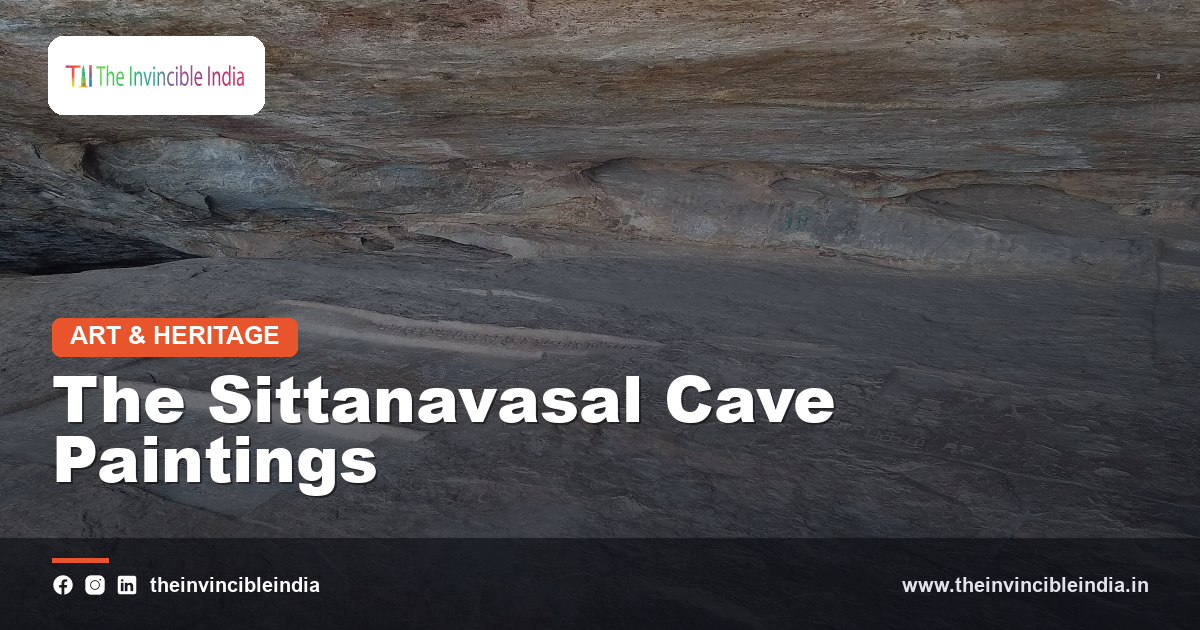
Tucked into a quiet hillside in the Pudukkottai district of Tamil Nadu, the Sittanavasal cave is one of South India’s most remarkable survivals of early medieval religious art. Known locally as Arivar Koil, this modest Jain rock-cut shrine holds a ceiling painting of a lotus pond that ranks among the finest examples to have come down from its era, standing alongside the broader early cave painting traditions of India. Carved directly into granite rock and accompanied by rows of polished stone beds once used by resident ascetics, the site offers a rare, intimate window into the artistic, architectural, and spiritual life of a Jain monastic community. This guide explores its history, technique, iconography, and enduring significance.
Quick Facts
| Detail | Information |
|---|---|
| Location | Sittanavasal, Pudukkottai district, Tamil Nadu |
| Type | Jain rock-cut cave shrine with murals |
| Also Known As | Arivar Koil, the Abode of the Sages |
| Art Form | Fresco-secco ceiling and pillar paintings |
| Associated Faith | Jainism |
| Protection | Centrally protected monument, Archaeological Survey of India |
Where Sittanavasal Lies
Sittanavasal is a small village in the Pudukkottai district of Tamil Nadu, set amid the dry, boulder-strewn landscape typical of the region’s interior plains. The site takes its name, in local tradition, from a phrase suggestive of “the abode of great saints,” a fitting description for a place long associated with ascetic retreat. A low outcrop of granite rock known locally as Eladipattam rises above the surrounding fields, and it is within this hill that the cave shrine and its accompanying chambers are carved.
The setting reflects a pattern common to early Jain and Buddhist establishments across South India, where natural rock formations on the margins of settled land were adapted into shelters for monks who had renounced worldly life. The relative isolation of the hill, away from the bustle of a town, would have suited a community seeking quiet and simplicity. Today the approach to the site still passes through open countryside before reaching the rock-cut steps leading up to the cave.
A Jain Retreat Carved in Stone
The Sittanavasal cave is popularly known as Arivar Koil, or the temple of the enlightened ones, a name that points directly to its origins as a Jain sanctuary rather than a Hindu or Buddhist one. It belongs to a broader tradition of rock-cut Jain establishments that spread across the Tamil country in the early medieval period, when ascetics sought out hills and caverns suitable for meditation and communal living.
Unlike free-standing temples built up from a foundation, the shrine at Sittanavasal was hollowed directly out of the living rock, a method that demanded patience and skilled labor but produced a structure inherently durable and resistant to the elements. The resulting sanctuary is modest in scale compared with the great rock-cut complexes of western India, yet it holds a place of particular importance in South Indian art history because of the paintings that survive within it.
The Rock Beds of the Ascetics
Adjoining the painted cave, and cut into the same outcrop, are a number of polished stone beds arranged within a series of natural and man-made shelters nearby. These beds, low rectangular platforms carved directly from the rock with a slightly raised portion to serve as a pillow, are a recurring feature of Jain and Buddhist monastic sites across South India. They indicate that Sittanavasal was not simply a shrine to be visited but an active dwelling place for a small community of monks.
The beds are typically arranged in rows within shallow shelters, offering minimal but sufficient protection from rain and sun. Some bear traces of inscriptions in early Tamil-Brahmi script, associated with donors or resident ascetics, underscoring the site’s long use as a functioning retreat rather than an isolated monument.
Rediscovery and Recognition
For centuries, Sittanavasal remained known chiefly to local communities and pilgrims, its significance to the wider world becoming clear only once scholars and antiquarians began documenting rock-cut monuments across the Tamil country in the modern era. As surveys of South Indian antiquities expanded, the cave’s paintings drew particular attention for their rarity, since surviving early medieval murals of this quality are uncommon outside a handful of celebrated sites.
Recognition brought both benefits and responsibilities. The site was eventually brought under the protection of heritage authorities, ensuring that its fragile paintings would not be lost to neglect or disturbance. Sittanavasal today is classified as a centrally protected monument, a status that allows regulated conservation work while restricting activities that could damage the delicate rock surfaces and pigments.
The Fresco-Secco Technique
The murals at Sittanavasal were executed using a method generally described as fresco-secco, in which pigments are applied to a plaster surface after it has dried, rather than while it is still wet as in true fresco. A fine lime-based plaster was first spread over the rock ceiling and walls to create a smooth, receptive ground, and the painted designs were then built up in layers of natural color.
This technique required considerable skill, since pigments bound to a dry surface are less durable than those absorbed into wet plaster, and the artists compensated with careful preparation of both the surface and the binding medium. The survival of the paintings across many centuries, despite humidity and the general vulnerability of secco work, speaks to the quality of that preparation.
The Ceiling Paintings: A Lotus Pond
The most celebrated portion of the Sittanavasal murals covers the ceiling of the front mandapam, where a lotus pond teeming with life is rendered in flowing, naturalistic lines. Lotus blossoms and leaves spread across the composition, interspersed with fish, geese, buffaloes wading through the water, and figures gathering the flowers. The scene has an unmistakable liveliness, achieved through confident outlines and a restrained but effective use of color.
Scholars generally read the pond as more than decoration, seeing in it a symbolic representation tied to Jain devotional themes, in which a lotus tank can stand for purity, abundance, and spiritual attainment. Whatever its precise doctrinal reading, the composition remains one of the finest surviving examples of narrative and decorative painting from early medieval South India.
Dancers and Later Additions
On the pillars of the cave, distinct in style from the ceiling composition, are painted figures of dancers rendered with swaying postures and ornamented limbs. Art historians generally regard these figures as later additions to the shrine, executed under subsequent patronage after the original ceiling paintings had already been completed, reflecting a different aesthetic sensibility attuned to the tastes of a later period.
The presence of these later paintings illustrates how the cave continued to attract patronage and artistic attention long after its initial excavation and decoration. Such layering of artistic phases is not unusual at long-used rock-cut sites, where successive generations of donors added their own contributions to an already sacred space.
Pigments and Palette
The colors used at Sittanavasal were drawn from naturally occurring mineral and earth sources, a practice common to early Indian mural traditions before the availability of synthetic pigments. Ochres and red earths supplied warm tones, while various greens, likely derived from mineral sources, gave the pond and foliage their characteristic hues. Black outlines, often made from carbon-based pigments, define the forms with precision, and white was used sparingly for highlights.
This limited but carefully chosen palette allowed the artists to achieve a surprising range of tonal effects through layering rather than through a wide variety of raw materials, contributing to the harmonious, unified appearance of the ceiling composition as a whole.
Echoes of Ajanta
Visitors and scholars alike have long noted stylistic affinities between the Sittanavasal paintings and the more extensively documented murals of Ajanta in the Deccan, particularly in the fluid line work, the naturalistic treatment of plant and animal forms, and certain conventions of figure drawing. These parallels have led many art historians to place Sittanavasal within a broader pan-Indian painting tradition of the early medieval period.
At the same time, Sittanavasal is not a mere copy of northern or Deccan models. Its Jain subject matter and the specific treatment of the lotus pond give it a distinct regional character, shaped by Tamil artistic sensibilities and the particular religious context of the shrine.
Patronage in the Pallava Period
The excavation and painting of the Sittanavasal cave are generally associated with the broader flourishing of rock-cut architecture in Tamil Nadu during the Pallava period, when royal and local patrons across the region supported the carving of cave temples and shrines for various faiths, including Jainism. The Pallavas are best known for their Shaivite and Vaishnavite rock-cut monuments elsewhere in Tamil Nadu, but their era also saw considerable Jain activity.
Precise attributions of patronage at Sittanavasal remain a matter of scholarly discussion rather than settled fact, and it is safest to describe the site as a product of this general climate of rock-cut patronage rather than to assign it to a single named ruler.
Pandya-Era Continuity
In the centuries following its initial excavation, the Sittanavasal region came under the influence of the Pandya dynasty, which continued to rule over much of the Tamil country and maintained an interest in religious institutions of various kinds, including Jain establishments. The later pillar paintings of dancing figures are often linked to this subsequent period of patronage, reflecting the site’s continued relevance well after its founding phase.
This continuity across dynastic changes underscores an important feature of many Tamil rock-cut sites: they were rarely static monuments frozen at the moment of their creation, but living religious spaces that could receive new patrons and new contributions across generations.
Architectural Details of the Cave
Beyond its paintings, the Sittanavasal cave displays architectural features characteristic of Pallava-period rock-cut work, including sturdy pillars with simple capitals and brackets that lend the mandapam a sense of structural clarity despite being carved rather than built. The proportions of the front hall are compact, in keeping with the modest scale typical of Jain rock-cut shrines in the Tamil region.
Sculptural elements accompany the architecture in places, complementing the painted surfaces. The overall design reflects a functional approach to sacred space, prioritizing a sheltered area suitable for worship over elaborate ornamentation, offering insight into the values of the ascetic community for whom the cave was carved.
Jain Heritage of the Wider Region
Sittanavasal is not an isolated phenomenon but part of a wider network of Jain rock-cut sites scattered across the hills of Tamil Nadu and neighboring regions, many bearing early Tamil-Brahmi inscriptions and rock beds similar to those found here. These sites collectively attest to a significant and sustained Jain presence in South India during the early historic and early medieval periods.
Studying Sittanavasal alongside these related sites helps place its paintings and architecture in proper context, revealing shared conventions in site selection and inscriptional practice across the broader Jain monastic network that once flourished in the Tamil country.
Conservation Challenges
Preserving the Sittanavasal paintings presents significant challenges, since fresco-secco pigments applied over a millennium ago are inherently fragile and vulnerable to humidity, temperature fluctuation, and physical contact. Moisture seepage through the rock, in particular, poses an ongoing threat to the plaster ground on which the colors rest, and even minor changes in the cave’s microclimate can accelerate deterioration.
Heritage authorities responsible for the site have undertaken conservation measures aimed at stabilizing the plaster and limiting further pigment loss, alongside steps such as regulating visitor access to the most sensitive areas, balancing public appreciation against the imperative of preservation.
Significance in Indian Art History
Sittanavasal occupies a distinctive place in the history of Indian painting precisely because so few early medieval murals survive outside a small number of well-known sites. Its lotus pond ceiling offers valuable evidence of the sophistication achieved by South Indian artists working in a demanding medium, and its explicitly Jain iconography broadens the picture of religious art in the region.
For historians of Tamil Nadu’s religious and cultural life, the cave also illustrates the interplay between Jain monastic practice and artistic patronage, showing how ascetic communities could be centers of considerable aesthetic achievement even while emphasizing renunciation.
Sittanavasal Today
Sittanavasal today draws visitors interested in art history, Jain heritage, and the rock-cut monuments of Tamil Nadu, standing as a quiet but significant stop for those tracing the region’s early medieval religious and artistic history. The climb to the cave, past the rock beds and up to the painted mandapam, offers a tangible sense of the ascetic setting in which the shrine was created and used.
Even with the fading of some painted surfaces over time, the surviving portions of the lotus pond ceiling continue to convey the skill of the artists who worked here many centuries ago, securing Sittanavasal a lasting place in the wider story of Indian mural painting.
Sources & Further Reading
- Archaeological Survey of India (asi.nic.in).
- Tamil Nadu Department of Archaeology (tnarch.tn.gov.in).
Frequently Asked Questions
What is Sittanavasal famous for?
Sittanavasal is famous for its Jain rock-cut cave shrine, popularly called Arivar Koil, and in particular for the rare early medieval fresco-secco paintings on its ceiling, most notably a detailed depiction of a lotus pond.
Which religion is associated with the Sittanavasal cave?
The cave is a Jain monument, built and used by ascetics of the Jain tradition as a place of retreat and worship. Its iconography and layout reflect established conventions of South Indian Jain rock-cut architecture.
What painting technique was used at Sittanavasal?
The murals were created using a fresco-secco method, in which natural mineral pigments were applied to a dry lime-plaster surface. This differs from true fresco, where pigment is applied to wet plaster.
Where is Sittanavasal located?
Sittanavasal is located in the Pudukkottai district of Tamil Nadu, carved into a rocky outcrop known locally as Eladipattam amid the surrounding countryside.
Is Sittanavasal a protected monument?
Yes, Sittanavasal is recognized as a centrally protected monument, which places it under the care of heritage authorities responsible for its conservation and regulated public access.