


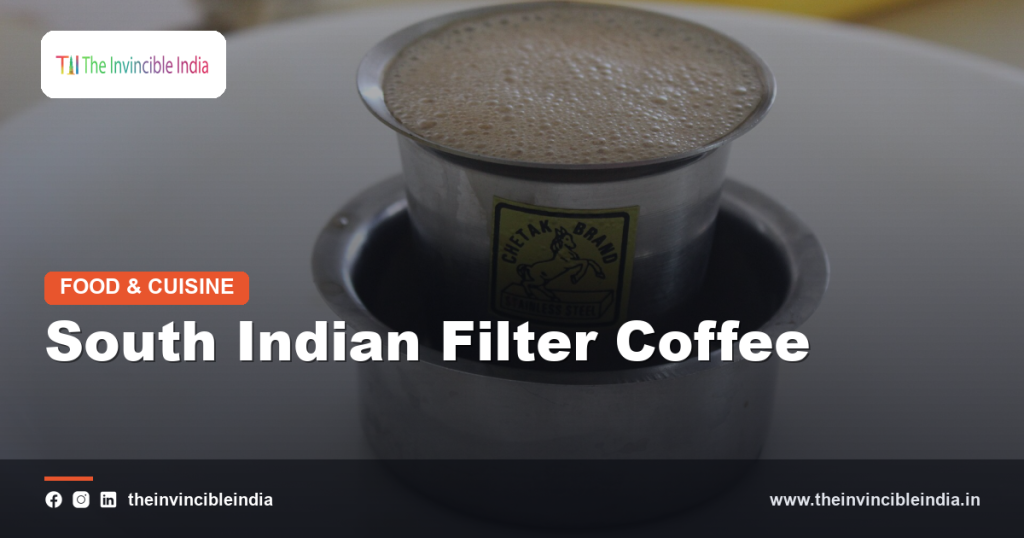
South Indian filter coffee is one of the most cherished daily rituals in the whole of Indian food culture, a strong, aromatic coffee brewed slowly through a traditional metal filter and served frothing hot in a distinctive tumbler and davara, often alongside a South Indian breakfast. Deeply rooted in the coffee-growing regions of the south, this coffee is treasured not merely as a drink but as a ritual, its brewing and serving following a beloved and unhurried tradition passed down through generations of South Indian households. From the slow drip of the decoction to the practised pour that creates its characteristic froth, every step of the process is cherished. This guide explores South Indian filter coffee, its tradition, its preparation and its treasured place in daily life.
Quick Facts
| Detail | Information |
|---|---|
| Region | South India, especially Tamil Nadu and Karnataka |
| Key tool | The traditional metal filter |
| Base | A strong coffee decoction |
| Served in | A tumbler and davara |
| Character | Strong, frothy and aromatic |
| Role | A cherished daily ritual |
South Indian Filter Coffee
South Indian filter coffee holds a place in the daily life of the region unlike that of almost any other drink, a strong, aromatic coffee whose brewing and serving follow a beloved and unhurried ritual passed down through generations. Far more than a quick morning pick-me-up, filter coffee is prepared with patience and care, from the slow drip of the decoction through a traditional metal filter to the practised pour that whips up its characteristic froth. Its ritual quality sets it apart. This cherished and unhurried ritual quality of South Indian filter coffee, prepared with patience from decoction to frothy pour, sets it apart from an ordinary cup of coffee, and this ritual remains one of the most treasured daily customs across South India.
Origins and Tradition
Coffee has long been cultivated in the hill regions of South India, and over generations the region developed its own distinctive way of brewing and enjoying the drink, quite different from coffee traditions elsewhere in the world. This South Indian style, built around a slow-brewed decoction and a distinctive method of serving, became deeply woven into the daily habits and hospitality of households across the region, passed down as a cherished tradition from one generation to the next. This traditional roots run deep. These deep traditional roots of South Indian filter coffee, woven into the daily habits and hospitality of the region for generations, run through the culture of the south, and this inherited tradition remains as central to daily life today as it has long been.
The Traditional Filter
At the heart of the tradition lies the filter itself, a simple two-chambered metal device in which coarsely ground coffee is packed and hot water is poured over it to slowly drip through into a strong decoction below. This slow, patient dripping, taking a good while to complete, is essential to the flavour, extracting a rich, strong essence from the coffee that cannot be hurried without losing its characteristic depth. This slow process is central to the ritual. This slow and patient dripping process at the heart of the traditional filter is central to the ritual of South Indian coffee, and the resulting strong, rich decoction is the very foundation on which the entire cherished tradition depends.
Preparing the Decoction
The decoction produced by the filter is a concentrated, strong coffee essence, carefully brewed and often prepared well ahead of when it is needed, ready to be diluted with hot milk at a moment’s notice. Many households keep a store of freshly made decoction on hand throughout the day, treating its preparation as an important daily task, since a well-made decoction is considered the true secret to a satisfying cup of filter coffee. This careful preparation defines quality. This careful and often advance preparation of the decoction, treated as an important daily task in South Indian households, defines the quality of the final cup, and a well-made decoction remains the true secret behind the tradition’s beloved flavour.
The Tumbler and Davara
South Indian filter coffee is traditionally served in a distinctive set of vessels, a small metal tumbler set within a wider metal bowl known as the davara, together forming an iconic image associated with the drink across the country. The davara serves a practical purpose, allowing the hot coffee to cool slightly as it is poured back and forth, while the pairing of tumbler and davara has become a beloved symbol of South Indian coffee culture in its own right. This iconic pairing is instantly recognisable. This iconic pairing of tumbler and davara, practical in cooling the coffee and beloved as a symbol of the tradition, is instantly recognisable across India, and this distinctive vessel set remains inseparable from the identity of South Indian filter coffee.
The Art of the Froth
A defining feature of South Indian filter coffee is its froth, achieved through the practised technique of pouring the coffee back and forth between the tumbler and davara from a height, aerating it until a light foam forms on top. This pouring technique, requiring a steady hand and practised skill, is considered essential to a proper cup, and the resulting froth is prized not just for appearance but for the way it softens and rounds out the strong flavour of the coffee. This frothing skill is much admired. This practised pouring technique that creates the characteristic froth of South Indian filter coffee is much admired, and mastering this skill, passed down through households, is considered an essential part of preparing the drink properly.
Coffee Estates of South India
The coffee used in this tradition is grown in the hill regions of South India, where estates in favourable climates have long cultivated coffee alongside other crops, contributing to a rich regional coffee culture. These growing regions have shaped the character of South Indian coffee, their beans forming the foundation of the strong, aromatic decoction so central to the tradition, and the connection between these estates and the daily ritual of filter coffee remains a source of regional pride. This connection to the land is significant. This connection between the coffee-growing hill regions of South India and the daily ritual of filter coffee is significant to the tradition, and this link between land and cup remains a proud part of the region’s coffee culture.
Coffee in Tamil Nadu
In Tamil Nadu, filter coffee holds an especially cherished place, deeply woven into daily routines, hospitality and even religious and family customs across the state. Offering a guest a cup of filter coffee is considered a fundamental act of hospitality, and the drink is prepared and enjoyed multiple times a day in many households, its aroma and ritual a familiar and comforting part of everyday life throughout the state. This deep place in daily life is notable. This especially cherished place of filter coffee in the daily routines and hospitality of Tamil Nadu is notable even within the wider South Indian tradition, and the drink remains one of the most treasured customs of the state’s culture.
Coffee in Karnataka
Karnataka, home to some of India’s most important coffee-growing districts, has its own strong and cherished filter coffee tradition, closely tied to the state’s role as a major producer of the bean. The connection between cultivation and consumption is especially close here, with many households and coffee houses taking particular pride in sourcing and brewing coffee true to the region’s rich growing heritage. This close connection to cultivation is distinctive. This close connection in Karnataka between coffee cultivation and the state’s own filter coffee tradition is distinctive within South India, and this pride in local sourcing and brewing remains a notable feature of the region’s coffee culture.
Coffee in Andhra and Telangana
In Andhra Pradesh and Telangana, filter coffee is likewise a cherished part of daily life, prepared according to the same broad tradition of decoction, tumbler and davara while carrying its own local touches and preferences. The drink is enjoyed throughout the day in households and small coffee establishments alike, its familiar aroma and ritual forming a comforting thread that runs through daily routines across these Telugu-speaking states. This shared yet local tradition endures. This shared yet locally flavoured tradition of filter coffee in Andhra Pradesh and Telangana endures as a comforting daily ritual, and its presence across these states shows how widely the South Indian filter coffee tradition has taken root beyond its most closely associated regions.
The Morning Ritual
For countless South Indian households, the day scarcely begins without a cup of filter coffee, its preparation and enjoyment forming an essential and unhurried part of the morning routine. The aroma of the brewing decoction, the practised pour that creates the froth, and the first sip of the hot, strong coffee together mark the true start of the day for many, a small but deeply cherished ritual repeated every single morning. This morning ritual is deeply ingrained. This deeply ingrained morning ritual of South Indian filter coffee, marking the true start of the day for countless households, remains one of the most cherished and unchanging customs in the daily life of the region.
Filter Coffee and Hospitality
Offering filter coffee to a guest is one of the most fundamental gestures of hospitality across South India, a small but meaningful act of welcome extended in homes throughout the region. A guest arriving at a South Indian household can expect to be offered a cup of filter coffee almost as a matter of course, the drink serving as a warm and immediate expression of welcome that transcends mere refreshment. This hospitality role is deeply valued. This role of filter coffee as a fundamental gesture of hospitality across South India, offered almost as a matter of course to guests, is deeply valued throughout the region, and this simple act of welcome remains one of the drink’s most cherished social functions.
Filter Coffee Versus Instant Coffee
Despite the convenience of instant coffee, many South Indian households remain devoted to the traditional filter method, valuing the depth of flavour and the ritual of preparation that instant coffee cannot replicate. For those raised on the tradition, the taste and process of filter coffee are considered far superior, and the slower, more deliberate method is preferred even when a quicker alternative is readily available. This preference for tradition remains strong. This continued preference for traditional filter coffee over instant alternatives, valued for its depth of flavour and its ritual, remains strong across South India, and this loyalty to tradition is a testament to how deeply the practice is cherished.
Filter Coffee in Coffee Houses
Beyond the home, filter coffee is served in countless small coffee houses and eateries across South India, establishments often as beloved for their coffee as for their food, drawing loyal regulars who return daily for their preferred cup. These establishments frequently pride themselves on their own particular blend and brewing method, and a visit to a favourite coffee house for a cup of filter coffee is, for many, as much a social ritual as a culinary one. This coffee house culture is cherished. This cherished culture of small coffee houses across South India, beloved for serving filter coffee prepared with pride and consistency, forms an important part of the region’s social and culinary life, drawing loyal regulars to their favourite cup day after day.
South Indian Filter Coffee Today
Today South Indian filter coffee continues to be cherished as a beloved daily ritual, its traditional filter, its slow-brewed decoction, and its frothy pour into tumbler and davara enduring largely unchanged despite the pace of modern life. Across Tamil Nadu, Karnataka, Andhra Pradesh, Telangana and beyond, the drink remains woven into hospitality, morning routines and social life, its aroma as comforting today as it has long been. Its enduring appeal remains undiminished. As one of the most cherished daily rituals in South Indian food culture, strong, frothy and steeped in tradition, filter coffee endures as a beloved symbol of the region’s hospitality and its deep and enduring love of a well-made cup.
Sources & Further Reading
- Coffee Board of India, Ministry of Commerce and Industry, Government of India (indiacoffee.org).
- Culinary references on the regional food traditions of India.
Frequently Asked Questions
What is South Indian filter coffee?
South Indian filter coffee is a strong, aromatic coffee brewed by slowly dripping hot water through coarsely ground coffee in a traditional two-chambered metal filter, then diluted with hot milk and served frothy in a distinctive tumbler and davara.
What is a davara?
A davara is the wide metal bowl in which the tumbler of filter coffee is traditionally served in South India. Pouring the coffee back and forth between the tumbler and davara helps cool it slightly and creates the characteristic froth prized in the drink.
Why is filter coffee poured back and forth?
Filter coffee is poured back and forth between the tumbler and davara from a height to aerate the drink, creating a light froth on top. This practised technique is considered essential to a properly prepared cup and softens the strong flavour of the coffee.
Where is South Indian filter coffee most popular?
South Indian filter coffee is especially cherished in Tamil Nadu and Karnataka, with strong traditions also found in Andhra Pradesh and Telangana. Karnataka is additionally home to some of India’s most important coffee-growing districts.
Why do people prefer filter coffee to instant coffee?
Many South Indians prefer filter coffee to instant coffee because of its deeper, richer flavour from the slow-brewed decoction and the cherished ritual of its preparation and serving, which instant coffee cannot replicate despite its convenience.