


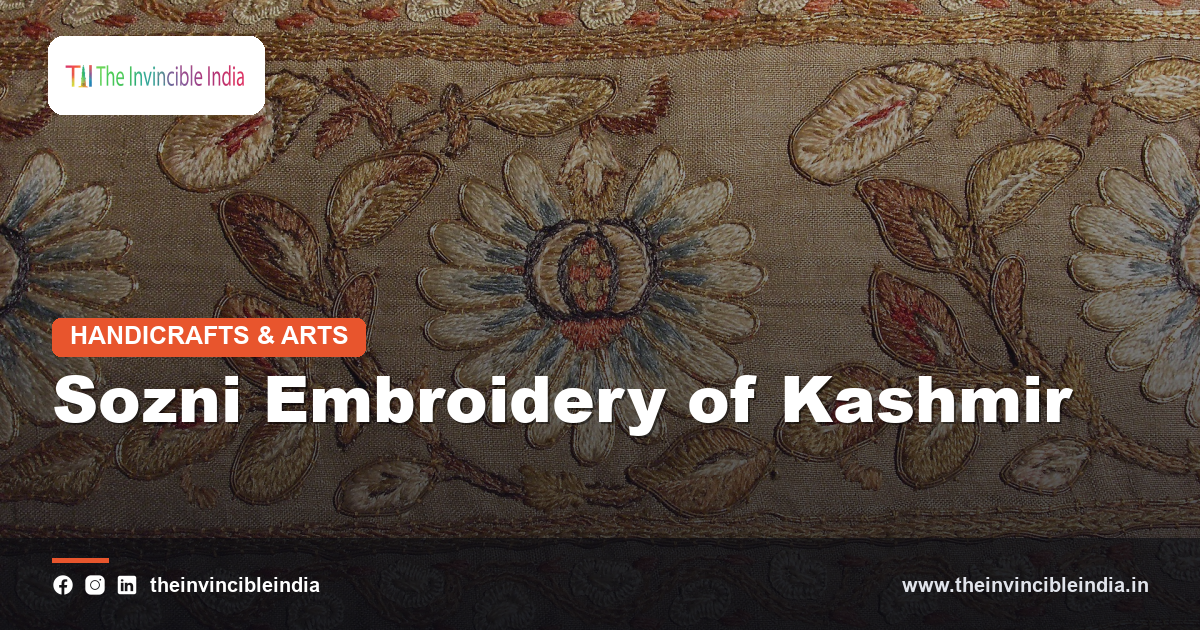
Sozni embroidery is the finest of the needlework traditions of Kashmir, a delicate art in which silk thread is stitched in minute stitches onto soft shawls and stoles. Its name is linked to the word for needle, and the craft is defined by extraordinary patience, since a single piece may take a very long time to complete. The patterns usually draw on the flowers, leaves and vines of the Kashmir valley, worked with such subtlety that the embroidery seems to float on the cloth. It is most often seen on the celebrated pashmina shawls of the region. This guide explores the history, materials, technique, motifs and revival of Sozni embroidery.
Quick Facts
| Detail | Information |
|---|---|
| Type | Fine hand needlework with silk thread |
| Region | Kashmir valley |
| Common base fabric | Pashmina and fine wool shawls |
| Typical motifs | Floral sprays, paisley, chinar leaves, vines |
| Key tool | A single fine needle, worked freehand |
| Also known as | Sozankari, Kashmiri needle embroidery |
What Is Sozni Embroidery
Sozni embroidery is a refined form of Kashmiri needlework in which very fine stitches are worked in silk or fine thread onto soft woollen fabric, most famously the pashmina shawl. The term is generally linked to the word for needle, and the craft is sometimes described as needle embroidery in Kashmiri contexts. What separates Sozni from other forms of embroidery is the delicacy of its execution, as the stitches are so small and even that the design looks as though it were part of the cloth. The patterns are generally subtle and tonal rather than bold. Sozni therefore represents one of the highest expressions of precision handwork in Indian textile art.
Kashmir and Its Textile Heritage
The Kashmir valley has long been celebrated for its textiles, from finely woven shawls to richly decorated cloths admired in India and far beyond. Its cool climate, high mountain pastures and skilled artisan communities created ideal conditions for refined woollen weaving and embroidery. Over many generations, Kashmiri craftspeople developed a reputation for patience, technical command and a sensitivity to natural beauty that appears in all their work. Embroidery grew alongside weaving as a means of enriching the finished cloth. Sozni belongs to this wider heritage, where every stage, from fibre to finishing, is handled by experienced hands with great care.
Origins and Historical Development
The precise origins of Sozni embroidery are difficult to date, but it is understood to have developed within the broader tradition of Kashmiri shawl making, which has deep historical roots. The shawls of the region attracted royal and noble patronage and became admired luxury goods valued far outside the valley. Embroidery gradually became a way of adding refinement to plain or lightly woven shawls, and skilled needleworkers built reputations for their work. Craft knowledge was held within families and workshops and passed down patiently across generations. Although details vary, the long continuity of the tradition is its defining feature, since Sozni survives today as a direct descendant of that historical craft culture.
The Pashmina Connection
Sozni embroidery is most closely associated with pashmina, the exceptionally soft and warm fibre that has made Kashmir shawls famous. Pashmina is a delicate fabric, and embroidering it requires great skill, since heavy or careless stitching could easily distort or damage the cloth. The embroiderer must match the lightness of the needlework to the lightness of the material, producing stitches that add beauty without adding stiffness. When this balance is achieved, the result is a shawl of remarkable softness and refinement, in which the embroidery enhances rather than overpowers the fabric. The partnership between pashmina and Sozni is one of the most admired combinations in Indian textile heritage.
Materials and Tools
The materials of Sozni embroidery are few but carefully chosen. The base is usually a fine pashmina or other soft woollen fabric, selected for its smooth surface and drape. The thread is generally a fine silk or a similarly delicate strand, which can be handled in very small stitches and provides a gentle sheen. The only essential tool is a thin needle, which the embroiderer holds with great control while working freehand. Scissors, a clean working surface and good light complete the setting. Because the materials are so fine, cleanliness and care are essential, and artisans take pains to keep their hands and workspace free of anything that might mark the cloth.
The Technique of Sozni
The technique of Sozni is based on very small, precise stitches worked directly on the fabric with a single needle. Often the outline of the pattern is first lightly marked on the cloth, and the embroiderer then fills it with fine stitches placed with extraordinary evenness. The thread is typically passed through the fabric in a way that keeps the surface smooth and flat, so that the motif seems drawn rather than stitched. Control of tension is critical, since stitches that are too tight can pucker the delicate cloth while loose ones can look untidy. Learning to judge this balance takes years, which is why Sozni is regarded as a master craft in its own right.
Motifs Drawn from Nature
Sozni patterns draw heavily on the natural world of the Kashmir valley. Flowers, leaves, creepers, fruit blossoms and the graceful curved paisley, known locally as the kairi or boota, are among the best-loved motifs. The leaf of the chinar tree, so closely associated with Kashmir, also features in much Kashmiri decorative art. These motifs are often arranged as scattered sprays across the field of the shawl or concentrated in borders and corners. The delicate scale of the stitches allows even tiny petals and veins to be indicated clearly. Through its natural imagery, Sozni expresses a deep affection for the landscape that inspired it and gives the work a timeless freshness.
Borders, Jaal and Overall Layouts
Sozni shawls may be arranged in several broad layouts depending on the effect desired. Some carry embroidery only along the borders, known as hashiya, framing a plain central field with a band of delicate pattern. Others display clusters of motifs in corners or at the ends of the shawl, leaving the rest of the cloth calm and open. In the most elaborate pieces, a network of interwoven stems and flowers, often called jaal, spreads across the entire surface. Each approach demands a different balance of time and design planning. The choice of layout shapes the personality of the shawl, from understated elegance to lavish richness, while the stitching itself remains uniformly fine.
Colour and Tonal Harmony
One of the characteristic qualities of Sozni work is its gentle handling of colour. Many pieces are embroidered in thread close in tone to the fabric, producing subtle, tonal designs that reveal themselves gradually as the light shifts. Others use contrasting shades to bring flowers and leaves into sharper relief, creating a more vivid, jewel-like effect. Either approach relies on careful matching and a refined sense of harmony between thread and ground. Because the stitches are tiny, even small changes in shade are visible and must be considered with care. This sensitivity to colour contributes to the quiet luxury that has long defined Kashmiri shawls and their needlework.
The Artisans and Their Skill
Behind every Sozni piece stands an artisan whose skill has been developed over many years of practice. Embroiderers often begin learning young, starting with simple motifs and progressing to more demanding patterns as their control improves. The work calls for steady hands, good eyesight, patience and long periods of concentration. In many households the craft is shared among family members, with different people contributing to design, stitching and finishing. The finest embroiderers are recognised within their communities for the evenness and clarity of their stitches. Their expertise is a form of intangible knowledge, and the future of the craft depends directly on its continued transmission to younger learners.
Time, Labour and the Value of a Piece
A genuine Sozni shawl is the product of considerable time and labour, which is a major reason for its value. Depending on the density of the embroidery, a single piece may occupy an artisan for a long period, since each tiny stitch is placed by hand with full attention. This investment of skill distinguishes handmade work from machine imitations, which can copy the pattern but not the depth and finesse of true needlework. Buyers who understand the effort involved are better able to appreciate the price and to recognise quality. The worth of Sozni lies not only in beauty but also in the human time and mastery that each shawl quietly represents.
Sozni in Kashmiri Culture and Dress
Embroidered shawls hold an honoured place in Kashmiri culture and are worn as part of formal dress, given as gifts and treasured as family heirlooms. A Sozni shawl may mark a wedding, a festival or another significant moment, and it is often passed from one generation to the next. Beyond shawls, fine embroidered stoles, scarves and wraps allow the craft to appear in a wider range of everyday and occasion wear. The enduring use of such pieces shows how deeply the craft is woven into social life. Sozni thus serves as more than an ornamental skill, acting as a carrier of memory, hospitality and regional pride.
Distinguishing Genuine Work
Because Sozni is highly prized, imitation is a concern, and buyers benefit from knowing how to recognise genuine handwork. In authentic pieces the stitches are tiny, regular and consistent, and the reverse side of the embroidery is usually neat, showing careful finishing. The design sits flat and smooth on the fabric rather than looking raised, stiff or printed. Machine-made imitations often show repeated, mechanical uniformity and may feel heavier or less supple. Purchasing from reputable outlets, cooperatives and certified sellers offers added assurance. Understanding these differences helps buyers support real artisans while avoiding misleading substitutes that undervalue the craft and the people who preserve it.
Recognition and Protection
Kashmiri handicrafts, including shawls and embroidery traditions, have received various forms of recognition and protection aimed at safeguarding their authenticity. Labelling and certification systems have been introduced to help buyers verify that a shawl is genuinely handmade in the region and to distinguish it from machine copies. Such measures also help artisans by establishing quality standards and encouraging fair pricing. Government agencies and cultural organisations continue to promote Kashmiri crafts through exhibitions and training. While challenges persist, these efforts reflect an understanding that Sozni is both a commercial product and a valuable component of the country’s intangible cultural heritage deserving careful protection.
Challenges to the Tradition
Sozni embroidery faces challenges familiar to many fine handicrafts. The extreme time and eyesight demanded by the work can make it difficult to attract younger learners, who may seek less strenuous careers. Competition from cheaper machine-embroidered goods can reduce demand for authentic pieces, while uncertain market access and regional disruptions have at times affected artisans’ incomes. Intermediaries can also take a large share of the final price. These difficulties threaten the continuity of skills that took generations to build. Addressing them requires fair wages, training opportunities and consistent public awareness of what makes handmade Sozni distinct and worth preserving.
Caring for a Sozni Shawl
A Sozni shawl is delicate and deserves careful handling to remain beautiful for decades. Dry cleaning or gentle hand washing by an experienced specialist is generally recommended, as rough treatment can damage both fabric and stitches. The shawl should be stored folded loosely in a clean cotton or muslin cloth, away from damp, direct sunlight and insects. Using natural repellents instead of harsh chemicals helps protect the fibres. Wearing the shawl with attention to snagging jewellery or rough surfaces prevents pulled threads. With such care, a Sozni piece can be treasured as an heirloom, retaining its softness, sheen and intricate stitching for future generations.
Sozni Embroidery Today
Today, Sozni embroidery remains a prized symbol of Kashmiri artistry, produced by dedicated artisans and supported by cooperatives, designers and cultural institutions. Contemporary makers apply the technique to stoles, scarves and fashion pieces, bringing the traditional skill to new audiences without compromising its refinement. Interest in handmade, slow-crafted textiles has helped renew appreciation for the discipline that Sozni demands. The craft continues to depend on skilled hands and on buyers willing to value authenticity. By appreciating its history, understanding its technique and supporting genuine artisans, admirers can help ensure that this exquisite needlework continues to flourish in the Kashmir valley and beyond.
Sources & Further Reading
- Ministry of Culture, Government of India (indiaculture.gov.in).
- Development Commissioner (Handicrafts), Ministry of Textiles, Government of India (handicrafts.nic.in).
Frequently Asked Questions
What is Sozni embroidery?
Sozni embroidery is a very fine form of hand needlework from Kashmir, usually worked in silk thread on pashmina shawls. It is known for its tiny, even stitches and delicate floral and paisley patterns.
Why is Sozni embroidery so expensive?
Each piece is stitched entirely by hand and may take a long time to complete, depending on the density of the design. The cost reflects the skill, patience and labour invested in the work as well as the fine quality of the fabric.
What motifs are used in Sozni embroidery?
Common motifs include flowers, leaves, vines, paisley and chinar leaves, all inspired by the natural world of Kashmir. They may appear as borders, scattered sprays or an overall network of pattern.
How can genuine Sozni work be identified?
Authentic work shows tiny, regular stitches, a neat reverse side and a design that lies smooth and flat on the cloth. Buying from reputable cooperatives and certified sellers offers additional assurance.
How should a Sozni shawl be cared for?
It should be dry cleaned or washed gently by a specialist and stored loosely folded in a cotton or muslin cloth. Keeping it away from damp, sunlight and insects helps preserve both fabric and stitching.