


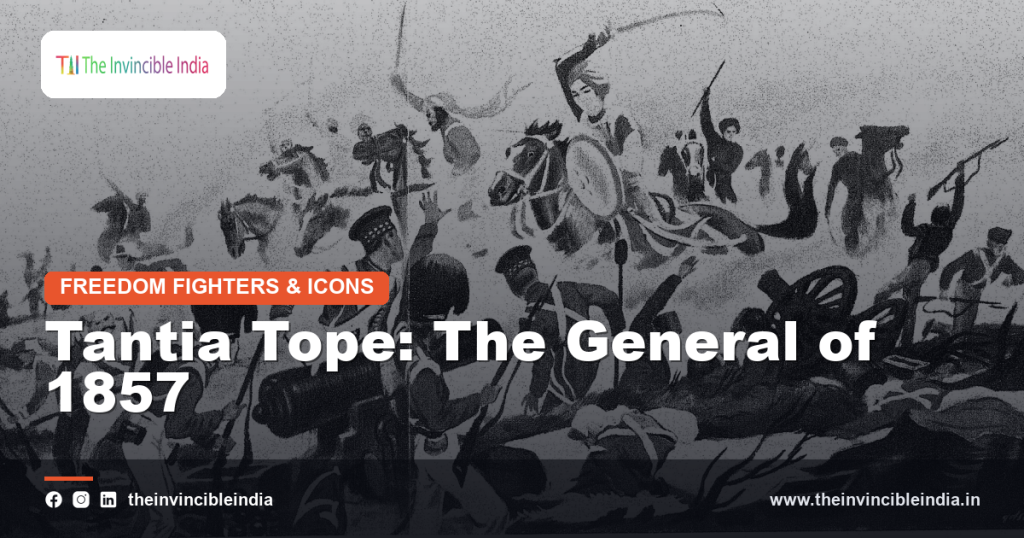
Tantia Tope is remembered as one of the most capable and resourceful military commanders to emerge from the Revolt of 1857, a leader whose skill in guerrilla warfare kept the flame of resistance alive across central India long after other centres of the uprising had fallen. A trusted lieutenant of Nana Saheb, Tantia Tope organised and led campaigns that repeatedly outmanoeuvred larger and better-equipped British forces, and his alliance with Rani Lakshmibai in the defence of Gwalior remains one of the most memorable episodes of the uprising. His eventual capture and execution did not diminish the reputation he had earned as a bold and inventive military strategist. This guide traces the life, campaigns and enduring legacy of Tantia Tope.
Quick Facts
| Detail | Information |
|---|---|
| Known as | General of the Revolt of 1857 |
| Associated with | Nana Saheb and the Peshwa household at Bithoor |
| Known for | Guerrilla campaigns across central India |
| Key alliance | Joint defence of Gwalior with Rani Lakshmibai |
| Captured | Betrayed and captured after prolonged evasion |
| Executed | 1859, by British military authorities |
The General of 1857
Tantia Tope is remembered as one of the ablest military leaders produced by the Revolt of 1857, a commander whose talent for organisation and improvisation allowed him to sustain armed resistance to British rule long after many other rebel centres had been subdued. His reputation as a general rested not on formal military training but on a natural gift for strategy, mobility and the effective use of limited resources against a far better equipped colonial force. Tantia’s campaigns took him across a wide expanse of central India, reflecting both his mobility as a commander and the scale of the resistance he helped to sustain. As the general of 1857, Tantia Tope’s contribution to the uprising remains one of its most remarkable military stories.
Early Life and Association with Bithoor
Tantia Tope’s early life was closely connected with the household of the Peshwa at Bithoor, near Kanpur, where he grew up in association with the family of Nana Saheb, the adopted heir of the last Peshwa. This close and long-standing connection placed Tantia within the circle of individuals directly affected by the British policy of refusing to recognise the continuation of the Peshwa’s pension and honours. His years at Bithoor gave him an intimate understanding of the grievances that would later fuel the uprising and forged the personal bond of trust with Nana Saheb that would define his role in the events of 1857. This early association at Bithoor shaped the entire course of Tantia’s later military career.
Bond with Nana Saheb
Tantia Tope’s relationship with Nana Saheb was one of deep personal loyalty and mutual trust, a bond that placed Tantia at the centre of Nana Saheb’s efforts to resist British authority once the uprising began in 1857. This close association meant that Tantia was entrusted with significant military responsibility, reflecting the confidence that Nana Saheb placed in his judgement and capability. Their shared background at Bithoor and their common grievance against British policy toward the Peshwa’s household gave their alliance a personal as well as a political dimension. This enduring bond with Nana Saheb remains central to understanding Tantia Tope’s role throughout the revolt.
The Outbreak of the Revolt of 1857
When the Revolt of 1857 broke out, sparked by a combination of military grievances and wider political and social discontent across northern and central India, Tantia Tope quickly emerged as one of the leaders willing to take up arms in organised resistance to British authority. The uprising spread rapidly across a wide area, drawing in soldiers, local rulers and ordinary people who shared a common resentment of colonial policy. Tantia’s association with the Bithoor household placed him naturally among the leadership of the rebellion in the Kanpur region as events unfolded. This outbreak of the revolt marked the beginning of the military career for which Tantia Tope would become famous.
Role in the Kanpur Campaign
During the uprising in the Kanpur region, Tantia Tope played an important organisational and military role in support of Nana Saheb’s leadership, helping to coordinate the forces engaged in the struggle against British troops stationed there. The events at Kanpur during this period were intense and hard fought, forming one of the most significant episodes of the wider uprising across northern India. Tantia’s contribution to the campaign reflected his emerging skills in organising and directing armed resistance under difficult and rapidly changing circumstances. This early experience in the Kanpur campaign gave Tantia the practical military grounding that he would later apply with great effect elsewhere.
Military Strategy and Guerrilla Warfare
As the uprising progressed and British forces began to regain ground, Tantia Tope increasingly turned to guerrilla tactics, relying on speed, mobility and surprise rather than direct confrontation with superior British firepower. This approach allowed him to sustain resistance across a wide territory, striking where the enemy was weakest and withdrawing before a decisive engagement could be forced upon him. His skill in this mode of warfare, well suited to the terrain and circumstances of central India, made him an exceptionally difficult adversary for British commanders to pin down. This mastery of guerrilla warfare remains the defining feature of Tantia Tope’s military reputation.
Campaign Across Central India
Tantia Tope led his forces across a broad sweep of central India, moving between regions and drawing on local support wherever he could find it, in a campaign that tested the endurance of both his own troops and the British forces sent to pursue him. This extended campaign demonstrated his considerable organisational ability, as he continued to muster and coordinate fighters even as the broader uprising elsewhere was being suppressed. His movements kept British commanders occupied for a prolonged period, extending the life of the resistance well beyond what more static defensive tactics might have achieved. This campaign across central India remains one of the most remarkable feats of sustained resistance in the history of the uprising.
Alliance with Rani Lakshmibai
Among the most memorable episodes of Tantia Tope’s campaign was his alliance with Rani Lakshmibai of Jhansi, another formidable leader of the uprising, with whom he combined forces in a joint effort to continue the resistance after their respective territories had come under British pressure. This alliance brought together two of the most capable military leaders of the revolt, combining Lakshmibai’s own considerable courage and leadership with Tantia’s strategic experience and mobility. Their combined forces achieved notable successes before eventually facing the full weight of British military response. This alliance with Rani Lakshmibai remains one of the most celebrated collaborations of the entire uprising.
The Gwalior Campaign
Together with Rani Lakshmibai, Tantia Tope took part in the campaign for control of Gwalior, a significant strategic centre whose capture gave the rebel forces a valuable base and a considerable boost to their cause at a critical stage of the uprising. The campaign at Gwalior demonstrated the continuing capacity of the rebel leadership to mount serious challenges to British authority even as much of the wider revolt had already been suppressed elsewhere. British forces eventually recaptured the city after fierce fighting, in an engagement that proved costly for the rebel cause. This Gwalior campaign remains one of the most significant late episodes of the Revolt of 1857.
Evading British Forces
Following the setbacks at Gwalior, Tantia Tope continued to evade capture for a considerable period, moving across difficult terrain in central India and relying on his considerable skill in irregular warfare to stay ahead of the British columns sent in pursuit. This extended pursuit became one of the most notable manhunts of the post-uprising period, testing the patience and resources of British military authorities determined to bring the campaign to a close. Tantia’s ability to sustain this evasion for so long, despite overwhelming odds, further enhanced his reputation as an exceptionally resourceful commander. This prolonged evasion remains a remarkable final chapter in his military career.
Betrayal and Capture
Tantia Tope’s long evasion of British forces eventually ended when he was betrayed and captured, bringing to a close the sustained campaign of resistance he had waged across central India since the earliest days of the uprising. His capture was treated by British authorities as a significant achievement, given the difficulty they had experienced in tracking down so skilled and elusive a commander. Even in captivity, Tantia is remembered for maintaining his dignity and composure, refusing to renounce the cause for which he had fought. This betrayal and capture marked the beginning of the final chapter of his life.
Trial by Military Court
Following his capture, Tantia Tope was tried by a British military court on charges connected with his leadership of the uprising, a proceeding conducted swiftly given the military circumstances of the time. He is remembered for facing the trial with calm dignity, neither seeking to deny his role in the resistance nor expressing regret for the cause he had served. The proceedings concluded with a sentence reflecting the seriousness with which British authorities regarded his contribution to the uprising. This trial by military court marked the formal conclusion of Tantia Tope’s remarkable military career.
Execution
Tantia Tope was executed in 1859, bringing to an end the life of one of the most capable and determined military leaders of the Revolt of 1857. Accounts from the period describe the composed and dignified manner in which he faced his execution, consistent with the resolve he had shown throughout his long campaign of resistance. His death marked the effective conclusion of organised armed resistance in the region he had fought so long to defend. This execution, while ending his life, only enhanced the reputation for courage and skill that Tantia Tope had earned during the uprising.
Reputation as a Military Strategist
Tantia Tope’s reputation as a military strategist rests on his demonstrated ability to sustain organised resistance across a wide territory using mobility, local knowledge and adaptive tactics rather than conventional set-piece battles. Military historians have long noted the skill with which he evaded pursuit and coordinated forces drawn from different regions and backgrounds, a considerable achievement given the resources available to him. His campaigns are frequently cited as an early and effective example of guerrilla warfare employed against a technologically superior colonial force. This reputation as a resourceful and capable strategist remains central to how Tantia Tope is remembered in military history.
Legacy in the History of 1857
The legacy of Tantia Tope rests on his role as one of the most effective and enduring military leaders of the Revolt of 1857, a commander whose campaigns kept the spirit of resistance alive across central India well beyond the initial phase of the uprising. His alliance with Nana Saheb and later with Rani Lakshmibai reflects the collaborative character of the resistance at its most effective, bringing together leaders of different backgrounds in a shared cause. Tantia’s sustained campaign, pursued at great personal risk until his eventual capture, exemplifies the determination that characterised the uprising’s most committed participants. This legacy secures Tantia Tope’s place among the foremost military figures of 1857.
Tantia Tope Today
Today Tantia Tope is remembered as one of the most skilled and resourceful commanders of the Revolt of 1857, honoured for his loyalty to Nana Saheb, his alliance with Rani Lakshmibai and his prolonged and inventive campaign against British forces across central India. Memorials and public commemorations across the regions where he fought continue to recall his contribution to the uprising, and his story remains a significant chapter in the history of India’s early resistance to colonial rule. He is remembered particularly for his mastery of guerrilla tactics under extremely difficult circumstances. As a symbol of resourceful and determined resistance, Tantia Tope endures in the nation’s memory as a hero of 1857.
Sources & Further Reading
- Ministry of Culture, Government of India, on the history of the 1857 uprising (indiaculture.gov.in).
- National Archives of India, records relating to the freedom struggle (nationalarchives.gov.in).
Frequently Asked Questions
Who was Tantia Tope?
Tantia Tope was a skilled military commander of the Revolt of 1857, closely associated with Nana Saheb, who led sustained guerrilla campaigns across central India and later allied with Rani Lakshmibai in the defence of Gwalior.
What was Tantia Topes military strategy?
Tantia Tope relied on guerrilla tactics, using mobility, speed and local knowledge to strike at British forces and evade direct confrontation, allowing him to sustain resistance across central India for a prolonged period.
What was Tantia Topes connection to Rani Lakshmibai?
Tantia Tope allied with Rani Lakshmibai in a joint campaign that included the defence of Gwalior, combining his strategic experience with her leadership in one of the most memorable collaborations of the 1857 uprising.
How was Tantia Tope captured?
After a prolonged period of evading British forces through skilled guerrilla movement across central India, Tantia Tope was eventually betrayed and captured, after which he was tried by a British military court.
How is Tantia Tope remembered today?
Tantia Tope is remembered as one of the most capable military leaders of the Revolt of 1857, honoured through memorials across central India for his resourceful and determined resistance to British rule.