


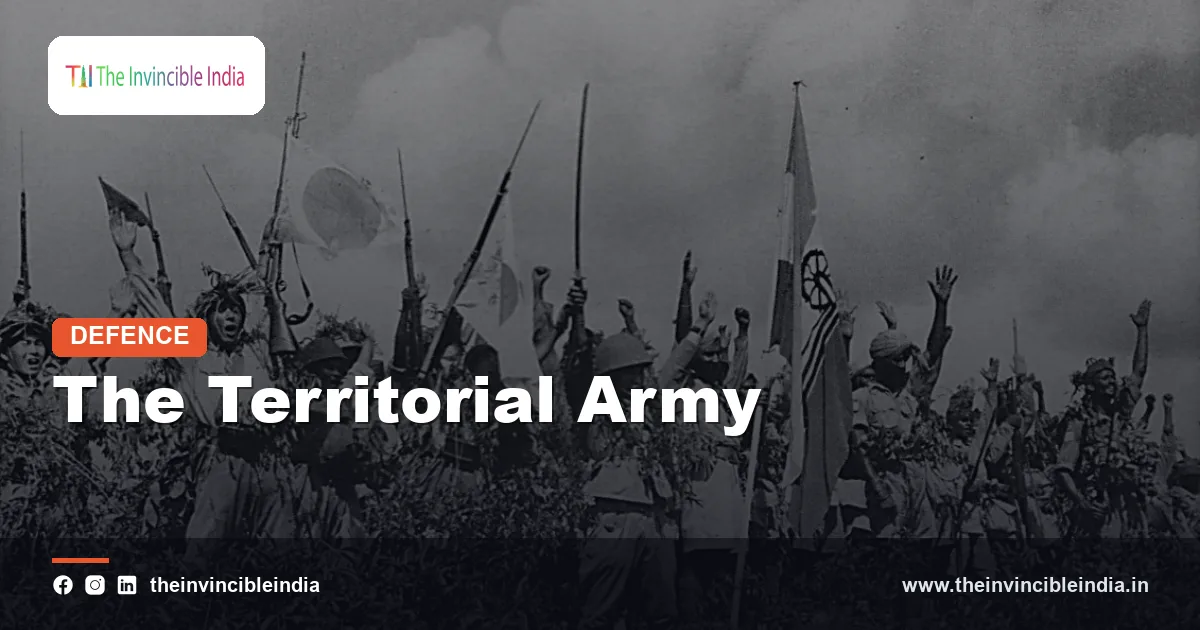
Most people picture the Indian Army as a force of full-time professionals, but there is another side to the story. The Territorial Army (TA) is a part-time, volunteer military force made up of ordinary citizens who hold regular civilian jobs, yet agree to train as soldiers and answer the call when the nation needs them. A railway engineer, an oil-company executive, a doctor or a young professional can all carry a TA rank alongside their everyday career.
This guide explains how the Territorial Army came into being, who can join, how it is organised, what kinds of units it has and what it actually does. It also clears up common confusion about how the TA differs from the regular Army, the Army reserves and the NCC. The details below are meant as a stable, general explainer; recruitment rules and unit lists are revised from time to time, so always check official notifications before applying.
Quick Facts
| Item | Details |
|---|---|
| Full name | Territorial Army (TA), part of the Indian Army |
| Nature of force | Part-time, volunteer, second line of defence |
| Legal basis | Territorial Army Act, 1948 |
| Formally inaugurated | 9 October 1949 (observed as Territorial Army Day) |
| Inaugurated by | C. Rajagopalachari, Governor-General of India |
| Motto | Savdhani Va Shoorta (Vigilance and Valour) |
| Predecessors | Indian Defence Force (1917) and Indian Territorial Force (1920) |
| Main unit types | Departmental, non-departmental (infantry) and ecological battalions |
| Parent ministry | Ministry of Defence, Government of India |
What Is the Territorial Army?
The Territorial Army is often described as India’s force of “citizen soldiers”. Its members are not career military personnel. They are gainfully employed people who pursue their own professions and, in addition, undergo military training for a set number of days every year. When the government calls the force out, the volunteers leave their civilian duties and serve as soldiers, with the same discipline and obligations as the regular Army.
Not a career, not a substitute
It helps to be clear about what the TA is not. It is not a full-time standing force, it is not a career path with a regular military salary, and it is not a replacement for the regular Army. Joining the TA does not mean leaving your job. Rather, the TA fills a gap between the regular Army and the civilian population, giving the country a pool of trained manpower that can be raised quickly without the expense of maintaining a much larger standing army in peacetime.
The idea of a second line of defence
Military planners describe the regular Army as the first line of defence. The Territorial Army is the second line. In normal times it trains, supports and stays ready. In an emergency it can be “embodied”, meaning formally called up for full-time service for a stated period, after which members return to civilian life.
History and the 1948 Act
The Territorial Army has colonial-era roots, though its present form is entirely a creation of independent India. Volunteer and auxiliary forces existed in British India for decades. The Indian Defence Force was created in 1917 during the First World War, mostly to allow Europeans and Anglo-Indians to serve part-time. It was replaced in 1920 by the Indian Territorial Force, which also opened doors to Indians through provincial battalions and the University Training Corps.
From force to Army
After Independence, the government wanted a modern voluntary reserve rooted in the new nation. Parliament passed the Territorial Army Act in 1948, laying down how the force would be raised, who could serve, and under what terms its members could be called out. The Territorial Army was then formally inaugurated on 9 October 1949 by C. Rajagopalachari, the Governor-General of India, at a ceremony in Delhi. That date is still celebrated each year as Territorial Army Day.
Key milestones
- 1917: Indian Defence Force raised during the First World War.
- 1920: Indian Territorial Force replaces it, with a wider role for Indians.
- 1948: Territorial Army Act passed by Parliament.
- 1949: The TA is formally inaugurated on 9 October.
- Later decades: Departmental and ecological units are added, and units are embodied during wars and emergencies.
Motto and Spirit of the Force
The Territorial Army’s motto is “Savdhani Va Shoorta”, usually translated as “Vigilance and Valour”. It captures the double character of the force: citizens who stay alert in everyday life and who are ready to show courage when duty calls. Many commentators also describe the TA in terms of service to people in distress, since a large part of its work involves helping civil authorities during floods, earthquakes and other disasters.
Volunteer ethos
Perhaps the most important feature of the TA is that nobody is conscripted into it. Every member chooses to take on military obligations on top of a full working life. That volunteer spirit shapes its culture. Officers and soldiers often come from backgrounds such as engineering, business, medicine, farming or public service, and they bring professional skills that the military can use directly.
Wearing two hats
A TA member lives a double life. At work they are a bank manager, a teacher or a technician. During training camps and embodiment they are a soldier in uniform, subject to military law and the chain of command. The force trains its people to switch smoothly between the two roles.
Who Can Join the Territorial Army?
The TA is open to citizens who are already gainfully employed or self-employed. This rule is central to the whole idea, because the force depends on members who have a civilian livelihood to return to. People who are unemployed, or who are already serving in the regular armed forces, are not the target audience.
Typical eligibility conditions
- Citizenship: Indian citizens only.
- Employment: A regular civilian occupation, including self-employment or a profession.
- Age: A broad adult age band, commonly cited as roughly 18 to 42 years, though limits can differ by category and notification.
- Education: Officers generally need a graduate degree from a recognised university.
- Fitness: Candidates must meet prescribed medical and physical standards.
Officer entry
Officers are selected through a written examination followed by an interview and medical assessment, in the same spirit as other military selection systems. Successful candidates are commissioned as officers of the TA. Other ranks are recruited separately through rallies and unit-level selection. Because exact age bands, examination patterns and notified vacancies change, aspirants should rely on current official advertisements.
Special categories
Certain categories of people, including serving employees of departments that raise their own TA units, may have special pathways. Some recruitment is also done through designated state and regional centres.
Training, Camps and Time Commitment
The TA is a part-time force, but it is not a casual one. New entrants go through an initial period of training, and they then continue to train every year. Commonly cited arrangements involve a block of initial training followed by an annual training commitment spread over a number of days or weeks, usually including an annual camp.
How it works in practice
- Initial training: Basic military instruction in drill, weapons handling, fieldcraft and discipline.
- Annual training: Regular refreshers each year so skills remain current.
- Annual camp: A concentrated period where the unit trains together, often with exercises.
- Embodiment: When called out, members serve full time for the stated duration.
Balancing work and service
Employers, public and private, are generally expected to release TA members for training and embodied service. The idea is that a worker’s military obligations are recognised as national service. Members are paid according to the rules for embodied or training periods, and they return to their civilian jobs afterwards. Officers are trained at the Army’s institutions, and the TA maintains its own pool of instructors and permanent staff drawn from the regular Army.
Types of Territorial Army Units
The TA is not a single mass of battalions. It includes different kinds of units designed for different purposes. Broadly, they fall into departmental units, non-departmental units and specialised units such as ecological battalions.
Departmental units
Departmental units are raised from employees of government departments or public sector organisations that run essential services. Examples include units linked to the Railways, oil and gas companies such as ONGC and Indian Oil, and telecom and similar services. The idea is simple: in a war or emergency, the people who know how to run these services can be called out in uniform and keep them running while also being under military discipline.
Non-departmental units
Non-departmental units are mainly infantry battalions recruited from the general civilian population. Many are affiliated with regular infantry regiments, wear that regiment’s insignia and take pride in its traditions. They are the TA’s combat-capable core.
Comparison of unit types
| Type | Recruited from | Main purpose |
|---|---|---|
| Departmental | Employees of Railways, oil, telecom and similar bodies | Keep essential services running in emergencies |
| Non-departmental infantry | General civilian population | Guard duties, internal security, manpower in war |
| Ecological battalions | Civilians and ex-servicemen | Afforestation and environmental restoration |
| Engineer and medical units | Professionals in those fields | Technical and medical support |
The Ecological Battalions: A Green Army
One of the most distinctive parts of the Territorial Army is its set of ecological task force battalions. These units combine military organisation with environmental work, and they are unusual among the armies of the world. Raised from the early 1980s onwards, they were created to help restore degraded land, plant trees and rebuild the green cover in fragile regions.
What they do
- Afforestation: Planting and nurturing large numbers of saplings on barren or degraded land.
- Soil and water conservation: Building structures to hold soil and recharge groundwater.
- Restoring fragile areas: Working in hills, deserts and mined or damaged landscapes.
- Community engagement: Involving local people in planting and caring for trees.
Why the model works
Military discipline is well suited to the long, patient and logistically demanding task of raising a forest. Soldiers can work in remote terrain, keep to schedules and protect plantations in their early years. These battalions are sponsored by the Ministry of Defence in cooperation with state governments and the environment authorities, and they have worked in places such as the hills of Uttarakhand and arid parts of Rajasthan. Their work shows that national defence can include protecting the environment as well as the borders.
Roles and Responsibilities of the TA
The TA exists to support the nation in several different ways, both in war and in peace. Its roles can be grouped into a few main categories.
Relieving the regular Army
By taking over static and guard duties such as protecting vital installations, lines of communication and rear areas, TA units free regular formations to concentrate on operations at the front. This is the classic second-line role.
Trained manpower in war and emergency
If the country faces a conflict or a serious security situation, the government can embody TA units. This gives the Army additional trained soldiers without recruiting and training an entire force from scratch.
Essential services and civil support
- Essential services: Departmental units help maintain railways, fuel supply and communications.
- Disaster relief: Search, rescue, relief distribution and restoration after floods, cyclones and earthquakes.
- Aid to civil authority: Assisting district administrations when asked, within the legal framework.
- Environmental work: The tree-planting and restoration tasks of the ecological battalions.
Deployments in Wars and Counter-Insurgency
The Territorial Army has been called out several times since its creation. Its units have been embodied during periods of conflict and heightened tension, including the wars of the 1960s and 1971, to strengthen the country’s defences and handle duties that left the regular Army free for frontline tasks.
Internal security
In later decades, TA infantry battalions have been deployed on counter-insurgency and internal security duties in sensitive regions, including Jammu and Kashmir and parts of the North-East, as well as in operations beyond the borders alongside the regular Army. In many of these roles, TA soldiers work shoulder to shoulder with regular units and operate under the same command structure.
Peacetime service
Away from operations, TA personnel have been involved in relief work after natural calamities and have assisted civil authorities in maintaining essential services. Individuals from the force have been honoured for gallantry and distinguished service, which shows that part-time soldiers are held to the same standards as their regular counterparts. Specific unit histories and honours are documented by the Army.
Famous Names in the Territorial Army
The TA has a tradition of granting honorary ranks to well-known citizens who have made outstanding contributions to society and who are willing to support the force’s visibility and recruitment. An honorary rank is a mark of recognition, and it does not make the holder a regular soldier.
Notable examples
- Kapil Dev: The cricketer who led India to the 1983 World Cup was conferred an honorary rank in the TA.
- M.S. Dhoni: The former India captain received an honorary Lieutenant Colonel rank in the TA, associated with a Parachute Regiment battalion, and undertook parachute training.
- Mohanlal: The Malayalam film actor holds an honorary Lieutenant Colonel rank in the TA, linked to a battalion of the Madras Regiment.
- Others: Several public figures, from sport, politics and industry, have served as TA officers or held honorary ranks at various times.
These ranks have helped draw public attention to the force and show that military service can be combined with a very different working life.
TA vs Regular Army, Reserves and the NCC
Because India has several organisations connected with defence and youth, it is easy to mix them up. The table below gives a simple comparison.
| Body | Nature | Key difference |
|---|---|---|
| Regular Army | Full-time professional force | Soldiers serve as a career and are on active duty throughout |
| Territorial Army | Part-time volunteer force | Members hold civilian jobs and are embodied only when required |
| Army reserves | Retired or released regular soldiers with a reserve liability | Previously served full time and can be recalled |
| NCC | Youth cadet organisation in schools and colleges | Offers training and discipline but is not a military force |
Understanding the differences
The regular Army is the standing professional force. The Army reserves are made up of people who have already served and can be recalled. The TA, by contrast, recruits civilians who have not necessarily served before and gives them a military role alongside their jobs. The National Cadet Corps, also created in 1948, is a youth development programme that gives students a taste of military life and leadership, but its cadets are not soldiers and cannot be deployed. The Home Guards, which are state-run volunteer bodies, are a separate organisation again.
The TA in India’s Defence Today
In the modern era, the Territorial Army occupies a quiet but useful place in India’s defence structure. It offers a cost-effective way of keeping a trained reserve of manpower, and it connects the armed forces with everyday civilian professions. Its departmental units give the government a way of protecting vital services during a crisis.
Renewed interest in expansion
In recent years, there has been renewed public and official discussion about making greater use of the TA, including ideas about expanding its role, opening it to more professionals and linking it with new short-service concepts for young citizens. Such proposals have been debated at various times, and details have changed, so readers should follow official announcements for the latest position.
Challenges
- Awareness: Many citizens still know little about the force and how to join.
- Time pressure: Balancing training with demanding civilian careers is hard.
- Modernisation: Equipment and training must keep pace with changing warfare.
Conclusion
The Territorial Army shows that national defence is not only the business of full-time soldiers. Since its inauguration on 9 October 1949, under the Act of 1948, it has given Indian citizens a way to serve the country without giving up their livelihoods. From railway engineers who keep the trains moving, to infantry battalions on guard duty, to the ecological units that plant forests, the TA turns ordinary people into reliable second-line defenders. Its story is a reminder that vigilance and valour can come from every walk of life.
Frequently Asked Questions
What is the Territorial Army in India?
The Territorial Army is a part-time, volunteer military force that forms the second line of defence behind the regular Army. Its members hold civilian jobs and train periodically, and they are called up for full-time service only when the government embodies the units in an emergency.
When was the Territorial Army established?
The Territorial Army Act was passed in 1948, and the force was formally inaugurated on 9 October 1949 by Governor-General C. Rajagopalachari. This date is observed every year as Territorial Army Day.
Who can join the Territorial Army?
Indian citizens who are gainfully employed or self-employed, meet the age and medical standards and, for officers, hold a graduate degree can apply. Officer selection is through a written examination and interview, and the exact criteria are set out in official notifications.
Is the Territorial Army a full-time job?
No. It is not a career and members do not give up their civilian professions. They undergo training for a set period every year, including an annual camp, and serve full time only when their unit is embodied for a specific duration.
What are the ecological battalions of the Territorial Army?
Ecological battalions are special TA units that carry out afforestation, soil conservation and environmental restoration, often in fragile or degraded regions. They combine military discipline with environmental work and are among the most unusual features of the force.
How is the Territorial Army different from the NCC?
The Territorial Army is a military force whose members can be embodied and deployed. The National Cadet Corps is a youth organisation in schools and colleges that offers training and discipline to students, but its cadets are not soldiers and are not part of the armed forces.
{“@context”:”https://schema.org”,”@graph”:[{“@type”:”FAQPage”,”mainEntity”:[{“@type”:”Question”,”name”:”What is the Territorial Army in India?”,”acceptedAnswer”:{“@type”:”Answer”,”text”:”The Territorial Army is a part-time, volunteer military force that forms the second line of defence behind the regular Army. Its members hold civilian jobs and train periodically, and they are called up for full-time service only when the government embodies the units in an emergency.”}},{“@type”:”Question”,”name”:”When was the Territorial Army established?”,”acceptedAnswer”:{“@type”:”Answer”,”text”:”The Territorial Army Act was passed in 1948, and the force was formally inaugurated on 9 October 1949 by Governor-General C. Rajagopalachari. This date is observed every year as Territorial Army Day.”}},{“@type”:”Question”,”name”:”Who can join the Territorial Army?”,”acceptedAnswer”:{“@type”:”Answer”,”text”:”Indian citizens who are gainfully employed or self-employed, meet the age and medical standards and, for officers, hold a graduate degree can apply. Officer selection is through a written examination and interview, and the exact criteria are set out in official notifications.”}},{“@type”:”Question”,”name”:”Is the Territorial Army a full-time job?”,”acceptedAnswer”:{“@type”:”Answer”,”text”:”No. It is not a career and members do not give up their civilian professions. They undergo training for a set period every year, including an annual camp, and serve full time only when their unit is embodied for a specific duration.”}},{“@type”:”Question”,”name”:”What are the ecological battalions of the Territorial Army?”,”acceptedAnswer”:{“@type”:”Answer”,”text”:”Ecological battalions are special TA units that carry out afforestation, soil conservation and environmental restoration, often in fragile or degraded regions. They combine military discipline with environmental work and are among the most unusual features of the force.”}},{“@type”:”Question”,”name”:”How is the Territorial Army different from the NCC?”,”acceptedAnswer”:{“@type”:”Answer”,”text”:”The Territorial Army is a military force whose members can be embodied and deployed. The National Cadet Corps is a youth organisation in schools and colleges that offers training and discipline to students, but its cadets are not soldiers and are not part of the armed forces.”}}]}]}