


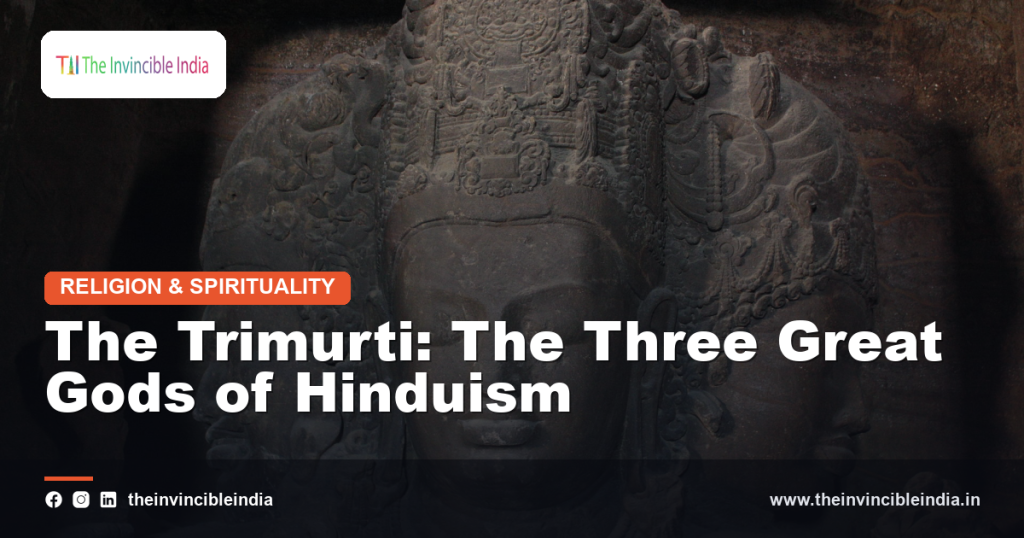
The Trimurti is the great triad of Hindu gods, the three supreme deities who together embody the fundamental functions of the divine in the cosmos: Brahma the creator, Vishnu the preserver, and Shiva the destroyer or transformer. This profound concept expresses the vision of the divine as responsible for the creation, preservation and dissolution of the universe in an eternal cycle, with each of the three great gods presiding over one of these cosmic roles. Around each of the three are rich traditions of worship, mythology and devotion, and each is paired with a great goddess. The Trimurti is one of the central and most illuminating concepts of Hindu theology. This guide explores the Trimurti, the three great gods, their roles, their consorts and the deep meaning of the triad.
Quick Facts
| Detail | Information |
|---|---|
| Meaning | Trimurti means the three forms |
| The three gods | Brahma, Vishnu and Shiva |
| Their roles | Creation, preservation and destruction of the universe |
| The cycle | The eternal cycle of creation, preservation and dissolution |
| Consorts | Saraswati, Lakshmi and Parvati |
| Concept | The divine functions embodied in three supreme deities |
The Three Forms of the Divine
The Trimurti, meaning the three forms, is a central concept of Hindu theology, expressing the vision of the divine as manifesting in three great deities who together embody the fundamental cosmic functions. These three gods, Brahma, Vishnu and Shiva, preside respectively over the creation, preservation and destruction of the universe, the three great processes that govern the cosmos in its eternal cycle. The concept of the Trimurti offers a profound way of understanding the divine as responsible for the whole cycle of existence, from creation through preservation to dissolution and renewal. As one of the great concepts of Hindu thought, the Trimurti illuminates the tradition’s vision of the divine and the cosmos and the roles of its three supreme gods.
The Cosmic Cycle
Underlying the concept of the Trimurti is the Hindu vision of the universe as passing through an eternal cycle of creation, preservation and dissolution, repeated endlessly across vast spans of cosmic time. The universe is created, sustained for a great age, and then dissolved, before being created anew, in a cycle without beginning or end. The three gods of the Trimurti preside over the three phases of this cycle, Brahma bringing the universe into being, Vishnu sustaining it, and Shiva dissolving it so that it may be renewed. This grand vision of a cyclical cosmos, governed by the three cosmic functions embodied in the Trimurti, is one of the most striking and profound aspects of Hindu thought and cosmology.
Brahma the Creator
The first of the Trimurti is Brahma, the creator, the god who brings the universe into being at the start of each cosmic cycle. Depicted with distinctive features that symbolise his role and knowledge, Brahma is honoured as the source of creation and is associated with the sacred knowledge of the Vedas. Interestingly, although he is one of the three great gods and the creator of the universe, Brahma is worshipped far less widely than Vishnu and Shiva, and temples dedicated to him are rare, for reasons explained in various traditional accounts. Nonetheless, as the creator who brings forth the universe, Brahma holds an essential place in the Trimurti and in the Hindu vision of the cosmic cycle.
Vishnu the Preserver
The second of the Trimurti is Vishnu, the preserver, the god who sustains and maintains the universe and upholds cosmic order and righteousness throughout the long age of the world’s existence. Vishnu is one of the most widely worshipped of all the Hindu deities, revered as supreme by a great tradition of devotees, and he is especially known for descending to earth in various incarnations to restore righteousness whenever it declines. His role as the preserver, protecting the world and upholding order, makes him a deeply beloved and reassuring deity. As the sustaining power of the divine in the Trimurti, Vishnu embodies the preservation and protection of the universe and the promise of divine intervention to uphold righteousness.
Shiva the Destroyer
The third of the Trimurti is Shiva, the destroyer, the god who brings about the dissolution of the universe at the end of each cosmic cycle, clearing the way for renewal. Yet Shiva’s role as destroyer is not merely negative, for destruction in this cosmic sense is part of the eternal process of renewal, and Shiva is a profound and many-sided god associated also with transformation, regeneration, meditation and grace. Widely worshipped and revered as supreme by a great tradition of devotees, Shiva embodies the transforming power of the divine. As the destroyer and transformer in the Trimurti, Shiva presides over the dissolution that makes renewal possible, embodying the deep truth that destruction and creation are bound together in the cosmic cycle.
The Balance of the Three
The Trimurti expresses a profound vision of balance, in which the three cosmic functions of creation, preservation and destruction are all necessary and work together in the eternal order of the universe. None of the three functions can be dispensed with, for creation requires preservation to sustain it and destruction to renew it, and the three gods together represent the complete cycle of existence. This vision of the balance and interdependence of the three cosmic processes, embodied in the three great gods, is one of the deep insights of the Trimurti concept. It presents the divine not as governing a single function but as embracing the whole cycle of existence, in a balanced and eternal order of creation, preservation and renewal.
Saraswati, Consort of Brahma
Each of the three gods of the Trimurti is paired with a great goddess, his consort, who embodies a complementary divine power. The consort of Brahma is Saraswati, the goddess of knowledge, learning, music and the arts, fittingly paired with the creator and associated with the sacred knowledge of creation. Saraswati is worshipped as the giver of wisdom, learning and artistic skill, honoured by students, scholars, musicians and artists, and she is one of the most beloved of the goddesses. Her pairing with Brahma the creator reflects the connection between creation and knowledge. As the goddess of wisdom and the arts, and the consort of Brahma, Saraswati holds an important and beloved place in the tradition of the Trimurti and its goddesses.
Lakshmi, Consort of Vishnu
The consort of Vishnu the preserver is Lakshmi, the goddess of wealth, prosperity, fortune and beauty, fittingly paired with the sustainer of the universe and associated with the abundance and well-being that preservation brings. Lakshmi is worshipped for prosperity, fortune and abundance, and she is one of the most beloved and widely worshipped of the goddesses, especially honoured at the festival of Diwali. Her pairing with Vishnu the preserver reflects the connection between preservation and the prosperity and well-being of the world. As the goddess of prosperity and fortune, and the consort of Vishnu, Lakshmi holds a central and cherished place in the tradition of the Trimurti and in the devotional life of Hindus.
Parvati, Consort of Shiva
The consort of Shiva is Parvati, the goddess who is his loving wife and a great goddess in her own right, embodying divine power, love and motherhood. Parvati is a gentle and benevolent form of the great Goddess, the loving companion of Shiva and the mother of their divine children, and she is also connected to the more powerful forms of the Goddess. Her pairing with Shiva reflects the union of the divine masculine and feminine and the balance of power and grace. As the beloved consort of Shiva, a great goddess and divine mother, and a form of the Divine Feminine, Parvati holds an important and beloved place in the tradition of the Trimurti and in the wider worship of the Goddess in Hinduism.
The Masculine and Feminine
The pairing of each of the three gods of the Trimurti with a great goddess reflects a profound Hindu understanding of the divine as embracing both the masculine and the feminine, in balance and union. The goddesses are not merely companions but embody the active power and energy of the divine, complementing and completing the gods with whom they are paired. This vision of the divine as encompassing both masculine and feminine principles, working together, is an important aspect of Hindu theology and is reflected in the pairing of the Trimurti with their goddesses. The honouring of the Divine Feminine alongside the male gods, and the vision of their union and balance, is one of the deep and beautiful features of the tradition.
Devotion to the Great Gods
While the Trimurti is a concept expressing the three cosmic functions, in actual worship Hindus most often devote themselves especially to Vishnu or to Shiva, or to the Goddess, as their chosen supreme deity, rather than worshipping the three equally. Great traditions of devotion have grown up around Vishnu and around Shiva, each worshipping their deity as the supreme reality while honouring the others. This means that the Trimurti concept coexists with the intense personal devotion of Hindus to particular deities. Understanding this helps to reconcile the theological concept of the three great gods with the lived reality of Hindu worship, in which devotees typically follow a path of loving devotion to one chosen form of the divine.
The Trimurti in Art
The concept of the Trimurti has inspired striking depictions in Hindu art, above all images that represent the three great gods together, sometimes as three faces of a single form, expressing their unity as three aspects of the one divine. Famous sculptural representations of the Trimurti are among the masterpieces of Indian art, powerfully conveying the concept of the three cosmic functions united in the divine. Such images express in visual form the profound theology of the Trimurti, the three forms of the one divine responsible for the whole cycle of existence. The depiction of the Trimurti in art is a beautiful and important expression of the concept and a treasured part of the artistic heritage of Hinduism.
The Meaning of the Triad
The deeper meaning of the Trimurti lies in its vision of the divine as embracing the whole of existence, in all its phases and processes, as a single, balanced and eternal order. By representing creation, preservation and destruction as three aspects of the divine, the Trimurti teaches that all these processes, even destruction, are part of the divine order and are necessary to the cycle of existence and renewal. It offers a profound way of understanding the divine, the cosmos and the meaning of change, growth and dissolution. This rich meaning, embracing the whole cycle of existence within the divine, is the deepest significance of the Trimurti and one of the great insights of Hindu thought about the nature of the divine and the world.
The Trimurti and the One
Ultimately, the three gods of the Trimurti, like all the Hindu deities, are understood in the deeper theology as forms of the one ultimate reality, Brahman, the single divine that underlies and encompasses all. The three gods represent three aspects or functions of this one reality, not three separate ultimate beings, and their unity is expressed in the concept of the Trimurti itself as the three forms of the one divine. This teaching connects the Trimurti to the profound Hindu vision of one reality behind the many forms. Understanding the Trimurti as three aspects of the one Brahman reveals the deep unity underlying the concept and connects it to the central teaching of Hinduism about the oneness of the divine.
The Trimurti Today
Today the concept of the Trimurti remains a cherished and illuminating part of Hindu thought, and the three great gods, Brahma, Vishnu and Shiva, along with their goddesses, continue to be central to the religious life of Hindus. Vishnu and Shiva in particular are worshipped with deep devotion across India by their great traditions of followers, and the vision of the divine as creator, preserver and destroyer continues to shape the Hindu understanding of the cosmos. The Trimurti endures as one of the great concepts of Hindu theology, expressing the profound vision of the divine as embracing the whole cycle of existence, and the three great gods remain among the most important and beloved deities of Hinduism.
Sources & Further Reading
- Ministry of Culture, Government of India, on the religious traditions of India (indiaculture.gov.in).
- The Puranas and the epics, the classical sources of Hindu theology and mythology.
Frequently Asked Questions
What is the Trimurti?
The Trimurti, meaning the three forms, is the great triad of Hindu gods: Brahma the creator, Vishnu the preserver and Shiva the destroyer. Together they embody the three cosmic functions of creation, preservation and destruction in the eternal cycle of the universe.
Who are Brahma, Vishnu and Shiva?
Brahma is the creator who brings the universe into being, Vishnu is the preserver who sustains it and upholds righteousness, and Shiva is the destroyer or transformer who dissolves the universe so it may be renewed. Together they form the Trimurti.
Why is Brahma rarely worshipped?
Although Brahma is one of the three great gods and the creator of the universe, he is worshipped far less widely than Vishnu and Shiva, and temples dedicated to him are rare, for reasons explained in various traditional accounts, while devotion focuses mostly on Vishnu, Shiva and the Goddess.
Who are the consorts of the Trimurti?
Each god of the Trimurti is paired with a great goddess: Saraswati, goddess of knowledge, is the consort of Brahma; Lakshmi, goddess of prosperity, is the consort of Vishnu; and Parvati, a great goddess and divine mother, is the consort of Shiva.
What does the Trimurti mean?
The Trimurti expresses the vision of the divine as embracing the whole cycle of existence, through creation, preservation and destruction, in a balanced and eternal order. The three gods are understood as three aspects of the one ultimate reality, Brahman.