


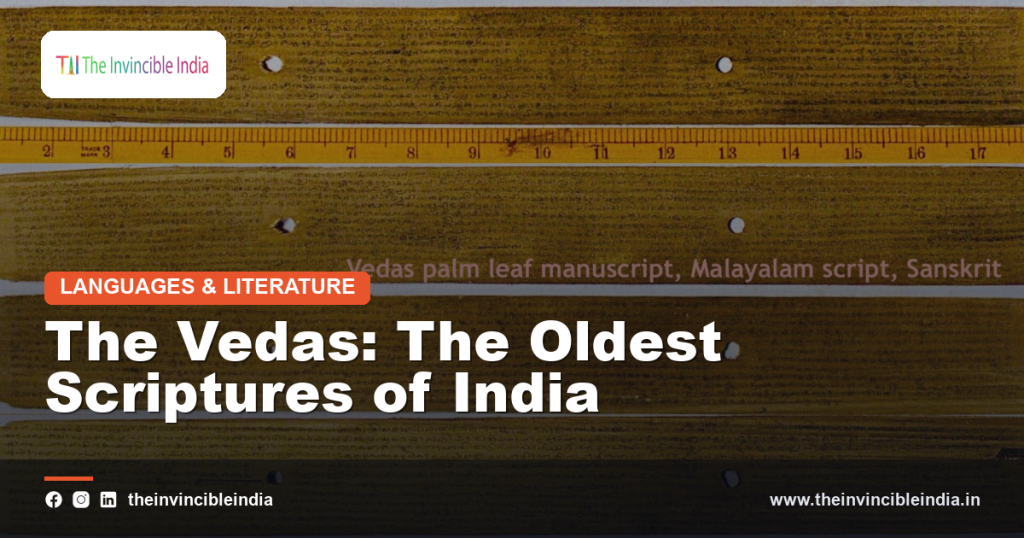
The Vedas are the oldest and most sacred scriptures of Hinduism, an ancient body of Sanskrit hymns, prayers and teachings that stands at the very foundation of Indian religion, philosophy and culture. Composed in the remote past and preserved for millennia through an extraordinary oral tradition, the Vedas are revered as revealed knowledge, the eternal wisdom heard by the ancient sages. There are four Vedas, each with its own hymns and purposes, and within them lie the Upanishads, the profound philosophical texts that are a wellspring of Indian thought. Composed in ancient Sanskrit, the Vedas are among the oldest religious texts in the world. This guide explores the four Vedas, their structure, their oral preservation, the Upanishads and their enduring importance.
Quick Facts
| Detail | Information |
|---|---|
| Type | The oldest sacred scriptures of Hinduism |
| Language | Ancient (Vedic) Sanskrit |
| Number | Four: the Rigveda, Yajurveda, Samaveda and Atharvaveda |
| Nature | Revered as shruti, revealed knowledge heard by the sages |
| Preservation | Transmitted for millennia by an oral tradition |
| Contain | Hymns, rituals, and the philosophical Upanishads |
The Foundation of Hinduism
The Vedas stand at the very foundation of Hinduism and of much of Indian civilisation, revered as the oldest and most authoritative of the sacred scriptures. For thousands of years they have been regarded as the ultimate source of religious knowledge and authority, the wellspring from which the vast traditions of Hindu religion, philosophy and ritual have flowed. To this day, the Vedas are held in the deepest reverence, and their hymns are chanted in worship and ceremony across India. As the most ancient layer of Hindu scripture and a foundation of Indian spiritual and intellectual life, the Vedas hold a place of unique importance in the religious heritage of India and the world.
Revealed Knowledge
The Vedas are traditionally regarded not as human compositions but as revealed knowledge, known as shruti, meaning that which is heard. According to tradition, the eternal truths of the Vedas were perceived or heard by the ancient sages, or rishis, in deep meditation, and then transmitted to humanity, so that the Vedas are seen as timeless and of more than human origin. This belief in the revealed, eternal nature of the Vedas gives them their supreme authority in the tradition and distinguishes them from later texts. The concept of shruti, of the Vedas as divinely heard eternal wisdom, is central to understanding the reverence in which they are held.
The Four Vedas
There are four Vedas, each with its own character and purpose. The Rigveda, the oldest and most important, is a collection of hymns of praise to the gods. The Yajurveda contains the formulas and prayers used in the performance of rituals and sacrifices. The Samaveda consists of hymns set to melody for chanting in worship, and is closely connected to the origins of Indian music. The Atharvaveda contains a wide range of hymns, including prayers for everyday life, healing and protection. Together these four Vedas form the complete body of Vedic scripture, each serving its own role in the religious and ritual life of the ancient tradition.
The Rigveda
The Rigveda is the oldest of the four Vedas and one of the oldest religious texts in the world, a collection of ancient hymns of praise addressed to the various gods. Composed in the remote past, its hymns celebrate the deities of the Vedic pantheon, the forces of nature and the cosmos, and express the religious vision of the ancient people who composed them. The Rigveda is of immense importance not only religiously but also as a source for understanding the language, society, religion and thought of ancient India. As the foundational and most ancient of the Vedas, the Rigveda holds a place of special reverence and is a treasure of the world’s most ancient literature.
The Yajurveda and Samaveda
The Yajurveda and the Samaveda each serve a special purpose in Vedic ritual. The Yajurveda is the Veda of ritual formulas, containing the prayers, chants and instructions used by priests in the performance of the sacrifices and ceremonies that were central to Vedic religion. The Samaveda is the Veda of melody, consisting largely of verses, many drawn from the Rigveda, arranged and set to musical chants for singing during worship. The Samaveda is of particular importance as a source of the ancient tradition of sacred music and is often regarded as a root of the classical music of India. Together these Vedas served the ritual and musical dimensions of Vedic worship.
The Atharvaveda
The Atharvaveda is distinct in character from the other three Vedas, containing a rich and varied collection of hymns that reach into the concerns of everyday life. Alongside hymns to the gods, it includes prayers and formulas for health and healing, for protection from harm, for prosperity and success, and for the many needs and anxieties of ordinary people. This gives the Atharvaveda a more practical and popular character, offering a fascinating window into the daily life, beliefs and concerns of ancient Indian society. As the fourth Veda, it broadens the scope of Vedic literature beyond lofty hymn and ritual to embrace the whole range of human life and its hopes and fears.
The Structure of Each Veda
Each of the Vedas is traditionally understood to have several layers or parts, reflecting different aspects and stages of the tradition. At the core are the hymns and verses themselves, the Samhitas. Attached to these are texts explaining and prescribing the rituals, and further texts of a more reflective and forest-dwelling character. Finally come the Upanishads, the philosophical texts that form the culmination of each Veda and explore its deeper spiritual meaning. This layered structure, moving from hymn and ritual to philosophy, reflects the development of the tradition and its movement from outward worship to inward contemplation. Understanding this structure is key to understanding the rich and varied contents of the Vedas.
The Upanishads
The crowning glory of the Vedic literature is the Upanishads, the profound philosophical texts that form the concluding part of the Vedas and are a wellspring of Indian philosophy and mysticism. In the Upanishads, the focus shifts from ritual and worship to deep spiritual inquiry, exploring the nature of ultimate reality, the self, consciousness and liberation, and the relationship between the individual soul and the universal spirit. Composed as dialogues and teachings of great depth and beauty, the Upanishads have inspired philosophers and seekers for millennia, in India and around the world. They represent the philosophical summit of the Vedas and one of the greatest contributions of India to the spiritual thought of humanity.
The Oral Tradition
One of the most remarkable features of the Vedas is that they were composed and preserved orally, transmitted from teacher to student by memory for thousands of years before they were ever written down. To ensure the perfect preservation of the sacred texts, elaborate and ingenious techniques of memorisation and recitation were developed, in which the words were learned in multiple patterns and orders so that not a single sound could be lost or altered. Through this extraordinary oral tradition, the Vedas were transmitted with astonishing accuracy across the ages. This feat of memory and dedication is one of the wonders of human culture and the means by which the ancient texts have survived intact.
Vedic Chanting
The oral tradition of the Vedas lives on in the practice of Vedic chanting, the precise recitation of the sacred texts according to strict rules of pronunciation, accent and rhythm. This chanting, learned through years of training, preserves the exact sounds of the Vedas as they have been passed down for millennia, and it is regarded as sacred in itself, the correct sound being essential to the power and meaning of the texts. The tradition of Vedic chanting has been recognised by UNESCO as a masterpiece of the intangible heritage of humanity, in acknowledgement of its extraordinary antiquity, sophistication and cultural value. This living tradition of chanting keeps the ancient Vedas alive in sound.
The Vedic World
The Vedas offer a precious window into the world of ancient India, the society, religion, thought and daily life of the people who composed them. Through their hymns and texts we glimpse the gods they worshipped, the rituals they performed, the values they held, and the concerns of their lives, from the grand to the everyday. The Vedas are thus not only sacred scripture but also an invaluable historical source, the earliest literary record of Indian civilisation, studied by scholars for the light they shed on the ancient past. This picture of the ancient Vedic world, preserved in the oldest layer of Indian literature, is one of the great treasures the Vedas hold.
Influence on Indian Thought
The influence of the Vedas on Indian religion, philosophy and culture is immense and pervasive. They are the foundation on which the vast edifice of Hindu tradition has been built, and their authority is acknowledged by the orthodox schools of Indian philosophy. The ideas of the Upanishads, in particular, have shaped Indian thought profoundly and continue to inspire philosophy and spirituality both in India and around the world. The rituals, hymns and concepts of the Vedas have echoed through the whole of later Indian religion and literature. This foundational influence, running through thousands of years of Indian civilisation, makes the Vedas one of the most important bodies of scripture in the history of the world.
Preserving the Vedas
The preservation of the Vedas, through both the ancient oral tradition and, in later times, written manuscripts, has been a sacred duty carried out with extraordinary care across the generations. Communities of learned reciters devoted their lives to memorising and transmitting the texts perfectly, and this dedication has continued into modern times. Today there are efforts to preserve and support the oral tradition and to document and study the Vedas, ensuring that this priceless heritage is not lost. The recognition of Vedic chanting as a treasure of world heritage has aided these efforts. The continued preservation of the Vedas, in sound and in text, safeguards one of humanity’s most ancient and precious spiritual inheritances.
The Vedas Today
Today the Vedas remain the most sacred and revered scriptures of Hinduism, their hymns still chanted in worship and ceremony across India and their authority still acknowledged at the foundation of the tradition. The oral tradition of Vedic chanting endures, honoured as a treasure of world heritage, and the Upanishads continue to inspire philosophy and spirituality around the globe. Scholars continue to study the Vedas for their religious, philosophical and historical riches. Ancient beyond almost all other scriptures, yet still living in the ritual and spiritual life of millions, the Vedas remain a foundation of Indian civilisation and one of the most precious spiritual inheritances of humanity.
Sources & Further Reading
- Ministry of Culture, Government of India, on the sacred literature of India (indiaculture.gov.in).
- UNESCO, on the Tradition of Vedic Chanting as intangible cultural heritage (ich.unesco.org).
- Sahitya Akademi and other institutions, on Sanskrit and Vedic literature.
Frequently Asked Questions
What are the Vedas?
The Vedas are the oldest and most sacred scriptures of Hinduism, an ancient body of Sanskrit hymns, prayers and teachings revered as revealed knowledge. There are four Vedas, and they stand at the foundation of Indian religion, philosophy and culture.
What are the four Vedas?
The four Vedas are the Rigveda, a collection of hymns of praise; the Yajurveda, containing ritual formulas; the Samaveda, consisting of hymns set to melody for chanting; and the Atharvaveda, containing hymns for everyday life, healing and protection.
What are the Upanishads?
The Upanishads are the philosophical texts that form the concluding part of the Vedas and a wellspring of Indian philosophy. They explore the nature of ultimate reality, the self and liberation, and have inspired philosophers and seekers for millennia.
How were the Vedas preserved?
The Vedas were composed and preserved orally, transmitted from teacher to student by memory for thousands of years using elaborate techniques of memorisation and recitation that ensured perfect accuracy, before they were ever written down.
Is Vedic chanting recognised by UNESCO?
Yes. The tradition of Vedic chanting has been recognised by UNESCO as a masterpiece of the intangible heritage of humanity, in acknowledgement of its extraordinary antiquity, sophistication and cultural value.