


Long before Delhi became the seat of sultans and emperors, the region around it was governed by regional Rajput dynasties whose names survive in tradition, inscriptions and monuments. Among the most frequently mentioned of these are the Tomaras, a ruling house traditionally credited with laying early foundations of a settlement called Dhillika. Their story runs from the Delhi region to the fortress city of Gwalior, where a later branch left a rich legacy in architecture and music. It also connects with the larger transition of power that followed, discussed in our guide to Prithviraj Chauhan, whose Chauhan line came to hold Delhi after the Tomaras.
Quick Facts
| Detail | Information |
|---|---|
| Dynasty | Tomara (Tomar) Rajput house |
| Early Region | Delhi and surrounding Haryana tracts |
| Later Seat | Gwalior in present-day Madhya Pradesh |
| Associated Works | Anangpur, Suraj Kund and early Lal Kot fortifications |
| Famed Ruler | Man Singh Tomar of Gwalior |
| Cultural Legacy | Fortified architecture and the growth of Dhrupad music |
Origins and Claims of Lineage
The Tomaras are counted among the Rajput ruling houses of early medieval northern India, a period when many new dynasties rose in the political spaces left by older empires. Like other Rajput families, they preserved traditions of a distinguished ancestry, and later bardic accounts linked them with the legendary heroes of epic memory. Historians treat such genealogies as cultural self-representation rather than precise family trees, but they reveal how rulers of the age sought legitimacy through descent. What can be said with confidence is that the Tomaras emerged as a regional power whose name became attached to Delhi and Haryana in medieval memory. Their beginnings remain less documented than their later achievements, and this gap invites caution. The origins of the dynasty therefore combine genuine regional history with the conventions of heroic lineage.
The Political World of Early Medieval North India
The Tomaras rose in a landscape shaped by the weakening of large imperial structures and the emergence of many competing regional kingdoms. Across the plains of the north, dynasties such as the Pratiharas, Chauhans and others negotiated power through alliances, rivalry and feudal relationships. Smaller houses often began as subordinate chiefs who served a stronger overlord before building independent authority. In this setting, a ruling family could grow by controlling trade routes, fortified points and productive agricultural land. The Delhi region, lying between the Ganga plains, the Punjab and the Rajasthan frontier, was a strategically valuable zone. Understanding this fluid political world helps explain how the Tomaras found their opportunity and why their authority was always contested by neighbouring powers.
Dhillika and the Founding Tradition
Tradition credits the Tomaras with establishing or greatly developing a settlement known as Dhillika, an early form of the name that would later become Delhi. The story of the name itself has inspired many explanations in popular memory, yet the broad idea that a Tomara ruler shaped the early town is widely repeated in historical writing. Dhillika was not yet the imperial capital of later centuries, but it was a place of political importance and growing population. Its location among hills, ridges and the Yamuna floodplain offered both defensive advantages and access to fertile land. By associating their name with this settlement, the Tomaras secured a lasting place in the long story of the city. Dhillika thus stands as the earliest recognisable chapter in a history that later grew enormously in scale.
Anangpal and the Early Fortifications
Among Tomara rulers, the name Anangpal is especially prominent in tradition and is often linked with the early fortified settlement at Lal Kot in the Mehrauli area of Delhi. The fort is regarded as one of the oldest recognisable defensive works in the city, later expanded by the Chauhans and then transformed by the Delhi Sultanate. Its walls, constructed in the local stone, tell of a ruling house that needed secure ground from which to govern and to store resources. Different traditions describe more than one ruler named Anangpal, and historians approach the details carefully. The essential point is that the Tomaras are associated with the first planned defences in this historic zone. Lal Kot therefore remains a physical reminder of the dynasty within the present-day cityscape.
Suraj Kund and Water Architecture
The area south of Delhi, in present-day Faridabad, holds Suraj Kund, a large semicircular reservoir with stepped sides that tradition attributes to a Tomara ruler. Whatever its exact date of construction, the structure reflects the Tomaras’ connection with the hilly Aravalli fringe, where managing seasonal rainfall was essential. Reservoirs and embankments in such landscapes collected monsoon runoff for use through the dry months, supporting settlements, agriculture and temples. The setting of Suraj Kund, in rugged terrain near older ruins, suggests a ritual as well as practical role, since sun worship is linked with its name. Water works of this kind belong to a long Indian tradition of combining utility with devotion. The reservoir endures as one of the most recognisable monuments associated with the dynasty.
Anangpur and the Aravalli Landscape
Close to Suraj Kund lies Anangpur, a site whose name is tied to Anangpal and which preserves remains of an embankment thought to belong to the same period of Tomara activity. Together these places show how the dynasty worked with the natural features of the Aravalli foothills rather than against them. Embankments slowed the flow of rainwater, recharged the ground and created a dependable supply for nearby communities. Such engineering required organisation, labour and planning, which indicates an administration capable of coordinating large projects. The surrounding ridges also offered vantage points for watching movement across the region. Anangpur therefore adds to the picture of a dynasty that governed through both fortification and careful management of land and water resources in a challenging environment.
The Iron Pillar and Tomara Tradition
The famous Iron Pillar standing in the Qutb complex at Mehrauli is older than the Tomaras and originated in a much earlier age, yet local tradition has connected it with Anangpal. In these accounts, a Tomara ruler is said to have brought the pillar to the Delhi area or to have reinstalled it within his settlement. Historians regard the details as tradition rather than proven fact, and the pillar’s original setting is usually associated with an earlier dynasty. Even so, the association shows how later communities wove older monuments into the story of their own rulers. The pillar’s remarkable resistance to corrosion has long fascinated visitors and metallurgists. Its place in Tomara lore illustrates how heritage sites collect layers of meaning across many centuries.
Haryana in Medieval Memory
The Tomaras are often mentioned in discussions of the early history of Haryana, the region surrounding Delhi that still carries a name recorded in medieval Sanskrit writing. A widely cited inscription from the period speaks of a land called Haryana in connection with Tomara rule and praises its prosperity. The text belongs to the world of royal panegyric, where poets celebrated kings and their domains, so it should be read as cultural testimony rather than a neutral survey. Nevertheless, it confirms that the region already had a recognisable identity and that the Tomaras were its prominent rulers. This link between a dynasty and the naming of a land is an important part of regional pride. It demonstrates how political history can shape the geography remembered by later generations.
Coinage and the Economy of Delhi
Coinage is one of the clearest ways to study medieval dynasties, and the Delhi region under the Tomaras and their successors is associated with a distinctive silver currency. Coins linked to the area circulated widely enough that later rulers continued to use familiar local types and references. A currency that was trusted in markets reflects a functioning commercial network, with merchants moving grain, cloth, horses and metals along regional routes. The settlement of Dhillika benefited from its position between several productive zones, making it a meeting point for trade. Rulers gained revenue through taxes on such activity, which funded forts, reservoirs and temples. The story of the money of early Delhi shows that the dynasty’s significance was economic as much as military, a feature often overlooked in heroic narratives.
Relations with Neighbouring Powers
Like most regional houses, the Tomaras lived in a constant balance of cooperation and conflict with surrounding states. Accounts suggest they sometimes acknowledged the superiority of a larger overlord while retaining local control, a common arrangement in a feudal political order. At other times they faced pressure from ambitious neighbours, among whom the Chauhans of the Ajmer region became especially important. Marriage ties, military service and tribute all shaped how these relationships worked in practice. The shifting alignments of the age meant that a dynasty could be a loyal ally one generation and a rival the next. Such diplomacy required skill, and the survival of the Tomaras for a considerable time suggests they managed it reasonably well. Their relations with powerful neighbours defined the limits of their independence.
Delhi Passes to the Chauhans
Traditional histories describe the eventual transfer of Delhi from the Tomaras to the Chauhan dynasty, who then developed the fortified site further and made it a significant stronghold. The Chauhans enlarged Lal Kot and raised the fortified city sometimes called Qila Rai Pithora, linked in popular memory with the famous ruler Prithviraj. The details of how the transfer occurred vary between sources, with some accounts emphasising conquest and others alliance and inheritance. What matters for history is that Delhi continued to grow in importance under new rulers while retaining the foundations laid earlier. The Tomaras therefore served as the first in a long sequence of dynasties to shape the city. This continuity explains why their name remains tied to the earliest layers of Delhi’s past.
The Tomaras of Gwalior
Centuries after the early Delhi period, another Tomara line rose to prominence far to the south at Gwalior, in the region that is now Madhya Pradesh. Historians distinguish this later branch from the early Delhi rulers, although both carry the same clan name and share traditions of Rajput identity. The Tomaras of Gwalior governed from a great hilltop fortress that dominated the surrounding plain and had been held by many dynasties before them. Their rule came at a time when northern India was shaped by the Delhi Sultanate and regional kingdoms competing for influence. By securing Gwalior, they gained one of the most formidable strongholds in the country. This second phase gave the Tomara name renewed distinction and produced its most celebrated ruler.
Man Singh Tomar as Ruler and Builder
Man Singh Tomar is the best remembered ruler of the Gwalior line, regarded as both a capable chief and a generous patron of the arts. Under his leadership the fortress was adorned with palaces, gateways and decorative features that still command admiration today. He governed at a time when maintaining independence required a careful approach to powerful northern neighbours, and he is remembered for holding the kingdom together with political skill. His reputation rests not only on defence but also on the cultural life of his court, where scholars, poets and musicians found support. The combination of military caution and artistic patronage is what makes him stand out among Rajput rulers. Man Singh remains the central figure through whom the Tomara legacy in central India is understood.
Gwalior Fort and Man Mandir Palace
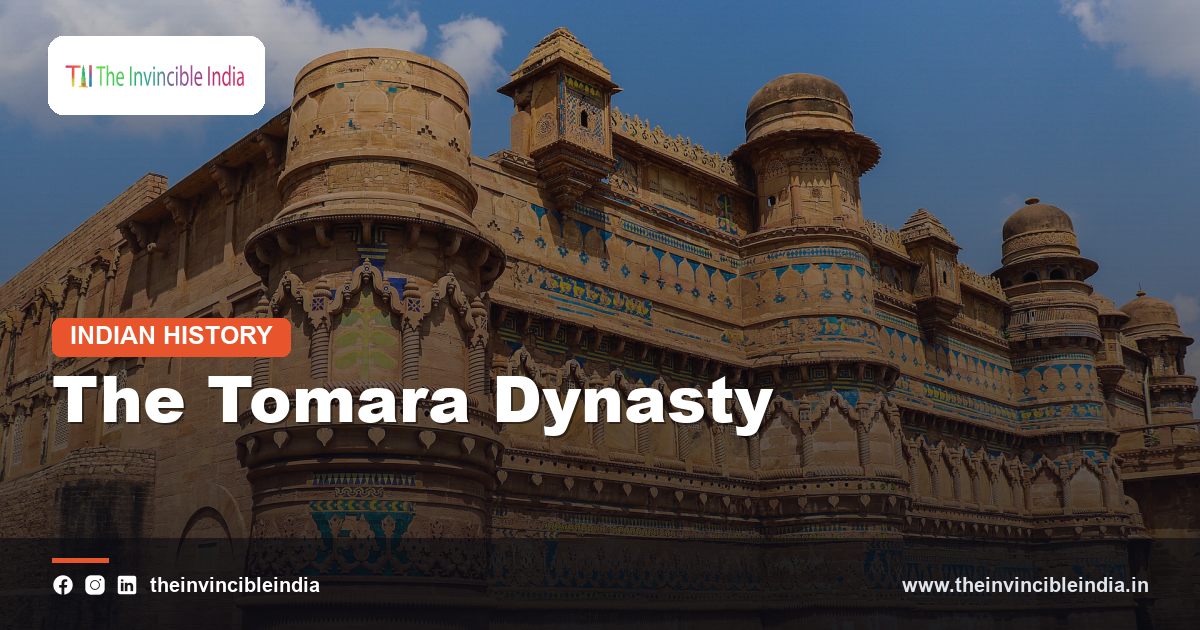
The Man Mandir Palace at Gwalior Fort is the architectural masterpiece most closely associated with the Tomara period. Its exterior is known for bold sandstone walls, rounded towers and bands of coloured glazed tile that once shone in bright blues, greens and yellows. Inside, courtyards, carved stone screens and pierced windows create spaces that balance privacy with light and ventilation. The design reflects traditions of Hindu palace architecture while also showing the wider artistic currents of the age, including decorative techniques familiar from other regions. Nearby, the Gujari Mahal and other structures enrich the fortress, which has been celebrated for centuries as one of the great citadels of India. Together, these buildings make Gwalior Fort a living record of Tomara taste and craftsmanship.
Music, Dhrupad and Royal Patronage
The court of Man Singh Tomar is remembered as a significant centre for the development of Hindustani classical music, particularly the form known as Dhrupad. This stately style, with its slow exploration of a raga through sustained notes and rhythmic cycles, was nurtured through royal support at Gwalior. Tradition also connects the court with the writing down and organising of musical knowledge, and it is often mentioned in accounts of how classical music schools grew in northern India. Gwalior later became famous as the home of one of the major gharanas, preserving this heritage into the modern era. The ruler’s interest in music suggests a view of kingship in which culture was part of sovereign duty. This patronage is among the most enduring contributions of the Tomaras to Indian civilisation.
Decline of Tomara Power in Gwalior
After the period of Man Singh, the Tomara kingdom of Gwalior faced mounting pressure from stronger northern powers, including the Lodi rulers of the Delhi Sultanate. The fortress, though formidable, could not remain forever beyond the reach of expanding states, and control eventually passed from the family. Later the region came under Mughal authority, and Gwalior became a notable imperial fortress and, in time, a prison for important captives. The Tomara line continued in other forms and in memory, but its sovereign rule in Gwalior came to an end. Such outcomes were common among regional dynasties when larger empires consolidated power. The decline did not erase the cultural achievements of the dynasty, which survived through buildings, music and the traditions of the local population.
The Tomara Dynasty Today
The Tomara dynasty survives in modern India through monuments, regional names and living cultural practices. Visitors to Mehrauli can walk among the ruins of Lal Kot, while those travelling to Faridabad can see the stepped reservoir at Suraj Kund, which hosts a well-known craft fair each year. At Gwalior, the great fort and the Man Mandir Palace continue to draw students of architecture and admirers of classical music. Communities bearing the Tomar name remain present across parts of north and central India, carrying a proud tradition of heritage. Historians continue to refine the picture as inscriptions and archaeological evidence are studied afresh. Taken together, these legacies make the Tomaras an essential chapter in the history of Delhi, Haryana and central India.
Sources & Further Reading
- Archaeological Survey of India (asi.nic.in).
- Ministry of Culture, Government of India (indiaculture.gov.in).
Frequently Asked Questions
Who were the Tomaras?
The Tomaras were a Rajput dynasty associated with early Delhi and the surrounding Haryana region, and later with Gwalior in central India. They are remembered for forts, water works and patronage of the arts.
What is the link between the Tomaras and Delhi?
Tradition credits the Tomaras with founding or greatly developing Dhillika, an early settlement that grew into Delhi. Fortifications such as Lal Kot are linked with their rule before the Chauhans expanded the site.
What are Suraj Kund and Anangpur?
Suraj Kund is a large stepped reservoir near Faridabad, and Anangpur preserves an associated embankment. Both are traditionally attributed to Tomara rulers and show their skill in managing water in the Aravalli landscape.
Who was Man Singh Tomar?
Man Singh Tomar was the most celebrated ruler of the Tomara line at Gwalior. He is known for building the Man Mandir Palace and for supporting musicians, which helped Dhrupad flourish at his court.
How did Tomara rule end in Gwalior?
Pressure from stronger northern powers, beginning with the Delhi Sultanate and later the Mughals, gradually removed Tomara control of the fortress. The dynasty’s cultural legacy in architecture and music nonetheless endured.