


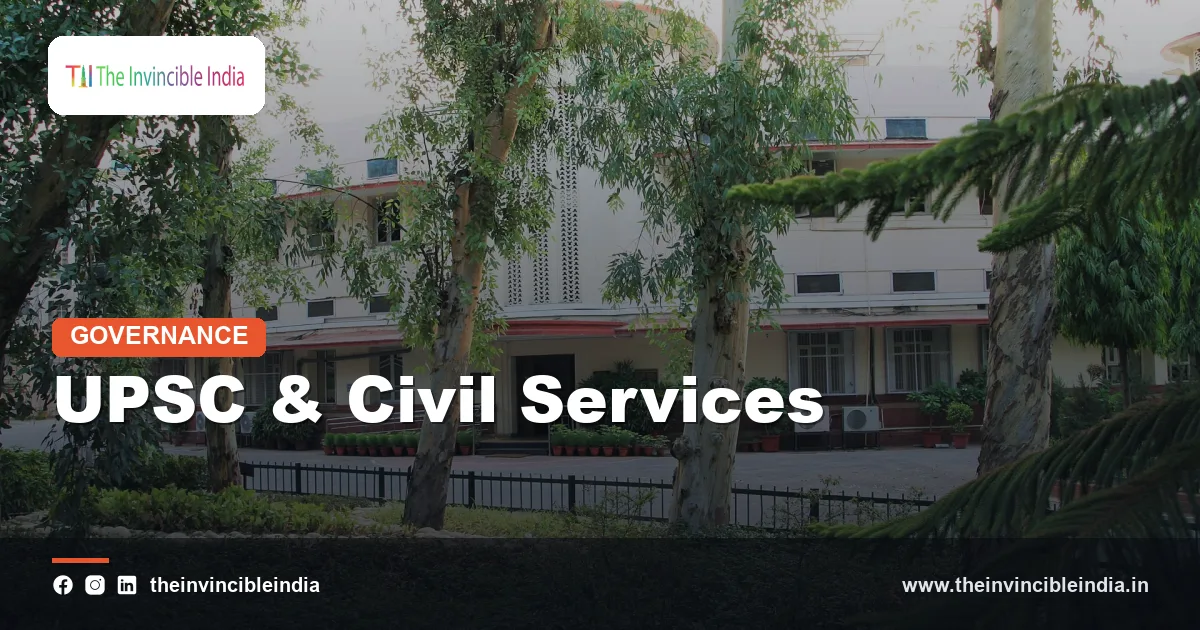
Every year, lakhs of young Indians sit down to attempt one of the most competitive recruitment tests in the world, and almost all of them are aiming at a single institution: the UPSC, or Union Public Service Commission. Based in Dholpur House on Shahjahan Road in New Delhi, the UPSC is the central agency that recruits officers for the senior ranks of the Indian administration, from district magistrates and police chiefs to diplomats and tax commissioners.
But the UPSC is more than an examination board. It is a constitutional body, created and protected by the Constitution of India so that the people who run the government machinery are chosen on merit rather than patronage. This explainer walks through its history, structure, functions, the famous Civil Services Examination, the services it fills, and the wider idea of a permanent, neutral civil service. Last updated: 1 October 2026.
Quick Facts
| Item | Detail |
|---|---|
| Full name | Union Public Service Commission (UPSC) |
| Nature | Independent constitutional body |
| Constitutional provisions | Articles 315 to 323 (Part XIV, Chapter II) |
| Predecessor | Public Service Commission, set up on 1 October 1926 |
| Became UPSC | With the Constitution coming into force on 26 January 1950 |
| Headquarters | Dholpur House, New Delhi |
| Members appointed by | The President of India |
| Flagship examination | Civil Services Examination (Preliminary, Mains and Personality Test) |
| Civil Services Day | 21 April every year |
What the UPSC Is and Why It Exists
A modern state needs administrators who can implement laws, manage public money, maintain law and order and represent the country abroad. Elected ministers decide policy, but a trained, full-time officer corps carries it out day after day, long after governments change. The question every democracy must answer is how to select that corps fairly. India’s answer was to entrust recruitment to an independent commission, insulated from the day-to-day pressure of politics.
The UPSC is that commission for the Union (central) government. Each state has its own State Public Service Commission, created under the same constitutional chapter, to recruit for state services. The UPSC therefore sits at the top of a two-tier system of merit-based recruitment.
Why a constitutional body matters
Because the UPSC is mentioned in the Constitution itself, it cannot be abolished or reshaped by an ordinary law. Its members enjoy protections, its expenses are charged to the Consolidated Fund of India, and it reports directly to the President. These features give it a degree of autonomy comparable to the Election Commission or the Comptroller and Auditor General.
History: From the 1926 Commission to the UPSC
The roots of the UPSC lie in the colonial Indian Civil Service (ICS). Competitive examinations for the ICS began in 1855, but they were held in London, which made it extremely difficult for Indians to compete. Satyendranath Tagore became the first Indian to enter the service in 1863. Demands for Indianisation, and for a body to oversee recruitment, grew steadily in the early twentieth century.
The Montagu-Chelmsford reforms and the Government of India Act, 1919 provided for a public service commission, and the Lee Commission of 1924 strongly recommended it. The Public Service Commission was finally established on 1 October 1926, with Sir Ross Barker as its first chairman. Its functions at first were limited and largely advisory.
Key milestones
- 1926: Public Service Commission set up under the 1919 Act.
- 1935: The Government of India Act, 1935 provided for a Federal Public Service Commission and for Provincial Public Service Commissions.
- 1937: The Federal Public Service Commission began functioning under the 1935 Act.
- 1950: The Constitution came into force on 26 January and the Federal Public Service Commission became the Union Public Service Commission.
- 1976 to 1979: Following the Kothari Committee, the three-stage pattern of Preliminary, Mains and Interview was introduced.
The Constitutional Framework: Articles 315 to 323
Part XIV of the Constitution deals with services under the Union and the States. Its second chapter, covering Articles 315 to 323, is devoted to Public Service Commissions. Together these articles establish the commissions, describe how members are appointed and removed, and set out what the commissions do.
| Article | Subject |
|---|---|
| 315 | Public Service Commissions for the Union and for the States |
| 316 | Appointment and term of office of members |
| 317 | Removal and suspension of a member |
| 318 | Power to make regulations on conditions of service of members and staff |
| 319 | Bar on holding certain offices after ceasing to be a member |
| 320 | Functions of Public Service Commissions |
| 321 | Power to extend the functions of the commissions |
| 322 | Expenses of the commissions |
| 323 | Reports of the commissions |
Related provisions elsewhere in Part XIV matter too. Article 312 allows Parliament to create new All India Services, and Articles 309 to 311 deal with the recruitment, conditions of service and protections available to civil servants.
Composition and Independence of the UPSC
The UPSC consists of a Chairman and a number of other members. The Constitution does not fix the exact strength; it leaves this to the President, who has typically appointed a Chairman along with several members. Both the Chairman and the members are appointed by the President of India.
Qualifications and tenure
The Constitution requires that at least half of the members should have held office for ten years or more under the Government of India or a State government. Beyond this, it prescribes no academic qualifications, so members often include senior civil servants, academics and professionals. A member holds office for six years or until reaching the age of 65, whichever comes first.
Safeguards for independence
- Security of tenure: A Chairman or member can be removed by the President only on specific grounds such as insolvency, engaging in paid employment outside office duties, or unfitness due to infirmity of mind or body.
- Removal for misbehaviour: Misbehaviour is a ground for removal only after the Supreme Court, on a reference from the President, holds an inquiry and reports that the member should be removed.
- Fixed conditions of service: The salary and service conditions of a member cannot be altered to his or her disadvantage after appointment.
- Charged expenditure: The commission’s expenses are charged on the Consolidated Fund of India, so they are not subject to a vote in Parliament.
- Post-tenure restrictions: The Chairman cannot take up further employment under the Union or a State government, and members face limits as well, with exceptions for certain commission posts.
Functions of the UPSC
Article 320 lays out the core duties of the commission. Its work falls broadly into three categories: recruitment, advice and reporting.
Conducting examinations
The UPSC conducts examinations for appointments to the services of the Union, including the All India Services and the central services. It also assists States, if two or more request, in framing and operating joint recruitment schemes for services needing specially qualified candidates.
Advising the government
The government must consult the UPSC on matters such as:
- the principles to be followed in making civil appointments, promotions and transfers from one service to another;
- the suitability of candidates for appointments, promotions and transfers;
- disciplinary matters affecting a person serving the Union in a civil capacity, including memorials and petitions relating to such matters;
- claims for reimbursement of legal expenses incurred by officers in the course of their duties, and claims for pensions in respect of injuries sustained in service.
Advisory, not binding
An important point is that the UPSC’s advice is consultative. The Union government is required to seek it on these matters, but is not strictly bound to accept it. Where the government rejects the commission’s advice, the reasons are expected to be explained in the commission’s annual report to the President, which is placed before Parliament.
Other examinations conducted
The Civil Services Examination is only one of many tests the UPSC holds. Others include:
- National Defence Academy and Naval Academy Examination (NDA and NA);
- Combined Defence Services Examination (CDS);
- Combined Medical Services Examination;
- Engineering Services Examination;
- Indian Economic Service and Indian Statistical Service Examination;
- Combined Geo-Scientist Examination;
- Central Armed Police Forces (Assistant Commandants) Examination;
- Indian Forest Service, which is now filled through the Civil Services Examination itself.
The commission also conducts recruitment by selection and interview for certain specialist posts in central government departments.
The Civil Services Examination: Three Stages
The Civil Services Examination (CSE) is the best-known examination the UPSC conducts. It is held once a year and the entire cycle, from notification to final results, typically stretches across roughly a year. It is designed to test knowledge, analytical ability, writing skills and personality, through three successive stages.
| Stage | Format | Purpose |
|---|---|---|
| Preliminary | Two objective-type (multiple choice) papers: General Studies Paper I and the Civil Services Aptitude Test (CSAT) Paper II | Screening test; marks do not count towards the final merit list |
| Mains | Nine descriptive papers, including an essay, four General Studies papers, two papers on an optional subject and two qualifying language papers | In-depth testing of knowledge and expression; counted in the final ranking |
| Personality Test (Interview) | Face-to-face interview before a UPSC board | Assesses personality, judgement, integrity and suitability for public service |
Stage one: the Preliminary
The Preliminary examination has two papers. General Studies Paper I covers history, geography, polity, economy, environment and current affairs. Paper II, the CSAT, tests comprehension, reasoning and basic numeracy. The CSAT is only qualifying, meaning candidates must secure the minimum prescribed percentage, but its marks are not used for ranking. Only the General Studies paper decides who proceeds.
Stage two: the Mains
The Mains is a written, descriptive test. Of its nine papers, two are language papers (one Indian language and English) that are qualifying in nature. The remaining seven are counted for merit: an essay paper, four General Studies papers covering heritage and society, governance and international relations, economy and technology, and ethics and integrity, and two papers on an optional subject chosen from a list of disciplines. Candidates may write most papers in a language listed in the Eighth Schedule or in English.
Stage three: the Interview
Candidates who qualify for the Mains are called for the Personality Test, which is not meant to be a general knowledge quiz. The board looks at mental alertness, clarity of expression, balance of judgement and awareness of social and administrative issues. The marks from the Mains and the Interview together decide the final rank, and the rank, along with the candidate’s preferences, shapes which service and cadre they receive.
Eligibility for the Civil Services Examination
The rules are notified each year, so candidates should always check the latest notification. In general terms, the framework works as follows.
- Educational qualification: A degree from a recognised university or an equivalent qualification. Final-year students may appear in the Preliminary, but must produce proof of passing before the Mains.
- Age limits: There is a minimum age of 21 years and a maximum that is higher for reserved categories. The upper limit for general category candidates is in the early thirties, with relaxations for Other Backward Classes, Scheduled Castes, Scheduled Tribes and certain other categories.
- Number of attempts: The number of attempts is capped, with more attempts allowed for reserved categories. Scheduled Caste and Scheduled Tribe candidates may attempt until they cross the upper age limit.
- Nationality: For the IAS, IPS and Indian Foreign Service, the candidate must be a citizen of India. For some other services, certain categories of non-citizens may be eligible.
Reservation for Scheduled Castes, Scheduled Tribes, Other Backward Classes, Economically Weaker Sections and persons with benchmark disabilities applies to vacancies, as provided by law.
The Services Filled: All India and Central Services
Success in the CSE leads to one of several services. These fall into two broad groups, and the difference between them is important.
| Feature | All India Services | Central Civil Services (Group A) |
|---|---|---|
| Examples | IAS, IPS, Indian Forest Service | Indian Foreign Service, Indian Revenue Service, Indian Audit and Accounts Service, and others |
| Employer | Common to both Union and States | The Union government |
| Cadre | Allotted to a State or joint cadre; officers serve in the State and also go on central deputation | Posted in central ministries, departments and offices, and abroad in some cases |
| Constitutional basis | Article 312, with Parliament’s authority to create new ones | Recruited under Union service rules |
The All India Services
The Indian Administrative Service (IAS), the Indian Police Service (IPS) and the Indian Forest Service (IFoS) are the three All India Services. They replaced the colonial ICS and Indian Police in 1947 to 1950. Their officers belong to a single national service but are assigned to State cadres, so they serve both State governments and the Centre. Article 312 permits Parliament to create more of these services if the Rajya Sabha passes a resolution supported by two-thirds of the members present and voting.
Central Civil Services, Group A
The Central Civil Services Group A include the Indian Foreign Service (IFS), the Indian Revenue Service (Income Tax and Customs and Indirect Taxes), the Indian Audit and Accounts Service, the Indian Railway services, the Indian Postal Service, the Indian Defence Accounts Service, the Indian Information Service, the Indian Trade Service and the Indian Corporate Law Service, among others. Some Group B services, such as those for Delhi, Andaman and Nicobar and similar territories, are also filled through the same examination.
Cadre allocation
For the All India Services, successful candidates are allotted to cadres, which are usually states or groups of states. Allocation takes into account the candidate’s rank, their stated preferences, the number of vacancies, and rules governing home-state and outside-state placement. A candidate with a high rank has a wider choice of both service and cadre.
The Steel Frame: Role of Civil Servants and the Permanent Executive
The phrase “steel frame” was originally used in British times for the ICS. After Independence, Sardar Vallabhbhai Patel, the first Home Minister, championed the retention of an all-India administrative service and is remembered for describing it as the steel frame of the country. In an address to probationers at Metcalfe House in Delhi on 21 April 1947, he stressed that a united India required an efficient, impartial service. Civil Services Day is observed on that date every year.
Permanent and political executive
The Indian system draws a clear line between two parts of the executive branch:
- The political executive: The Prime Minister, Union ministers and their State counterparts. They are elected, set policy, and are answerable to the legislature and ultimately to the voters.
- The permanent executive: Civil servants. They stay in service irrespective of which party governs, advise ministers, and implement decisions.
The idea is neutrality. A civil servant is expected to offer frank advice, follow lawful decisions and serve any elected government with equal commitment. Constitutional protections, such as those in Article 311 (which says that an officer cannot be dismissed or removed without due inquiry and an opportunity to be heard, subject to exceptions), support this independence.
The administrative hierarchy
At the Centre, a ministry is typically headed by a minister, with a Secretary as the senior-most civil servant. Below the Secretary are Additional Secretaries, Joint Secretaries, Directors, Deputy Secretaries and Under Secretaries. The Cabinet Secretary leads the entire civil service. In a State, the Chief Secretary heads the administration, and at the district level the District Magistrate and Collector coordinates development and revenue work, while the Superintendent of Police leads the police.
Training Academies
Selection is only the beginning. All officers undergo structured training before taking up their posts.
- LBSNAA, Mussoorie: The Lal Bahadur Shastri National Academy of Administration in Mussoorie, Uttarakhand, trains IAS officers. It also runs a common Foundation Course for officers from many services, bringing future colleagues together early in their careers.
- SVPNPA, Hyderabad: The Sardar Vallabhbhai Patel National Police Academy trains IPS officers.
- Indira Gandhi National Forest Academy, Dehradun: The training centre for the Indian Forest Service.
- Foreign Service Institute, New Delhi: It trains new diplomats of the Indian Foreign Service.
- Service-specific institutions: Other services run their own academies, for example for taxation, audit and railways.
Training combines classroom study of law, public administration and economics, field attachments in districts, and exposure to rural and urban conditions. After the academy phase, officers join their cadres for on-the-job learning, usually as sub-divisional officers or assistant superintendents.
Reforms and Debates
The civil services have changed through several reviews, among them the Kothari Committee (1976), the Satish Chandra Committee (1989), the Alagh Committee (2001), the Hota Committee (2004) and the Second Administrative Reforms Commission. Two recent topics stand out.
Lateral entry
Lateral entry refers to hiring specialists from outside the regular civil services, such as from the private sector, academia or public enterprises, usually on contract at senior levels like Joint Secretary and Director. Supporters see it as a way to bring in domain expertise; critics raise questions about transparency, reservation and the career structure of regular officers. The UPSC has been involved in the selection process, and the idea continues to be debated.
Mission Karmayogi
Launched in 2020 as the National Programme for Civil Services Capacity Building, Mission Karmayogi aims to move officials from a rule-based to a role-based approach to training. It uses an online learning platform, iGOT Karmayogi, where officials can access courses tailored to their competencies, supported by a Capacity Building Commission.
Other continuing debates
- the weight given to the CSAT and the pattern of the Preliminary examination;
- the place of regional languages in the examination;
- cadre allocation policy and the balance between home-state and outside-state postings;
- stability of tenure for officers and safeguards against arbitrary transfers.
Conclusion
The UPSC occupies a quiet but central place in Indian democracy. By selecting officers through open competition, protecting its own members with constitutional safeguards and advising the government on service matters, it supports the principle that public office should be filled by merit. The civil servants it recruits form the permanent executive that gives continuity to governance, whichever party is in power. As India’s administrative needs evolve, through reforms like lateral entry and Mission Karmayogi, the broader goal remains the same: a capable, neutral and accountable civil service.
Frequently Asked Questions
What does UPSC stand for and what does it do?
UPSC stands for Union Public Service Commission. It is a constitutional body that recruits officers for the All India Services and the central services through competitive examinations. It also advises the Union government on recruitment rules, promotions, transfers and disciplinary matters concerning civil servants.
Which Articles of the Constitution deal with the UPSC?
Articles 315 to 323 in Part XIV of the Constitution deal with Public Service Commissions. These cover the establishment of the commissions, appointment and removal of members, their functions and expenses, and their annual reports. Article 312 separately provides for the creation of All India Services.
What are the stages of the Civil Services Examination?
There are three stages. The Preliminary has two objective papers, including the qualifying CSAT; the Mains has nine descriptive papers including an essay, General Studies and an optional subject; and the final stage is the Personality Test or Interview. The Mains and Interview marks decide the final rank.
What is the difference between All India Services and central services?
The All India Services, namely the IAS, IPS and Indian Forest Service, are common to the Union and States, and officers are allotted to State cadres. The central services, such as the Indian Foreign Service and Indian Revenue Service, serve only the Union government and are posted in central departments or abroad.
Why are civil servants called the steel frame of India?
The phrase was first used for the colonial Indian Civil Service. After Independence, Sardar Vallabhbhai Patel advocated a strong, unified all-India administrative service and is closely associated with calling it the steel frame of the country. It reflects the role of civil servants in holding the administration together irrespective of changes in government.
Where are IAS and IPS officers trained?
IAS officers are trained at the Lal Bahadur Shastri National Academy of Administration in Mussoorie, which also runs a common Foundation Course. IPS officers are trained at the Sardar Vallabhbhai Patel National Police Academy in Hyderabad. Other services have their own specialised training institutions.
{“@context”:”https://schema.org”,”@graph”:[{“@type”:”FAQPage”,”mainEntity”:[{“@type”:”Question”,”name”:”What does UPSC stand for and what does it do?”,”acceptedAnswer”:{“@type”:”Answer”,”text”:”UPSC stands for Union Public Service Commission. It is a constitutional body that recruits officers for the All India Services and the central services through competitive examinations. It also advises the Union government on recruitment rules, promotions, transfers and disciplinary matters concerning civil servants.”}},{“@type”:”Question”,”name”:”Which Articles of the Constitution deal with the UPSC?”,”acceptedAnswer”:{“@type”:”Answer”,”text”:”Articles 315 to 323 in Part XIV of the Constitution deal with Public Service Commissions. These cover the establishment of the commissions, appointment and removal of members, their functions and expenses, and their annual reports. Article 312 separately provides for the creation of All India Services.”}},{“@type”:”Question”,”name”:”What are the stages of the Civil Services Examination?”,”acceptedAnswer”:{“@type”:”Answer”,”text”:”There are three stages. The Preliminary has two objective papers, including the qualifying CSAT; the Mains has nine descriptive papers including an essay, General Studies and an optional subject; and the final stage is the Personality Test or Interview. The Mains and Interview marks decide the final rank.”}},{“@type”:”Question”,”name”:”What is the difference between All India Services and central services?”,”acceptedAnswer”:{“@type”:”Answer”,”text”:”The All India Services, namely the IAS, IPS and Indian Forest Service, are common to the Union and States, and officers are allotted to State cadres. The central services, such as the Indian Foreign Service and Indian Revenue Service, serve only the Union government and are posted in central departments or abroad.”}},{“@type”:”Question”,”name”:”Why are civil servants called the steel frame of India?”,”acceptedAnswer”:{“@type”:”Answer”,”text”:”The phrase was first used for the colonial Indian Civil Service. After Independence, Sardar Vallabhbhai Patel advocated a strong, unified all-India administrative service and is closely associated with calling it the steel frame of the country. It reflects the role of civil servants in holding the administration together irrespective of changes in government.”}},{“@type”:”Question”,”name”:”Where are IAS and IPS officers trained?”,”acceptedAnswer”:{“@type”:”Answer”,”text”:”IAS officers are trained at the Lal Bahadur Shastri National Academy of Administration in Mussoorie, which also runs a common Foundation Course. IPS officers are trained at the Sardar Vallabhbhai Patel National Police Academy in Hyderabad. Other services have their own specialised training institutions.”}}]}]}