

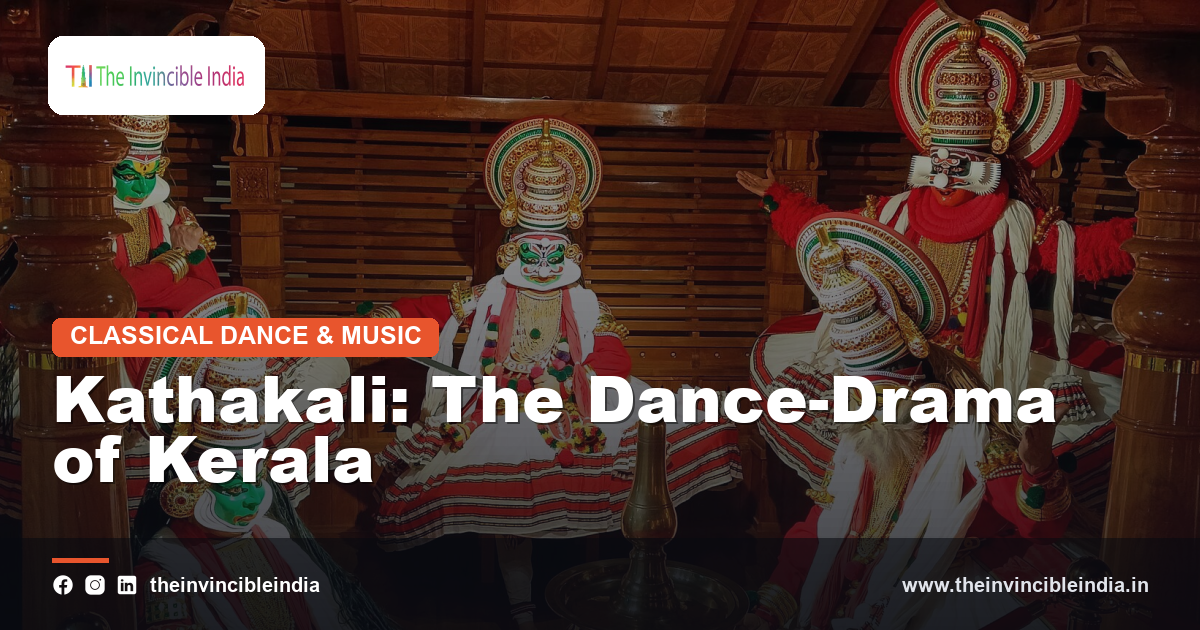
Kathakali is one of the eight classical dance forms of India and the great dance-drama of Kerala, instantly recognised by its towering headdresses, billowing costumes and the extraordinary painted faces of its performers. It is a total theatre that fuses dance, drama, music, mime and elaborate visual art to enact stories from the Hindu epics and legends. Every emotion and every line of the story is conveyed without spoken words, through a precise vocabulary of hand gestures, dazzling footwork and, above all, the astonishing expressiveness of the eyes and face. Developed over centuries in the temples and courts of Kerala, Kathakali is among the most spectacular performing arts in the world. This guide explores its history, make-up, technique, music and living tradition.
Quick Facts
| Detail | Information |
|---|---|
| Type | Classical dance-drama, one of India’s eight classical dances |
| Origin | Kerala, South India |
| Emerged | Around the seventeenth century, from earlier temple arts |
| Language of story | Told through mudras and facial expression, sung in Manipravalam |
| Signature | Elaborate make-up (chutti), towering headgear, all-night performances |
| Drums | Chenda and maddalam |
A Dance-Drama Born in Kerala
Kathakali is a dramatic art in which stories are performed rather than merely danced, and it stands apart from India’s other classical forms in its scale and theatricality. The word combines katha, meaning story, and kali, meaning play or performance, and the art is essentially a form of storytelling theatre. Performers do not speak or sing their own lines; instead, vocalists narrate the story while the actor-dancers bring it to life through movement, gesture and expression. Traditionally staged through the night in temple precincts, lit by a large brass oil lamp, a Kathakali performance is an immersive spectacle that unites many arts into a single overwhelming experience.
Origins and Roots
Kathakali took shape in Kerala around the seventeenth century, drawing on older ritual and performance traditions of the region, including temple arts and martial and dramatic forms. It grew in part from earlier dance-dramas, and the tradition credits the patronage of local rulers with shaping its early development. Over time it absorbed a rich body of technique and a repertoire of plays, and distinct styles and schools developed as it was refined by generations of masters. From these roots emerged the highly codified art known today, with its detailed rules for make-up, costume, gesture and music, preserved and passed on through rigorous training in the traditional teacher-disciple relationship.
The All-Night Temple Performance
In its traditional setting, a Kathakali performance was an all-night event held in the courtyard of a temple or a great house, beginning in the evening and continuing until dawn. The stage was simple, defined by a large brass oil lamp whose flame lit the performers’ faces and heightened the drama of their expressions. The evening opened with preliminary items announcing the performance before the main story unfolded at a measured, unhurried pace that allowed the actors to explore each moment in depth. This leisurely rhythm, so different from modern stagecraft, gave the audience time to savour the artistry, and many traditional performances are still staged in this immersive, night-long form.
The Elaborate Make-Up
The make-up of Kathakali, known as chutti, is among the most elaborate in world theatre and can take several hours to apply. Natural pigments are used to paint the face in bold colours, and for certain characters a raised white frame is built up along the jaw from rice paste and paper, transforming the actor’s face into a stylised mask. The colours and patterns are not decorative alone; they identify the type of character being portrayed and signal his nature to the audience at a glance. Beneath the paint the performer’s features remain mobile, so that the powerful expressions and eye movements read vividly against the striking painted design.
The Character Types
Kathakali characters fall into recognisable types, each defined by its make-up and costume. The pacha, or green-faced, characters are noble and virtuous heroes, gods and kings. The kathi, or knife, characters, marked by upturned patterns, are arrogant or villainous figures of high birth. The bearded types, or thadi, come in varieties that denote different natures, from the fierce to the divine, while the kari, or black, make-up marks demonic and forest characters. The minukku, or radiant, make-up in softer tones is used for gentle characters such as women, sages and brahmins. This visual code lets the audience read a character’s essential nature the moment he steps into the light.
Costume and the Towering Headgear
The Kathakali costume is as monumental as the make-up. Heroic characters wear a vast, voluminous skirt built out with layers of stiffened cloth, a richly ornamented jacket, and heavy jewellery, together with a large and elaborately decorated crown or headdress that adds greatly to the performer’s height and presence. The overall effect is to transform the human actor into a larger-than-life figure, part man and part divine or demonic being. The weight and scale of the costume demand strength and control, and moving, dancing and expressing emotion while wearing it is itself a considerable feat that only long training makes possible.
Mudras: The Language of Gesture
Because the performers neither speak nor sing, the entire story is told through a precise language of hand gestures, or mudras, combined with movement and expression. This gesture language is highly developed, with a set of basic hand shapes that can be combined and varied to represent a vast range of words, objects, actions and ideas. A trained audience can follow the narrative in detail through the hands alone, reading the gestures as one reads words. Mastering this vocabulary so that it flows with clarity and grace, in perfect time with the music and the story, is one of the central disciplines of the Kathakali actor.
Navarasam and the Art of Expression
If the hands carry the words of Kathakali, the face carries its soul. The art places extraordinary emphasis on facial expression, and performers train for years to gain complete control over the muscles of the face, especially the eyes, eyebrows and cheeks. Central to this is the mastery of the navarasam, the nine fundamental emotional states, from love and laughter to anger, fear, wonder and peace, each of which the actor must be able to summon and portray with total conviction. Special eye exercises give performers their famous ability to move the eyes with startling speed and precision, and it is this command of expression that gives Kathakali its emotional power.
The Music of Kathakali
Kathakali is accompanied by its own distinctive style of music, sung by vocalists who narrate the story and give voice to the characters while the actors perform. The lead singer keeps time with a gong and is joined by a second vocalist with cymbals, and the songs are composed in a blend of Sanskrit and Malayalam. The music sets the mood of each scene and drives the rhythm of the dance, and the close coordination between singers, drummers and dancers is essential to the flow of the drama. The melodic tradition of Kathakali is related to the temple music of Kerala and forms an inseparable part of the whole.
The Drums: Chenda and Maddalam
Percussion is the heartbeat of Kathakali, and two drums dominate its soundscape. The chenda, a tall cylindrical drum played with sticks, produces a loud, powerful and thrilling sound used especially for scenes of energy, conflict and heroism. The maddalam, a horizontal barrel drum played with the hands, gives a softer, rounder tone suited to gentler and more lyrical moments. Together the drummers respond closely to the movements and expressions of the actors, punctuating gestures and heightening emotion, so that the drumming is not mere accompaniment but an active partner in the drama, shaping its rhythm and intensity from moment to moment.
Stories from the Epics
The repertoire of Kathakali is drawn largely from the great Hindu epics, the Ramayana and the Mahabharata, and from the Puranas, the vast body of myth and legend. The plays, known as attakatha, retell episodes featuring gods, demons, kings and heroes, full of love, valour, jealousy and cosmic conflict. These stories, familiar to audiences from childhood, provide the emotional and moral world in which the art unfolds, and the appeal of a performance lies less in surprise than in the depth and beauty with which a well-known episode is brought to life. The grandeur of the epic material is well matched to the larger-than-life style of the form.
Rigorous Training
Becoming a Kathakali performer demands one of the most rigorous trainings in all of the performing arts, begun in childhood and continued over many years. Students undergo intense physical conditioning to build the strength, stamina and flexibility needed to sustain the heavy costume and the demanding movements, including a distinctive regime of body massage and exercise. They train the eyes and facial muscles through special exercises until they can move them with extraordinary control, and they memorise the vast vocabulary of gestures and the repertoire of plays. This long and arduous apprenticeship, undertaken under the close supervision of masters, forges the complete artist who can command the stage through the night.
The Green Room and Preparation
Much of the artistry of Kathakali begins long before the performer steps into the light, in the elaborate preparation of the make-up and costume. The application of the chutti and the painting of the face can take several hours, and the process is itself a specialised craft, often carried out by dedicated make-up artists while the performer lies still. As the paint is applied and the costume assembled, the actor gradually withdraws into the character he is to portray, so that by the time he is fully attired he has been transformed, outwardly and inwardly, into the god, king or demon of the story. This slow, meditative preparation is an essential part of the tradition.
Kathakali and Kerala's Identity
Kathakali is far more than a stage art; it is a cherished emblem of Kerala’s cultural identity, admired across the state and recognised around the world as one of its defining traditions. Its striking imagery, the green-faced hero in his towering crown, has become a visual symbol of Kerala itself, appearing in art, tourism and popular culture. Yet beneath the spectacle it remains a living devotional and artistic practice, tied to the temples, festivals and communities that have sustained it for centuries. In preserving and celebrating Kathakali, Kerala keeps alive a unique fusion of dance, drama, music and painting found nowhere else, and passes on a proud inheritance to future generations.
Kathakali Today
Kathakali remains a living art, taught in dedicated institutions in Kerala, most notably the Kerala Kalamandalam, and performed both in its traditional temple settings and on modern stages in India and abroad. While full all-night performances continue, shorter versions are also staged to suit contemporary audiences and touring, and the art has found admirers around the world who are drawn to its visual splendour and emotional intensity. Efforts to train new generations of performers and musicians keep the demanding tradition alive, and Kathakali stands today as one of the most remarkable and instantly recognisable of all India’s classical arts.
Sources & Further Reading
- Sangeet Natak Akademi, national academy for music, dance and drama, on the classical dance forms of India (sangeetnatak.gov.in).
- Kerala Kalamandalam, deemed university for art and culture, on Kathakali training and repertoire (kalamandalam.org).
- Ministry of Culture, Government of India, on the performing-art traditions of Kerala (indiaculture.gov.in).
Frequently Asked Questions
What is Kathakali?
Kathakali is a classical dance-drama from Kerala and one of the eight classical dance forms of India. It tells stories from the Hindu epics through elaborate make-up and costume, hand gestures and facial expression, accompanied by singing and drumming, without the performers speaking.
Where did Kathakali originate?
Kathakali originated in Kerala, in South India, around the seventeenth century, developing from earlier temple and dramatic traditions of the region under the patronage of local rulers.
Why do Kathakali performers wear such elaborate make-up?
The elaborate make-up, called chutti, identifies the type of character being portrayed. Colours and patterns signal whether a figure is noble, villainous, divine or demonic, so the audience can read a character’s nature at a glance, while the mobile face beneath conveys emotion.
What are the main drums used in Kathakali?
The two main drums are the chenda, a tall cylindrical drum played with sticks for powerful, energetic scenes, and the maddalam, a horizontal barrel drum played by hand for softer, more lyrical moments.
What stories does Kathakali tell?
Kathakali plays, known as attakatha, are drawn mainly from the Hindu epics, the Ramayana and the Mahabharata, and from the Puranas, retelling episodes featuring gods, demons, kings and heroes.


