

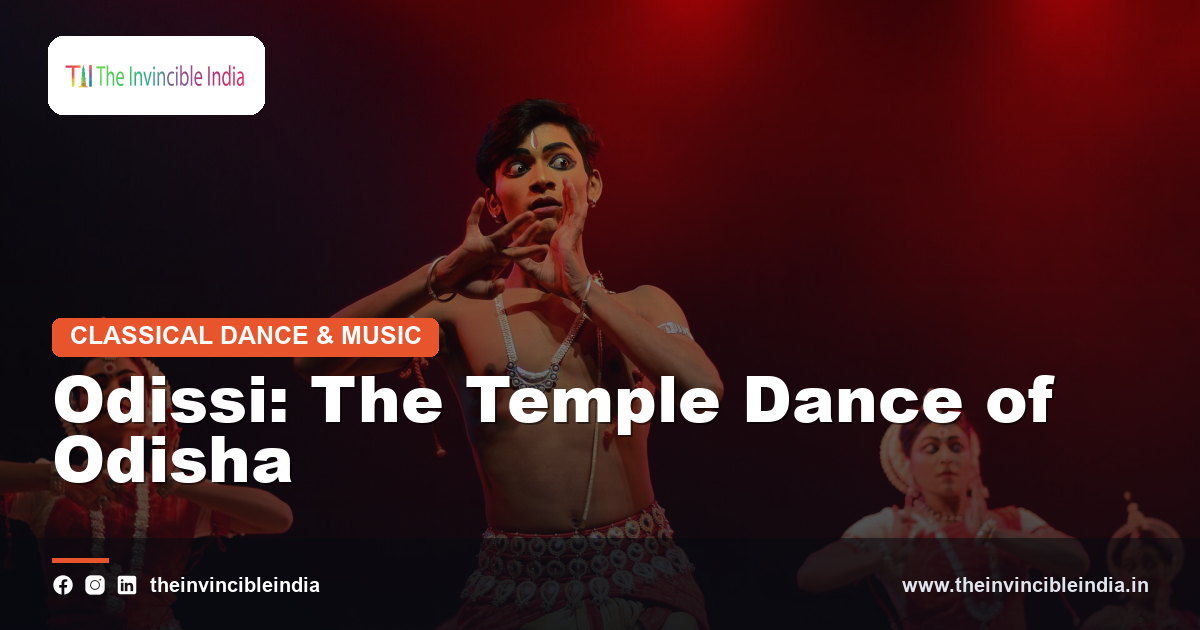
Odissi is one of the eight classical dance forms of India and the classical temple dance of Odisha, renowned for its lyrical grace, its fluid movement of the torso and its striking resemblance to the sculptures that adorn the region’s ancient temples. Among the oldest of India’s dance traditions, it grew as an offering to the deity in the great temples of Odisha, above all in the worship of Lord Jagannath at Puri. With its signature swaying postures, its sculptural poses and its blend of pure rhythm and tender expression, Odissi is often described as sculpture set in motion. This guide traces its history, technique, music, costume and revival.
Quick Facts
| Detail | Information |
|---|---|
| Type | One of India’s eight classical dance forms |
| Origin | Odisha, eastern India |
| Roots | Temple dance tradition linked to the worship of Lord Jagannath |
| Signature postures | Tribhanga (three-bend) and chowka (square) |
| Character | Lyrical, graceful and sculptural |
| Revival | Reconstructed in the mid-twentieth century by dedicated gurus |
India's Temple Dance from Odisha
Odissi is the classical dance of the eastern state of Odisha and one of the most graceful of all Indian dance forms. Like Bharatanatyam and Odisha’s own temple sculpture, it grew from a tradition of dance offered as worship within the temple, and its aesthetic is inseparable from the carved figures that decorate the walls and doorways of the region’s shrines. The dance is distinguished by its soft, flowing quality, its emphasis on the independent movement of the torso, and its poses that seem to step straight out of stone. In Odissi, devotion, sculpture and dance meet in a single art of great beauty and refinement.
Ancient Roots
Odissi is often counted among the oldest surviving classical dance traditions of India, and evidence of dance in the region reaches back to antiquity. Carvings in the ancient rock-cut caves of Odisha depict dance and music, and dance figures abound in the sculpture of the state’s later temples, testifying to a long and continuous performance culture. The tradition drew on the pan-Indian theory of the Natya Shastra as well as on regional texts on dance, and it developed its own distinctive grammar of movement over the centuries. This deep antiquity, written into the very stones of Odisha, gives the dance a powerful sense of connection to the distant past.
Maharis and Gotipuas
Two communities of performers preserved the Odissi tradition through the centuries. The maharis were temple dancers, women dedicated to the service of the deity who performed dance and song as part of temple ritual, much like the devadasis of the South. Alongside them arose the tradition of the gotipuas, boys dressed as girls who danced outside the temple, in public and in the courts, and who kept alive the technique when the temple tradition declined. Many of the gurus who later reconstructed Odissi for the modern stage had themselves trained as gotipuas, and these two streams together carried the art through periods of upheaval into the twentieth century.
The Jagannath Connection
The spiritual heart of Odissi lies in the worship of Lord Jagannath, the presiding deity of Odisha, whose great temple at Puri is one of the most important pilgrimage sites in India. The maharis performed before Jagannath as an act of devotion, and much of the dance’s repertoire and emotional world is bound up with the god and with the devotional poetry addressed to him. The themes of divine love, longing and surrender that run through Odissi draw deeply on this tradition. The connection to Jagannath gives the dance not only its subject matter but also its underlying spirit, as an offering of beauty and devotion to the divine.
Tribhanga and Chowka
Two postures define the distinctive look of Odissi. The tribhanga, or three-bend posture, curves the body gracefully at the neck, waist and knee into a gentle S-shape, creating the sensuous, sculptural lines for which the dance is famous and which echo the temple carvings. The chowka, or square posture, is a stable, symmetrical stance with the weight evenly balanced and the arms held out, said to represent Lord Jagannath and providing a grounded counterpoint to the fluid tribhanga. The alternation between the soft curves of the tribhanga and the firm geometry of the chowka gives Odissi its characteristic rhythm of movement and its unmistakable visual identity.
The Sculpturesque Quality
More than any other Indian classical dance, Odissi is celebrated for its sculptural quality, the way in which the dancer’s body forms poses that mirror the figures carved on Odisha’s temples. Central to this is the independent movement of the torso, shifted from side to side while the lower body holds its position, a technique that lends the dance its distinctive fluidity and grace. Poses are held with a soft, rounded elegance rather than sharp angularity, and transitions flow smoothly one into the next. Watching a skilled Odissi dancer is often likened to seeing the deities and celestial dancers of the temple walls come gently to life.
The Repertoire
A traditional Odissi recital follows a structured sequence that moves from invocation to pure dance to expression and finally to spiritual release. It usually opens with the mangalacharan, an invocation offering salutations to the deity, the earth and the audience, followed by the battu or sthayi, a piece of pure dance in the chowka posture. The pallavi is a lyrical elaboration of a musical theme, blossoming from slow to fast, while the abhinaya pieces present expressive interpretations of devotional poetry. The recital typically concludes with the moksha, a climactic dance symbolising spiritual liberation. This progression gives an Odissi performance its satisfying arc, from greeting to transcendence.
Abhinaya and the Gita Govinda
The expressive heart of Odissi lies in its abhinaya, and no source is more central to it than the Gita Govinda, the twelfth-century devotional poem by the Odia poet Jayadeva, which celebrates the love of Radha and Krishna. Its verses, sung and interpreted through gesture and expression, form a cherished part of the Odissi repertoire and allow the dancer to explore the many moods of divine love, from joy and yearning to sorrow and union. Through subtle facial expression and graceful gesture, the dancer brings this poetry to life, and the tender, devotional character of the Gita Govinda has shaped the emotional world of Odissi more than any other text.
Music and Costume
Odissi is performed to the classical music of Odisha, a distinct tradition with its own ragas and style, accompanied by instruments including the pakhawaj or mardala drum, the flute, the sitar and the harmonium, together with vocal music. The mardala in particular drives the rhythm of the dance. The costume is elegant and distinctive: the dancer wears a brightly coloured sari, often in the local ikat weave, draped and stitched in a special style, and is adorned with striking silver filigree jewellery, a headpiece evoking a temple tower, and ankle bells. This graceful ensemble completes the image of the Odissi dancer as a living temple sculpture.
The Twentieth-Century Revival
Like several Indian classical dances, Odissi declined under colonial rule as the temple tradition weakened, and by the early twentieth century it survived mainly through the gotipuas. Its reconstruction as a full classical concert dance was the achievement of a group of devoted gurus and scholars in the mid-twentieth century, who drew on surviving practice, temple sculpture and classical texts to codify and enrich the form. Among the most celebrated of these masters was Guru Kelucharan Mohapatra, whose artistry and teaching shaped modern Odissi profoundly. Their work restored the dance to the stage and secured its recognition as one of the great classical arts of India.
The Mardala and Rhythm
The rhythmic foundation of Odissi is provided by the mardala, the traditional barrel drum of Odisha, whose distinctive tone and technique set the dance apart from the percussion of other classical forms. The drummer is far more than an accompanist: he recites the rhythmic syllables that guide the dancer, marks the intricate rhythmic passages, and engages in a lively dialogue of sound and movement, especially in the pure-dance sections. Mastery of the mardala is a demanding art in its own right, and a skilled drummer and dancer working in close partnership can raise a performance to great heights. The rhythms of Odissi, at once subtle and vigorous, owe their character to this remarkable instrument.
The Guru-Shishya Tradition
Odissi is handed down through the guru-shishya parampara, the age-old relationship between teacher and disciple that lies at the heart of Indian classical arts. Under the close, personal guidance of a guru, students absorb not only the technique of the dance but its spirit, aesthetics and devotional depth, over many years of dedicated practice. This intimate transmission preserves the subtleties of style that cannot be captured in books, and it was through such lineages that the twentieth-century masters rebuilt and enriched the form. The bond between guru and disciple remains central to Odissi today, ensuring that the living knowledge of the dance passes faithfully from one generation to the next.
Odissi on the World Stage
From its revival in the mid-twentieth century, Odissi has travelled far beyond Odisha to become a celebrated presence on stages across India and around the globe. Its grace, sculptural beauty and devotional depth have won it audiences in many countries, and Indian and international dancers alike now perform and teach it worldwide. The Indian diaspora has carried the tradition abroad, and cultural festivals regularly feature the dance, introducing new audiences to its lyrical charm. This global reach is a measure of how completely the once-endangered temple dance has been restored to vitality, and of the universal appeal of its blend of rhythm, sculpture and tender emotion.
Odissi Today
Today Odissi is practised and cherished across India and around the world, taught in academies and performed on stages far beyond Odisha. Its grace and sculptural beauty have won it admirers everywhere, and dancers of many backgrounds now study it seriously, carrying forward the tradition rebuilt by the twentieth-century gurus. Contemporary artists continue to create new choreography while preserving the classical repertoire, and the dance remains closely tied to the devotional culture of Odisha and to the memory of the temple. In its flowing lines and tender expression, Odissi keeps alive one of India’s oldest and most beautiful traditions of dance as devotion.
Sources & Further Reading
- Sangeet Natak Akademi, national academy for music, dance and drama, on the classical dance forms of India (sangeetnatak.gov.in).
- Ministry of Culture, Government of India, on the classical dance traditions of Odisha (indiaculture.gov.in).
- Jayadeva, Gita Govinda (twelfth century), the devotional poem central to the Odissi repertoire.
Frequently Asked Questions
What is Odissi?
Odissi is one of the eight classical dance forms of India and the classical temple dance of Odisha. It is known for its lyrical grace, its fluid torso movement and its sculptural poses, and grew from a tradition of dance offered as worship, especially to Lord Jagannath.
What is the tribhanga posture?
The tribhanga, or three-bend posture, is the signature stance of Odissi, in which the body curves gracefully at the neck, waist and knee into a gentle S-shape. It creates the sensuous, sculptural lines that echo the figures carved on Odisha’s temples.
Who were the maharis and gotipuas?
The maharis were female temple dancers who performed Odissi as part of temple ritual, while the gotipuas were boys dressed as girls who danced in public and the courts. Both communities preserved the tradition, and many later gurus trained as gotipuas.
How is Odissi connected to Lord Jagannath?
Odissi is deeply tied to the worship of Lord Jagannath, the presiding deity of Odisha whose great temple is at Puri. The maharis danced before Jagannath in devotion, and much of the repertoire and emotional spirit of the dance is bound up with the god.
Who revived Odissi in the twentieth century?
Odissi was reconstructed in the mid-twentieth century by a group of devoted gurus and scholars, among them the celebrated Guru Kelucharan Mohapatra, who drew on surviving practice, temple sculpture and classical texts to restore it as a concert dance.


