

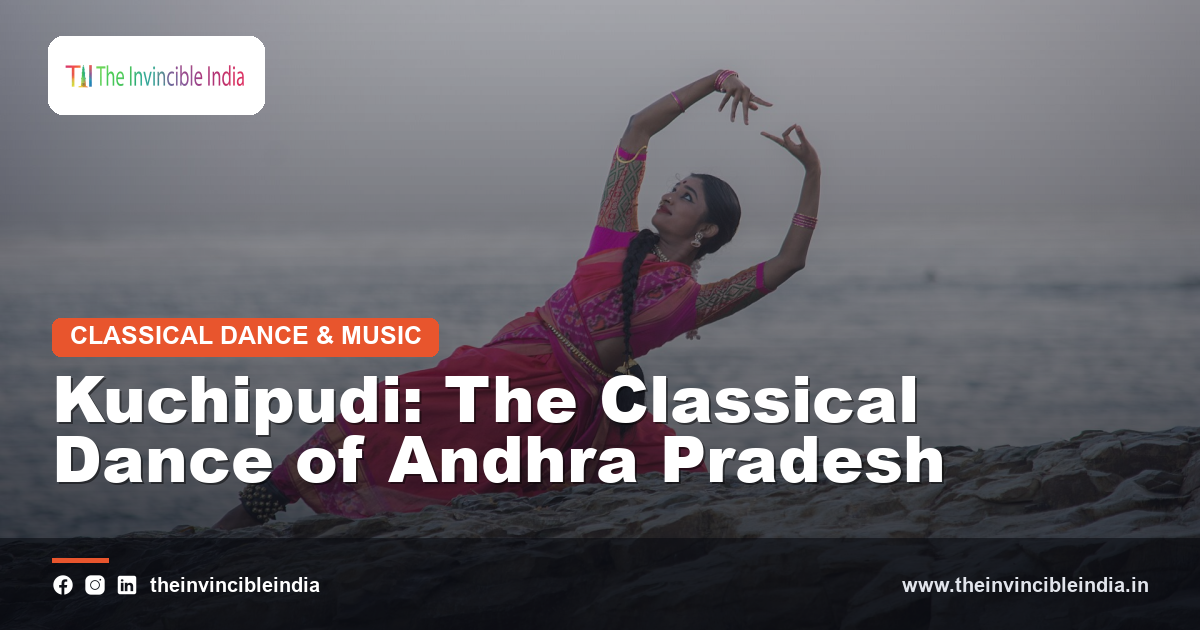
Kuchipudi is one of the eight classical dance forms of India and the classical dance of Andhra Pradesh, celebrated for its lively grace, quicksilver footwork and rich tradition of dance-drama. Taking its name from the village where it flourished, Kuchipudi began as a devotional theatre performed by groups of men who enacted stories of gods and heroes, and it later developed into the solo concert form widely seen today. Blending fluid, rounded movement with dazzling rhythm and expressive storytelling, and famous for the spectacular tarangam danced on the rim of a brass plate, Kuchipudi is among the most engaging of India’s classical arts. This guide explores its history, technique, music and living tradition.
Quick Facts
| Detail | Information |
|---|---|
| Type | One of India’s eight classical dance forms |
| Origin | The village of Kuchipudi, Andhra Pradesh |
| Tradition | Began as a devotional dance-drama performed by men |
| Signature item | Tarangam, danced on the rim of a brass plate |
| Music | Carnatic music |
| Character | Fluid, graceful and quick, blending dance and drama |
A Dance Named for a Village
Kuchipudi takes its name from a village in the Krishna district of Andhra Pradesh, where the tradition was nurtured and from which it spread. For generations, families in the village dedicated themselves to the art, performing devotional dance-dramas and passing the knowledge from one generation to the next. This deep connection between the dance and its home village is unusual among the classical forms and gives Kuchipudi a strong sense of rootedness in a particular community and place. Even as the art has spread across India and the world, the village remains the symbolic heart of the tradition and the source of its distinctive style and repertoire.
Origins as Devotional Theatre
Kuchipudi began not as a solo dance but as a form of devotional theatre, performed by troupes of men who enacted stories from mythology as an act of worship and community celebration. These dance-dramas combined dance, music, dialogue and drama into a single performance, staged in temples and villages for religious festivals. The performers, drawn from a hereditary community of dance masters, played all the roles, including the female characters, and dedicated their lives to the art. This theatrical origin shaped the character of Kuchipudi, giving it a strong dramatic and narrative element that survives in the solo form even today.
The Legacy of Siddhendra Yogi
The tradition credits the saint-poet Siddhendra Yogi with shaping and systematising Kuchipudi as it is known today. According to tradition, he composed the famous dance-drama Bhamakalapam, centred on Satyabhama, a queen of Krishna, and trained the young men of the village to perform it, establishing a lineage of dedicated artists. His work gave the form a defining repertoire and a sense of sacred purpose, and Bhamakalapam remains one of the most celebrated pieces in the Kuchipudi tradition. The reverence for Siddhendra Yogi reflects the deeply devotional spirit in which the dance was created and has been sustained across the centuries.
From Dance-Drama to Solo Form
While Kuchipudi began as a group dance-drama, it gradually developed a solo concert form that could be performed by a single dancer on the modern stage. In this transformation, the narrative and dramatic elements of the tradition were distilled into solo pieces that combine pure dance, expression and storytelling. Today both traditions continue: the full dance-dramas are still staged, preserving the theatrical roots of the art, while the solo form has carried Kuchipudi to concert stages across India and the world. The solo dancer draws on the whole heritage of the form, moving between the roles of narrator, character and pure dancer within a single recital.
Quicksilver Technique
Kuchipudi is known for its lively, quicksilver quality, marked by rapid, rhythmic footwork, brisk movements and a flowing, rounded grace that distinguishes it from the more angular styles of some other classical dances. The dance demands agility and precise timing, and its energetic passages of pure rhythm are among its great delights. At the same time it retains a soft, graceful fluidity, so that speed is balanced by elegance. This combination of swiftness and grace, of crisp rhythm and gentle flow, gives Kuchipudi its characteristic charm and makes a skilled performance both exhilarating and beautiful to watch.
The Spectacular Tarangam
The most famous and spectacular feature of Kuchipudi is the tarangam, in which the dancer performs while balancing on the rim of a brass plate, moving it across the stage with the feet in time to the rhythm. This demanding feat, sometimes made even more dramatic by balancing a pot of water or a pattern of lit lamps on the head, requires extraordinary balance, control and mastery of rhythm. The tarangam is a highlight of many performances and a signature of the form, showcasing the dancer’s technical brilliance and poise. Its blend of virtuosity and grace has made it one of the most memorable images in all of Indian classical dance.
The Three Elements
Like the other classical forms, Kuchipudi is built on the interplay of pure dance, expression and drama. Nritta, the pure rhythmic dance, showcases the dancer’s command of footwork and timing; nritya, the expressive dance, uses gesture and facial expression to convey mood and meaning; and natya, the dramatic element, brings characters and stories to life. Kuchipudi is especially rich in the dramatic dimension, a legacy of its origins as theatre, and a solo dancer may portray a whole cast of characters, shifting between them with skill. This balance of rhythm, expression and drama gives the form its depth and variety.
Abhinaya and Storytelling
Expression and storytelling lie at the heart of Kuchipudi, reflecting its roots in devotional drama. Through abhinaya, the art of expression, the dancer uses subtle movements of the face, eyes and body, together with hand gestures, to portray characters and convey the shifting emotions of a story. In pieces such as those drawn from the tradition of Bhamakalapam, the performer may present a vivid, rounded character, full of personality and feeling. This strong narrative and dramatic quality, in which the dancer becomes a storyteller and actor as much as a dancer, is one of the defining features of Kuchipudi and a source of its enduring appeal.
Music of Kuchipudi
Kuchipudi is performed to Carnatic music, the classical tradition of South India, which provides the melodic and rhythmic framework for the dance. A vocalist sings the compositions and poetry, while the mridangam supplies the percussion and melodic instruments such as the violin and flute complete the ensemble. A conductor keeps time and recites the rhythmic syllables that guide the dancer, and the close coordination between the dancer and the musicians is essential to the flow of the performance. The rich Carnatic repertoire, with its devotional songs and intricate rhythms, is well suited to the expressive and dramatic character of Kuchipudi.
Costume and Adornment
The Kuchipudi costume is graceful and colourful, designed to enhance the movement of the dance. Female dancers wear a bright, stitched costume based on the sari, often with a pleated fan of cloth at the front that opens with the movements of the legs, together with traditional jewellery adorning the head, ears, neck and waist. Bells are tied around the ankles to sound out the rhythm of the footwork, and the eyes and features are made up to make expressions read clearly. In the dance-drama tradition, elaborate costumes distinguish the various characters. The overall effect is elegant and festive, in keeping with the lively spirit of the form.
The Kalapams and Repertoire
The repertoire of Kuchipudi includes both the traditional dance-dramas and the items of the solo concert form. Among the dance-dramas, the kalapams, such as the celebrated Bhamakalapam, are central, presenting extended dramatic works with music, dance and dialogue. The solo repertoire includes pieces of pure dance, expressive interpretations of devotional and poetic songs, and virtuoso items such as the tarangam. Together these give the form great range, from the theatrical grandeur of the full dance-dramas to the concentrated artistry of the solo recital. This rich and varied repertoire allows Kuchipudi to display every facet of its tradition, from storytelling to spectacular technique.
The Twentieth-Century Revival
In the twentieth century, Kuchipudi was carried from its village setting to the wider world through the efforts of dedicated masters who taught, choreographed and popularised the form. They opened the tradition, once largely the preserve of a hereditary male community, to students of all backgrounds, including women, who have since become among its most celebrated exponents. Through the founding of dance schools, the creation of new choreography and performances across India and abroad, these masters secured Kuchipudi’s place among the great classical dances and ensured its transmission to new generations. Their work transformed a village tradition into a living national and international art.
Training and Discipline
Mastering Kuchipudi requires years of dedicated training, traditionally under the close guidance of a guru. Students begin with the basics of posture, rhythm and footwork, gradually building the agility, balance and stamina the dance demands, before progressing to expressive work and the full repertoire, including demanding items such as the tarangam. Alongside technique, they absorb the music, poetry and dramatic tradition that give the dance its meaning. This long apprenticeship, rooted in the bond between teacher and student, instils not only physical skill but a deep understanding of the art, and it is through such training that the living tradition of Kuchipudi is passed on.
Rhythm and the Jatis
Rhythm lies at the core of Kuchipudi, and the dance delights in intricate rhythmic patterns woven in partnership with the percussion. The performer executes crisp sequences of footwork set to rhythmic syllables recited by the conductor, and these passages of pure rhythm, full of speed and precision, are among the most exciting parts of a recital. The dialogue between the dancer’s feet and the beat of the mridangam, each answering the other, builds to thrilling climaxes. This command of rhythm, combined with the flowing grace of the movement, is a defining feature of Kuchipudi and a measure of a dancer’s skill and training.
Kuchipudi Today
Today Kuchipudi is practised and cherished across India and around the world, taught in academies and performed on stages far beyond its home village. Its lively grace, dramatic richness and spectacular technique have won it audiences everywhere, and dancers of many backgrounds now study it seriously. Both the traditional dance-dramas and the solo concert form continue to flourish, and contemporary artists create new works while preserving the classical repertoire. The Indian diaspora has carried the dance abroad, and it features regularly at cultural festivals. In balancing its village roots and devotional spirit with a vibrant modern life, Kuchipudi remains one of India’s most engaging classical arts.
Sources & Further Reading
- Sangeet Natak Akademi, national academy for music, dance and drama, on the classical dance forms of India (sangeetnatak.gov.in).
- Ministry of Culture, Government of India, on the classical dance traditions of Andhra Pradesh (indiaculture.gov.in).
Frequently Asked Questions
What is Kuchipudi?
Kuchipudi is one of the eight classical dance forms of India and the classical dance of Andhra Pradesh. It is a lively dance-drama tradition known for its quicksilver footwork, expressive storytelling and the spectacular tarangam danced on the rim of a brass plate.
Where did Kuchipudi originate?
Kuchipudi originated in the village of the same name in the Krishna district of Andhra Pradesh, where families dedicated themselves to the devotional dance-drama tradition and passed it down through generations.
What is the tarangam in Kuchipudi?
The tarangam is a famous item of Kuchipudi in which the dancer performs while balancing on the rim of a brass plate and moving it across the stage with the feet, sometimes while balancing a pot of water or lit lamps on the head, requiring great balance and control.
Who was Siddhendra Yogi?
Siddhendra Yogi was the saint-poet credited by tradition with shaping and systematising Kuchipudi, composing the famous dance-drama Bhamakalapam and training the young men of the village to perform it.
What music accompanies Kuchipudi?
Kuchipudi is performed to Carnatic music, the classical tradition of South India, with a vocalist, the mridangam for percussion, melodic instruments such as the violin and flute, and a conductor who recites the rhythmic syllables.


