

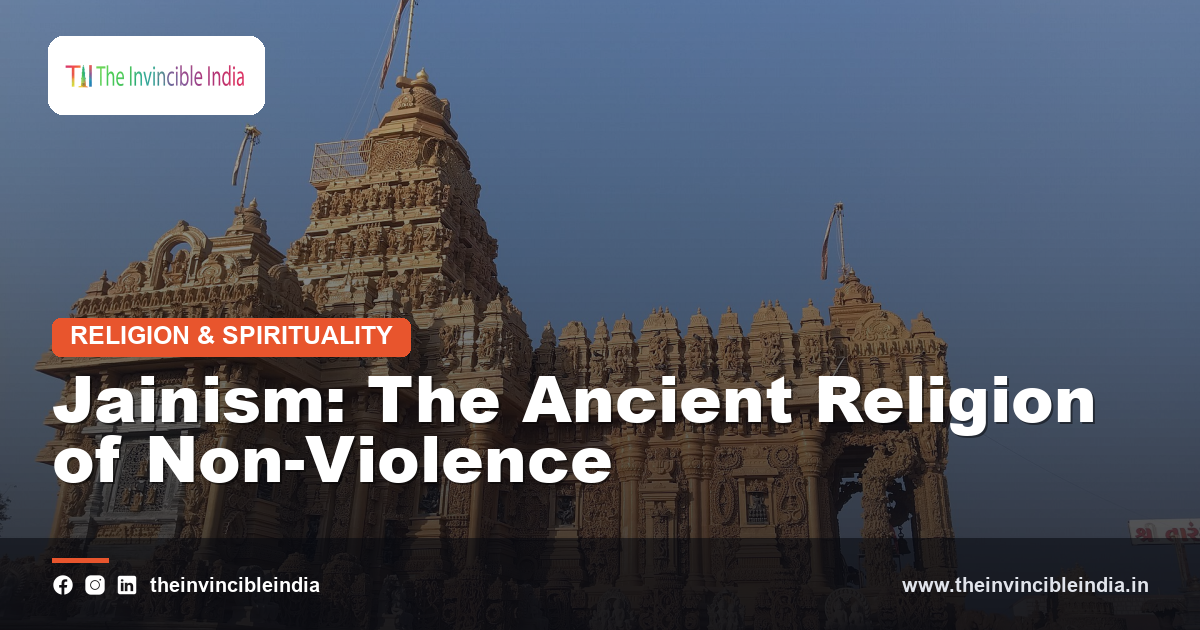
Jainism is one of the most ancient religions of India, a profound spiritual tradition built above all on the supreme principle of non-violence, or ahimsa. Teaching a path of strict self-discipline, compassion and non-attachment towards the liberation of the soul, Jainism reveres a line of great spiritual teachers known as the Tirthankaras, the last of whom, Mahavira, gave the tradition its enduring form. With its deep commitment to non-violence towards all living beings, its rich philosophy, and its magnificent heritage of temples and art, Jainism has made a profound contribution to the spiritual and cultural life of India. This guide explores the beliefs, teachings, Tirthankaras, sects and heritage of Jainism, one of the great spiritual traditions of India.
Quick Facts
| Detail | Information |
|---|---|
| Type | An ancient Indian religion |
| Supreme principle | Ahimsa, non-violence towards all living beings |
| Teachers | The twenty-four Tirthankaras, the last being Mahavira |
| Core values | Non-violence, non-attachment and many-sidedness of truth |
| Goal | Liberation (moksha) of the soul |
| Sects | The Digambara and Svetambara traditions |
An Ancient Religion of Non-Violence
Jainism is one of the most ancient religions of India, a tradition of great antiquity and profound spiritual depth, distinguished above all by its supreme emphasis on non-violence towards all living beings. At the heart of Jainism lies a vision of the sacredness of all life and a commitment to harming no living creature, a principle carried further in Jainism than in perhaps any other tradition. Combined with a path of strict self-discipline, compassion and detachment, this reverence for life shapes the whole of Jain belief and practice. As an ancient faith built on the principle of non-violence, Jainism holds a distinctive and honoured place among the great spiritual traditions of India and the world.
The Tirthankaras
Central to Jainism are the Tirthankaras, the great spiritual teachers who, according to Jain tradition, attained the highest realisation and showed others the path to liberation. The word Tirthankara means one who makes a ford, a crossing over the ocean of worldly existence to liberation. Jain tradition holds that there have been twenty-four Tirthankaras in the present age, a succession of enlightened teachers who established and renewed the path. The Tirthankaras are revered as the supreme spiritual guides and are the focus of Jain devotion, their images enshrined in the temples. The line of the twenty-four Tirthankaras is fundamental to Jainism, embodying the tradition’s vision of the path to liberation shown by enlightened teachers.
Rishabhanatha and the First Tirthankara
The first of the twenty-four Tirthankaras of the present age, according to Jain tradition, was Rishabhanatha, a figure of great antiquity revered as the one who first established the path and taught humanity the arts of civilised life. Jain tradition regards him as living in a remote and ancient age, at the very dawn of the present cycle of time, and honours him as a founding figure of the tradition and of civilisation itself. The reverence for Rishabhanatha reflects the Jain belief in the great antiquity of their faith, reaching back to the beginning of the present age. As the first Tirthankara, Rishabhanatha holds a place of special honour in Jainism and its understanding of its own ancient origins.
Mahavira
The twenty-fourth and last Tirthankara of the present age was Mahavira, who lived some two and a half thousand years ago and gave Jainism its enduring form. Born a prince, Mahavira renounced his worldly life to become an ascetic, and after long and severe spiritual striving he attained the highest realisation. He then taught the path of non-violence, self-discipline and liberation, organising the community of his followers and giving the tradition the shape it has held ever since. Mahavira is the great teacher most closely associated with Jainism in the historical period, and his life and teaching are central to the tradition. As the last Tirthankara, he is revered as the one who renewed and established the eternal Jain path for the present age.
The Principle of Ahimsa
The supreme principle of Jainism is ahimsa, non-violence, the avoidance of harm to any living being, which is carried in Jainism to an extraordinary degree. Jains hold that all living beings, from humans and animals down to the smallest creatures, possess a soul and are to be treated with the utmost care and compassion, and they strive to avoid causing harm to any of them in thought, word or deed. This profound commitment to non-violence shapes every aspect of Jain life, from diet to livelihood to daily conduct. Ahimsa is the very heart of Jainism, its most defining and influential teaching, and its example has inspired movements of non-violence far beyond the Jain community.
Vegetarianism and Diet
The Jain commitment to non-violence finds one of its most visible expressions in a strict vegetarian diet, aimed at minimising harm to living beings. Jains avoid all meat, and many observe further restrictions, avoiding certain foods and taking care in how food is prepared and eaten, all in order to reduce the harm caused to life as far as possible. This careful, compassionate approach to diet, rooted in the principle of ahimsa, is a central feature of Jain practice and one of the most distinctive aspects of the Jain way of life. The Jain dietary tradition, one of the strictest and most thoughtful in the world, is a direct and daily expression of the reverence for all life at the heart of the religion.
Non-Attachment
Alongside non-violence, a central principle of Jainism is non-attachment, or aparigraha, the limiting of possessions, desires and attachments as a path to spiritual freedom. Jains hold that attachment to material things and worldly desires binds the soul and hinders its liberation, and so they value simplicity, self-restraint and the giving up of unnecessary possessions. For Jain monks and nuns, this is carried to the point of renouncing worldly possessions almost entirely, while lay Jains practise moderation and generosity. This principle of non-attachment, curbing greed and desire in the pursuit of spiritual freedom, is one of the great teachings of Jainism and an important part of its path towards the liberation of the soul.
Anekantavada
A distinctive and profound teaching of Jainism is anekantavada, the doctrine of the many-sidedness of truth, which holds that reality is complex and can be viewed from many perspectives, none of which alone captures the whole truth. This teaching encourages intellectual humility, tolerance and openness, recognising that different viewpoints may each hold a part of the truth and that no single perspective is complete. Anekantavada fosters a spirit of respect for other views and a rejection of dogmatism, and it is one of Jainism’s important contributions to philosophy and to the ethics of understanding. This wise teaching of the many-sidedness of truth reflects the tolerant and thoughtful spirit of Jainism and its profound approach to the nature of reality and knowledge.
Karma and the Soul
Jainism has a distinctive and detailed understanding of the soul and of karma. It teaches that every living being possesses an eternal soul, which in its pure state is characterised by infinite knowledge, bliss and energy, but which has become bound and obscured by karma. In the Jain view, karma is understood as a kind of subtle matter that attaches to the soul as a result of one’s actions, binding it to the cycle of rebirth and obscuring its true nature. The spiritual path aims to stop the influx of new karma and to shed the karma already accumulated, so that the soul may be purified and liberated. This detailed teaching on the soul and karma is central to Jain philosophy and its vision of liberation.
The Path to Liberation
The goal of Jainism is the liberation of the soul, its release from the bondage of karma and the cycle of rebirth, and its attainment of its pure, eternal and blissful nature. The path to this liberation lies through right faith, right knowledge and right conduct, often called the three jewels of Jainism, which together purify the soul and free it from karma. This path involves ethical living, above all non-violence, self-discipline, non-attachment and, for those who take it up fully, ascetic renunciation. The attainment of liberation, in which the purified soul rises to eternal freedom and bliss, is the supreme aim of the Jain path and the fulfilment of the spiritual journey towards which all Jain practice is directed.
Monks, Nuns and Lay Followers
The Jain community is traditionally made up of monks and nuns, who have renounced worldly life to follow the path fully, and lay followers, who live in the world while observing Jain principles as far as they can. The monks and nuns practise strict discipline, non-violence, non-attachment and austerity, dedicating their lives to spiritual progress, and they are deeply revered. The lay followers support the ascetic community and strive to live by the principles of non-violence, honesty, non-attachment and compassion in their daily lives and work. This structure, combining a dedicated ascetic community with a devout laity, is central to Jain society and to the preservation and practice of the tradition across the generations.
The Digambara and Svetambara
Jainism has two main traditions or sects, the Digambara and the Svetambara, which share the core beliefs of Jainism but differ in certain practices and interpretations. The names refer to a difference concerning the practice of the most advanced monks in relation to clothing, one of the points on which the two traditions diverge, along with certain differences in scripture, ritual and other matters. Despite these differences, both traditions hold to the fundamental principles of Jainism, above all non-violence, and revere the Tirthankaras. The division into the Digambara and Svetambara traditions is an important feature of the Jain community, reflecting the development of the tradition over its long history while preserving its shared essential teachings.
Magnificent Temples
Jainism has produced a magnificent heritage of temples, among the most beautiful and remarkable religious monuments in India. Jain temples are renowned for their exquisite and intricate carving, their beauty and their serene atmosphere, and some are counted among the finest works of Indian architecture. Famous Jain temples, celebrated for their astonishing marble carving or their dramatic hilltop settings, draw admirers and pilgrims alike. There are also colossal Jain statues that are wonders of the sculptor’s art. This rich architectural and artistic heritage, expressing the devotion and refinement of the Jain community, is a precious part of India’s cultural treasure and a lasting monument to the beauty and depth of the Jain tradition.
Contributions to Culture
Beyond religion, the Jain community has made significant contributions to the culture, literature, learning and economic life of India across the centuries. Jain scholars produced important works of philosophy, literature, grammar and science, and Jain patrons supported art, learning and the building of temples and libraries. The Jain emphasis on ethics, honesty and non-attachment has also been associated with distinguished contributions to trade and commerce and to charitable and philanthropic activity. This wide contribution to Indian civilisation, in learning, art, literature, commerce and philanthropy, reflects the values and vitality of the Jain community and its important place in the history and culture of India, well beyond its numbers.
A Message for the World
The teachings of Jainism, above all its supreme principle of non-violence, carry a message of great relevance for the modern world. Its reverence for all life, its ethic of compassion and non-harm, its teaching of non-attachment and simple living, and its doctrine of the many-sidedness of truth speak powerfully to a world troubled by violence, greed, environmental harm and intolerance. The Jain example of non-violence has inspired movements for peace and non-violence far beyond the Jain community. This message of non-violence, compassion, restraint and tolerance is one of Jainism’s great gifts to humanity, and its wisdom offers guidance for the challenges of the contemporary world.
Jainism Today
Today Jainism continues as a living religion, practised by a devout community in India and among Jains around the world, and cherished for its ancient heritage and its profound teachings. Its followers continue to observe its principles of non-violence, vegetarianism, non-attachment and compassion, its magnificent temples remain places of worship and wonder, and its message of non-violence and tolerance continues to resonate. Though a relatively small community, the Jains have an influence and a heritage far greater than their numbers. As an ancient religion of non-violence, with its reverence for all life and its path of self-discipline towards the liberation of the soul, Jainism endures as one of the great and distinctive spiritual traditions of India and the world.
Sources & Further Reading
- Ministry of Culture, Government of India, on the religious traditions of India (indiaculture.gov.in).
- Archaeological Survey of India, on Jain temples and monuments (asi.nic.in).
Frequently Asked Questions
What is Jainism?
Jainism is one of the most ancient religions of India, built above all on the supreme principle of non-violence, or ahimsa. It teaches a path of self-discipline, compassion and non-attachment towards the liberation of the soul, and reveres a line of great teachers called the Tirthankaras.
Who are the Tirthankaras?
The Tirthankaras are the great spiritual teachers of Jainism who attained the highest realisation and showed the path to liberation. Jain tradition holds that there have been twenty-four Tirthankaras in the present age, the first being Rishabhanatha and the last being Mahavira.
What is ahimsa in Jainism?
Ahimsa is the supreme principle of Jainism, the avoidance of harm to any living being. Jains hold that all living beings possess a soul and strive to avoid harming any creature in thought, word or deed, which shapes every aspect of their lives, including a strict vegetarian diet.
Who was Mahavira?
Mahavira was the twenty-fourth and last Tirthankara of the present age, who lived some two and a half thousand years ago. Born a prince, he renounced worldly life, attained the highest realisation, and taught the path of non-violence and liberation, giving Jainism its enduring form.
What are the two main sects of Jainism?
The two main traditions of Jainism are the Digambara and the Svetambara, which share the core beliefs of the religion, above all non-violence and reverence for the Tirthankaras, but differ in certain practices, interpretations and scriptures.


