

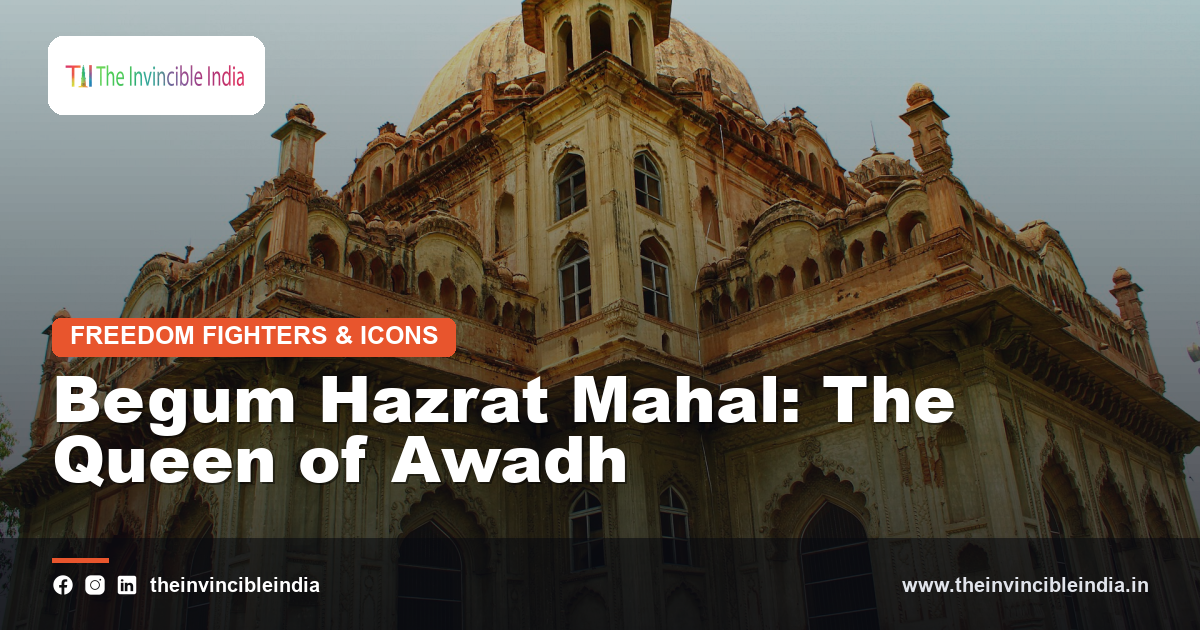
Begum Hazrat Mahal stands among the earliest and most courageous of India’s women freedom fighters, a queen of Awadh who took up the cause of resistance against colonial rule at a moment of grave crisis for her kingdom. When the great uprising of 1857 broke out across northern India, she stepped forward as a determined leader in Lucknow, organising and inspiring resistance to British forces alongside contemporaries later celebrated in the tradition of India’s freedom fighters. Refusing to accept the terms offered by the colonial authorities, she chose exile over surrender, and her memory has since been honoured as a symbol of defiance and dignity. This guide explores the life, struggle and enduring legacy of Begum Hazrat Mahal, the Queen of Awadh.
Quick Facts
| Detail | Information |
|---|---|
| Title | Begum (Queen) of Awadh |
| Associated event | The uprising of 1857 in Lucknow |
| Role | Regent leading resistance on behalf of her son |
| Known for | Refusing British terms and continuing resistance |
| Later life | Went into exile in Nepal |
| Commemoration | Honoured with a memorial park in Lucknow |
The Queen of Awadh
Begum Hazrat Mahal is remembered with great pride as the Queen of Awadh who chose the path of resistance rather than submission when her kingdom and her country faced the encroachment of colonial power. As one of the consorts of the ruler of Awadh, she held a position of dignity within the royal household, but it was her extraordinary response to the crisis of 1857 that secured her lasting place in history. At a time when few women held public leadership roles, she stepped into a position of command and inspired those around her with her courage and determination. As the Queen of Awadh who led resistance against colonial forces, Begum Hazrat Mahal remains one of the most celebrated women in the history of India’s freedom struggle.
Early Life
Details of Begum Hazrat Mahal’s early life are not extensively documented, but she is understood to have risen from modest circumstances to a position within the royal household of Awadh, a princely state of considerable cultural and political importance in northern India. Her rise within the royal court reflected both her personal qualities and the complex social world of the Awadh court in the nineteenth century. Little in her early circumstances would have suggested the role of determined resistance leader that she would later assume, yet the strength of character she displayed in later years suggests a woman of considerable resolve from an early stage. This background within the Awadh court set the stage for the dramatic events that would soon transform her into a leading figure of resistance.
Consort of the Nawab of Awadh
Begum Hazrat Mahal became one of the consorts of the ruler of the princely state of Awadh, a position that placed her close to the political life of the court at a time of growing tension between the kingdom and the expanding colonial power. Her position within the royal household gave her both insight into the political affairs of Awadh and a personal stake in its fate as British policy grew increasingly assertive towards the princely states. This connection to the ruling house of Awadh would prove decisive when the kingdom’s fortunes changed dramatically in the years that followed. Her role as consort within this royal family situates her personal history within the broader story of Awadh’s relationship with colonial power.
The Annexation of Awadh
A pivotal turning point in the history of Awadh, and in the life of Begum Hazrat Mahal, came with the annexation of the kingdom by the colonial authorities, an action that removed the reigning Nawab from power and placed the state under direct British administration. This annexation was widely resented across Awadh, seen by many as an unjust seizure of a state that had long maintained its own distinct identity and governance. The grievance created by this annexation would soon feed directly into the great uprising that swept the region. The annexation of Awadh forms the essential background to Begum Hazrat Mahal’s later emergence as a leader of resistance against colonial rule.
The Uprising of 1857
When the great uprising against colonial rule broke out in 1857, spreading rapidly across northern India, the region of Awadh became one of its most significant centres, with deep local grievances over the annexation fuelling widespread rebellion. The uprising drew together soldiers, nobility and ordinary people in a broad, if not always coordinated, challenge to colonial authority, and Lucknow, the capital of Awadh, became a major site of resistance. It was in this dramatic context that Begum Hazrat Mahal stepped forward to assume a position of leadership. The uprising of 1857 provided both the crisis and the opportunity through which she would emerge as one of its most notable figures.
Assuming Leadership in Lucknow
As the uprising gathered force in Awadh, Begum Hazrat Mahal assumed a position of leadership in Lucknow, stepping into the political vacuum created by the removal of the Nawab and taking charge of the resistance effort in the region. Her assumption of leadership at such a critical and dangerous moment reflected considerable courage and political acumen, as she worked to rally support for the cause of Awadh’s restoration and the resistance to colonial forces. This decisive step transformed her from a royal consort into an active political and military leader. Her assumption of leadership in Lucknow marks the beginning of the most celebrated chapter of Begum Hazrat Mahal’s life.
Regent for Her Son
Begum Hazrat Mahal took on the role of regent, governing on behalf of her young son, who was proclaimed the ruler of Awadh during the uprising, a step that gave a measure of legitimacy and continuity to the resistance movement in the region. As regent, she exercised real authority over the administration and the conduct of the resistance, making her one of the few women of her era to hold such direct political and military responsibility. This arrangement allowed the cause of Awadh’s independence to be pursued under a recognised, if contested, sovereign authority. Her role as regent for her son is a distinctive and historically significant aspect of her leadership during the uprising.
Rallying Resistance
Begum Hazrat Mahal worked energetically to rally soldiers, nobles and ordinary people of Awadh to the cause of resistance, using her position and her evident determination to sustain the morale of those fighting against colonial forces. Accounts from the period describe her active involvement in organising the defence of Lucknow and in encouraging continued resistance even as the military situation grew increasingly difficult. Her personal courage and visible commitment to the cause helped to inspire loyalty among those who fought under the banner of Awadh’s restoration. This active rallying of resistance forces stands as one of the most remarkable aspects of her leadership during the uprising of 1857.
Administration during the Uprising
Beyond the immediate demands of resistance, Begum Hazrat Mahal also took on responsibilities of administration in the territory under her authority during the uprising, seeking to maintain order and governance even amid the upheaval of conflict. This administrative role demonstrated a practical capacity for governance alongside her more visible role as a rallying figure for resistance, reflecting the seriousness with which she approached the responsibilities of regency. Maintaining a functioning administration under such difficult wartime conditions was itself a significant achievement. This dimension of her leadership, combining military resistance with practical governance, adds further depth to the historical picture of Begum Hazrat Mahal’s role in 1857.
The Siege and Defence of Lucknow
Lucknow became the site of prolonged and intense conflict during the uprising, as colonial forces sought to reassert control over the city and the wider region of Awadh, and Begum Hazrat Mahal played a central role in organising its defence. The siege and subsequent fighting for control of Lucknow were among the most significant military episodes of the entire uprising, and her leadership during this period of sustained conflict has been widely noted by historians of the period. Despite the eventual recapture of the city by colonial forces, the resistance she organised had demonstrated the depth of local opposition to British rule. This defence of Lucknow remains a defining episode of Begum Hazrat Mahal’s story.
A Symbol of Womens Leadership
Begum Hazrat Mahal’s role during the uprising of 1857 stands as one of the most notable early examples of women’s leadership in India’s long history of resistance to colonial rule, at a time when such public leadership by women was exceedingly rare. Her willingness to take direct command of political and military affairs, rather than remaining in a purely ceremonial or domestic role, set her apart as a figure of unusual determination and capability. This example would later be recognised and celebrated as part of a broader tradition of women’s participation in the freedom struggle. As a symbol of women’s leadership in the resistance movement, Begum Hazrat Mahal occupies a particularly important place in the history of 1857.
Retreat and Continued Resistance
As colonial forces gradually gained the upper hand and recaptured Lucknow, Begum Hazrat Mahal was compelled to retreat, but she continued to resist and to seek support for the cause of Awadh’s restoration for some time even after the fall of the city. Her refusal to abandon the struggle immediately, even in the face of overwhelming odds, reflected the depth of her commitment to the cause she had taken up. This continued resistance, sustained under increasingly difficult circumstances, extended the period of active opposition in the region beyond the fall of its capital. Her persistence in continuing the struggle after the initial setback speaks to her extraordinary resolve.
Refusal of British Terms
When the uprising was ultimately suppressed and the colonial authorities offered terms, including the possibility of a pension or settlement, to those who had participated in the resistance, Begum Hazrat Mahal is remembered for her refusal to accept such an arrangement, choosing instead the hardship of exile over accommodation with colonial rule. This refusal has become one of the most celebrated aspects of her story, seen as an act of principled defiance and dignity in the face of defeat. Her stance stood in contrast to some others who chose to come to terms with the new order. This refusal of British terms remains a powerful symbol of her unbending commitment to the cause of Awadh and of resistance to colonial rule.
Exile in Nepal
Following the collapse of organised resistance in Awadh, Begum Hazrat Mahal made her way into exile in Nepal, where she spent the remaining years of her life far from the kingdom she had fought to defend. Life in exile was undoubtedly difficult, yet she is remembered as having maintained her dignity and her identification with the cause of Awadh even in these reduced circumstances. Her choice of exile over submission to colonial authority has been seen as consistent with the courage and principle she displayed throughout the uprising. This period of exile in Nepal, continuing until her death, forms the final chapter of Begum Hazrat Mahal’s remarkable life.
Commemoration and Memorials
In recognition of her contribution to the resistance of 1857, Begum Hazrat Mahal has been honoured in independent India through various forms of commemoration, including a park in Lucknow renamed in her memory and other tributes recognising her role in the freedom struggle. These acts of commemoration reflect the enduring respect accorded to her as one of the earliest and most notable women to lead resistance against colonial rule. Her memory has also been kept alive through postal and educational tributes that introduce her story to new generations. These memorials and commemorations ensure that Begum Hazrat Mahal’s contribution to India’s history of resistance continues to be recognised and honoured.
The Legacy of Begum Hazrat Mahal
The legacy of Begum Hazrat Mahal rests on her extraordinary courage in assuming leadership of resistance against colonial rule at one of the most critical moments in nineteenth century Indian history. As regent and military leader in Lucknow during the uprising of 1857, she demonstrated that women could and did play decisive roles in the struggle against colonial power, well before the organised freedom movement of the twentieth century took shape. Her refusal to accept British terms and her choice of principled exile over accommodation have made her an enduring symbol of dignity and resistance. This legacy secures her place among the most respected early leaders of India’s long struggle for freedom.
Begum Hazrat Mahal Remembered Today
Today Begum Hazrat Mahal is remembered and honoured as one of the earliest and most courageous women to resist colonial rule in India, her memory kept alive through memorials, educational tributes and the continuing study of the uprising of 1857. She is celebrated particularly as a pioneering example of women’s leadership in the freedom struggle, an inspiration recognised well before such leadership became more widely represented in the twentieth century movement. Her story continues to be told as part of the broader history of Awadh and of India’s long path towards independence. As the Queen of Awadh who chose resistance and dignity over surrender, Begum Hazrat Mahal endures as a revered figure in the nation’s memory.
Sources & Further Reading
- Ministry of Culture, Government of India, on women leaders of the 1857 uprising (indiaculture.gov.in).
- Archaeological Survey of India and Lucknow heritage records relating to Awadh (asi.nic.in).
Frequently Asked Questions
Who was Begum Hazrat Mahal?
Begum Hazrat Mahal was the Queen of Awadh who led resistance against colonial forces in Lucknow during the uprising of 1857, taking on the role of regent for her son and organising defiance against British rule at great personal risk.
What role did she play in the uprising of 1857?
During the uprising, Begum Hazrat Mahal assumed leadership in Lucknow, acted as regent for her son, and organised and rallied resistance against colonial forces, playing an active role in both the military defence and administration of Awadh.
Why did Begum Hazrat Mahal go into exile?
After the uprising was suppressed, Begum Hazrat Mahal refused to accept the terms offered by the colonial authorities and chose exile in Nepal instead, a decision remembered as an act of principled defiance rather than accommodation with colonial rule.
How is Begum Hazrat Mahal commemorated today?
Begum Hazrat Mahal is commemorated through a memorial park in Lucknow renamed in her honour, along with postal and educational tributes that continue to introduce her story and her role in the 1857 uprising to new generations.
Why is Begum Hazrat Mahal significant to womens history?
Begum Hazrat Mahal is significant to women’s history as one of the earliest and most notable women to assume direct political and military leadership in resistance to colonial rule, well before such leadership became more common in the freedom movement.


