

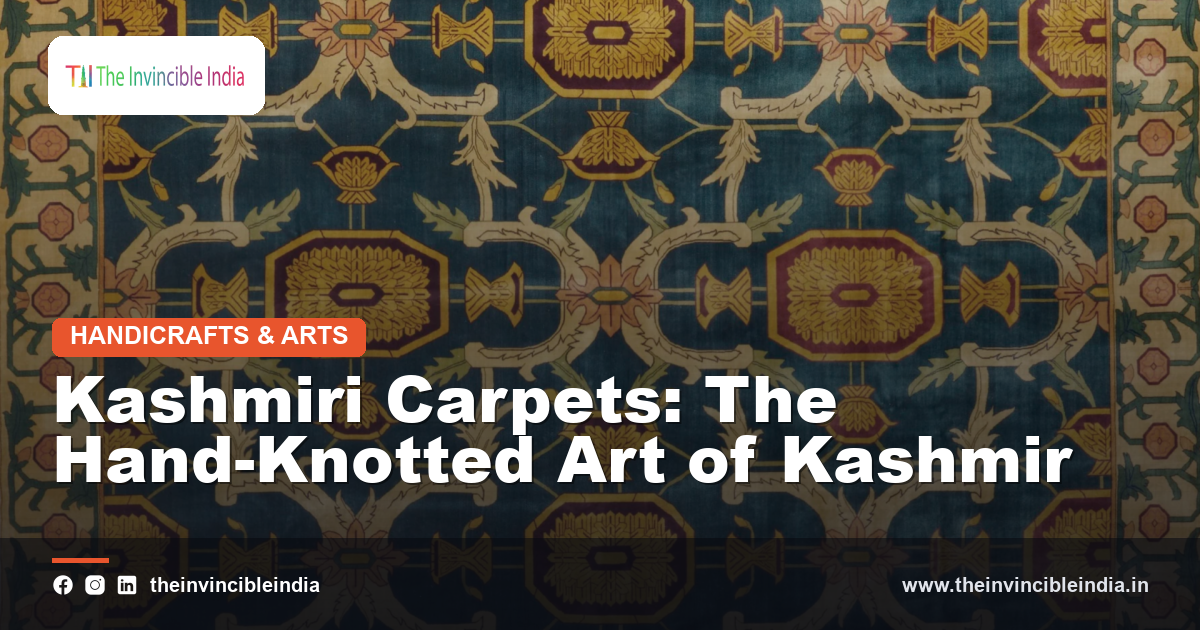
Kashmiri carpets are hand-knotted floor coverings renowned for their fine knot density, lustrous silk or wool pile, and intricate floral and medallion designs rooted in Persian-influenced court art. Woven on vertical looms using techniques introduced to the Kashmir valley many centuries ago, these carpets are prized alongside other regional crafts such as Pashmina shawls as expressions of Kashmir’s long tradition of fine textile artistry. Each carpet can take months or years to complete, depending on its size and knot count, making genuine Kashmiri carpets valued heirlooms and significant artistic investments.
Quick Facts
| Detail | Information |
|---|---|
| Also Known As | Kashmir rugs, hand-knotted Kashmir carpets |
| Primary Region | Kashmir Valley, Jammu and Kashmir |
| Core Materials | Silk, wool, silk-on-cotton |
| Technique | Hand-knotting on a vertical loom |
| Signature Designs | Persian-style florals, medallions, tree of life |
| Quality Measure | Knot density (knots per square inch) |
Persian Influence and Origins
The art of hand-knotted carpet weaving associated with Kashmir traces its stylistic and technical roots to Persian carpet-making traditions, which developed sophisticated knotting techniques and elaborate floral design vocabularies over many centuries. Trade, cultural exchange, and skilled artisans travelling between Persia and Central and South Asia carried these techniques into the Indian subcontinent.
Kashmir, with its established textile expertise and favourable climate for producing high-quality wool and silk, proved a particularly receptive setting for the craft to take root. Over time, Kashmiri weavers developed their own distinct interpretations of Persian-derived motifs, resulting in carpets that carry a recognisable regional character.
The Craft's Arrival in Kashmir
Historical accounts commonly credit the introduction of formal carpet weaving to Kashmir to periods of cultural exchange with Persia and Central Asia, during which skilled artisans and craft traditions moved into the valley under rulers who valued fine textile production. Royal and noble patronage played an important role in establishing carpet weaving as a serious craft.
As the craft became established, it integrated with Kashmir’s existing textile economy, which already included fine wool and shawl production. The valley’s geographic setting, combined with a strong artisan tradition, allowed Kashmiri carpet weaving to develop distinctive local characteristics over time.
The Vertical Loom
Kashmiri carpets are traditionally woven on a vertical loom, a large upright frame on which the warp threads are stretched from top to bottom, allowing weavers to work knots row by row from the bottom upward. This arrangement is well suited to producing large, evenly tensioned carpets.
The loom must maintain consistent tension throughout weaving, since any unevenness can distort the finished carpet’s shape or pattern alignment. Skilled loom setup, including careful spacing and tensioning of warp threads, is an important preparatory skill essential to the quality of the finished product.
The Hand-Knotting Process
At the heart of Kashmiri carpet making is the hand-knotting process, in which weavers tie individual knots of coloured yarn around pairs of warp threads, row after row, gradually building up the carpet’s pile and pattern from the base upward. Each knot is tied by hand and then trimmed to an even pile height.
A single carpet can require an enormous number of individual knots, particularly for finely detailed pieces, meaning that completing even a modestly sized carpet can take many months. Weavers typically follow a coded pattern guide, calling out colour and knot instructions as they work.
Materials: Silk and Wool
Kashmiri carpets are woven using wool, silk, or a combination of silk pile on a cotton foundation, with each material producing carpets of distinct texture, sheen, and durability. Wool carpets tend to be more hard-wearing and are often chosen for larger floor coverings, while silk carpets are prized for their fine detail and lustrous sheen.
Some carpets combine silk highlights within a wool ground to accentuate particular motifs. The quality of raw material, including the fineness and consistency of the yarn used, significantly affects both the appearance and longevity of the finished carpet.
Knot Density and Quality
Knot density, typically measured as the number of knots per square inch, is one of the most important indicators of quality and craftsmanship in a Kashmiri carpet, with higher knot counts generally allowing for finer detail and more intricate design work. Carpets with very high knot density require significantly more time and skill to produce.
Knot density also affects the durability and feel of a carpet, with densely knotted pieces generally offering a firmer, more resilient pile. Buyers and collectors often use knot density, along with material quality, as key criteria when assessing value and authenticity.
Design Vocabulary
Kashmiri carpet designs draw heavily on a Persian-influenced vocabulary of florals, vines, medallions, and the recurring tree of life motif, typically arranged in symmetrical compositions built around a central field and framing borders. Popular patterns include dense all-over floral repeats and formal medallion designs.
Borders typically consist of multiple narrow bands featuring smaller repeating patterns that frame and complement the central design. While rooted in this shared vocabulary, Kashmiri weavers have developed their own characteristic colour combinations and stylistic details.
The Talim System
A distinctive feature of Kashmiri carpet weaving is the talim, a coded written notation system that records a carpet’s design as a sequence of symbols indicating colour and knot placement, read aloud by a caller as weavers work the pattern row by row. This allows complex designs to be reproduced accurately without a full visual image.
Skilled talim readers and carpet designers occupy an important specialised role within the workshop, translating a visual design concept into the symbolic language weavers can follow, and allowing a successful design to be preserved and rewoven accurately at a later date.
Colour and Natural Dyes
Colour plays a central role in Kashmiri carpet design, with traditional palettes favouring rich, warm tones such as deep reds, blues, and golds that complement the intricate floral and medallion patterns typical of the craft. Historically, dyes were derived from natural sources including plants and minerals.
While synthetic dyes are widely used in contemporary production for their reliability, some workshops continue to use natural dyeing methods. Colour matching across a large carpet requires careful planning, since even small inconsistencies in dye batches can become visible once woven.
Regional Workshops
Carpet weaving in Kashmir is organised through numerous small workshops and home-based production units spread across the valley, often concentrated in and around Srinagar and surrounding towns with long-established weaving traditions. These workshops vary considerably in scale, from small family operations to larger enterprises.
Master weavers and designers within these workshops are often responsible for developing new talim patterns or adapting traditional designs for particular commissions. This dispersed, workshop-based structure has helped carpet weaving skills remain embedded within local communities across generations.
Carpet Sizes and Uses
Kashmiri carpets are produced in a wide range of sizes, from small decorative rugs and prayer mats to large room-sized carpets designed to cover substantial floor areas in formal settings. Smaller silk carpets are often produced primarily for display, sometimes framed or hung as wall art.
Larger wool carpets are more commonly used as functional floor coverings in homes, offices, and public buildings, valued for their durability alongside their decorative qualities. Runners, a long narrow carpet format, are also a common product of Kashmiri workshops.
Distinguishing Genuine Carpets
Identifying a genuine hand-knotted Kashmiri carpet from a machine-made or mislabelled imitation requires attention to several key features, including the appearance of individual knots on the carpet’s reverse side, which should be clearly visible and slightly irregular. Fringe on a genuine carpet is typically an extension of the warp threads rather than sewn on separately.
Buyers are also advised to examine knot density, material quality, and overall design precision. Reputable sellers and government-recognised craft marks can provide additional assurance of authenticity for buyers purchasing from outside the region.
The Weaver Community
Carpet weaving in Kashmir has traditionally been practised by skilled artisans, often men, working within family-based workshops where techniques are passed down through direct apprenticeship over many years of practice. Becoming a proficient carpet weaver requires considerable time to develop the speed and pattern-reading skill needed for fine work.
Economic and political disruptions affecting the wider Kashmir region over the decades have at times significantly impacted weaver livelihoods. Support through craft development programmes and cooperative structures has aimed to stabilise incomes and preserve weaving skills.
Export and Global Reputation
Kashmiri carpets have long enjoyed an international reputation for quality, sought after by collectors, interior designers, and buyers around the world who value the fine detail and craftsmanship associated with the region’s weaving tradition. Export markets have historically provided an important source of income for Kashmiri workshops.
This international demand has encouraged some workshops to adapt colour palettes to suit export market preferences, while others continue to produce carpets primarily in traditional regional styles. Government trade promotion efforts have periodically supported Kashmiri carpet exports.
Challenges Facing the Craft
Kashmiri carpet weaving faces a number of ongoing challenges, including competition from machine-made carpets that can replicate similar visual patterns at a fraction of the cost and time required for genuine hand-knotting. The lengthy production time required means artisans must be fairly compensated for months of skilled labour.
Broader economic and infrastructural challenges affecting the Kashmir region have at times disrupted production and access to international markets. Quality certification schemes and direct trade initiatives connecting weavers to buyers remain important responses to these pressures.
Caring for a Kashmiri Carpet
Proper care significantly extends the life and appearance of a hand-knotted Kashmiri carpet, with regular light vacuuming and periodic professional cleaning recommended to remove dust without damaging the delicate pile, particularly in fine silk pieces. Direct, prolonged exposure to sunlight can fade natural or synthetic dyes over time, so owners are generally advised to rotate carpets periodically and limit continuous exposure to strong light.
Spills should be blotted rather than rubbed, and specialist cleaning is usually recommended over household detergents, which can damage natural dyes or fine silk fibres. Occasional turning and reversing of a carpet also helps ensure even wear across its surface. With appropriate care, a well-made Kashmiri carpet can remain in excellent condition for many decades, often improving in appearance as the pile settles and develops a soft, lived-in lustre.
Kashmiri Carpets Today
Kashmiri carpets today remain a benchmark of fine hand-knotted craftsmanship, admired internationally for their intricate Persian-influenced designs, careful material selection, and the specialised talim system that allows complex patterns to be woven with precision. The craft continues to be sustained by skilled weavers working within family and workshop-based structures.
Continued export demand, government support, and growing consumer interest in authentic handmade textiles all contribute to the ongoing viability of the tradition, standing as a testament to generations of Kashmiri weavers who have preserved this demanding art form.
Sources & Further Reading
- Ministry of Textiles, Government of India (texmin.nic.in).
- Ministry of Culture, Government of India (indiaculture.gov.in).
Frequently Asked Questions
What materials are used to make Kashmiri carpets?
Kashmiri carpets are traditionally woven using wool, silk, or a combination of silk pile on a cotton foundation, with the choice of material affecting the carpet’s texture, sheen, durability, and price.
What is the talim system in Kashmiri carpet weaving?
The talim is a coded written notation system that records a carpet’s design as symbols for colour and knot placement, read aloud by a caller so weavers can reproduce complex patterns accurately without a printed guide.
How can you tell if a Kashmiri carpet is hand-knotted?
A genuine hand-knotted carpet typically shows clear, slightly irregular knots on its reverse side and fringe that is an extension of the warp threads rather than sewn on separately, unlike most machine-made carpets.
Why do Kashmiri carpets take so long to make?
Kashmiri carpets are made by tying an enormous number of individual knots by hand, row by row, and finely detailed high knot-density carpets can take many months or even years of steady work to complete.
What is knot density and why does it matter?
Knot density refers to the number of knots per square inch in a carpet, with higher density generally indicating finer detail, more skilled craftsmanship, and greater durability, all of which affect a carpet’s value.


