

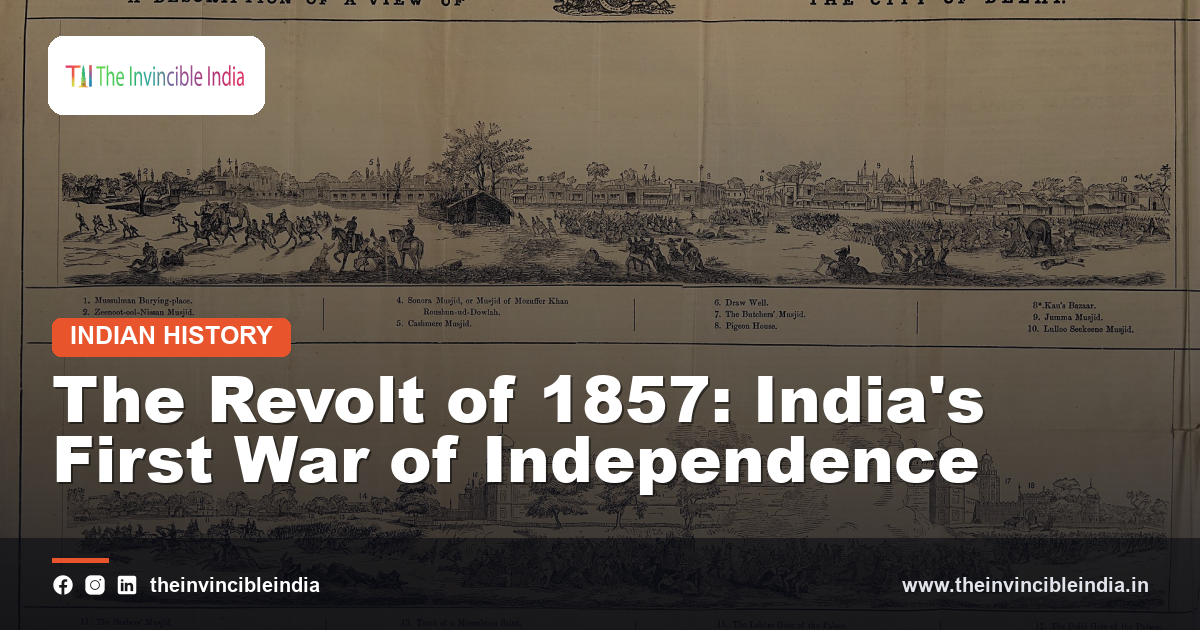
The Revolt of 1857 was one of the most significant and dramatic events in the history of India, a great and courageous uprising against colonial rule that spread across large parts of northern and central India. Beginning among soldiers of the Company’s own army and quickly drawing in rulers, nobles, peasants and ordinary people, the revolt became a widespread and passionate struggle for freedom and dignity, remembered by many as India’s first great war of independence. Though it was ultimately suppressed, the uprising shook the foundations of colonial rule, brought an end to the era of Company governance, and gave India abiding heroes and martyrs whose courage is still honoured today. This guide explores the causes, events, heroes and legacy of the Revolt of 1857, a stirring chapter that followed the long decline of the Mughal Empire.
Quick Facts
| Detail | Information |
|---|---|
| Nature | A great uprising against colonial rule |
| Also known as | India’s first war of independence |
| Where | Northern and central India |
| Notable heroine | Rani Lakshmibai of Jhansi |
| Outcome | Suppressed, but colonial governance was reorganised |
| Legacy | A landmark in India’s freedom struggle |
A Great Uprising
The Revolt of 1857 was one of the most significant uprisings in the history of India, a widespread and passionate rebellion against colonial rule that erupted with dramatic suddenness and spread rapidly across large parts of the country. What began as a mutiny among soldiers grew swiftly into a broader uprising joined by rulers, nobles, landholders, peasants and ordinary townspeople, all driven by deep grievances against the policies and conduct of the ruling power. This growth from a military mutiny into a popular uprising is central to its significance. This growth of the Revolt of 1857 from a mutiny among soldiers into a broad and passionate uprising joined by people of many backgrounds is central to its importance, and the scale and courage of the rebellion made it one of the most dramatic and significant episodes in the history of colonial India.
The Rule of the East India Company
By the middle of the nineteenth century, a great trading company had grown into the dominant political power across much of India, ruling vast territories through its own administration and army. This company governed with growing authority over Indian rulers and peoples, annexing kingdoms, reshaping land and revenue systems, and extending its control over ever larger areas, so that its rule touched the lives of millions of people in ways both direct and indirect. This dominance of the Company set the stage for the coming unrest. This wide-ranging dominance of the East India Company over India by the mid-nineteenth century, achieved through annexation, administration and military power, set the stage for the deep unrest that was to follow, and the grievances that built up under this rule became the seedbed of the great revolt.
Seeds of Discontent
Long before the revolt broke out, discontent had been building among many sections of Indian society over the policies and actions of the ruling power. Rulers resented the annexation of their states, landholders and peasants suffered under new systems of land revenue and taxation, soldiers felt their pay, promotion and treatment were unjust, and many people across the country feared that their customs, religion and way of life were under threat from rapid and unwelcome change. These accumulated grievances are the true roots of the revolt. These accumulated grievances of rulers, landholders, peasants and soldiers over annexation, taxation and interference in customary life are the true roots of the Revolt of 1857, and they explain why the uprising, once begun, found such wide and passionate support across so many sections of society.
Religious and Social Anxieties
Alongside political and economic grievances, deep anxieties over religion and social custom played an important part in fuelling the unrest that led to the revolt. Many people feared that changes introduced under colonial rule, and the activities of missionaries and reformers, threatened their religious beliefs and social traditions, and these fears spread widely among both soldiers and civilians. It was in this charged atmosphere that a controversy over the cartridges issued to soldiers, believed to be greased with substances offensive to their religious beliefs, became the immediate spark of the uprising. This controversy is remembered as the spark of revolt. This controversy over the cartridges, coming amid wider religious and social anxieties among soldiers and the public, is remembered as the spark that ignited the Revolt of 1857, though the true causes of the uprising ran far deeper than this single incident.
The Sepoy Soldiers
The soldiers of the Company’s army, known as sepoys, formed the backbone of colonial military power in India and became the first to rise in revolt. Recruited in large numbers from across India, these soldiers had long served the Company’s army with skill and loyalty, but by the 1850s many had grown resentful over questions of pay, promotion, respect and religious sensitivity, and it was their mutiny that opened the great uprising. Their role as the first rebels is central to the story. This role of the sepoy soldiers, whose long service and mounting grievances led them to become the first to rise against the Company’s rule, is central to the story of the revolt, and their mutiny opened the way for a much wider and more passionate uprising across the country.
The Outbreak of the Revolt
The revolt broke out openly when soldiers at a garrison town rose against their officers, seized arms and began a march that would carry the uprising to the old Mughal capital. This dramatic outbreak, triggered by punishment meted out to soldiers who had refused the controversial cartridges, saw the mutineers break free of their officers, release imprisoned comrades and set out for Delhi, carrying the flame of rebellion with them. This outbreak marks the true beginning of the uprising. This dramatic outbreak of the revolt, in which soldiers rose against their officers and marched toward Delhi, marks the true beginning of the uprising, and news of their success and defiance spread quickly, encouraging others across northern India to rise in turn.
The Rising Spreads
From its beginnings, the revolt spread with remarkable speed across large parts of northern and central India, drawing in soldiers, rulers and common people alike. Garrison after garrison rose in mutiny, and in many towns and regions local rulers, landholders and ordinary people joined the uprising, driven by their own grievances and inspired by the example of the rebels, so that within a short time a large part of the country was engulfed in rebellion against colonial authority. This rapid spread reveals the depth of popular discontent. This rapid spread of the revolt across northern and central India, drawing in soldiers, rulers and common people who joined for their own reasons, reveals the depth and breadth of the discontent that had built up against colonial rule, and it transformed a military mutiny into a genuine popular uprising.
Delhi and the Last Mughal Emperor
The rebels marched upon Delhi and there persuaded the aged Mughal emperor, who still held ceremonial dignity though little real power, to lend his name and blessing to their cause. The emperor’s acceptance of this role gave the uprising a symbol of legitimacy and continuity with India’s past, rallying many who still respected the old imperial line, and Delhi became a rallying point and centre of the rebellion for a time. This role of Delhi and the emperor gave the revolt symbolic unity. This role of Delhi as the rallying point of the revolt, and of the last Mughal emperor as its symbolic figurehead, gave the uprising a unity and legitimacy in the eyes of many, even though real power and leadership in the field lay with the rebel soldiers and local leaders themselves.
The Heroism of the Rani of Jhansi
Among the most celebrated figures of the revolt is the Rani of Jhansi, a queen whose courage and determination in defence of her kingdom made her one of the most enduring symbols of the uprising. Facing the loss of her state and the threat of conquest, she took up the cause of resistance with great personal courage, leading her forces in the defence of her kingdom and becoming, in the memory of the nation, an emblem of valour and sacrifice. Her heroism is remembered with deep reverence. This heroism of the Rani of Jhansi, whose courage and determination in defence of her kingdom made her one of the most celebrated figures of the revolt, is remembered with deep reverence across India, and her example continues to inspire as a symbol of courage in the face of overwhelming odds.
Other Great Leaders of the Revolt
Besides the Rani of Jhansi, the revolt produced several other notable leaders whose courage and resistance became part of its enduring story. Figures who took up arms and led resistance in different regions, whether rulers, nobles or commanders, gave the uprising its wide leadership across many fronts, and their efforts, though ultimately unsuccessful, added greatly to the drama and significance of the revolt. These other leaders are honoured alongside the Rani. These other leaders of the Revolt of 1857, who took up arms and led resistance in different regions of the country, are honoured alongside the Rani of Jhansi as figures of courage, and their combined efforts across many fronts gave the uprising its remarkable breadth and its lasting place in the memory of the nation.
The Struggles at Kanpur and Lucknow
Some of the fiercest and most dramatic episodes of the revolt unfolded in the cities of Kanpur and Lucknow, where prolonged sieges and hard fighting left a deep mark on the memory of the uprising. In both cities, rebel forces besieged garrisons for extended periods, and the fighting there was marked by great hardship, courage and loss on all sides, making these episodes among the most remembered and discussed events of the entire uprising. These struggles are among the most dramatic of the revolt. These prolonged and dramatic struggles at Kanpur and Lucknow, marked by lengthy sieges and hard fighting, are among the most remembered episodes of the Revolt of 1857, and they illustrate both the intensity of the uprising and the great cost it exacted from all who were caught up in it.
The Courage and Sacrifice of the People
Beyond its famous leaders, the revolt drew upon the courage and sacrifice of countless ordinary people, soldiers, townsfolk and villagers, whose contribution is an essential part of its story. Many thousands of people, known and unknown, took part in the uprising, offering their support, their resources and often their lives to a cause they believed in, and this widespread participation gave the revolt its character as a genuine popular movement rather than a rebellion of a few. This courage of ordinary people is a vital part of the legacy. This courage and sacrifice of countless ordinary people, soldiers and civilians alike, who took part in the Revolt of 1857 often at great personal cost, is a vital part of its legacy, and it is this popular participation that gives the uprising its enduring place in the memory of the nation.
The Suppression of the Revolt
Despite its early successes and wide spread, the revolt was gradually and forcefully suppressed by the superior military strength of the colonial power over a period of hard campaigning. Reinforcements were brought in, key cities and strongholds were retaken after fierce fighting, and rebel forces were defeated one by one across the affected regions, until organised resistance came to an end and colonial authority was reasserted throughout the country. This suppression brought the uprising to its close. This gradual and forceful suppression of the revolt, achieved through hard campaigning and superior military strength, brought the great uprising to its close, though the memory of the courage and sacrifice shown during the rebellion endured long after the fighting itself had ended.
The End of Company Rule
One of the most significant consequences of the revolt was the end of the East India Company’s rule over India and the transfer of governance directly to the Crown. In the aftermath of the uprising, the authorities recognised that the old system of Company administration could not continue, and India came under direct rule from the Crown, with important changes made to policy, administration and the relationship between rulers and the ruled. This transfer of power is a major consequence of the revolt. This transfer of governance from the East India Company to the Crown in the wake of the uprising is one of the most far-reaching consequences of the Revolt of 1857, marking a fundamental turning point in the political history of colonial India.
A Turning Point in History
The Revolt of 1857 is widely regarded as a great turning point in the history of India, an event whose consequences shaped the course of the country for generations to come. It exposed the depth of discontent against colonial rule, brought lasting changes to the system of governance, and planted early seeds of the wider movement for freedom and self-rule that would grow in the decades that followed, making the revolt a foundation upon which later generations built their own struggle. This turning point is central to its historical importance. This character of the Revolt of 1857 as a great turning point, whose consequences reshaped governance and planted early seeds of the freedom movement, is central to its historical importance, and it is remembered as a foundational chapter in India’s long journey toward independence.
The Revolt of 1857 Today
Today the Revolt of 1857 is remembered and honoured across India as a landmark event in the nation’s history, a courageous chapter that is often described as the first great war of independence. Memorials, statues and museums across the country, including tributes to heroes such as the Rani of Jhansi, keep alive the memory of the uprising, and its story continues to be told as an inspiring example of courage and sacrifice in the face of colonial rule. The memory of 1857 continues to inspire. As a great and courageous uprising against colonial rule that is remembered as India’s first widespread war of independence, the Revolt of 1857 endures in national memory through its memorials and its heroes, and it remains one of the most significant and stirring chapters in the long history of India.
Sources & Further Reading
- National Archives of India (archives.gov.in).
- Ministry of Culture, Government of India (indiaculture.gov.in).
Frequently Asked Questions
What was the Revolt of 1857?
The Revolt of 1857 was a great and widespread uprising against colonial rule in India, beginning as a mutiny among soldiers and growing into a broad popular rebellion joined by rulers, landholders and ordinary people. It is remembered by many as India’s first great war of independence.
What caused the Revolt of 1857?
The revolt arose from a combination of long-standing grievances, including resentment over the annexation of kingdoms, changes to land and revenue systems, and anxieties over religion and social custom. A controversy involving cartridges issued to soldiers is remembered as the immediate spark that ignited the uprising.
Who was the Rani of Jhansi?
The Rani of Jhansi was a queen who became one of the most celebrated figures of the Revolt of 1857, remembered for her courage and determination in defending her kingdom. She remains an enduring symbol of valour and sacrifice in Indian history.
How did the Revolt of 1857 end?
The revolt was gradually suppressed after a period of hard fighting, as reinforcements arrived and key cities and strongholds were retaken. In its aftermath, rule over India passed from the East India Company directly to the Crown.
Why is the Revolt of 1857 important?
The Revolt of 1857 is important as a major turning point in Indian history, exposing widespread discontent with colonial rule and bringing lasting changes to governance. It is remembered as an inspiring early chapter in the country’s long struggle for freedom.


