

The Pallava Dynasty was one of the great ruling powers of ancient and early medieval South India, a dynasty renowned above all as pioneering builders whose temples and monuments laid the foundation for centuries of southern architecture. Ruling from their capital at Kanchipuram, the Pallavas extended their authority over a large part of the south, fostered art, literature and learning, and maintained trade and cultural contacts across the seas, but it is their extraordinary achievement in stone, especially at the port town of Mahabalipuram, that has made them immortal in the history of Indian art. This guide explores the Pallava dynasty, its rise, its architectural genius, and its enduring legacy, an important forerunner to the later glories of the Chola dynasty.
Quick Facts
| Detail | Information |
|---|---|
| Region | South India, especially Tamil Nadu |
| Capital | Kanchipuram |
| Famed for | Pioneering temple architecture |
| Great site | Mahabalipuram |
| Patronage | Art, literature and learning |
| Legacy | A foundation for later South Indian architecture |
Builders of the South
The Pallava Dynasty was one of the great ruling powers of ancient and early medieval South India, remembered above all as pioneering builders whose achievements in architecture and sculpture shaped the course of southern art for centuries. Ruling over a substantial part of the south for several centuries, the Pallavas combined political strength with an extraordinary devotion to building, and their monuments remain among the most treasured and studied works of early Indian architecture. This character as builders defines their legacy. This character of the Pallava Dynasty as great builders, whose architectural achievements shaped the course of southern art, defines its lasting legacy, and the dynasty holds an honoured place among the great ruling powers of South Indian history.
Origins of the Pallavas
The origins of the Pallava dynasty lie in the early centuries of the common era, when the family rose to prominence in the region of southern India that would become their heartland. Emerging from earlier local powers, the Pallavas gradually built up their authority in the area around present-day Tamil Nadu and adjoining regions, laying the foundations of what would grow into a substantial and long-lasting kingdom. These origins mark the beginning of a long dynasty. These origins of the Pallava dynasty in the early centuries of the common era, rising from earlier local powers to prominence in southern India, mark the beginning of a long and eventually illustrious ruling line, whose achievements would come to define much of the character of the ancient south.
The Capital at Kanchipuram
The city of Kanchipuram served as the capital of the Pallava dynasty, a great centre of religion, learning and culture that flourished under their rule for generations. From this capital the Pallava kings governed their realm, and the city grew into a renowned centre of temples, scholarship and craft, so celebrated that it came to be regarded as one of the most sacred and important cities of the south. This role of Kanchipuram is central to the dynasty. This role of Kanchipuram as the capital and great cultural centre of the Pallava dynasty is central to its story, and the city’s flourishing under Pallava patronage established its lasting reputation as one of the most revered cities of South India.
Rise to Power in the South
Over the centuries, the Pallava dynasty rose to become one of the leading powers of South India, extending its authority through skilful governance and military strength. The Pallava kings built up a substantial kingdom through conquest, alliance and administration, bringing wide territories under their control and establishing themselves as one of the dominant forces in the political landscape of the ancient south. This rise to power is a mark of the dynasty’s strength. This rise of the Pallava dynasty to become one of the leading powers of South India, achieved through governance and military strength over successive generations, is a mark of the dynasty’s enduring strength, and it laid the groundwork for the great cultural achievements for which the Pallavas are remembered.
Rivalry with the Chalukyas
Throughout much of their history, the Pallavas were engaged in a long rivalry with another great power of the Deccan, a rivalry marked by repeated conflict and shifting fortunes over the generations. The two powers contested for supremacy in the region between their respective territories, and this sustained rivalry, though costly, also spurred both sides to great achievements in governance, military organisation and cultural patronage. This rivalry shaped much of the dynasty’s history. This long rivalry of the Pallavas with a great neighbouring power of the Deccan, marked by repeated conflict over the generations, shaped much of the political history of the dynasty, and the contest between these two powers is a defining feature of the story of the ancient south.
Pioneers of Temple Architecture
The Pallava dynasty is celebrated above all as pioneers of temple architecture, whose innovations laid the essential foundations for the later development of South Indian temple building. Under Pallava patronage, builders and craftsmen experimented with new forms, moving from simple rock-cut shrines to more elaborate structural temples, and these early experiments established architectural principles and styles that would be refined and expanded by later dynasties of the south. This pioneering role is the dynasty’s greatest legacy. This pioneering role of the Pallava dynasty in the development of temple architecture, whose innovations laid the essential foundations for later South Indian building traditions, is the dynasty’s greatest and most celebrated legacy, and it secures their place among the most important patrons of art in Indian history.
The Rock-Cut Wonders
Among the earliest and most remarkable achievements of Pallava builders are the rock-cut shrines and sculpted panels that they carved directly from the living stone of the southern landscape. These rock-cut monuments, carved with great skill and artistry directly into hillsides and boulders, include shrines, halls and relief carvings depicting deities, legends and scenes of daily life, and they represent an extraordinary early chapter in the story of Indian rock-cut art. These rock-cut wonders showcase the dynasty’s artistry. These rock-cut wonders created by Pallava craftsmen, carved with skill and artistry directly into the stone of the southern landscape, showcase the extraordinary artistry of the dynasty, and they remain among the most admired and studied examples of ancient Indian sculpture and architecture.
The Shore Temple of Mahabalipuram
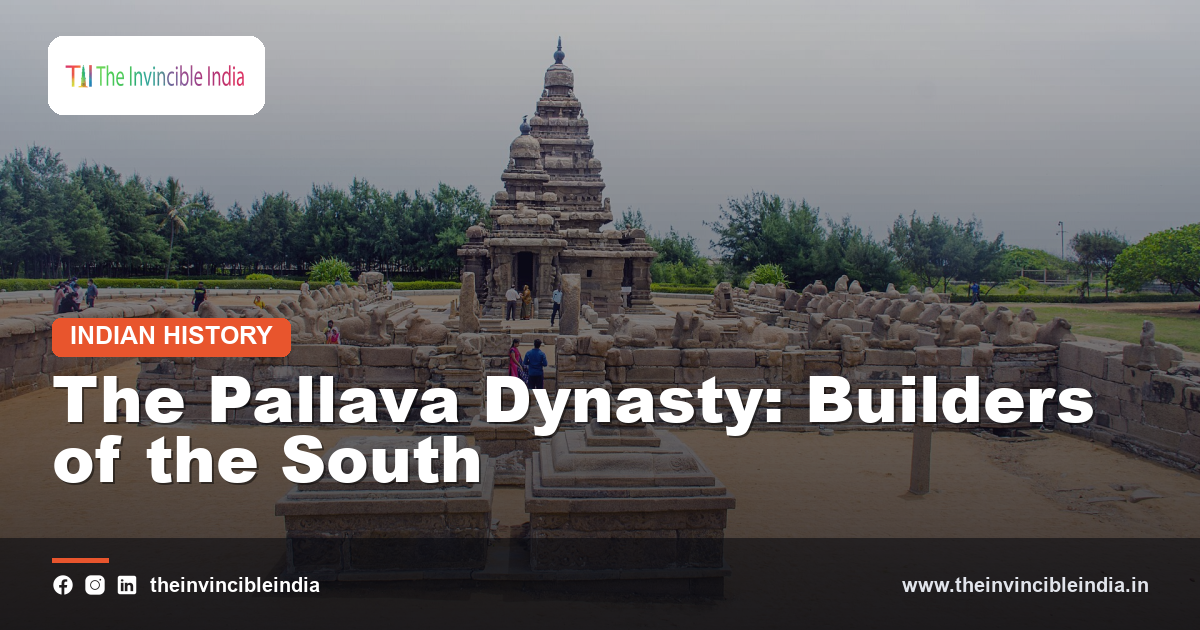
Among the most celebrated monuments of the Pallava dynasty is the Shore Temple, a graceful structural temple standing at the edge of the sea at Mahabalipuram and recognised today as a World Heritage Site. Built of finely carved stone and facing the waves, this temple represents an important stage in the transition from rock-cut shrines to free-standing structural temples, and its enduring beauty, weathered by centuries of wind and salt spray, continues to captivate visitors from around the world. This temple is a crowning glory of Pallava art. This Shore Temple at Mahabalipuram, a graceful structural monument recognised as a World Heritage Site, is a crowning glory of Pallava art and architecture, and it stands as one of the most iconic and beloved images of ancient South Indian civilisation.
The Five Rathas
Among the most distinctive creations of Pallava craftsmen are the monolithic shrines carved from single great boulders at Mahabalipuram, each shaped in the form of a chariot and known collectively as a group of rathas. These extraordinary monuments, each carved as a complete building from a single mass of rock and displaying a different architectural style, demonstrate the remarkable skill and inventiveness of Pallava sculptors and provide valuable insight into the variety of architectural forms current in their time. These rathas are a unique achievement of the dynasty. These monolithic rathas of Mahabalipuram, extraordinary shrines carved from single boulders in varied architectural styles, are a unique and celebrated achievement of the Pallava dynasty, and they remain among the most remarkable monuments of ancient Indian art.
Mahabalipuram: Port and Monument City
The town of Mahabalipuram served the Pallavas not only as a great centre of art and architecture but also as an important port, connecting their kingdom to maritime trade routes across the seas. This dual role as both a bustling harbour and a showcase of royal artistic patronage made Mahabalipuram a place of special importance to the Pallava kings, who adorned it with monuments while also benefiting from the trade and contacts that passed through its harbour. This dual role enriches the town’s significance. This dual role of Mahabalipuram as both an important port and a showcase of Pallava artistic achievement enriches its significance in history, and the town remains treasured today both as a heritage site and as a monument to the maritime reach of the Pallava kingdom.
Patrons of Learning and Literature
The Pallava kings were notable patrons of learning and literature, fostering scholarship in Sanskrit and in the languages of the south during their long rule. Kanchipuram under Pallava patronage became renowned as a centre of education and scholarship, attracting scholars and students, and the court encouraged the composition of literary and scholarly works, contributing to the intellectual life of the ancient south. This patronage of learning is an important legacy. This patronage of learning and literature by the Pallava kings, which made Kanchipuram a renowned centre of scholarship, is an important part of the dynasty’s legacy, and it reflects the broader cultural richness that flourished under Pallava rule alongside their architectural achievements.
Religion and Culture under the Pallavas
Religion played a central role in the life and patronage of the Pallava dynasty, whose kings supported and fostered the worship of the major deities of the period through temple building and endowment. The Pallava kings were devoted patrons of religious institutions, and their support for temples, shrines and religious festivals helped to shape the religious culture of the south during their rule, weaving faith closely into the political and artistic life of the kingdom. This role of religion enriches the dynasty’s story. This central role of religion in the life and patronage of the Pallava dynasty, expressed through temple building and religious endowment, enriches the story of the kingdom, and it underlines the close connection between faith, art and governance in ancient South India.
Maritime Trade and Overseas Contacts
The Pallava kingdom, with its access to the sea through ports such as Mahabalipuram, maintained active trade and cultural contacts with distant lands across the ocean. Goods, ideas and cultural influences passed between the Pallava realm and regions of Southeast Asia and beyond, contributing to a wider exchange that enriched the kingdom and helped to spread aspects of South Indian culture, religion and art to distant shores. This maritime reach broadens the dynasty’s significance. This maritime trade and cultural exchange maintained by the Pallava kingdom through its coastal ports broadens the significance of the dynasty beyond its own borders, and it reflects the wider role of South India as a hub of trade and cultural contact in the ancient world.
Art and Sculpture
Beyond architecture, the Pallava dynasty is celebrated for its achievements in sculpture, producing works of great grace, detail and narrative power. Pallava sculptors carved figures of deities, mythological scenes and everyday life with remarkable skill and sensitivity, achieving a distinctive style admired for its elegance and expressiveness, and these sculptures remain among the finest examples of early South Indian art. This sculpture is a hallmark of Pallava artistry. This achievement in sculpture by Pallava artists, marked by grace, detail and narrative power, is a hallmark of the dynasty’s artistry, and it stands alongside their architecture as one of the most celebrated contributions of the Pallavas to the art history of India.
Legacy in Later Dynasties
The architectural and artistic innovations of the Pallava dynasty provided an essential foundation for the later dynasties of South India, most notably the great empire that would rise after them in the same region. The temple styles, techniques and artistic conventions pioneered under Pallava patronage were adopted, refined and expanded by their successors, so that the later flowering of South Indian temple architecture owes a direct debt to the innovations first developed under the Pallavas. This influence on later dynasties is a lasting achievement. This lasting influence of Pallava innovations on the later dynasties of South India, who adopted and expanded upon their architectural achievements, is one of the dynasty’s most significant achievements, and it secures the Pallavas an essential place in the long story of Indian temple architecture.
The Pallavas Today
Today the Pallava dynasty is remembered and celebrated as one of the great builders and patrons of ancient South Indian civilisation, its legacy visible above all in the monuments that still stand at Mahabalipuram. The rock-cut shrines, the graceful Shore Temple and the remarkable rathas continue to draw visitors and scholars from around the world, and the dynasty’s pioneering role in the development of temple architecture is honoured as a foundational chapter in the story of Indian art. The Pallava legacy continues to inspire admiration. As pioneering builders whose innovations at Mahabalipuram and Kanchipuram shaped the course of South Indian architecture, the Pallava dynasty endures as one of the most celebrated and admired chapters in the history and heritage of India.
Sources & Further Reading
- Archaeological Survey of India, on the Group of Monuments at Mahabalipuram (asi.nic.in).
- UNESCO World Heritage Centre, on the Group of Monuments at Mahabalipuram (whc.unesco.org).
Frequently Asked Questions
Who were the Pallavas?
The Pallavas were a great ruling dynasty of ancient and early medieval South India, based at their capital of Kanchipuram, renowned above all for pioneering achievements in temple architecture and sculpture, especially at the port town of Mahabalipuram.
What is Mahabalipuram famous for?
Mahabalipuram is famous for its remarkable Pallava-era monuments, including the graceful Shore Temple, a group of monolithic shrines known as rathas, and rock-cut carvings, all recognised together as a UNESCO World Heritage Site.
What is the Shore Temple?
The Shore Temple is a celebrated structural temple built by the Pallava dynasty at Mahabalipuram, standing at the edge of the sea. It marks an important stage in the development of South Indian temple architecture and remains one of its most iconic monuments.
What was the Pallava dynasty famous for?
The Pallava dynasty was famous for pioneering the development of South Indian temple architecture, for its rock-cut and structural monuments at Mahabalipuram, for its patronage of learning at Kanchipuram, and for its long rivalry with the Chalukyas of the Deccan.
Why are the Pallavas important in Indian history?
The Pallavas are important because their architectural innovations laid the foundation for the later flowering of South Indian temple building, including under the Chola dynasty, and their monuments at Mahabalipuram remain among the most celebrated treasures of Indian heritage.


