

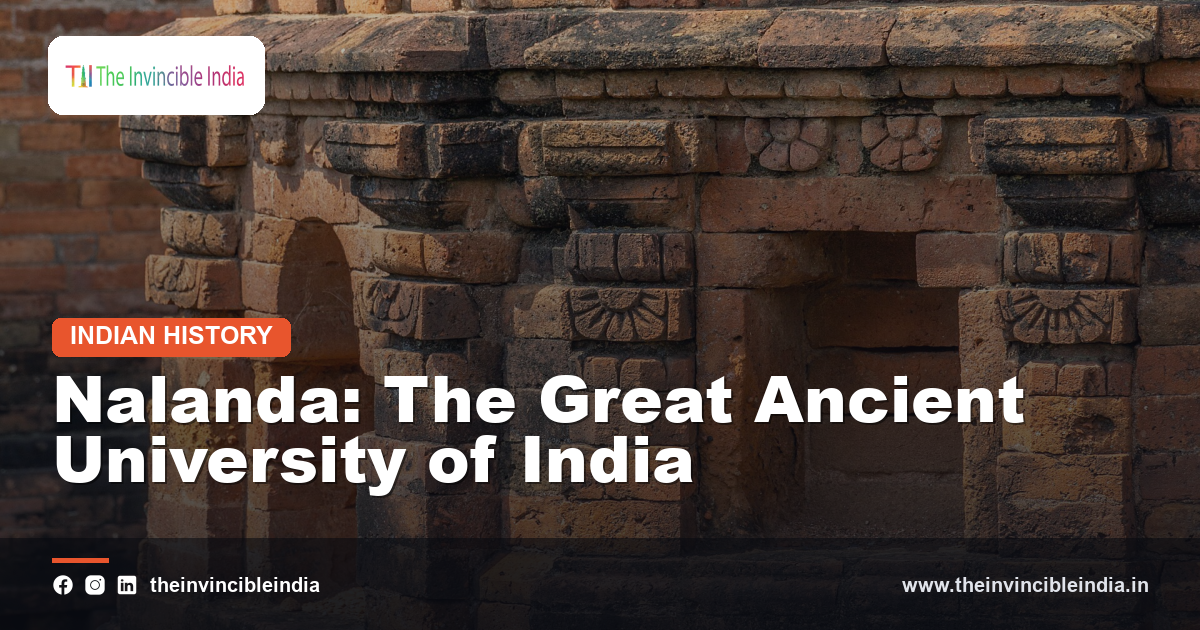
Nalanda was one of the great centres of learning in the ancient world, a renowned monastic university in India whose fame as a seat of scholarship and Buddhist learning spread across Asia. Flourishing for several centuries under the patronage of successive rulers, Nalanda attracted students, monks and scholars from distant lands, offering instruction not only in Buddhist philosophy but also in logic, grammar, medicine and other branches of knowledge, and its vast library was celebrated as one of the great repositories of learning of its age. Though it eventually declined, the ruins of Nalanda endure today as a treasured symbol of India’s ancient intellectual heritage. This guide explores the history, learning and legacy of Nalanda, a great institution nurtured through the age of the Gupta Empire and beyond.
Quick Facts
| Detail | Information |
|---|---|
| Location | Bihar, eastern India |
| Type | A great ancient monastic university |
| Renowned for | Buddhist learning and a vast library |
| Students from | Across Asia, including China and Tibet |
| Famous visitor | The Chinese pilgrim Xuanzang |
| Legacy | A UNESCO World Heritage Site |
The Great Ancient University
Nalanda was one of the great centres of learning in the ancient world, a renowned monastic university in India whose reputation as a seat of scholarship and religious study spread far beyond the subcontinent. For several centuries it flourished as one of the foremost institutions of higher learning of its age, attracting students and scholars from many lands and producing a legacy of intellectual achievement that is still admired today. This reputation as a great university defines Nalanda’s fame. This reputation of Nalanda as a great ancient university, renowned across Asia for its scholarship and learning, defines its enduring fame, and it secures Nalanda a special place among the great centres of learning in world history.
The Origins of Nalanda
The origins of Nalanda as a centre of learning lie in the establishment of a monastery in the region that would grow, over succeeding generations, into a great and famous seat of scholarship. What began as a more modest religious foundation expanded steadily under the support of successive patrons, gradually developing into the large and renowned institution for which Nalanda would become celebrated across Asia. These origins mark the beginning of a great institution. These origins of Nalanda, growing from a more modest foundation into a large and celebrated institution over succeeding generations, mark the beginning of one of the great success stories in the history of learning, and they set the stage for its rise to fame across the ancient world.
A Great Monastic Institution
Nalanda functioned as a great monastic institution, combining the religious life of a Buddhist monastery with the intellectual life of a centre of advanced study and scholarship. Monks and students lived and studied together within its precincts, following a life that combined religious discipline with rigorous academic pursuit, and this combination of monastic community and scholarly institution gave Nalanda its distinctive character as both a place of faith and a place of learning. This dual character defines the institution. This dual character of Nalanda as both a great monastic community and a centre of advanced scholarship defines the institution, and it reflects the close relationship between religious life and intellectual pursuit that characterised much of ancient Indian learning.
Royal Patronage Through the Ages
Nalanda’s growth and success over the centuries depended heavily on the generous patronage of a succession of rulers, who supported the institution with grants of land, resources and protection. Various ruling powers across different periods extended their patronage to Nalanda, recognising its value as a centre of learning and religion, and this sustained royal support allowed the university to grow, flourish and maintain its reputation across many generations. This patronage is essential to Nalanda’s story. This sustained royal patronage extended to Nalanda by a succession of rulers across the centuries is essential to its story, and it explains how the institution was able to grow into one of the great centres of learning of the ancient world.
A Center of Buddhist Learning
Nalanda was renowned above all as a great centre of Buddhist learning, where the study of Buddhist philosophy, scripture and doctrine was pursued with depth and rigour by generations of monks and scholars. The university became one of the most important institutions for the study and preservation of Buddhist teachings, and its scholars produced and preserved important works of Buddhist philosophy and commentary, contributing significantly to the intellectual tradition of the faith. This role in Buddhist learning is central to Nalanda’s fame. This central role of Nalanda as a great centre of Buddhist learning, where scholars studied and preserved the philosophy and teachings of the faith, is central to its fame, and it secures Nalanda’s place as one of the most important institutions in the history of Buddhism.
A Broad Curriculum
Though renowned chiefly for Buddhist studies, Nalanda offered a broad curriculum that extended well beyond religious philosophy to include subjects such as logic, grammar, medicine, mathematics and astronomy. This wide range of subjects reflected the ambition of the institution to serve as a comprehensive centre of learning, and students at Nalanda could pursue advanced study across many different fields of knowledge, making the university a truly universal centre of scholarship in its time. This broad curriculum enriches Nalanda’s reputation. This broad curriculum offered at Nalanda, extending well beyond religious philosophy into fields such as logic, medicine and astronomy, enriches its reputation as a comprehensive centre of learning, and it reflects the remarkably wide scope of ancient Indian scholarship pursued within its halls.
Students from Across Asia
Nalanda’s fame as a centre of learning attracted students and scholars not only from across India but also from distant lands across Asia, including China, Tibet, Korea and Southeast Asia. These students undertook long and often arduous journeys to study at Nalanda, drawn by its reputation for excellence in Buddhist learning and scholarship, and their presence made the university a truly international centre of education, connecting the intellectual life of India with much of the wider Asian world. This international student body reflects Nalanda’s global reputation. This drawing of students and scholars from across Asia to study at Nalanda reflects the university’s truly global reputation in the ancient world, and it underlines the important role Nalanda played in connecting the intellectual traditions of India with the wider civilisations of Asia.
The Great Library of Nalanda
Nalanda was celebrated for its vast library, a great repository of manuscripts and texts that was renowned as one of the richest collections of learning in the ancient world. Housing an immense number of texts covering religion, philosophy, science and many other subjects, the library served as an essential resource for the scholars and students of the university, and its fame as a centre of knowledge added greatly to the prestige of the institution as a whole. This library is a celebrated feature of Nalanda. This great library of Nalanda, renowned as one of the richest collections of manuscripts and learning in the ancient world, is a celebrated feature of the institution, and its vast holdings reflect the remarkable scale and ambition of Nalanda as a centre of scholarship.
Renowned Teachers and Scholars
Nalanda was home over the centuries to many renowned teachers and scholars, whose learning and teaching helped to build and sustain the university’s reputation as a centre of excellence. These scholars, expert in Buddhist philosophy and various other fields of knowledge, taught and mentored generations of students, and their intellectual contributions, both in teaching and in scholarly composition, played a vital role in establishing Nalanda’s lasting fame across Asia. These renowned scholars are central to Nalanda’s legacy. These renowned teachers and scholars who taught at Nalanda over the centuries, contributing to its reputation through their learning and their guidance of students, are central to the institution’s legacy, and their intellectual achievements helped secure Nalanda’s place among the great centres of learning in history.
The Testimony of Xuanzang
Much of what is known today about life and learning at Nalanda comes from the detailed account left by the Chinese Buddhist pilgrim Xuanzang, who studied at the university and later wrote extensively about his experiences there. His descriptions of the university’s buildings, its scholars, its curriculum and its daily life provide an invaluable and vivid record of Nalanda at the height of its fame, offering historians one of the most important sources for understanding the institution. This testimony is an invaluable historical record. This detailed testimony of Xuanzang, who studied at Nalanda and later described its buildings, scholars and daily life in his writings, is an invaluable historical record, and it remains one of the most important sources for understanding the university in the period of its greatest fame.
Life and Learning at Nalanda
Life at Nalanda combined rigorous scholarly study with the disciplined routine of monastic life, creating an environment dedicated wholly to learning and reflection. Students followed a demanding course of study under the guidance of their teachers, participating in debate, discussion and rigorous examination of texts and ideas, and this disciplined and dedicated approach to learning helped to produce scholars of great depth and accomplishment. This disciplined life shaped Nalanda’s academic culture. This disciplined combination of monastic routine and rigorous scholarly study that characterised life at Nalanda shaped its distinctive academic culture, and it helped the university to produce generations of scholars renowned for their depth of learning and accomplishment.
Architecture and the Campus
Nalanda occupied an extensive campus of monasteries, halls, shrines and residential quarters, reflecting the scale and grandeur appropriate to one of the great universities of the ancient world. The buildings of Nalanda, arranged across a large complex, provided space for teaching, worship, study and daily life, and the scale and organisation of the campus reflected the importance and prestige of the institution during the centuries of its greatest flourishing. This architecture reflects Nalanda’s grandeur. This extensive campus of monasteries, halls and shrines that made up Nalanda reflects the grandeur appropriate to one of the great universities of the ancient world, and its architectural remains today offer valuable insight into the scale and organisation of ancient Indian institutional life.
A Beacon for Buddhism Abroad
Nalanda served as an important beacon for the spread and strengthening of Buddhism beyond the borders of India, as students who studied there carried the teachings and traditions they learned back to their own distant homelands. Scholars and monks who trained at Nalanda played an important role in transmitting Buddhist philosophy, texts and practices to regions such as Tibet, China and Southeast Asia, helping to shape the development of Buddhism across much of Asia. This role as a beacon abroad is a significant legacy. This role of Nalanda as a beacon for the spread of Buddhism abroad, through students who carried its teachings back to their distant homelands, is a significant part of its legacy, and it underlines the far-reaching influence of the university well beyond the borders of India.
Decline and Destruction
After flourishing for many centuries, Nalanda eventually went into decline and was ultimately destroyed amid the invasions and upheavals that affected the region in the medieval period. This decline brought to an end the long and glorious history of the university as a functioning centre of learning, and the loss of its great library and institutions was a severe blow to the scholarly tradition it had represented for so long. This decline marks a tragic close to a great era. This decline and eventual destruction of Nalanda amid the upheavals of the medieval period marks a tragic close to a great era of learning, and the loss of the university is remembered as one of the great tragedies in the intellectual history of ancient India.
Rediscovery and Preservation
In more recent times, the ruins of Nalanda were rediscovered and have since been carefully excavated and preserved, allowing the world to appreciate the scale and grandeur of this once-great university. Archaeological work has uncovered the extensive remains of monasteries, halls and stupas, and the site has been preserved and presented so that visitors and scholars today can appreciate the achievements of this ancient centre of learning. This preservation ensures Nalanda’s memory endures. This rediscovery and careful preservation of the ruins of Nalanda in more recent times ensures that the memory and achievements of this great ancient university endure, and the preserved site now serves as a lasting monument to India’s rich intellectual heritage.
Nalanda's Legacy Today
Today Nalanda is remembered and honoured as one of the greatest centres of learning in the history of the world, its ruins recognised as a UNESCO World Heritage Site and its legacy celebrated across India and beyond. The story of its scholars, its vast library and its international community of students continues to inspire admiration, and the memory of Nalanda has even prompted the establishment of a modern university bearing its name, carrying its spirit of learning into the present day. Nalanda’s legacy continues to inspire. As one of the great ancient universities of the world, renowned for its scholarship, its vast library and its international community of students, Nalanda endures as one of the most treasured and inspiring chapters in the intellectual history of India.
Sources & Further Reading
- Archaeological Survey of India, on the Archaeological Site of Nalanda Mahavihara (asi.nic.in).
- UNESCO World Heritage Centre, on Nalanda Mahavihara (whc.unesco.org).
Frequently Asked Questions
What was Nalanda?
Nalanda was a great ancient monastic university in India, renowned as one of the foremost centres of learning in the ancient world. It attracted students and scholars from across Asia and was especially celebrated for its study of Buddhist philosophy.
What did students study at Nalanda?
Students at Nalanda studied Buddhist philosophy and scripture as its core subject, but the university also offered a broad curriculum including logic, grammar, medicine, mathematics and astronomy, making it a comprehensive centre of learning.
Who was Xuanzang and why is he important to Nalanda's history?
Xuanzang was a Chinese Buddhist pilgrim who studied at Nalanda and later wrote a detailed account of the university, its scholars and its daily life. His writings remain one of the most valuable historical sources about the institution.
What happened to Nalanda?
After flourishing for many centuries, Nalanda declined and was eventually destroyed amid invasions and upheavals in the medieval period, bringing an end to its long history as a functioning centre of learning.
Why is Nalanda important in Indian history?
Nalanda is important as one of the greatest ancient universities in the world, whose scholarship, library and international community of students made it a beacon of learning that helped shape the intellectual and religious history of much of Asia.


