

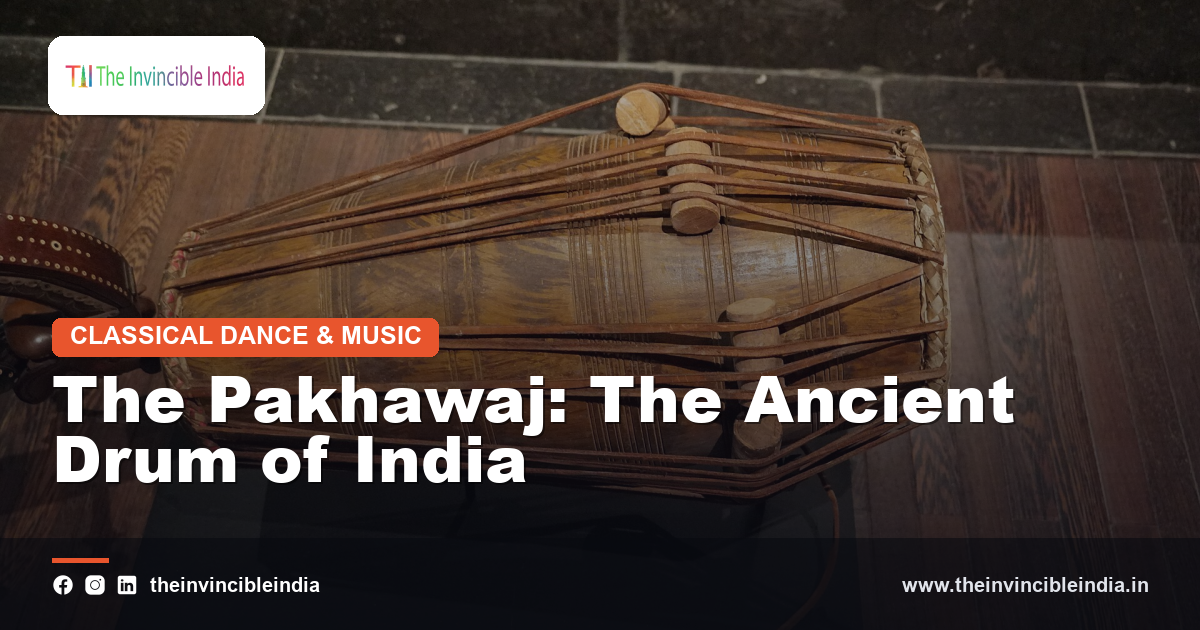
The pakhawaj is a double-headed barrel drum of North India, laid horizontally and played with the palms and fingers of both hands to produce a deep, resonant sound that has accompanied Indian devotional and classical music for centuries. It is widely regarded as an ancestor of the more familiar tala-based percussion instruments of the modern concert stage, and it remains the principal percussion accompaniment to dhrupad, one of the oldest continuously performed styles of Hindustani vocal music. Its rich vocabulary of bols, or spoken rhythmic syllables, and its distinctive tuned bass and treble heads give the pakhawaj a gravity and depth well suited to dhrupad’s slow, meditative unfolding. This guide traces its history, construction, technique and enduring place in Indian music.
Quick Facts
| Detail | Information |
|---|---|
| Type | Double-headed barrel drum (membranophone) |
| Origin | North India, ancient percussion tradition |
| Shape | Horizontal wooden barrel with two drumheads |
| Tuning | Wooden blocks and leather straps adjust pitch |
| Primary use | Percussion accompaniment to dhrupad vocal music |
| Legacy | Regarded as a historical ancestor of the tabla |
What Is the Pakhawaj
The pakhawaj is a barrel-shaped drum with two heads, one at each end, played horizontally across the player’s lap or on a stand with the hands and fingers rather than sticks. Its two heads differ in size and construction, producing a deep bass tone from the larger head and a higher, more resonant tone from the smaller one, allowing a single player to command a wide range of pitch and timbre. This dual-headed design and horizontal playing posture distinguish it from the paired drums of the tabla, even though the two instruments share a common ancestry and much of their underlying rhythmic vocabulary.
Ancient Origins
The pakhawaj is counted among the oldest percussion instruments of the Indian subcontinent, with barrel-shaped, double-headed drums of this general type appearing in classical texts and temple sculpture from a very early period, indicating a long continuous tradition of similar instruments across Indian history. Regional forms of the double-headed barrel drum developed differently in North and South India, with the southern mridangam sharing the same basic principle while diverging in construction and repertoire. This deep historical lineage places the pakhawaj at the root of much of India’s classical percussion practice, its ancient form still recognisable in instruments played today.
Construction of the Drum
A pakhawaj is carved from a single block of wood, traditionally seasoned hardwood, hollowed into a barrel shape that tapers slightly from a wider bass end to a narrower treble end. Both ends are covered with layered leather heads, stretched taut and held in place by a system of leather straps that run the length of the drum, allowing the tension, and therefore the pitch, of each head to be adjusted. The careful selection of wood and the skilled preparation of the leather heads are essential to achieving the drum’s characteristic deep, rounded tone, making instrument-making itself a specialised craft passed down through dedicated workshops.
The Two Heads and Their Sounds
The two heads of the pakhawaj are tuned to produce contrasting tones that together give the instrument its full character. The larger bass head produces a deep, resonant sound achieved partly through a paste applied to its centre, which adds mass and warmth to the tone, while the smaller treble head, carrying its own tuned application of paste at the centre, produces a higher, ringing sound capable of clear articulation. This combination allows a single player to sustain both a steady rhythmic foundation and intricate melodic-rhythmic patterns, a duality that gives dhrupad’s percussion accompaniment its distinctive gravity and richness.
Tuning with Straps and Blocks
Unlike drums tuned with modern mechanical hardware, the pakhawaj is tuned through a traditional system of leather straps woven along its body and small wooden blocks wedged beneath these straps, which can be tapped and repositioned to adjust the tension of the drumheads and thereby their pitch. This method requires skill and careful attention, since the bass head in particular must often be tuned to match the tonic of the accompanying vocal or instrumental performance. Environmental factors such as humidity can affect the leather and require retuning before or even during a performance, making tuning an ongoing practical skill for the pakhawaj player.
Playing Technique and Bols
The pakhawaj is played with the palms, fingers and heel of the hand striking the two heads in combination, producing a vocabulary of distinct sounds each represented by a spoken syllable, or bol, that names and teaches the stroke. Students learn to recite these bols aloud before translating them into physical technique on the drum, a method shared across Indian percussion traditions that allows complex rhythmic compositions to be memorised and transmitted with precision. Mastery involves not only individual strokes but the ability to combine them fluently into extended rhythmic patterns and compositions performed within the framework of a tala.
The Pakhawaj and Dhrupad
The pakhawaj is inseparably linked with dhrupad, the austere and ancient style of Hindustani vocal music known for its slow, meditative development and its grounding in a strict, formal structure. Within a dhrupad performance the pakhawaj enters after the extended unmetered alap, providing a steady, weighty rhythmic accompaniment that matches the vocal style’s gravity and depth rather than the lighter, more decorative percussion suited to other genres. This close pairing has preserved both traditions together over centuries, since dhrupad singers and pakhawaj players have long trained and performed within the same lineages and institutions.
Relation to the Tabla
The pakhawaj is widely regarded by musicians and scholars as a historical forerunner of the tabla, the paired drums that today dominate Hindustani percussion accompaniment across most musical genres. Many of the tabla’s rhythmic compositions and technical vocabulary are believed to descend from pakhawaj practice, adapted to the tabla’s different construction and to the lighter, more ornamental style suited to instrumental and light classical music. As the tabla rose to prominence, the pakhawaj came to be associated more narrowly with dhrupad and related older forms, even as its foundational contribution to Indian percussion technique remained widely acknowledged.
Repertoire and Compositions
Pakhawaj players draw on an extensive repertoire of fixed rhythmic compositions, built from the instrument’s characteristic bols and organised within the framework of various talas, the cyclical rhythmic patterns that structure Indian classical music. These compositions range from steady accompanying patterns that support a vocalist through a fixed rhythmic cycle to elaborate solo passages that showcase the player’s command of rhythm and improvisation. Such repertoire has been preserved and transmitted through generations of practitioners, forming a substantial body of traditional composition that parallels, and in some cases predates, the corresponding repertoire developed for the tabla.
Pakhawaj in Temple and Devotional Music
Beyond the concert stage, the pakhawaj has long played a role in temple and devotional music traditions across North India, accompanying forms of devotional singing that share dhrupad’s emphasis on gravity and steady rhythmic structure. Its deep, resonant tone suits the contemplative mood of such devotional performance, and in some regions the drum remains closely tied to specific ritual and community musical practices. This devotional dimension runs alongside its classical concert role, reflecting the pakhawaj’s broader historical position as an instrument bridging sacred and courtly musical life across many centuries of Indian tradition.
Regional Styles and Gharanas
As with much of Hindustani classical music, pakhawaj playing developed distinct regional styles and family lineages, known as gharanas or baaj, each associated with particular approaches to technique, tuning and repertoire passed down through generations of hereditary musicians. These stylistic lines preserved subtle differences in how compositions were phrased and performed, contributing to the richness and diversity of pakhawaj tradition as a whole. Knowledge of these distinct lineages remains valued among serious students and scholars of the instrument, who see them as preserving different facets of a long and layered performance history.
Making a Pakhawaj
Constructing a pakhawaj requires specialised woodworking skill to carve and hollow the barrel-shaped body from a single piece of timber, followed by the equally demanding craft of preparing and stretching the layered leather heads at each end. The application of the tonal paste to the centre of each head, essential to the instrument’s characteristic sound, is itself a precise craft requiring experience to achieve correct thickness and placement. As with many Indian classical instruments, pakhawaj making has traditionally been carried out within dedicated family workshops where technique is passed down through direct apprenticeship rather than written instruction.
Learning the Pakhawaj
Training in the pakhawaj traditionally follows the guru-shishya method, with students learning directly under an experienced teacher over a period of many years, beginning with the recitation and practice of basic bols before progressing to full compositions and improvisation. Because the pakhawaj is closely tied to dhrupad, students of the drum often develop a close working knowledge of that vocal style as well, understanding how their accompaniment must support its particular structure and mood. This close relationship between instrument and vocal genre shapes much of pakhawaj pedagogy even today.
Decline and Revival
As the tabla rose to dominate Hindustani percussion accompaniment through the modern era, the pakhawaj saw its role narrow considerably, becoming closely tied mainly to dhrupad and related older musical forms that themselves experienced periods of reduced popularity. In more recent decades, renewed interest in dhrupad and in India’s older classical traditions has brought corresponding attention back to the pakhawaj, with dedicated musicians and institutions working to sustain its technique and repertoire. This gradual revival reflects a broader pattern in Indian classical music of returning to and reviving older forms even as newer instruments and styles continue to flourish alongside them.
Pakhawaj Solo Performance
Beyond its role as an accompanist, the pakhawaj also has a tradition of solo performance, in which a player presents an extended, self-contained display of rhythmic composition and improvisation built around the structure of a chosen tala. Such solo recitals allow the pakhawaj player to demonstrate the full range of the instrument’s bols, tonal contrasts and compositional forms without the constraint of following a vocalist’s or dancer’s pace. These performances are especially valued by connoisseurs of Hindustani percussion, since they reveal the depth of the pakhawaj’s own musical language, separate from its more familiar supporting role in dhrupad and devotional settings.
The Pakhawaj Today
Today the pakhawaj survives as a specialised but respected instrument, played primarily by dedicated dhrupad accompanists and taught within institutions committed to preserving India’s older classical forms. While it no longer commands the widespread popularity of the tabla, its historical importance and its unique tonal depth continue to attract serious students and scholars of Indian percussion. As dhrupad itself experiences renewed appreciation among classical music audiences, the pakhawaj’s future appears closely bound to that of the ancient vocal tradition it has accompanied for so many generations.
Sources & Further Reading
- Sangeet Natak Akademi, national academy for music, dance and drama (sangeetnatak.gov.in).
- Ministry of Culture, Government of India (indiaculture.gov.in).
Frequently Asked Questions
What is a pakhawaj?
The pakhawaj is an ancient double-headed barrel drum from North India, played horizontally with the hands. It is best known as the traditional percussion accompaniment for dhrupad, one of the oldest styles of Hindustani classical vocal music.
How is the pakhawaj different from the tabla?
The pakhawaj is a single barrel-shaped drum with two heads played horizontally, while the tabla consists of two separate drums played upright. The pakhawaj is widely regarded as a historical ancestor of the tabla.
How is a pakhawaj tuned?
A pakhawaj is tuned using leather straps and small wooden blocks wedged along its body, which adjust the tension of its two drumheads and, in turn, their pitch, rather than mechanical hardware.
What music does the pakhawaj accompany?
The pakhawaj is most closely associated with dhrupad, the ancient and austere style of Hindustani vocal music. It has also traditionally accompanied certain devotional and temple music forms in North India.
Is the pakhawaj still played today?
Yes. Although the tabla is now far more widespread, the pakhawaj remains actively played and taught, particularly among dhrupad accompanists and institutions dedicated to preserving India’s older classical traditions.


