

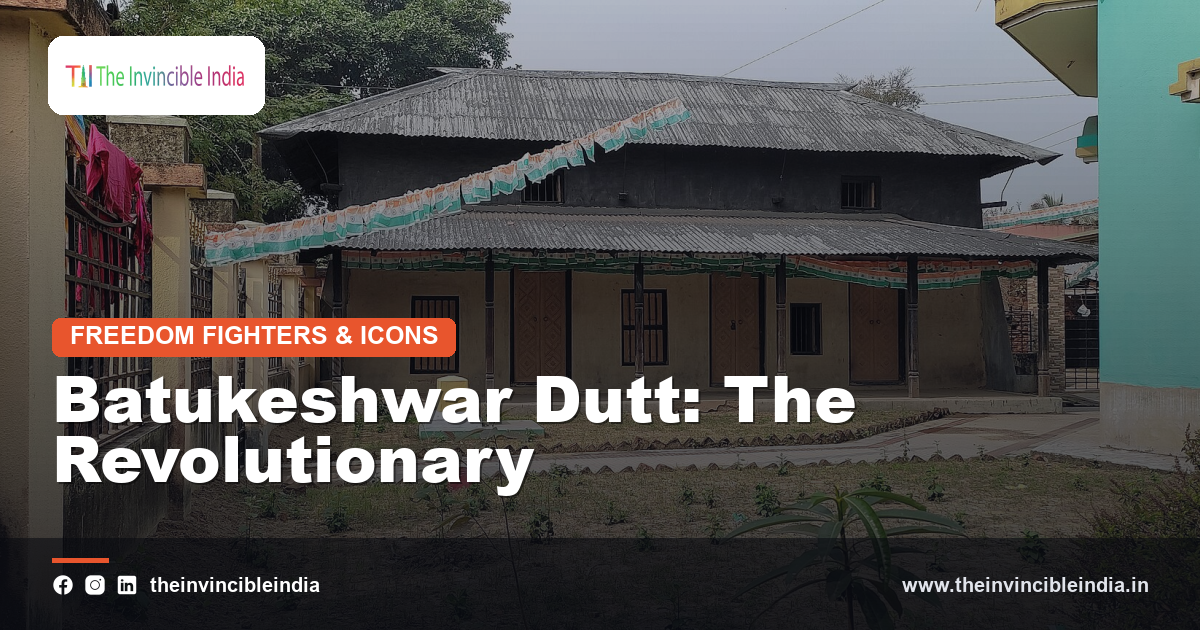
Batukeshwar Dutt is remembered as the steadfast comrade who stood beside Bhagat Singh in one of the most striking acts of revolutionary defiance in India’s freedom struggle, the deliberate and symbolic action inside the Central Legislative Assembly. A committed member of the Hindustan Socialist Republican Association, Dutt shared fully in the risks and convictions of his more famous comrade, choosing to court arrest rather than flee so that their protest might carry its full political meaning. His subsequent years of harsh imprisonment, borne with quiet endurance, and his largely unassuming life after independence reflect a rare combination of courage and humility. This guide traces the life, sacrifice and legacy of Batukeshwar Dutt.
Quick Facts
| Detail | Information |
|---|---|
| Known as | Comrade of Bhagat Singh in the Assembly action |
| Born | 1910, in Oari village, Bengal |
| Organisation | Hindustan Socialist Republican Association (HSRA) |
| Known for | The Central Legislative Assembly action |
| Sentence | Transportation for life, served in the Andaman Cellular Jail |
| Died | 1965 |
The Revolutionary Who Endured
Batukeshwar Dutt holds a distinctive place among India’s revolutionaries as the comrade who shared fully in one of the movement’s most dramatic acts of protest yet lived on for decades to carry the memory of that sacrifice forward. Unlike some of his closest comrades, whose lives were cut short by execution, Dutt endured years of harsh imprisonment and, later, a life largely lived away from public attention, bearing both with the same quiet dignity that had marked his revolutionary service. His story adds an important and often overlooked dimension to the history of the Hindustan Socialist Republican Association. As the revolutionary who endured, Batukeshwar Dutt’s life illuminates the long personal cost that the freedom struggle exacted even from those who survived it.
Early Life in Bengal
Batukeshwar Dutt was born in 1910 in a village in Bengal, a region whose long tradition of nationalist activity and intellectual ferment shaped the political consciousness of many young men of his generation. He grew up amid the currents of the Swadeshi and nationalist movements that had already left a deep imprint on Bengali society, and he absorbed from an early age a strong sense of patriotic duty. His family background, while not directly political, provided the stable and education-oriented environment from which his later revolutionary commitment would grow. This upbringing in Bengal, steeped in a regional culture of nationalist activism, gave Dutt an early and lasting orientation toward the cause of India’s freedom.
Joining the Revolutionary Movement
As a young man, Batukeshwar Dutt moved toward organised revolutionary activity, eventually making his way into the ranks of the Hindustan Socialist Republican Association, the underground organisation dedicated to achieving India’s complete independence through disciplined revolutionary action. His decision to join the movement reflected a deliberate and considered choice rather than youthful impulse, grounded in genuine conviction about the necessity of organised resistance to colonial rule. Within the Association, Dutt quickly built the trust of senior members through his reliability and his readiness to accept personal risk for the cause. This step into the revolutionary underground marked the beginning of the most consequential period of Dutt’s life.
Friendship with Bhagat Singh
Within the Hindustan Socialist Republican Association, Batukeshwar Dutt formed a close and enduring friendship with Bhagat Singh, a bond built on shared ideals, mutual trust and a common willingness to accept the gravest personal risk for the cause of India’s freedom. The two worked closely together in planning and carrying out the Association’s activities, drawing strength from each other’s conviction and clarity of purpose. Their friendship extended beyond political calculation into genuine personal affection, a closeness that would be tested and ultimately affirmed through the events that followed. This comradeship with Bhagat Singh remains one of the defining relationships of Dutt’s revolutionary life.
The Idea Behind the Assembly Action
The Hindustan Socialist Republican Association conceived of an action inside the Central Legislative Assembly in Delhi as a deliberate act of protest against repressive legislation being considered by the colonial government, intended to make a forceful political statement rather than to cause harm to individuals. The plan called for a controlled and symbolic disruption of the Assembly’s proceedings, accompanied by the distribution of leaflets explaining the revolutionaries’ aims to the wider public. Dutt and Bhagat Singh were chosen to carry out this carefully considered action, one designed to draw maximum national and international attention to the cause of Indian independence. This carefully reasoned plan reflected the Association’s belief that dramatic, symbolic action could awaken public consciousness more effectively than quiet appeal.
The Central Legislative Assembly Action
Batukeshwar Dutt, together with Bhagat Singh, carried out the planned action inside the Central Legislative Assembly, deliberately ensuring that it caused no harm to those present while still delivering an unmistakable political message to the colonial government and to the wider public. Amid the resulting commotion, the two revolutionaries scattered leaflets explaining their aims and raised slogans demanding freedom, actions intended to be heard and remembered well beyond the chamber itself. Rather than attempt to escape, they remained at the scene, prepared to accept the legal consequences of their protest. This action inside the Assembly became one of the most widely remembered episodes of the revolutionary phase of India’s freedom struggle.
Deliberate Arrest and Its Purpose
A crucial and deliberate feature of the Assembly action was the decision by Dutt and Bhagat Singh to remain at the scene and accept arrest rather than attempt to flee, a choice made so that their trial might serve as a public platform for the message they wished to convey. This willingness to court arrest reflected the Association’s broader strategy of using dramatic action followed by open political defiance in the courtroom to reach a national audience. Dutt embraced this course with full understanding of its likely personal cost, placing the wider cause above his own safety and freedom. This deliberate arrest set the stage for the extended legal proceedings and imprisonment that followed.
The Assembly Bomb Case Trial
Following their arrest, Batukeshwar Dutt and Bhagat Singh faced trial in what came to be known as the Assembly Bomb Case, a proceeding that both men used deliberately to explain and defend their revolutionary convictions before the court and, through press coverage, before the country at large. Their conduct during the trial won them considerable public sympathy, as they presented their action as a matter of political principle rather than criminal intent. The case drew close national attention and contributed significantly to the growing prominence of the Hindustan Socialist Republican Association in the public mind. This trial marked an important stage in Dutt’s revolutionary career and in the wider history of the movement.
Sentenced to Transportation for Life
At the conclusion of the Assembly Bomb Case, Batukeshwar Dutt was sentenced to transportation for life, a punishment that would separate him from his family and homeland for a prolonged and uncertain period. Unlike Bhagat Singh, who would later be tried separately and face execution in connection with other revolutionary activity, Dutt’s sentence meant years of imprisonment far from the mainland, a fate that tested his endurance in different but no less demanding ways. He accepted this sentence with the same composure that had marked his conduct throughout the trial. This severe sentence marked the beginning of the longest and most physically demanding chapter of Dutt’s life.
Imprisonment in the Andaman Cellular Jail
Batukeshwar Dutt served a significant part of his sentence in the Cellular Jail on the Andaman Islands, a notoriously harsh colonial prison reserved for political prisoners considered especially dangerous by the authorities. Conditions in the jail were severe, and political prisoners there endured considerable hardship, isolation and deprivation as a matter of deliberate colonial policy. Dutt bore these conditions with the same quiet resilience that had characterised his earlier revolutionary conduct, refusing to allow the harshness of his confinement to break his spirit or his convictions. This period of imprisonment in the Andaman Cellular Jail stands as one of the most demanding tests endured by any veteran of the freedom struggle.
Hunger Strikes and Prisoner Rights
While imprisoned, Batukeshwar Dutt joined fellow political prisoners in protesting the harsh conditions of their confinement, including participation in hunger strikes intended to press for fair and humane treatment for those held for political offences. These protests, undertaken at considerable personal risk to health, drew public attention to the plight of political prisoners across British India and added to the growing pressure on colonial authorities to reform prison conditions. Dutt’s willingness to endure further suffering in pursuit of this cause reflects the same selfless commitment that had defined his earlier revolutionary activity. This advocacy for prisoner rights forms an important, if less celebrated, part of his legacy.
Later Years of Imprisonment
As the years of his sentence passed, Batukeshwar Dutt continued to endure the isolation and hardship of prison life, sustained by his convictions even as many of his closest comrades from the movement’s most active years had already been executed or had themselves completed long sentences. He remained largely out of the public eye during this period, a contrast to the intense national attention his earlier actions had attracted. Dutt’s patient endurance through these later years of imprisonment reflects a quieter, less celebrated form of sacrifice than the dramatic action for which he was originally sentenced. This extended period of confinement shaped the reserved and unassuming character for which he was later known.
Release and Return
Batukeshwar Dutt was eventually released from prison after years of confinement, returning to a country whose political landscape had changed considerably since the events that had led to his imprisonment. His release was met with recognition from those who remembered his role in the Assembly action, though the passage of time and his long absence from public life meant that he did not seek to reclaim the prominence he might once have commanded. He resumed civilian life with the same modesty and quiet dignity that had marked his conduct throughout his imprisonment. This return to ordinary life after such an extraordinary sacrifice marks an important, often underappreciated chapter of his story.
Life After Independence
After India achieved independence, Batukeshwar Dutt largely withdrew from public political life, choosing a modest existence far removed from the recognition and reward that some might have expected for a man who had risked everything for the national cause. He faced considerable personal and financial hardship in his later years, a circumstance that many who knew his history found difficult to reconcile with the scale of his earlier sacrifice. Despite this, Dutt is not recorded as having sought special privilege on account of his revolutionary past, maintaining instead the same quiet humility that had characterised his conduct throughout his life. This unassuming later life reflects a dimension of sacrifice that receives less attention than dramatic revolutionary action itself.
Legacy and Remembrance
The legacy of Batukeshwar Dutt rests on his willingness to share fully in the risk and consequence of one of the freedom struggle’s most memorable acts of protest, and on the quiet endurance with which he bore years of harsh imprisonment that followed. His life offers an important reminder that the freedom movement’s sacrifices were not confined to those who lost their lives, but extended also to those who survived to bear the long personal cost of their convictions. Dutt’s close association with Bhagat Singh ensures that his own contribution, though sometimes overshadowed, remains an essential part of that shared story. This legacy of steadfast, unassuming sacrifice continues to be honoured by historians of the freedom struggle.
Batukeshwar Dutt Today
Today Batukeshwar Dutt is increasingly recognised as an essential figure of India’s revolutionary freedom struggle, remembered for standing beside Bhagat Singh in the Central Legislative Assembly action and for enduring years of harsh imprisonment with quiet resolve. Memorials, public commemorations and historical accounts have worked in recent decades to restore fuller recognition to his contribution, ensuring that his story is not eclipsed by that of his more widely remembered comrade. He is remembered particularly for the humility and endurance that marked both his imprisonment and his later life. As a steadfast comrade and survivor of great sacrifice, Batukeshwar Dutt endures in the nation’s memory as a true hero of India’s independence.
Sources & Further Reading
- Ministry of Culture, Government of India, on the revolutionary phase of the freedom movement (indiaculture.gov.in).
- National Archives of India, records relating to the freedom struggle (nationalarchives.gov.in).
Frequently Asked Questions
Who was Batukeshwar Dutt?
Batukeshwar Dutt was a Bengal-born revolutionary of the Hindustan Socialist Republican Association who, together with Bhagat Singh, carried out the symbolic action inside the Central Legislative Assembly and endured years of harsh imprisonment as a result.
What was the Central Legislative Assembly action?
The Central Legislative Assembly action was a deliberate, symbolic protest carried out by Batukeshwar Dutt and Bhagat Singh, involving a controlled disruption and the distribution of leaflets, intended to draw national attention to the cause of Indian independence without harming those present.
Why did Dutt and Bhagat Singh allow themselves to be arrested?
Dutt and Bhagat Singh deliberately remained at the scene of the Assembly action and accepted arrest so that their subsequent trial could serve as a public platform to explain and defend their revolutionary convictions before the nation.
What happened to Batukeshwar Dutt after his sentence?
Batukeshwar Dutt was sentenced to transportation for life and served a significant part of his imprisonment in the Andaman Cellular Jail before his eventual release, after which he lived a largely modest and private life.
How is Batukeshwar Dutt remembered today?
Batukeshwar Dutt is remembered as a steadfast comrade of Bhagat Singh whose courage and endurance through years of harsh imprisonment form an essential part of the history of India’s revolutionary freedom struggle.


