

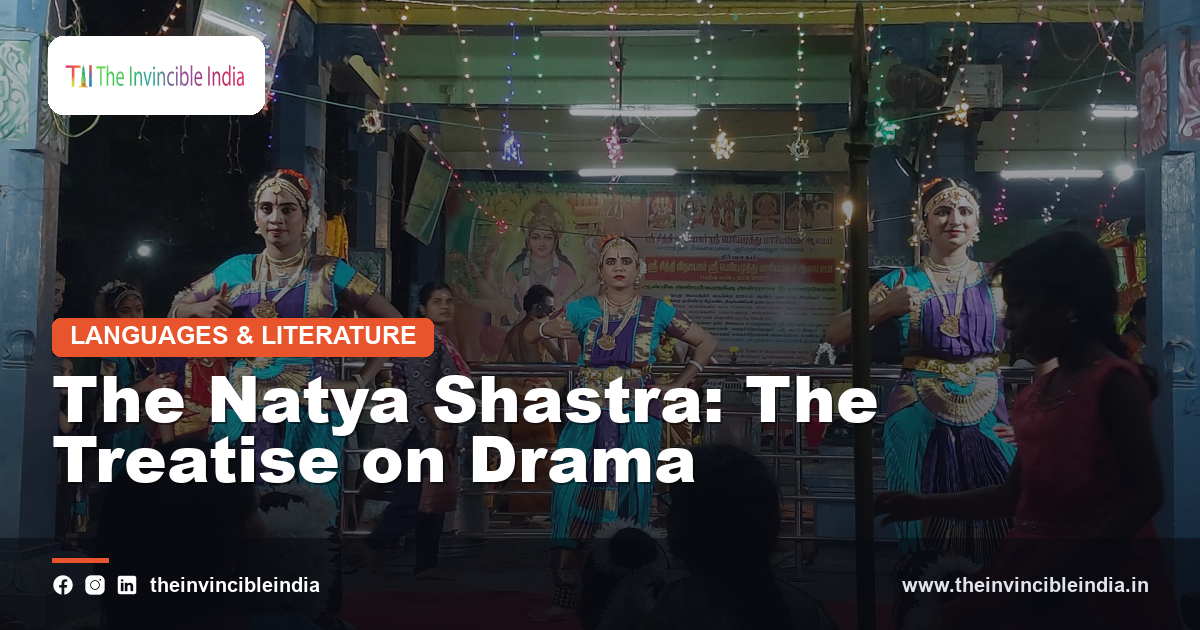
The Natya Shastra is a foundational Sanskrit treatise that systematically addresses the theory and practice of drama, dance and music in ancient India, composed in the same classical language explored in our guide to Kalidasa. Traditionally attributed to the sage Bharata, it presents an extraordinarily detailed framework covering stagecraft, characterisation, emotional expression and aesthetic theory, most notably through its influential discussion of rasa, or aesthetic sentiment. Far more than a technical manual, the Natya Shastra situates the performing arts within a broader philosophical and cultural framework, treating drama as a comprehensive art capable of conveying the full range of human experience. Its principles continue to shape Indian classical dance, theatre and music many centuries after its composition. This guide explores its structure, key concepts and enduring legacy.
Quick Facts
| Detail | Information |
|---|---|
| Genre | Sanskrit treatise on dramaturgy and performing arts |
| Traditional Attribution | Sage Bharata |
| Core Concept | Rasa, the theory of aesthetic sentiment |
| Scope | Drama, dance, music, stagecraft and theatre architecture |
| Language | Sanskrit |
| Legacy | Foundational influence on Indian classical dance and theatre |
What Is the Natya Shastra
The Natya Shastra is an extensive Sanskrit treatise dedicated to the theory and practice of the performing arts, covering drama, dance, music and related disciplines in remarkable detail. It is widely regarded as the foundational text of Indian dramaturgy, providing a systematic framework that has influenced performing arts traditions across the subcontinent for many centuries.
The text addresses an unusually broad range of topics, from practical matters such as stage construction and costume to abstract aesthetic theory concerning the emotional effect of performance on an audience. This combination of technical instruction and philosophical reflection distinguishes the Natya Shastra as a uniquely comprehensive work within world dramatic literature.
Attribution to Sage Bharata
Tradition attributes the Natya Shastra to the sage Bharata, credited as its author and often described within the text itself as having received the knowledge of drama through divine inspiration before transmitting it to human students. This attribution situates the origins of Indian theatre within a sacred and revered lineage of knowledge transmission.
While questions of authorship and composition remain a subject of ongoing scholarly discussion, the association with Bharata has remained central to how the text is understood and honoured within the tradition. The name Bharata is itself commemorated in Bharatanatyam, one of the major classical dance forms of India, reflecting this enduring connection.
Scope and Structure of the Text
The Natya Shastra is organised into numerous chapters addressing a wide range of subjects related to dramatic performance, including acting technique, dance movement, musical accompaniment, costume, makeup and theatre construction. This comprehensive scope reflects an ambition to treat drama as a total art form, integrating multiple performing disciplines within a single coherent framework.
The systematic organisation of the text, moving from theoretical foundations through detailed practical instruction, has made it an enduring reference work for practitioners and scholars alike. Its thoroughness distinguishes it from many other ancient treatises on the arts, which often address a narrower range of technical concerns.
The Concept of Rasa
Among the most influential contributions of the Natya Shastra is its theory of rasa, generally translated as aesthetic sentiment or emotional flavour, describing the particular emotional experience that a successful performance evokes in its audience. According to this theory, the purpose of drama and related performing arts is to generate specific rasas through carefully coordinated elements of performance.
This concept has proven extraordinarily influential, extending well beyond drama into broader Indian aesthetic theory concerning poetry, music and visual art. The idea that artistic works are ultimately judged by the emotional experience they successfully evoke remains a foundational principle within Indian traditions of aesthetic criticism.
The Principal Rasas
The Natya Shastra identifies a set of principal rasas, each corresponding to a distinct aesthetic emotion such as love, heroism, wonder, compassion or fear, which performers aim to evoke in their audience through voice, gesture and expression. These rasas provide a shared vocabulary for discussing and evaluating the emotional impact of a performance.
This classification system has served as a durable framework for performers across many generations, offering clear categories through which to structure the emotional arc of a dramatic or dance performance. The enduring use of this framework within Indian classical dance and theatre reflects the lasting authority of the Natya Shastra’s aesthetic theory.
Bhava: Emotional States
Closely related to rasa is the concept of bhava, referring to the emotional states and psychological conditions that performers portray in order to give rise to rasa in the audience. The Natya Shastra offers detailed guidance on the various bhavas a performer might express, along with techniques for conveying them convincingly.
This careful distinction between the performer’s expressed emotional state and the aesthetic experience generated in the audience reflects a sophisticated understanding of the psychology of performance. The interplay between bhava and rasa remains central to training in Indian classical dance and drama, shaping how performers approach emotional expression on stage.
Guidance on Dance Technique
The Natya Shastra provides extensive guidance on dance technique, distinguishing between pure, rhythmic movement performed for its own aesthetic value and expressive, narrative movement intended to convey meaning and emotion. This distinction remains fundamental to the structure of Indian classical dance forms practised today.
Detailed instructions covering hand gestures, body postures, footwork and facial expression demonstrate the text’s careful attention to the technical vocabulary of dance as a communicative art. This systematic treatment of movement and gesture has provided a lasting technical foundation for generations of dancers trained within classical Indian traditions.
Guidance on Music
Alongside its treatment of drama and dance, the Natya Shastra addresses music as an essential component of dramatic performance, discussing melodic structure, rhythm and the role of vocal and instrumental accompaniment in supporting theatrical presentation. This integration reflects the close historical relationship between music and drama within Indian performing arts.
The text’s musical discussions have been studied as an important early source for understanding the theoretical foundations of Indian classical music, complementing later, more specialised treatises on the subject. This connection between the Natya Shastra and the broader tradition of Indian musicology underscores its significance across multiple performing art disciplines.
Stagecraft and Theatre Architecture
The Natya Shastra devotes considerable attention to the practical aspects of stagecraft, including detailed guidance on theatre construction, seating arrangements and stage design intended to optimise the audience’s experience of performance. This practical dimension reflects the text’s comprehensive approach to drama as both an art and a coordinated public event.
Such architectural guidance illustrates the seriousness with which ancient Indian tradition approached the physical staging of drama, treating the design of performance spaces as integral to successful theatrical presentation. This attention to venue and setting complements the text’s more abstract discussions of aesthetic theory and performance technique.
Costume, Makeup and Presentation
The Natya Shastra offers detailed instruction on costume and makeup appropriate to different characters and dramatic situations, recognising visual presentation as an important tool for communicating character, status and emotional tone to the audience. Guidance on colour, ornamentation and styling reflects careful attention to the visual dimension of performance.
This emphasis on presentation complements the text’s broader concern with achieving a unified, convincing theatrical effect, in which visual, vocal and physical elements work together to evoke the intended rasa. Such detailed attention to costume and appearance has continued to inform performance traditions in Indian classical dance and theatre.
Classification of Characters
The Natya Shastra provides a systematic classification of dramatic characters according to their social status, moral qualities and role within the narrative, offering guidance on how each type should be portrayed through speech, gesture and demeanour. This classification helped standardise character portrayal across different dramatic productions.
By establishing clear conventions for character types, the text enabled performers and playwrights to draw upon a shared dramatic vocabulary, facilitating consistency and mutual understanding across different performance traditions. This systematic approach to characterisation remains a notable feature distinguishing classical Sanskrit drama from other dramatic traditions.
Influence on Classical Dance Forms
The theoretical framework established in the Natya Shastra has profoundly shaped the development of India’s classical dance forms, many of which explicitly draw upon its concepts of rasa, bhava and structured gesture in their training and performance practice. Dance forms across different regions of India trace elements of their technical and theoretical foundation to this text.
This shared foundational influence, despite considerable regional variation in style and technique, illustrates the Natya Shastra’s role as a unifying theoretical reference point across India’s diverse classical dance traditions. Its continued relevance to contemporary dance training underscores the lasting authority of its aesthetic and technical principles.
Influence on Classical Music
Beyond dance and drama, the Natya Shastra’s musical discussions contributed to the early theoretical foundations of Indian classical music, addressing concepts later elaborated in dedicated musicological treatises. Its treatment of melody and rhythm within the context of dramatic performance provided an important early framework for musical theory.
This influence reflects the closely intertwined historical development of Indian drama, dance and music, disciplines that the Natya Shastra treats as complementary elements of a unified performing art. The text’s continued citation in discussions of classical Indian music underscores its foundational status across multiple performing art traditions.
Sanskrit Dramaturgy and Later Texts
The Natya Shastra established a framework that later Sanskrit writers on dramaturgy and aesthetics continued to build upon, producing further treatises that refined and extended its theories of rasa and dramatic composition. These later works engaged closely with the original text, testifying to its lasting authority within Sanskrit literary and aesthetic scholarship.
This ongoing tradition of commentary and elaboration reflects the Natya Shastra’s foundational status within Sanskrit intellectual culture, comparable to other major classical treatises addressed in our overview of Sanskrit literature. Its influence extended well beyond drama itself, shaping broader currents of Indian literary and aesthetic theory.
Preservation and Manuscript Tradition
Like many ancient Sanskrit texts, the Natya Shastra has survived through a manuscript tradition maintained by scholars and institutions dedicated to preserving classical literature, with careful copying across generations ensuring its transmission to the present day. Variations across different manuscript versions have prompted careful scholarly comparison and editing.
Modern critical editions of the Natya Shastra draw upon this manuscript tradition to present as complete and accurate a text as possible, supporting both academic study and practical application by contemporary performers. This ongoing scholarly engagement ensures the continued availability and study of the text in its full complexity.
The Natya Shastra Today
Today, the Natya Shastra remains a foundational reference for practitioners, scholars and students of Indian classical dance, music and theatre, studied both for its historical significance and its continuing practical relevance to performance training. Institutions dedicated to classical arts regularly draw upon its principles in shaping curricula and performance standards.
The enduring influence of its concepts, particularly rasa and bhava, across such a wide range of performing art forms testifies to the depth and sophistication of its original theoretical vision. As a living reference for artists many centuries after its composition, the Natya Shastra continues to shape how Indian performing arts are taught, practised and understood.
Sources & Further Reading
- Sangeet Natak Akademi.
- Ministry of Culture, Government of India (indiaculture.gov.in).
Frequently Asked Questions
What is the Natya Shastra?
The Natya Shastra is an ancient Sanskrit treatise on drama, dance and music, providing a comprehensive theoretical and practical framework for the performing arts in India.
Who is traditionally credited with the Natya Shastra?
The text is traditionally attributed to the sage Bharata, whose name is also commemorated in the classical dance form Bharatanatyam.
What is rasa in the Natya Shastra?
Rasa refers to the aesthetic sentiment or emotional experience that a performance is intended to evoke in its audience, a central concept in Indian dramatic and artistic theory.
How has the Natya Shastra influenced Indian dance?
Many classical Indian dance forms draw directly upon the Natya Shastra’s concepts of gesture, expression and rasa in their training and performance practice.
Does the Natya Shastra cover music as well as drama?
Yes, the text addresses music alongside drama and dance, discussing melody and rhythm as essential components of dramatic performance.


