

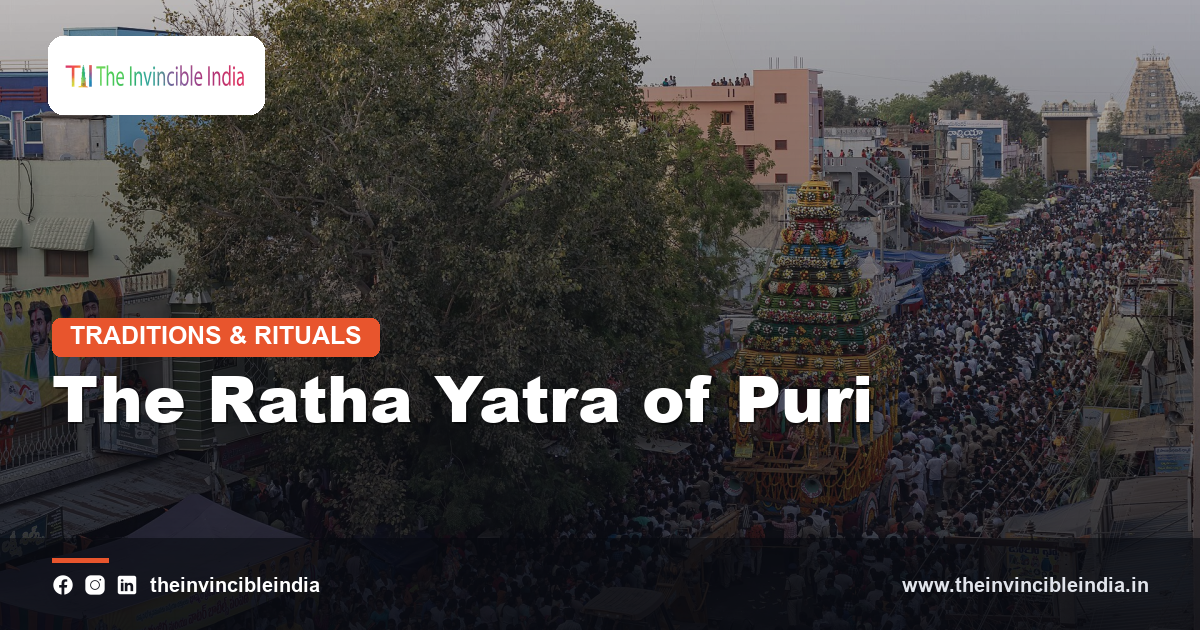
The Ratha Yatra of Puri is one of the most spectacular festivals in the Hindu calendar, centred on an annual chariot procession carrying the deities Jagannath, Balabhadra and Subhadra through the streets of Puri in Odisha. Jagannath is worshipped as a form of Vishnu, linking the festival in spirit to other Vaishnava celebrations such as Janmashtami, though its distinctive chariot-pulling ritual and immense public participation give it a character all its own. Three enormous wooden chariots, newly built each year, carry the deities from the Jagannath Temple to the Gundicha Temple, drawing pilgrims and spectators from across India and beyond. This guide explores the festival’s origins, rituals and enduring significance.
Quick Facts
| Detail | Information |
|---|---|
| Also Known As | Rath Yatra, Car Festival of Puri |
| Dedicated To | Lord Jagannath, Balabhadra and Subhadra |
| Type of Observance | Hindu chariot festival and pilgrimage |
| General Timing | Shukla Paksha Dwitiya of Ashadha (June-July) |
| Key Practices | Chariot construction, Pahandi procession, chariot pulling |
| Region of Prominence | Puri, Odisha, with related processions across India |
Meaning and Significance
The Ratha Yatra of Puri commemorates an annual journey in which Lord Jagannath, together with his brother Balabhadra and sister Subhadra, travels from the main temple to a secondary shrine in specially built chariots. The festival is regarded as an occasion when the deity leaves the confines of the sanctum and comes out among ordinary people, allowing even those who cannot normally enter the temple to have a darshan, or sacred viewing, of the deity.
This democratising quality is often highlighted as central to the festival’s meaning, distinguishing it from temple worship confined to an inner sanctum. The image of the deity travelling among the public, rather than remaining enclosed, has made Ratha Yatra one of the most widely recognised expressions of devotion in Indian religious life.
Jagannath, Balabhadra and Subhadra
The three deities central to the festival, Jagannath, Balabhadra and Subhadra, are represented by distinctive wooden images with large, rounded eyes and simplified forms unlike the more naturalistic sculptures found in many other Hindu temples. Jagannath, whose name translates roughly as “Lord of the Universe”, is worshipped as a form of Vishnu, while Balabhadra is regarded as his elder brother and Subhadra as their sister.
The three are worshipped together as a trinity at the Jagannath Temple throughout the year, and the Ratha Yatra is the principal occasion on which all three leave the temple together in public procession. Their distinctive iconography, unlike any other set of temple images in India, has become one of the most recognisable visual symbols of Odishan religious culture.
Mythological and Religious Background
Several traditional narratives describe the origins of Jagannath worship and the practice of the annual chariot journey, though these accounts belong to devotional literature and oral tradition rather than historical record. Many versions describe the deity’s image being fashioned from a sacred log under divine instruction, an account cherished by devotees as an explanation for the images’ distinctive, unfinished appearance.
The Ratha Yatra itself is generally linked in tradition to Jagannath’s journey to visit his aunt’s home, represented by the Gundicha Temple, echoing the universal custom of visiting family. Because these stories form part of a long oral and devotional tradition, they are best appreciated as expressions of faith and cultural memory rather than as literal history.
The Jagannath Temple of Puri
The Jagannath Temple in Puri, one of the Char Dham pilgrimage sites revered across Hindu tradition, is the starting point of the Ratha Yatra and the spiritual centre of the festival. Its towering spire is a landmark of the city and a major destination for pilgrims throughout the year, with the temple complex housing numerous shrines besides the main sanctum of Jagannath, Balabhadra and Subhadra.
Ratha Yatra is the one occasion when the deities leave this temple and become visible in the open, drawing attention not only to the festival itself but to the temple’s broader place in Odisha’s religious and civic life. The temple’s kitchens, rituals and daily routines are all closely tied to the rhythms of this annual festival calendar.
Position in the Hindu Calendar
Ratha Yatra falls on the second day of the bright fortnight of the lunar month of Ashadha, generally corresponding to June or July in the Gregorian calendar. As with other festivals governed by the lunar calendar, the exact Gregorian date shifts from year to year, and the temple’s own calendar of rituals determines the precise timing of each stage of the festival.
The festival’s monsoon-season timing is often noted as significant, coinciding with a period of renewal in the agricultural cycle in much of eastern India. This seasonal placement adds another layer to the festival’s association with journeys, change and the passage from one period to the next.
The Three Chariots
Each year, three chariots are newly constructed for Jagannath, Balabhadra and Subhadra, built according to traditional specifications that determine their height, number of wheels and colour scheme. Jagannath’s chariot, known as Nandighosa, is the largest of the three, followed by Balabhadra’s Taladhwaja and Subhadra’s Darpadalana, each decorated with distinctive canopies and carved wooden figures.
The chariots are rebuilt from scratch every year rather than reused, a practice that reflects a broader theme in Hindu ritual of renewal through repeated creation. Their immense scale, towering several storeys high, makes them among the most visually striking structures associated with any Indian festival.
Chariot Construction Traditions
Construction of the chariots begins months in advance and is carried out by specialist carpenters and artisans belonging to hereditary occupational communities associated with the temple. The work follows measurements and conventions preserved across generations, ensuring that each year’s chariots, though newly built, closely resemble those of previous years in proportion and design.
Wood for the chariots is traditionally sourced from specific types of trees, and the construction process itself is treated as a ritual activity rather than ordinary carpentry, accompanied by particular customs and observances. This blending of craftsmanship and ritual reflects the broader Indian pattern in which skilled labour and religious devotion are closely intertwined.
The Pahandi Procession
Before the chariots can be pulled, the deities must be ceremonially moved from the temple sanctum to their respective chariots in a ritual known as Pahandi, in which the images are carried in a swaying, rhythmic manner by temple priests amid chanting and the sound of traditional instruments. This procession is itself considered a significant ritual moment, distinct from the chariot pulling that follows.
The Pahandi draws large crowds who gather to witness the deities emerge from the temple, and the ritual’s distinctive swaying movement is said to allow devotees a clear and sustained view of the images as they pass. Its careful choreography reflects the precision with which Jagannath Temple rituals are conducted throughout the year.
Pulling of the Chariots
Once the deities are seated in their chariots, thousands of devotees take hold of thick ropes attached to each chariot and pull them along the Bada Danda, the grand avenue leading from the Jagannath Temple toward the Gundicha Temple. Participation in this act of pulling is considered highly meritorious, and devotees from across social backgrounds join together in the effort.
The sheer scale of the crowds involved, along with the size and weight of the chariots, makes the pulling a lengthy and physically demanding undertaking. The shared, communal nature of the task is often cited as embodying the festival’s broader message of collective devotion transcending individual distinctions.
Gundicha Temple and the Journey
The Gundicha Temple, situated some distance from the main Jagannath Temple, is the destination of the outward journey and is traditionally regarded as the deities’ garden house or aunt’s residence. The deities remain at this temple for several days before beginning their return journey, during which time devotees continue to visit and offer worship.
The period of residence at the Gundicha Temple is treated as a distinct phase of the festival, with its own set of rituals separate from those of the outward and return journeys. This extended structure, spanning more than a single day of celebration, is part of what gives Ratha Yatra its unusually elaborate and multi-staged character.
The Return Journey (Bahuda Yatra)
After several days at the Gundicha Temple, the deities begin their return journey to the main temple in a ritual known as Bahuda Yatra, again carried in their chariots and pulled by devotees along the same grand avenue. This return leg is accompanied by its own set of rituals and is regarded as an important, if somewhat less crowded, counterpart to the outward journey.
A distinctive custom associated with the return journey involves an offering of a sweet delicacy to Jagannath outside the main temple before the deities re-enter, a moment surrounded by its own devotional significance. The completion of the return journey marks the formal conclusion of the main Ratha Yatra festivities for the year.
Rituals and Offerings Along the Way
Throughout the festival period, a range of specific rituals accompany each stage of the deities’ journey, including particular offerings, chants and ceremonial gestures performed by temple priests at set points along the route. Devotees lining the streets often make their own offerings and prayers as the chariots pass, participating in the festival even without pulling the ropes directly.
Prasad, food first offered to the deities, is distributed to pilgrims at various points during the festival, extending the ritual’s communal dimension to include shared eating alongside shared devotion. These layered rituals, combining temple protocol with popular participation, are part of what sustains the festival’s scale and continuity year after year.
Regional Ratha Yatras Across India
While the Puri festival is the most prominent, Ratha Yatra celebrations honouring Jagannath or other deities are held in various forms across India, often organised by temples and religious communities with ties to Odishan tradition. Cities with significant Odia populations frequently host their own smaller-scale chariot processions modelled on the Puri festival.
Other regional chariot festivals, dedicated to different deities and following their own local customs, exist independently across the country, reflecting a broader Indian tradition of processional temple festivals. These parallel traditions illustrate how the basic idea of a deity travelling among devotees resonates well beyond any single temple or region.
Ratha Yatra Beyond India
The Ratha Yatra of Puri has also inspired chariot festivals organised by Hindu communities and religious organisations in various countries outside India, particularly where International Society for Krishna Consciousness (ISKCON) temples and similar institutions are active. These international observances typically adapt the core elements of chariot procession and public participation to local settings.
Such festivals abroad often serve as an introduction to Jagannath worship and Odishan festival tradition for wider audiences, including many who may not otherwise encounter this particular strand of Hindu practice. Their growth over recent decades reflects the broader global spread and adaptation of Indian religious festivals within diaspora communities.
Cultural and Artistic Significance
Beyond its religious dimension, Ratha Yatra holds considerable cultural and artistic significance for Odisha, intersecting with traditions of woodcarving, chariot building, textile decoration and temple architecture that have developed around the festival over a long period. The distinctive iconography of Jagannath has become a recognisable emblem of Odishan identity well beyond strictly religious contexts.
The festival also features prominently in regional literature, folk songs and visual art, reflecting its deep integration into the cultural life of the region. This intertwining of religious observance and artistic tradition situates Ratha Yatra alongside other major Indian festivals in which faith and craftsmanship reinforce one another.
Ratha Yatra Today
In the present day, the Ratha Yatra of Puri continues to draw enormous crowds of pilgrims and visitors, with elaborate arrangements made each year for crowd management, medical care and public safety given the scale of participation. Media coverage and live broadcasts now allow audiences across India and abroad to witness the festival’s key moments in real time.
Despite the scale of contemporary organisation, the essential structure of the festival, the annual construction of new chariots, the Pahandi procession, the pulling of the ropes and the journey to and from the Gundicha Temple, remains consistent with long-established tradition. This continuity amid growing scale is part of what continues to draw devotees generation after generation.
Sources & Further Reading
- Ministry of Culture, Government of India (indiaculture.gov.in).
- Archaeological Survey of India (asi.nic.in).
Frequently Asked Questions
What is the Ratha Yatra of Puri?
The Ratha Yatra of Puri is an annual Hindu festival in which the deities Jagannath, Balabhadra and Subhadra are carried in large wooden chariots from the Jagannath Temple to the Gundicha Temple.
Why are new chariots built every year?
Building new chariots annually reflects a broader theme in Hindu ritual of renewal through repeated creation, and the practice follows traditional specifications preserved across generations.
What is the Pahandi ritual?
Pahandi is the ceremonial procession in which temple priests carry the deities from the sanctum to their chariots in a distinctive swaying, rhythmic movement.
What happens at the Gundicha Temple?
The deities reside at the Gundicha Temple, traditionally regarded as their garden house, for several days before returning to the main temple in a journey known as Bahuda Yatra.
Is Ratha Yatra celebrated outside Puri?
Yes, smaller chariot festivals inspired by the Puri tradition are held in various parts of India and by Hindu communities in other countries, particularly through organisations such as ISKCON.


