

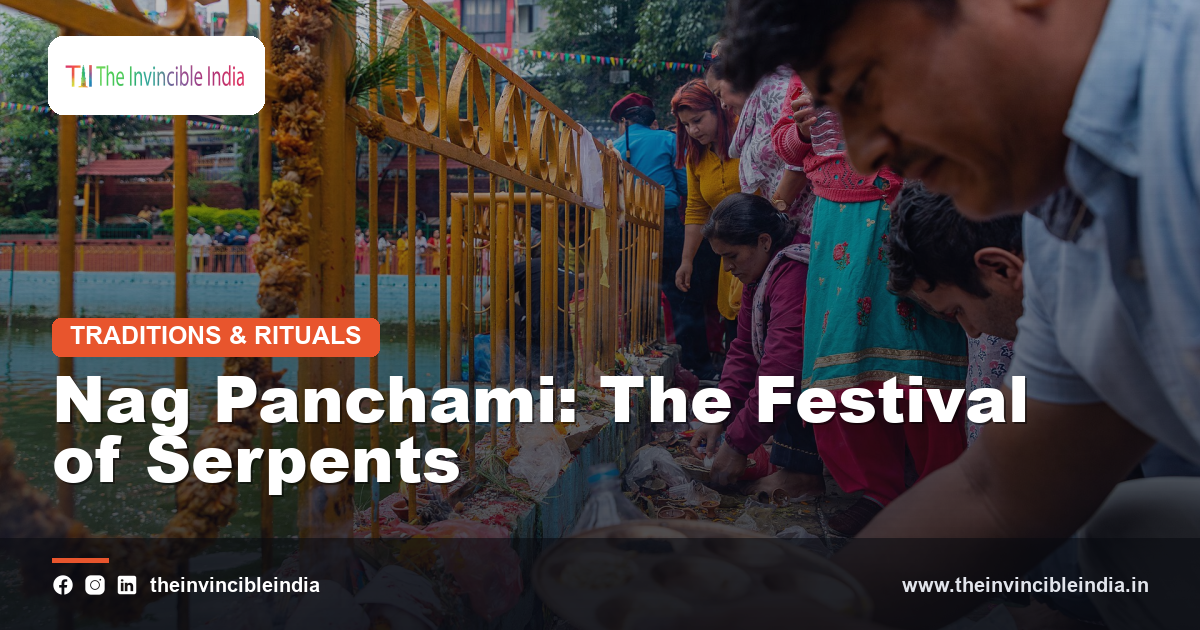
Nag Panchami is a Hindu festival dedicated to the worship of nagas, serpent deities that hold a distinct place in Indian religious tradition. Observed during the monsoon month of Shravan, the festival reflects a long-standing reverence for snakes found across Hindu mythology, including their association with Lord Shiva, who is honoured during Maha Shivaratri and is traditionally depicted wearing a serpent. Devotees offer prayers, milk and other offerings to snake images or, in some communities, to live snakes handled by traditional keepers. This guide surveys the festival’s meaning, mythology and the many regional forms it takes across the country.
Quick Facts
| Detail | Information |
|---|---|
| Also Known As | Snake worship festival |
| Dedicated To | Nagas, serpent deities of Hindu tradition |
| Type of Observance | Hindu religious festival |
| General Timing | Shukla Paksha Panchami of Shravan (July-August) |
| Key Practices | Worship of snake images, offerings of milk |
| Region of Prominence | Observed across India, with regional variations |
Meaning and Significance
Nag Panchami is dedicated to the worship of nagas, serpent deities regarded in Hindu tradition as powerful beings associated with both protection and the natural world. The festival reflects a long-standing reverence for snakes in Indian culture, in which they are seen not merely as creatures to be feared but as beings worthy of respect and ritual acknowledgement.
For many devotees, the day is an occasion to seek protection from snakebite and to express gratitude toward these creatures, who occupy an ambivalent but significant place in agrarian life. This blend of respect and practical concern gives the festival a character distinct from more celebratory Hindu observances.
Serpents in Indian Tradition
Snakes hold a prominent and varied place across Indian religious and cultural tradition, appearing in mythology, temple iconography and regional folklore as symbols of fertility, protection, danger and transformation. Nagas are often depicted as semi-divine beings capable of taking human form, distinct from ordinary snakes, and are associated with the underworld and with guardianship of treasure and water sources.
This layered symbolism means that serpents in Indian tradition are rarely viewed in a single, simple way, but rather as complex figures carrying multiple meanings depending on context. Nag Panchami draws on this rich and long-standing symbolic tradition rather than on any single narrow interpretation.
Mythological Associations
Several mythological narratives are associated with Nag Panchami, including stories describing the churning of the cosmic ocean, in which the serpent Vasuki plays a significant role, and accounts of Krishna subduing the serpent Kaliya, a story recounted widely across devotional literature. Shiva’s association with snakes, worn as ornaments around his neck, also connects the festival to wider Shaivite tradition.
As with many festival origin stories, these narratives belong to a long oral and textual tradition rather than to historical record, and are best understood as symbolic teachings about balance, danger and divine protection rather than as literal accounts. Their retelling continues to shape how devotees understand the festival’s significance.
Position in the Hindu Calendar
Nag Panchami falls on the fifth day of the bright fortnight of the lunar month of Shravan, generally corresponding to July or August in the Gregorian calendar, placing it within the monsoon season. As with other lunar festivals, the exact Gregorian date shifts each year, and regional almanacs are consulted to confirm the day of observance.
The monsoon timing of the festival is often noted as significant, since heavy rains during this period tend to bring snakes out of flooded burrows and closer to human settlements, a practical reality that many scholars suggest may have contributed to the timing and character of the observance.
Rituals and Worship Practices
On Nag Panchami, devotees typically worship images or idols of snakes, often fashioned from clay, silver or drawn on walls near the household entrance, offering milk, flowers, rice and other items as part of the ritual. Prayers are recited seeking protection from snakebite and blessings for the household and fields.
In some regions, anthills, believed to be potential snake habitations, are also worshipped directly, with offerings placed at their entrance. These varied practices share a common underlying gesture, an act of respectful acknowledgement directed toward a creature that inspires both reverence and caution in equal measure.
Offerings Made to Snakes
Milk is among the most common offerings made during Nag Panchami, poured over snake images or, in some traditional settings, offered directly to live snakes. Other typical offerings include turmeric, vermilion, flowers and cooked rice, presented as part of a structured sequence of worship performed at home shrines or at designated worship sites.
These offerings are generally understood as gestures of respect and appeasement rather than as functional feeding, reflecting the broader devotional logic found in Hindu ritual, where symbolic offerings communicate reverence toward the divine or semi-divine recipient rather than serving a practical purpose.
The Role of Snake Charmers
Traditionally, snake charmers, belonging to particular itinerant communities with long-standing expertise in handling snakes, played a visible role in Nag Panchami observances in some parts of India, bringing snakes, often cobras, to towns and villages so that devotees could make offerings directly to a living creature. This practice formed part of a broader traditional economy connecting these communities to seasonal festival demand.
Over recent decades, this practice has become far less common, reflecting both changing regulations concerning wildlife and a broader shift within the festival toward symbolic worship using images rather than live animals, a change discussed further later in this guide.
Nag Panchami and Agrarian Life
Nag Panchami’s timing within the monsoon season connects it closely to the rhythms of agrarian life in much of India, a period when fields are freshly sown and snakes, dislodged by rain, become more visible near farmland and homes. The festival’s protective themes are often linked to this practical agricultural context, in which farmers sought to coexist safely with snakes that also help control rodent populations in the fields.
This agrarian dimension situates Nag Panchami among a number of Indian festivals whose timing and themes are closely tied to seasonal and agricultural cycles, reflecting a broader pattern in which religious observance and practical rural life are deeply intertwined.
Regional Variations Across India
Nag Panchami is observed with distinct customs in different parts of India, reflecting local traditions of snake worship and regional interpretations of the festival’s mythology. In some northern and central states, household worship of drawn or moulded snake images predominates, while other regions place greater emphasis on visiting temples specifically dedicated to naga deities.
These regional differences illustrate the broader pattern seen across many Hindu festivals, in which a shared religious theme, in this case reverence for serpents, is expressed through locally rooted customs shaped by geography, agricultural practice and community tradition.
Nag Panchami in Maharashtra
In Maharashtra, Nag Panchami is observed with particular regional customs, including household rituals involving drawn images of snakes and communal gatherings at temples associated with naga worship. Certain villages in the state have historically been noted for distinctive local traditions surrounding the festival, reflecting the strong regional character the observance can take.
Women in many Maharashtrian households also observe specific customs on this day, including avoiding certain kitchen activities associated with cutting or frying, out of respect for the day’s association with snakes. These household-level customs illustrate how broad festival themes are adapted into everyday domestic practice.
Nag Panchami in South India
In parts of South India, Nag Panchami, sometimes observed under related regional names and calendars, involves visits to naga-devta shrines, often located near termite mounds or under sacred trees, sites traditionally associated with serpent deities. Offerings of milk and turmeric are commonly made at these outdoor shrines, distinct from the household-centred worship more common elsewhere.
South Indian temple traditions also include specific rituals addressing sarpa dosha, an astrological concern relating to serpent deities, for which dedicated poojas are performed at particular temples. This regional emphasis reflects the broader South Indian tradition of temple-centred ritual practice built around a wide range of specific concerns.
Nagas in Art and Sculpture
Naga imagery appears widely across Indian art and temple architecture, from ancient sculpture and cave carvings to temple friezes depicting serpent deities in human or hybrid form. Naga stones, small carved images of coiled snakes, are a common sight near temples, sacred trees and water bodies across many parts of the country, often placed by devotees seeking blessings.
This long artistic tradition reflects the deep and continuous presence of serpent symbolism within Indian visual culture, extending well beyond the specific occasion of Nag Panchami into architecture, sculpture and everyday devotional objects found throughout the subcontinent.
Fasting and Dietary Customs
Some devotees observe dietary restrictions on Nag Panchami, commonly avoiding fried foods or foods requiring cutting or chopping, customs understood as a mark of respect toward snakes on this particular day. These restrictions vary by region and household, with some communities observing a full fast and others simply modifying their usual meals.
Such customs reflect a broader pattern found across Hindu festivals, in which everyday domestic practices are temporarily adjusted to align with the spirit of a particular observance, translating a religious theme into small, concrete changes in daily household routine.
Symbolism of the Snake
The snake carries multiple layers of symbolism within Hindu tradition, representing at once danger, protection, fertility and transformation, owing to its capacity to shed its skin and its association with both the underworld and with guardianship. Nag Panchami draws on this rich symbolic range rather than any single fixed meaning.
This multivalent symbolism helps explain why serpent worship persists as a distinct thread within Hindu practice, separate from the worship of the major deities, offering devotees a way to engage with themes of danger and protection that other festivals do not directly address.
Changing Practices and Conservation Awareness
In recent decades, growing awareness of wildlife conservation and animal welfare has led to a broader shift in how Nag Panchami is observed, with many communities and authorities encouraging worship of snake images rather than the use of live, often captured, snakes during festival rituals. This shift reflects a general and ongoing conversation about balancing traditional practice with animal welfare concerns.
Many temples and community organisations have accordingly adapted their observance to focus on symbolic worship, a change generally described as evolving gradually rather than through any single decisive moment. This adaptation illustrates how long-standing festival practices continue to develop in response to contemporary values.
Nag Panchami Today
Today, Nag Panchami continues to be observed across India through household worship, temple visits and regional customs, even as the practice of using live snakes has become far less common than in previous generations. Symbolic worship of snake images, offerings of milk and turmeric, and household rituals remain the primary ways the festival is marked.
The continued observance of Nag Panchami, adapted to contemporary sensibilities while retaining its core themes of respect and protection, reflects the broader capacity of Indian festival tradition to evolve without losing its underlying meaning across generations of practice.
Sources & Further Reading
- Ministry of Culture, Government of India (indiaculture.gov.in).
- Sangeet Natak Akademi (sangeetnatak.gov.in).
Frequently Asked Questions
What is Nag Panchami?
Nag Panchami is a Hindu festival dedicated to the worship of nagas, or serpent deities, observed through offerings of milk and prayers seeking protection from snakebite.
When is Nag Panchami observed?
It falls on the fifth day of the bright fortnight of the lunar month of Shravan, generally in July or August, during the monsoon season.
Are live snakes used in Nag Panchami worship?
The practice has become far less common in recent decades, with growing emphasis on worshipping snake images out of wildlife conservation and animal welfare concerns.
Why is the festival linked to Lord Shiva?
Shiva is traditionally depicted wearing a serpent as an ornament, connecting Nag Panchami to wider Shaivite tradition and imagery of snakes in Hindu mythology.
How does Nag Panchami relate to agrarian life?
Its monsoon timing coincides with a period when snakes become more visible near farmland, linking the festival’s protective themes to practical rural coexistence with snakes.


