

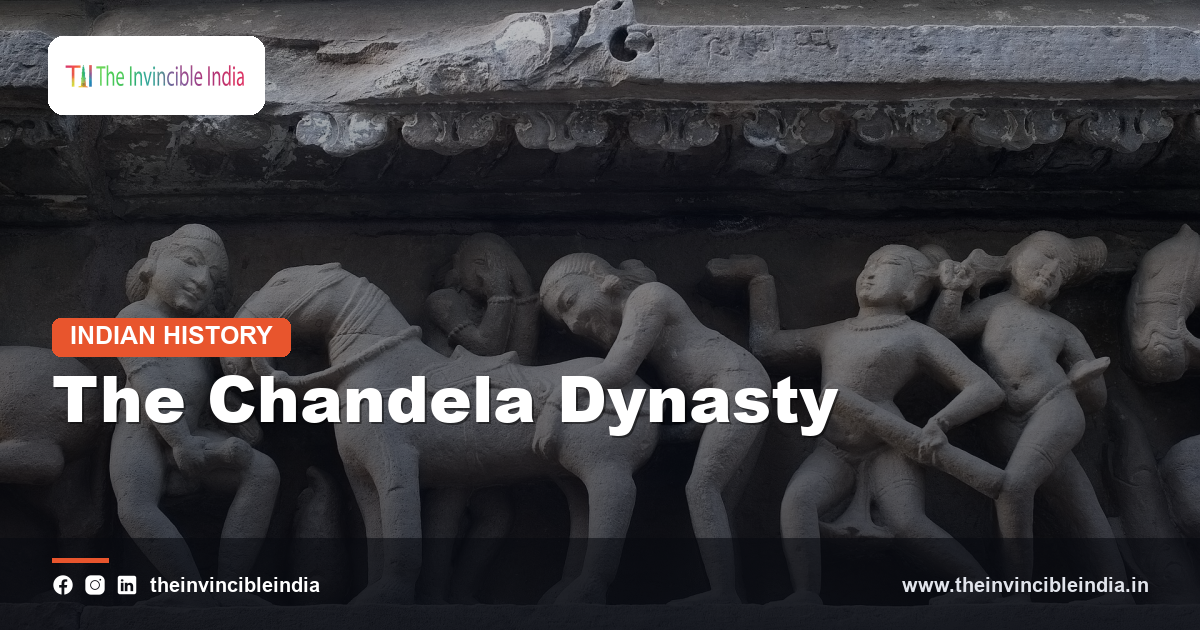
In the hilly, forested tract of central India known as Bundelkhand, a regional dynasty rose from local chieftainship to become one of the most prolific temple-building powers of the medieval period. The Chandelas, ruling in a landscape that also came within the wider orbit of powers such as the Rajput clans of northern and central India, are remembered above all for the extraordinary temple complex at Khajuraho, whose sculptural richness remains unmatched among surviving monuments of its era. Beyond their artistic patronage, the Chandelas also built and held one of the subcontinent’s most formidable hill forts at Kalinjar, a stronghold that withstood repeated sieges across generations. This guide surveys the dynasty’s origins, governance, culture, and enduring architectural legacy.
Quick Facts
| Detail | Information |
|---|---|
| Region | Bundelkhand, present-day Madhya Pradesh and adjoining Uttar Pradesh |
| Approximate Period | Roughly the 9th to the 13th century CE |
| Capitals | Khajuraho as a religious center, with Mahoba as a political capital |
| Key Stronghold | The hill fort of Kalinjar |
| Religions Patronized | Hinduism, including Shaivism and Vaishnavism, alongside Jainism |
| Legacy | The Khajuraho group of temples, a UNESCO World Heritage Site |
Origins in Bundelkhand
The Chandela dynasty traced its roots to the rugged, forested region of Bundelkhand in central India, an area of rocky uplands and river valleys that had traditionally supported a patchwork of smaller local powers. According to later dynastic tradition, the family claimed descent through legendary origins that blended local lore with claims of respectable lineage, a common pattern among medieval Indian ruling houses seeking to legitimize their authority. Emerging initially as a subordinate power under larger regional overlords, the Chandelas gradually built up an independent base of strength within their home territory. Their rise took place during a broader period of political fragmentation across northern and central India, when numerous regional dynasties were competing to fill the space left by weakening larger empires. This gradual consolidation from local chieftaincy to independent kingship set the pattern for the dynasty’s later development.
Rise to Independent Power
As Chandela strength grew, successive rulers moved from a position of nominal subordination toward full independence, asserting sovereign authority over Bundelkhand and its surrounding territories. This transition was achieved through a combination of military consolidation, strategic marriage alliances, and the steady extension of control over agriculturally productive land and important trade routes. Early Chandela rulers are credited in inscriptions with securing the dynasty’s core territory and laying the administrative and military foundations for later expansion. The construction of religious monuments accompanied this political consolidation, with temple building serving both devotional and political purposes by visibly demonstrating royal power and piety. This dual process of territorial consolidation and monumental patronage became a defining feature of Chandela rule from its earliest independent phase onward.
Extent of Chandela Territory
At its height, Chandela authority extended across much of Bundelkhand, a region spanning parts of present-day Madhya Pradesh and adjoining areas of Uttar Pradesh, bounded by river systems and forested hill country that offered natural defensive advantages. Control over this territory was anchored by a network of fortified towns and hill strongholds, of which Kalinjar was the most formidable, allowing the dynasty to defend its core lands against external pressure. The Chandelas maintained shifting relationships with neighboring powers along their frontiers, at times expanding influence into adjoining regions and at other times contracting under pressure from rivals. This combination of a defensible core territory and a network of fortified outposts allowed the dynasty to sustain its independence for several centuries despite the presence of larger and more powerful neighbors. Bundelkhand’s distinctive geography thus played a central role in shaping the dynasty’s political fortunes.
Notable Rulers
Chandela inscriptions preserve the names of a long line of rulers across many generations, several of whom are remembered for particular achievements in temple building, territorial consolidation, or successful resistance against external invaders. Certain rulers are especially associated with the great phase of temple construction at Khajuraho, during which the most celebrated shrines of the complex were conceived and completed under sustained royal patronage. Others are remembered chiefly for military resilience, defending Chandela territory and the fortress of Kalinjar against determined incursions from powerful neighboring states. The dynastic tradition also credits certain rulers with extending Chandela influence temporarily into neighboring regions during periods of relative strength. Taken together, this sequence of rulers illustrates a dynasty capable of sustaining both cultural patronage and military resilience across a long historical span.
System of Governance
Chandela administration combined central royal authority with a network of local officials and feudatory chiefs responsible for revenue collection and order within their respective territories. Inscriptions recording land grants to temples and religious institutions provide much of the surviving evidence for how the dynasty organized its administrative and fiscal affairs. Provincial governance appears to have relied on a mixture of appointed officials and local notables who retained considerable autonomy so long as they acknowledged Chandela overlordship and met their obligations to the center. This layered approach to administration allowed the dynasty to govern a territory of varied terrain and dispersed settlement without requiring a single, rigid bureaucratic structure. The endurance of Chandela rule across several centuries suggests that this flexible administrative system proved well suited to the practical demands of governing Bundelkhand.
Kalinjar: The Great Hill Fortress
Among the Chandela dynasty’s most significant strategic assets was the hill fortress of Kalinjar, a naturally defensible stronghold perched atop a steep sandstone plateau that had been fortified and refortified across many centuries. The fort’s commanding position and formidable defenses made it a crucial bastion for Chandela power, repeatedly withstanding sieges from ambitious regional and external powers seeking to break Chandela resistance. Within its walls, the fort also housed temples and water reservoirs, reflecting its role as both a military stronghold and a center of religious and civic life. Control of Kalinjar carried great symbolic as well as practical value, and its capture or successful defense features prominently in accounts of the period’s shifting political fortunes. The fortress remains one of the most impressive surviving examples of medieval Indian military architecture associated with the dynasty.
Religious Patronage
Chandela rulers were generous patrons of religious institutions, supporting Hindu traditions centered on Shiva and Vishnu while also extending considerable patronage to Jain communities within their territory. This pluralistic approach to religious support reflects a broader pattern among medieval Indian dynasties, in which rulers sought to secure legitimacy and social cohesion by funding multiple faiths simultaneously. Royal and elite patronage funded the construction of numerous temples across Chandela territory, of which the complex at Khajuraho represents the most ambitious and enduring expression. Religious endowments recorded in inscriptions also supported the maintenance of priests, ritual specialists, and temple staff, integrating religious institutions into the broader economic and social fabric of the kingdom. This sustained religious patronage across generations produced one of the richest concentrations of temple architecture found anywhere in medieval India.
The Khajuraho Temple Complex
The temples at Khajuraho stand as the single most celebrated achievement of Chandela patronage, a concentrated group of shrines built over an extended period and dedicated to various Hindu deities alongside a smaller number of Jain temples. Constructed primarily from sandstone, the temples are renowned for their soaring towers, harmonious proportions, and extraordinarily dense sculptural programs covering nearly every exterior surface. The sculptural repertoire at Khajuraho spans devotional, mythological, courtly, and everyday themes, executed with remarkable technical skill and a distinctive sense of movement and naturalism. Originally numbering considerably more structures than survive today, the complex nonetheless retains enough intact temples to convey the scale of the original architectural undertaking. Recognized today as a UNESCO World Heritage Site, Khajuraho remains the defining monument of Chandela artistic achievement.
Sculptural Art and Iconography
The sculptural art of the Khajuraho temples is distinguished by its technical refinement, fluid modeling of the human form, and an unusually broad range of subject matter drawn from religious, courtly, and daily life. Panels depict deities, celestial figures, musicians, dancers, and scenes of courtly and domestic activity, arranged in carefully organized bands across the temple exteriors. This comprehensive sculptural program reflects a worldview in which the sacred and the everyday were understood as interconnected aspects of a single ordered cosmos, a common theme in medieval Indian temple art. The consistency of style across many structures suggests the presence of well-organized workshops of skilled artisans working under sustained royal patronage over an extended period. This artistic achievement places Chandela sculpture among the most celebrated bodies of work in the history of Indian temple art.
Temple Architecture and Design
Architecturally, the Khajuraho temples exemplify a mature phase of the North Indian, or Nagara, temple style, characterized by tall curvilinear towers rising above a sanctum and a sequence of connected halls leading toward it. Builders paid careful attention to proportion and elevation, creating a sense of upward movement that culminates in the temple’s central spire, a hallmark of the Nagara architectural tradition. Many temples are raised on high platforms, allowing for a circumambulatory path and enhancing their visual prominence within the surrounding landscape. The integration of elaborate sculpture with structural design reflects a holistic architectural philosophy in which ornamentation and form were conceived together rather than added afterward. This architectural sophistication cemented the reputation of Chandela builders as among the most accomplished of their era.
Language, Learning, and Inscriptions
Sanskrit served as the principal language of Chandela inscriptions, which record royal genealogies, land grants, and dedications to temples and religious institutions across the kingdom. These inscriptions, often engraved on temple walls or on separate stone and copper plate records, remain a primary source for reconstructing Chandela political and religious history. The dynasty’s courts are understood to have supported learned brahmins and religious scholars, consistent with the broader pattern of royal patronage extended toward temples and their attached institutions. While no single body of Chandela court literature survives as prominently as the monuments themselves, the inscriptional record reflects a court literate in classical conventions of praise and genealogical record-keeping. This documentary legacy continues to inform modern scholarly understanding of the dynasty’s history and achievements.
Economy and Society
The Chandela economy rested on an agrarian base supported by the fertile lands and river valleys of Bundelkhand, supplemented by craft production and regional trade passing through the territory. Land grants to temples and religious institutions, recorded extensively in inscriptions, provided a stable economic foundation for the maintenance of priests, artisans, and temple staff associated with major religious sites. Society within Chandela territory appears to have been organized around agrarian villages and market towns, with artisans and craft guilds playing an important role in supplying materials and labor for the dynasty’s extensive temple-building activity. The scale of construction at Khajuraho alone implies a sophisticated economy capable of mobilizing skilled labor, materials, and resources over an extended period. This combination of agrarian productivity and craft specialization sustained the dynasty’s cultural and architectural ambitions.
Rivalries with Neighboring Powers
Throughout their history, the Chandelas engaged in shifting rivalries and occasional alliances with neighboring dynasties, including regional powers to the north and west whose territories bordered Bundelkhand. Control of strategic strongholds such as Kalinjar made the region a recurring target for ambitious rulers seeking to expand their own influence, resulting in periodic conflicts over the fortress and surrounding territory. The Chandelas generally proved resilient in these contests, drawing on the defensive advantages of their fortified strongholds and the loyalty of local feudatories to resist outright conquest for an extended period. As the political landscape of northern India shifted with the emergence of new powers from the northwest, Chandela rulers faced increasingly serious challenges to their independence. This long history of contested frontiers illustrates the competitive political environment of medieval central India in which the dynasty operated.
Decline of Chandela Authority
By the early centuries of the second millennium, mounting pressure from powerful new forces advancing into northern India gradually weakened Chandela authority, despite the dynasty’s long record of resilience. Repeated conflicts placed considerable strain on Chandela resources and military capacity, even as key strongholds such as Kalinjar continued to offer determined resistance. Over time, Chandela territory contracted, and the dynasty’s political independence gave way to reduced local authority within a changing regional order. This decline mirrored a broader pattern across much of northern and central India during this period, as many long-established regional dynasties faced similar pressures. The eventual eclipse of Chandela political power nonetheless left behind the monumental legacy at Khajuraho as an enduring testament to the dynasty’s earlier strength.
Legacy in Indian History
The Chandela dynasty is remembered today primarily through its extraordinary architectural legacy, with the Khajuraho temples standing as one of the most studied and admired monuments of medieval Indian art. Beyond their artistic contribution, the Chandelas also exemplify the broader pattern of regional dynastic power that characterized much of medieval central India, combining local military strength with sophisticated cultural patronage. The fortress of Kalinjar continues to be recognized as an important example of medieval Indian military architecture, reflecting the dynasty’s strategic acumen alongside its artistic achievements. Historians studying the period draw on Chandela inscriptions and monuments to reconstruct the political and religious life of Bundelkhand during the medieval era. This layered legacy secures the Chandelas an important place in the broader narrative of Indian history.
The Chandela Dynasty Today
Today, the legacy of the Chandela dynasty draws visitors, scholars, and pilgrims from around the world to Khajuraho, where the surviving temples continue to be studied for their architectural sophistication and sculptural artistry. Conservation efforts by heritage authorities work to protect the site’s delicate stone carvings from weathering and the pressures of tourism, ensuring the monuments remain accessible for future generations. The Kalinjar fort likewise remains an important heritage site, attracting visitors interested in medieval military architecture and the region’s layered history. Ongoing scholarship continues to refine understanding of Chandela political history, religious patronage, and artistic achievement through the study of inscriptions and monuments. Through both its temples and its fortresses, the Chandela dynasty remains a vivid presence in the cultural memory of central India.
Sources & Further Reading
- Archaeological Survey of India (asi.nic.in).
- Ministry of Culture, Government of India (indiaculture.gov.in).
Frequently Asked Questions
Who were the Chandelas?
The Chandelas were a medieval dynasty that ruled the Bundelkhand region of central India from roughly the 9th to the 13th century CE, remembered chiefly for their extensive temple-building activity.
What is the Chandela dynasty famous for?
The dynasty is best known for constructing the Khajuraho group of temples, celebrated for their architecture and dense, finely carved sculpture, as well as for holding the formidable Kalinjar fort.
Where was the Chandela capital located?
Khajuraho served as the dynasty’s principal religious center, while Mahoba functioned as an important political capital, with Kalinjar fort serving as a key military stronghold.
What religions did the Chandelas support?
Chandela rulers primarily patronized Hindu traditions centered on Shiva and Vishnu, while also extending meaningful support to Jain communities and institutions within their territory.
Why is Kalinjar fort significant?
Kalinjar was a strategically vital hill fortress that repeatedly withstood sieges, serving as a key symbol of Chandela military resilience across several centuries of regional conflict.


