

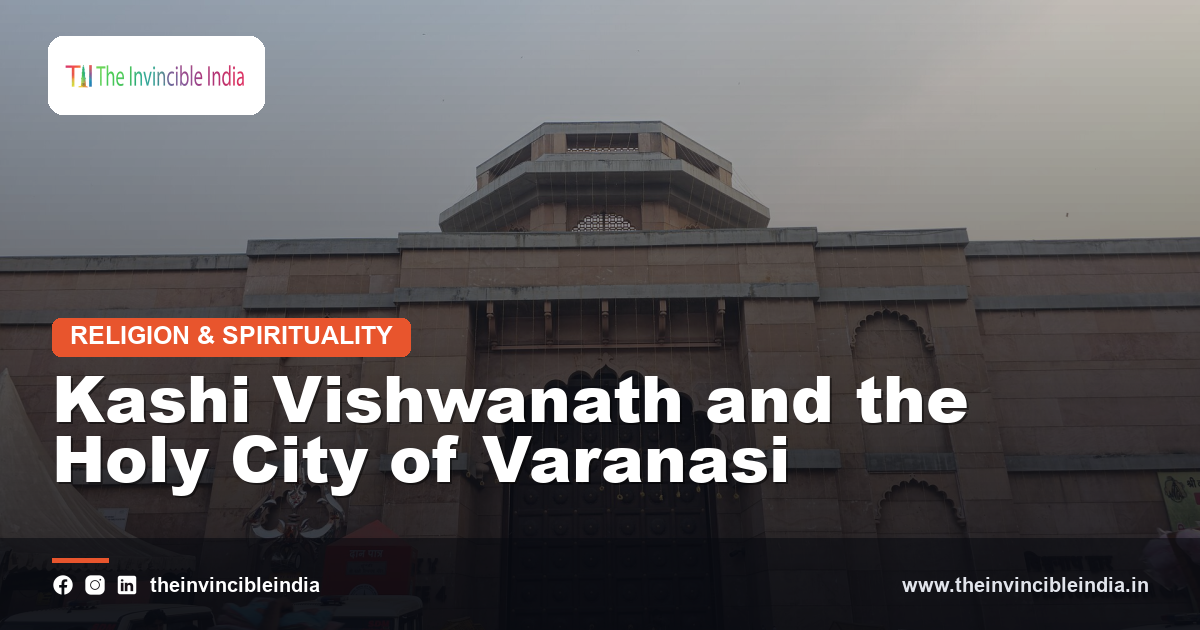
Varanasi, one of the oldest continuously inhabited cities associated with organized religious life in India, is centered spiritually on the temple of Kashi Vishwanath, dedicated to Lord Shiva. Set along the banks of the Ganga, the city has for centuries drawn pilgrims, scholars, and seekers who regard it as among the most sacred places in the Hindu world. The temple itself, though modest in scale compared to some of India’s grand hill or coastal shrines, holds an outsized place in devotional memory as one of the jyotirlingas associated with Shiva worship. Together, the temple and the city form a single spiritual landscape in which ritual, learning, and everyday life along the river remain deeply intertwined.
Quick Facts
| Detail | Information |
|---|---|
| Location | Varanasi, Uttar Pradesh |
| Deity | Lord Shiva, as Vishwanath |
| Sacred River | Ganga |
| Tradition | Shaiva worship within Hinduism |
| Significance | One of the twelve jyotirlingas |
| City Character | Ancient center of pilgrimage and learning |
Varanasi: A City of Ancient Sanctity
Varanasi, also known by the older name Kashi, is widely regarded as one of the most enduring centers of religious life in India, with a continuous tradition of pilgrimage and worship stretching back many centuries. Its identity as a sacred city rests as much on lived devotional practice as on any single monument.
Set along a great curve of the Ganga, the city has long attracted pilgrims, scholars, and seekers, sustaining a religious and cultural life that has adapted through many historical periods while retaining its essential character as a place set apart for sacred purpose.
The Legend and Antiquity of Kashi
Traditional narratives describe Kashi as a city especially favored by Shiva, a belief that has shaped devotional imagination around the city for generations. Such accounts, transmitted through oral tradition and popular retelling, emphasize the city’s unique spiritual status rather than offering precise historical claims.
Regardless of the specifics of these traditional narratives, Varanasi’s long-standing association with sanctity has made it a natural destination for pilgrims and scholars alike, reinforcing its reputation as one of the principal centers of Hindu religious life across the subcontinent.
Kashi Vishwanath: The Temple of Shiva
At the spiritual center of the city stands the Kashi Vishwanath temple, dedicated to Shiva in his form as Vishwanath, meaning lord of the universe. The temple has been rebuilt and restored across different periods of history, reflecting the resilience of devotional practice in the face of changing historical circumstances.
Despite these changes, the temple has remained a continuous focus of worship, drawing pilgrims who consider a visit here central to a complete pilgrimage to Varanasi. Its enduring presence at the heart of the old city underscores its unbroken devotional significance.
Shiva Worship and the Jyotirlinga Tradition
Kashi Vishwanath is counted among the twelve jyotirlingas, sacred sites across India associated with a luminous manifestation of Shiva. This classification places the temple within a wider devotional geography that spans the subcontinent, linking Varanasi to other major centers of Shiva worship.
For devotees, visiting a jyotirlinga site carries particular spiritual weight, and Kashi Vishwanath’s inclusion among this select group has long reinforced Varanasi’s standing as one of the most important destinations within the Shaiva devotional tradition.
Architecture and Restoration Over Time
The present temple structure reflects a history of periodic rebuilding, undertaken by different patrons across generations who sought to restore and beautify the shrine. This layered architectural history is typical of many ancient Indian temples that have faced disruption and renewal over long periods of time.
Rather than diminishing its sanctity, this history of restoration is often seen by devotees as evidence of the site’s enduring spiritual pull, drawing continued patronage and devotion across changing historical eras and reaffirming its central place in the religious life of the city.
The Ghats of Varanasi
Lining the riverbank, the ghats of Varanasi form a series of stepped embankments that serve as the setting for bathing, ritual, and daily life along the Ganga. Each ghat carries its own local associations and traditions, together forming one of the most distinctive urban riverfronts in India.
For pilgrims, descending to the river along these ghats is often considered as important as visiting the temple itself, since ritual bathing in the Ganga is regarded as an act of purification central to a complete pilgrimage experience in the holy city.
Ganga Aarti and Evening Ritual
Each evening, riverside ceremonies known as Ganga Aarti are performed at certain ghats, involving coordinated offerings of light, chanting, and ritual gesture directed toward the sacred river. These ceremonies draw large gatherings of both pilgrims and visitors who come to witness the ritual.
The Ganga Aarti has become one of the most recognizable expressions of devotional life in Varanasi, embodying the city’s broader reverence for the river as a living sacred presence rather than simply a geographic feature running through the city.
Varanasi as a Center of Learning
Beyond its role as a pilgrimage destination, Varanasi has long been recognized as a center of traditional learning, particularly in philosophy, scripture, and the Sanskrit language. Scholars and students have historically gathered in the city to study under respected teachers within its long-standing intellectual traditions.
This dual identity, as both a sacred city and a seat of learning, has reinforced Varanasi’s broader cultural significance, positioning it as a place where devotional practice and intellectual inquiry have coexisted and reinforced one another across many generations.
Death and Moksha in Varanasi's Spiritual Geography
Varanasi holds a distinctive place in Hindu belief as a location associated with the pursuit of moksha, or liberation from the cycle of rebirth. This belief has drawn many devotees to the city in their later years, and cremation along its riverbanks is regarded by tradition as spiritually significant.
This association has shaped much of the city’s religious character, contributing to its reputation as a place where the themes of life, death, and liberation are held together within a single continuous spiritual landscape along the sacred river.
Pilgrimage Circuits Connected to Kashi
Varanasi is often visited as part of broader pilgrimage circuits that include nearby sacred sites, allowing devotees to combine a visit to Kashi Vishwanath with other significant destinations in the wider region. These circuits reflect long-established patterns of devotional travel across northern India.
Such combined pilgrimages illustrate how individual sacred cities are rarely experienced in isolation, but instead form part of an interconnected network of devotional geography that pilgrims traverse according to established custom and personal spiritual goals.
Historical Continuity Amid Change
Across many centuries, Varanasi has experienced periods of political and social change, yet its core identity as a center of Hindu religious life has persisted with remarkable continuity. This resilience is often cited as one of the city’s most distinctive characteristics among India’s sacred centers.
The ability of Varanasi’s devotional life to adapt to changing circumstances while preserving its essential character reflects a broader pattern found at many ancient Indian pilgrimage sites, where ritual continuity has endured despite the passage of time and shifting historical conditions.
The Kashi Vishwanath Corridor
In recent years, a major redevelopment project connected the Kashi Vishwanath temple more directly to the riverfront, creating an expanded corridor intended to improve pilgrim access and enhance the surrounding sacred precinct. The project reflects ongoing efforts to modernize facilities at heavily visited religious sites.
This redevelopment illustrates a broader trend across major Indian pilgrimage centers, where infrastructure improvements are undertaken to accommodate growing numbers of visitors while aiming to preserve and highlight the historical and spiritual character of the surrounding sacred landscape.
Cultural and Artistic Legacy
Varanasi has long been associated with distinctive traditions in music, weaving, and classical arts, many of which developed in close connection with the city’s religious life and pilgrim economy. These traditions continue to be practiced and passed down within the city today.
This artistic legacy adds another dimension to Varanasi’s identity, demonstrating how the city’s sacred character has historically nurtured cultural expression well beyond formal ritual, contributing to its broader reputation as a center of both spiritual and artistic significance in India.
Varanasi's Role in Indian Spirituality
Within the broader landscape of Indian spirituality, Varanasi occupies a position of particular reverence, often described by pilgrims and scholars alike as a city where the sacred and the everyday are especially closely interwoven. This perception has sustained its appeal across many generations of devotees.
The city’s combination of temple worship, riverine ritual, and scholarly tradition continues to make it a reference point for understanding the broader character of Hindu religious life, illustrating themes that recur across many of India’s sacred cities and pilgrimage centers.
Festivals and the Sacred Calendar
Varanasi observes a rich calendar of religious festivals throughout the year, many centered on Shiva worship and marked by special rituals at Kashi Vishwanath and along the ghats. These occasions draw heightened numbers of pilgrims and visitors to the city.
The rhythm of these festivals reinforces the city’s identity as a place of continuous ritual life, in which sacred time is marked not only by daily worship but also by a recurring cycle of larger communal celebrations throughout the year.
The Pilgrim Experience in the Old City
Reaching Kashi Vishwanath traditionally involves navigating the narrow, winding lanes of the old city, a network of paths lined with shops, smaller shrines, and centuries-old residences. This journey through the old quarter is often described by pilgrims as an experience in itself, distinct from the temple visit that follows.
The dense, layered character of these lanes reflects the organic growth of the city around its sacred core over many centuries, rather than any planned design. For visitors, moving through this old urban fabric on the way to the temple heightens the sense of stepping into a living historical and devotional landscape, where commerce, residence, and ritual have coexisted closely for generations. Many pilgrims combine this walk with brief stops at smaller neighborhood shrines, treating the entire approach to Kashi Vishwanath as a continuous sequence of devotional encounters rather than a single destination reached by the most direct route.
Kashi Vishwanath Today
Today, Kashi Vishwanath and the city of Varanasi continue to draw pilgrims, scholars, and visitors from across India and beyond, sustaining an unbroken tradition of Shiva worship and riverine ritual along the Ganga. The recent expansion of the temple precinct has renewed attention to the site while preserving its historic core.
As Varanasi continues to balance modernization with the preservation of its ancient character, Kashi Vishwanath remains at the spiritual heart of the city, embodying the enduring continuity of devotion that has defined this sacred place for many centuries.
Sources & Further Reading
- Ministry of Culture, Government of India (indiaculture.gov.in).
- Archaeological Survey of India (asi.nic.in).
Frequently Asked Questions
What is Kashi Vishwanath temple dedicated to?
The temple is dedicated to Lord Shiva, worshipped here in his form as Vishwanath, meaning lord of the universe.
Why is Varanasi considered especially sacred?
Varanasi is regarded as one of the oldest centers of Hindu religious life, associated with Shiva worship, the sacred Ganga, and traditional learning, and is linked in belief to the pursuit of liberation.
What is a jyotirlinga?
A jyotirlinga is one of twelve sites across India associated with a luminous manifestation of Shiva. Kashi Vishwanath is counted among these twelve sacred sites.
What role do the ghats play in Varanasi's religious life?
The ghats are stepped embankments along the Ganga used for ritual bathing, ceremonies such as the evening Ganga Aarti, and daily life connected to the river’s sacred status.
What is the Kashi Vishwanath Corridor?
It is a redevelopment project that connected the temple more directly to the riverfront, improving pilgrim access while aiming to preserve the sanctity of the surrounding precinct.


