

The Vakataka dynasty rose to prominence in the Deccan region of central India in the centuries following the decline of the Satavahana kingdom, establishing itself as one of the leading powers of the peninsula during the classical age of Indian civilisation. Ruling alongside, and eventually joined by marriage to, the northern Gupta Empire, the Vakatakas presided over a period of political stability and remarkable cultural achievement in the Deccan, sustaining trade, religious patronage and artistic production across their territories. Though their political reach never rivalled that of the great empires of the Gangetic plain, the dynasty is remembered above all for its association with one of the most treasured artistic legacies of ancient India: the painted caves of Ajanta. This guide surveys the origins, governance, religious life and enduring artistic legacy of the Vakataka dynasty.
Quick Facts
| Detail | Information |
|---|---|
| Era | Classical-age Deccan, alongside the Gupta period |
| Region | Central India and the northern Deccan |
| Known for | Political stability and patronage of Ajanta’s murals |
| Notable link | Marriage alliance with the Gupta Empire |
| Famous site | The Ajanta Caves |
| Legacy | A golden age of Deccan art and letters |
A Deccan Power of the Classical Age
The Vakataka dynasty emerged as one of the principal ruling powers of the Deccan plateau during the classical age of Indian history, a period widely remembered for political consolidation and a remarkable flowering of art, religion and literature across the subcontinent. Rising in the region roughly corresponding to modern Vidarbha and its surrounding territories, the Vakatakas built a kingdom that, while more compact than the great northern empires of the era, proved stable enough to sustain generations of patronage and cultural achievement. Their rule is often studied alongside that of the Gupta dynasty in the north, with which the Vakatakas came to share close ties. This standing as a leading Deccan power defines the dynasty’s place in Indian history, and it is this combination of political stability and cultural patronage that continues to draw the attention of historians and art lovers to the Vakataka age.
Origins and Rise
The Vakataka dynasty rose to prominence in the wake of the decline of the Satavahana kingdom, which had earlier dominated much of the Deccan and whose weakening opened the way for new regional powers to assert themselves across central India. The early Vakataka rulers consolidated their authority over a substantial territory, drawing on both military strength and careful alliance-building to secure their position among the various kingdoms competing for influence in the region. This process of consolidation unfolded gradually, with successive rulers extending and stabilising the kingdom’s borders over time. This steady rise of the Vakataka dynasty from the vacuum left by Satavahana decline established the foundations of a kingdom that would endure for several generations, setting the stage for the political stability and cultural patronage that would later define the era.
Relations with the Gupta Empire
One of the defining features of Vakataka history was the close relationship the dynasty developed with the Gupta Empire of northern India, a connection sealed through a notable marriage alliance between the two royal houses. This alliance linked the fortunes of the Deccan-based Vakatakas with those of the great imperial power to the north, fostering a period of relative peace and mutual benefit between the two dynasties. Diplomatic ties of this kind were significant in an age when regional powers frequently contended for territory and influence. This alliance between the Vakataka and Gupta dynasties illustrates the interconnected political landscape of classical India, in which marriage and diplomacy served as important tools for securing stability alongside military strength, and it remains one of the most notable examples of inter-dynastic cooperation from the period.
The Two Branches of the Dynasty
Over time, the Vakataka royal line divided into two related branches, each ruling its own portion of the wider Vakataka territory from a separate seat of power, a common pattern among ancient Indian dynasties as kingdoms grew and family lines multiplied. These branches maintained their own courts and administrations while sharing a common ancestry and broadly similar cultural and religious traditions. Such divisions did not necessarily imply hostility, and the branches often coexisted for extended periods. This division of the Vakataka dynasty into two branches reflects the broader pattern of dynastic expansion and division seen across ancient Indian history, and it helps explain the geographic spread of Vakataka inscriptions, monuments and influence across different parts of the Deccan and central India.
Capitals: Nandivardhana and Vatsagulma
The two branches of the Vakataka dynasty ruled from separate capitals, with one line governing from a city associated with Nandivardhana in the eastern part of the territory and the other from Vatsagulma further to the west, each city serving as a hub of administration, religion and courtly life for its respective branch. These capitals functioned as centres from which regional governance was conducted and from which royal patronage of temples, scholars and artists was directed. Their prominence reflects the dynasty’s regional organisation. This dual-capital structure of the Vakataka dynasty, with Nandivardhana and Vatsagulma each anchoring a separate branch, reflects the practical realities of governing a dispersed Deccan territory and highlights the adaptable administrative approach the dynasty employed across its history.
Administration and Society
Vakataka governance relied on a structure of regional officials and local administrators who managed the day-to-day affairs of towns and villages under the oversight of the royal court, a system recorded in surviving inscriptions that grant land and privileges to temples and scholars. Society during this period included a mix of agricultural communities, artisans, traders and religious institutions, all of which contributed to the general prosperity that supported the dynasty’s cultural patronage. Land grants to Brahmins and religious establishments were a notable feature of Vakataka administration. This administrative and social structure of the Vakataka kingdom, sustained by land grants and a functioning local bureaucracy, provided the stable foundation upon which the dynasty’s celebrated artistic and religious achievements could be built and maintained.
Religious Patronage
The Vakataka rulers were active patrons of religious life, supporting Brahmanical traditions through land grants and ceremonial patronage while also extending support to Buddhist institutions within their territory, reflecting the pluralistic religious character common to many ancient Indian courts. This dual patronage allowed different religious communities to flourish side by side under Vakataka rule, each contributing to the cultural richness of the age. Royal inscriptions recording grants to temples and monasteries survive as evidence of this patronage. This broad-based religious patronage under the Vakataka dynasty, extended to both Brahmanical and Buddhist institutions, reflects the pluralistic spirit of the age and helped create the conditions under which the era’s greatest artistic achievements, including the Buddhist cave art of Ajanta, could be produced.
The Ajanta Caves: A Shared Legacy
The Ajanta Caves, a series of rock-cut Buddhist monastic and worship halls carved into a cliff face in the Deccan, owe much of their finest artistic work to patronage extended during the Vakataka period, when local rulers, officials and merchants sponsored the excavation and decoration of several of the site’s most celebrated caves. This patronage occurred within Vakataka territory and under conditions of relative peace and prosperity that the dynasty helped sustain. The caves stand today as one of the great treasures of world art. This association between the Vakataka dynasty and the Ajanta Caves represents one of the most significant cultural legacies of the period, linking the dynasty’s name permanently to a site now recognised as a masterpiece of ancient Buddhist art and architecture.
Ajanta's Mural Paintings
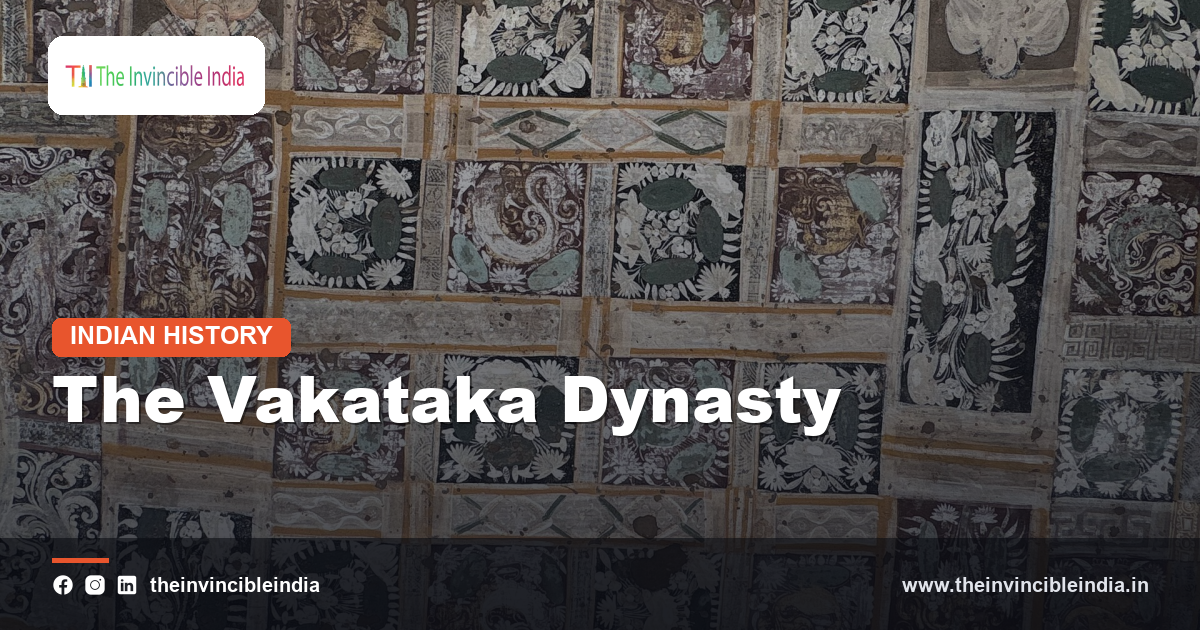
Among the most celebrated features of the Ajanta Caves are their surviving mural paintings, created during the Vakataka period, which depict scenes from the life of the Buddha, Jataka tales and courtly life with a sophistication of colour, composition and expression rarely equalled elsewhere in ancient art. These paintings offer valuable insight into the aesthetic sensibilities, dress and daily life of the period, preserved in remarkable detail on the cave walls and ceilings. Their survival across so many centuries is considered extraordinary. These murals at Ajanta, created under the favourable conditions of Vakataka-era patronage, are regarded as among the finest surviving examples of ancient Indian painting, and their influence can be traced in later artistic traditions across South and Southeast Asia.
Sanskrit Literature and Learning
The Vakataka court is remembered as a centre of Sanskrit learning and literary activity, with royal patronage extended to poets, scholars and religious teachers who contributed to the intellectual life of the kingdom. Inscriptions from the period, composed in polished Sanskrit, reflect the linguistic and literary sophistication cultivated at the Vakataka court, offering historians valuable information about the dynasty’s genealogy, achievements and religious donations. This literary culture paralleled similar developments at the Gupta court. This tradition of Sanskrit learning at the Vakataka court, closely paralleling the literary flowering associated with the contemporary Gupta age, situates the dynasty firmly within the broader classical culture of the period and underscores its contribution to the intellectual life of ancient India.
Trade and Economy
The Vakataka kingdom benefited from its position along trade routes connecting the Deccan plateau to both the northern plains and the western coast, facilitating the exchange of goods, ideas and artisans that supported the dynasty’s prosperity. Agricultural production, supplemented by craft industries and regional commerce, provided the economic foundation for the kingdom’s administration and its extensive religious and artistic patronage. Merchants and guilds are recorded as contributors to religious endowments of the period. This economic activity within the Vakataka kingdom, sustained by trade and agriculture across the Deccan, underpinned the prosperity that allowed the dynasty to support the ambitious artistic and religious projects for which the era is now remembered.
Art and Sculpture Beyond Ajanta
While Ajanta remains the most famous artistic legacy of the Vakataka period, the dynasty’s patronage extended to sculpture and architecture at other sites across its territory, reflecting a broader cultural flowering that was not confined to a single location. Stone carving, temple construction and other forms of religious art developed during this period drew on shared artistic conventions of the age, contributing to the wider visual culture of classical Deccan India. These lesser-known sites complement the fame of Ajanta. This wider artistic production under Vakataka patronage, extending beyond the renowned caves of Ajanta, complements and enriches the picture of a dynasty whose cultural achievements spanned multiple forms of religious and courtly art across its territory.
Relations with Neighbouring Powers
Beyond its alliance with the Gupta Empire, the Vakataka dynasty maintained relations, sometimes cooperative and at other times competitive, with various neighbouring kingdoms and regional powers across the Deccan and central India. These relations shaped the shifting boundaries of Vakataka territory over the course of the dynasty’s history, as rulers balanced diplomacy and military readiness to protect their interests. Regional politics of the period were marked by a shifting patchwork of allegiances. This web of regional relationships surrounding the Vakataka kingdom illustrates the complex political environment of classical India, in which even a stable and prosperous dynasty had to navigate constantly changing relationships with the powers that bordered its territory.
Decline of the Dynasty
In time, the Vakataka dynasty entered a period of decline, as the two branches of the ruling family gradually lost strength and cohesion amid changing regional political conditions across the Deccan. The precise circumstances of this decline are recorded unevenly in surviving sources, but the general pattern of weakening central authority followed by the rise of successor powers is consistent with broader trends in the political history of ancient India. New regional dynasties would later rise to prominence in the Deccan. This decline of Vakataka power, unfolding gradually across its two branches, brought an end to a notable chapter of Deccan history even as the cultural achievements of the era continued to be admired long afterward.
Legacy in Deccan History
The legacy of the Vakataka dynasty endures chiefly through its contribution to art, religion and literature, achievements that outlasted its political power by many centuries and continue to shape the study of ancient Indian civilisation. Historians view the Vakataka period as an important complement to the better-known Gupta age, illustrating that cultural brilliance during this era was not confined to the northern plains alone. The dynasty’s patronage helped establish artistic conventions that later traditions would build upon. This legacy of the Vakataka dynasty in Deccan history secures its place as one of the significant cultural powers of classical India, remembered for sustaining a golden age of art and learning alongside its northern Gupta contemporaries.
The Vakataka Dynasty Today
Today the Vakataka dynasty is remembered chiefly through the surviving splendour of the Ajanta Caves, whose paintings and carvings continue to be studied, restored and admired by scholars, artists and visitors from around the world as one of the outstanding achievements of ancient Indian art. The dynasty’s association with the Gupta Empire and its contribution to Sanskrit learning further enrich its historical significance. Its cultural achievements remain a touchstone for the classical age. As a Deccan power remembered for political stability, close ties to the Gupta Empire, and an extraordinary artistic legacy centred on Ajanta, the Vakataka dynasty endures as an essential chapter in the story of classical Indian civilisation.
Sources & Further Reading
- Archaeological Survey of India, on the Ajanta Caves (asi.nic.in).
- Ministry of Culture, Government of India (indiaculture.gov.in).
Frequently Asked Questions
What was the Vakataka dynasty known for?
The Vakataka dynasty, a leading power of the classical-age Deccan, is best known for its political stability, its marriage alliance with the Gupta Empire, and its patronage of the celebrated painted caves at Ajanta.
How were the Vakatakas connected to the Gupta Empire?
The Vakataka and Gupta dynasties were linked by a notable marriage alliance between their royal houses, which fostered friendly relations between the Deccan-based Vakatakas and the great imperial power of northern India.
What is the connection between the Vakataka dynasty and Ajanta?
Many of the finest caves and mural paintings at Ajanta were created during the Vakataka period, sponsored by rulers, officials and merchants within Vakataka territory under conditions of stability the dynasty helped sustain.
Why did the Vakataka dynasty divide into two branches?
As the ruling family expanded, the Vakataka line divided into two related branches, each governing from its own capital, a common pattern among ancient Indian dynasties as kingdoms grew across generations.
Why is the Vakataka period historically significant?
The Vakataka period is significant for demonstrating that the cultural brilliance of the classical age extended beyond the Gupta north into the Deccan, producing enduring achievements in art, religion and Sanskrit learning.


