

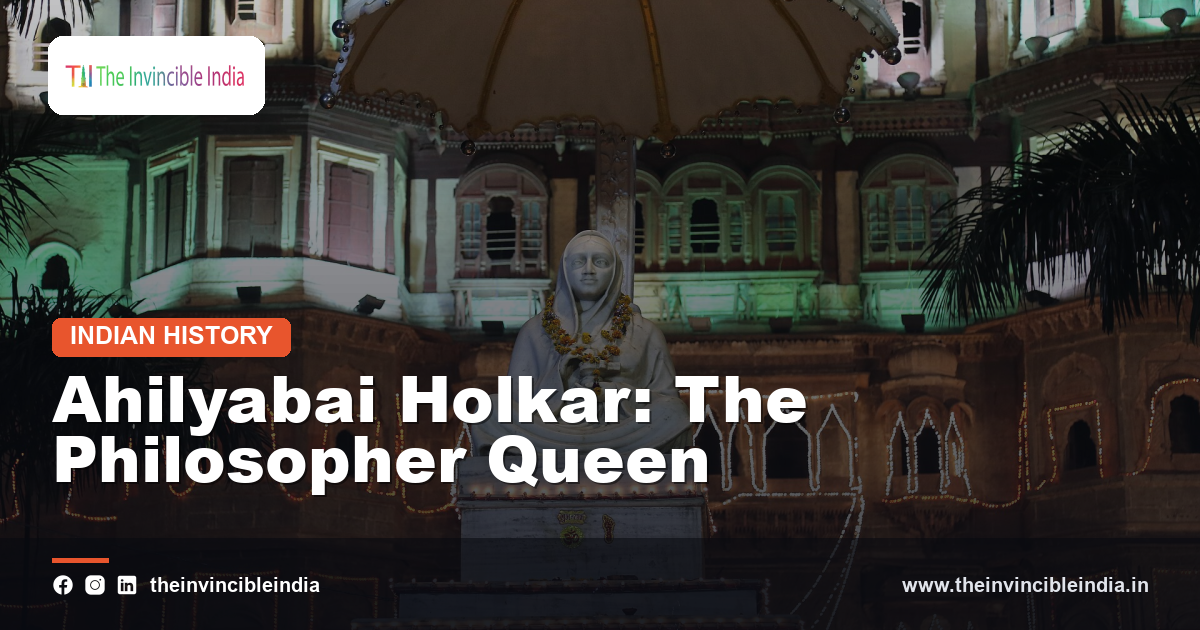
Among the many regional rulers who emerged from the wider Maratha empire, few are remembered with as much affection as Ahilyabai Holkar, the queen of the Holkar state of Malwa whose reign is still recalled as a model of just and compassionate governance. Rising to authority after a series of personal losses within the ruling family, she took direct charge of the state at a time when many expected power to pass quickly into other hands, and instead built a long and stable administration admired well beyond her own territory. Her legacy rests less on military conquest than on temple building, support for trade and craft, and a lasting reputation for personally accessible justice. This guide surveys her life, her approach to rule, and the legacy she left behind.
Quick Facts
| Detail | Information |
|---|---|
| Region | Malwa, centered on present-day Madhya Pradesh |
| Approximate Period | 18th century |
| Dynasty | Holkar dynasty of the Maratha confederacy |
| Capital | Maheshwar, on the banks of the Narmada river |
| Known For | Welfare-oriented governance and extensive temple patronage |
| Legacy | Temples, ghats, and rest houses built across the Indian subcontinent |
Early Life and Family Background
Ahilyabai Holkar was born into a modest family in the Maratha heartland and, according to long-standing tradition, was noted for her devout and thoughtful character even as a young girl. She was married into the Holkar family, a prominent Maratha noble house that held growing authority over the Malwa region under the wider umbrella of the Maratha confederacy. As a young member of a powerful military household, she would have observed at close hand the demands of statecraft, revenue administration, and the constant campaigning that defined Maratha political life in this period. Her early years gave little outward indication of the extensive authority she would later wield, yet they placed her at the center of a family whose fortunes were closely bound to the fate of Malwa. This formative period shaped the values of duty and piety that would come to define her later rule.
Marriage into the Holkar Household
Marriage brought Ahilyabai into a household defined by military service to the wider Maratha confederacy, with the Holkar family holding responsibility for territory and revenue across Malwa on behalf of the larger Maratha polity. Within this household she was gradually exposed to matters of administration, charitable endowment, and religious patronage that were already part of Holkar family practice. Contemporary and later accounts describe her as an attentive and capable presence within the family even before she assumed direct authority, contributing to decisions on charitable works and estate management. The Holkar court, like other Maratha noble households of the era, balanced military obligation with religious and civic responsibility, and Ahilyabai absorbed both dimensions of this tradition. This grounding in household administration proved essential when she was later called upon to govern in her own right.
Family Tragedies and the Path to Regency
A series of untimely deaths within the ruling Holkar family left the state of Malwa without an obvious adult male successor capable of governing at a critical moment, and Ahilyabai stepped into this vacuum with notable resolve. Rather than allow the state to pass into instability or outside control, she petitioned for the right to administer Malwa’s affairs directly, a request that reflected both her personal standing and the trust she had built within the household and its wider network of advisors and commanders. Her assumption of authority came during a period when female rulers were uncommon in Maratha political life, making her position a notable departure from prevailing expectation. She approached this responsibility not as a temporary caretaker but as a committed ruler intent on securing the long-term welfare of her subjects. This transition marked the beginning of one of the most distinctive reigns in eighteenth-century India.
Assuming Direct Rule of Malwa
Once installed as ruler, Ahilyabai governed Malwa directly for an extended period, overseeing revenue collection, justice, and public works with a hands-on approach that became a defining feature of her reign. She retained loyal military commanders to manage defense and frontier security while she herself focused on civil administration, charitable works, and the daily needs of her subjects. Her rule is remembered as notably stable in comparison to the frequent upheavals that characterized many contemporary regional courts, a stability attributed to her careful, consultative style of governance. She is also described as personally frugal, directing state resources toward public welfare rather than courtly display. This combination of administrative diligence and personal restraint earned her lasting respect among both contemporaries and later generations of historians.
A Distinctive Philosophy of Governance
Ahilyabai’s approach to governance emphasized direct accessibility to her subjects, with tradition holding that she made herself available to hear petitions and grievances from ordinary people rather than relying solely on intermediaries. This emphasis on approachable rule reflected a broader philosophy in which the welfare of cultivators, artisans, and traders was treated as a central responsibility of the state rather than a secondary concern. She is remembered for favoring measured, deliberate decision-making over impulsive action, weighing the interests of her subjects carefully before acting on matters of taxation or public works. Her reputation as a fair and even-handed administrator extended well beyond Malwa, drawing attention from neighboring courts and travelers who passed through her territory. This philosophy of service-oriented rule remains the central theme of her enduring historical reputation.
Maheshwar: Capital on the Narmada
Ahilyabai chose Maheshwar, a town on the banks of the sacred Narmada river, as her capital and center of administration, transforming it into a hub of governance, craft, and religious life. The riverside fort and palace complex she developed there served as both a seat of government and a residence reflecting her personal simplicity rather than ostentatious display. Maheshwar’s location along the Narmada connected it to important routes of trade and pilgrimage, allowing the town to grow in both commercial and religious significance during her rule. Ghats built along the riverfront provided facilities for bathing and ritual observance, reinforcing the town’s standing as a center of devotional life. Today, Maheshwar’s fort and riverfront remain closely associated with her memory and continue to attract visitors interested in her legacy.
Temple Building Across the Subcontinent
One of the most remarkable aspects of Ahilyabai’s rule was the sheer geographic reach of her temple-building and restoration projects, which extended far beyond her own territory to sacred sites across much of the Indian subcontinent. She funded the construction or renovation of temples, shrines, and associated structures at numerous pilgrimage centers, reflecting both personal devotion and a broader vision of public religious welfare. This patronage was not confined to any single sect or region, encompassing sites sacred to a wide range of devotional traditions across India. Such extensive, cross-regional patronage was unusual for a ruler whose direct political authority was limited to a single state, underscoring the scale of her personal commitment to religious welfare. This legacy of temple building remains among the most visible and enduring aspects of her historical memory.
Support for Pilgrims and Travelers
Beyond temple construction, Ahilyabai funded the establishment of rest houses, wells, and other facilities intended to support pilgrims and travelers moving along major routes across the subcontinent. These works reflected a practical understanding of the hardships faced by ordinary devotees undertaking long journeys to sacred sites, often on foot and with limited resources. By investing in infrastructure that eased these journeys, she extended the benefits of her rule to people who would never live under her direct administration. This pattern of infrastructure-focused charity distinguished her patronage from purely ceremonial religious giving, grounding it instead in tangible public benefit. Such projects reinforced her broader reputation as a ruler concerned with the practical welfare of ordinary people, wherever they might live.
Ghats, Wells, and Public Infrastructure
Within her own territory and beyond, Ahilyabai sponsored the construction of bathing ghats, stepwells, and other civic infrastructure designed to serve everyday needs alongside religious observance. These projects addressed practical concerns such as reliable access to water, a matter of considerable importance in the semi-arid stretches of central India, while also enhancing the dignity and function of sacred riverfronts and tanks. Her attention to such infrastructure reflects a governance style that valued sustained public benefit over short-term display, favoring durable stone construction intended to serve communities for generations. Many of these structures were built using skilled local labor, providing employment and supporting craft traditions in the process. This emphasis on durable civic works remains a distinctive feature of her broader development philosophy.
Economic Policy and Patronage of Trade
Ahilyabai’s administration paid close attention to the economic wellbeing of cultivators, artisans, and traders, recognizing that a prosperous population was essential to the long-term stability of her state. She is remembered for policies that sought to ease the burden of taxation on farmers, particularly during periods of hardship, and for actively encouraging craft production within her territory. Trade along routes passing through Malwa benefited from the security and stability her rule provided, encouraging merchants to travel and conduct business with greater confidence. This attentiveness to economic conditions reflected a broader understanding that sustainable governance depended on the prosperity of ordinary subjects rather than short-term extraction of revenue. Her economic policies contributed to a period of relative stability and modest prosperity within Malwa during her reign.
The Maheshwari Textile Tradition
Among Ahilyabai’s most enduring contributions to Indian craft is her association with the development of the Maheshwari textile tradition, a distinctive style of handwoven cotton and silk sarees produced in and around her capital. She is credited with encouraging skilled weavers to settle in Maheshwar and supporting the refinement of designs that combined local motifs with elegant, understated patterns. This royal patronage helped establish Maheshwar as a recognized center of textile craftsmanship, a reputation that has persisted for generations after her rule. The tradition of Maheshwari weaving continues to be practiced today, sustaining livelihoods for artisan communities in the region. Her role in nurturing this craft tradition illustrates the broader pattern of her patronage, which combined practical economic support with lasting cultural contribution.
An Accessible Approach to Justice
Ahilyabai is remembered in tradition for personally hearing petitions and disputes brought by her subjects, an approach to justice that emphasized direct accountability between ruler and ruled. This accessibility stood in contrast to more distant or heavily bureaucratic models of justice common in other contemporary courts, and it contributed significantly to her reputation for fairness. Disputes over land, water rights, and local grievances were addressed with attention to the specific circumstances of those involved, rather than through rigid or impersonal application of rule. This personal engagement with justice reinforced trust between the ruler and her subjects, an asset that supported the broader stability of her administration. Her reputation for even-handed judgment remains one of the central pillars of her historical memory.
Military Organization and Defense
While Ahilyabai focused much of her personal attention on civil administration and charitable works, she relied on capable military commanders to maintain the defense and security of Malwa within the wider context of Maratha confederate politics. Her state maintained sufficient military strength to protect its territory and interests amid the shifting alliances and rivalries that characterized eighteenth-century India. This division of responsibility, in which trusted commanders handled military affairs while she concentrated on governance and welfare, allowed her administration to function effectively across multiple domains simultaneously. Her ability to secure loyal and competent military leadership speaks to the trust and respect she commanded within her court. This balanced approach to security and civil governance contributed to the notable stability of her long reign.
Standing Within the Wider Maratha Confederacy
As ruler of Malwa, Ahilyabai occupied an important position within the broader Maratha confederacy, a loose network of allied and sometimes rival states that together exercised considerable influence across much of the Indian subcontinent during this period. Her relations with other Maratha courts combined cooperation on shared interests with the careful, independent management of her own state’s affairs. She maintained Malwa’s standing and reputation within this wider political landscape without becoming entangled in every rivalry or conflict that affected neighboring courts. This careful navigation of confederate politics allowed her to preserve stability at home while remaining a respected figure within the broader Maratha world. Her reputation for wisdom and fairness extended her influence well beyond the borders of her own territory.
Personal Simplicity and Devotion
Accounts of Ahilyabai’s personal life consistently emphasize her simplicity, piety, and disciplined daily routine, traits that stood in contrast to the courtly display common among many contemporary rulers. She is remembered as deeply devoted to religious observance, a devotion that informed both her personal conduct and her extensive patronage of temples and pilgrimage sites. Rather than accumulating personal wealth or luxury, she is described as directing state resources toward public welfare and religious endowment, reflecting a governing philosophy rooted in service rather than self-interest. This personal restraint reinforced the moral authority she commanded among her subjects and contemporaries alike. Her disciplined and devout character remains a central element of the reverence with which she continues to be remembered.
Ahilyabai Holkar in Historical Memory
In the generations following her death, Ahilyabai Holkar came to be remembered as an exemplary ruler, frequently cited as a model of just and welfare-oriented governance by later commentators and historians. Her reputation transcended regional and sectarian boundaries, in part because her temple patronage and infrastructure projects touched communities across a wide geographic area rather than being confined to a single region or tradition. She is often described using titles that reflect her esteemed status, evoking both her wisdom and her devotion to public service. This broad-based reverence distinguishes her from many contemporary rulers whose memory remained largely confined to their own territories. Her enduring reputation continues to inform popular and scholarly understanding of just rule in pre-modern India.
Ahilyabai Holkar Today
Today, Ahilyabai Holkar is remembered across India through the temples, ghats, and rest houses she funded, many of which remain in active use at pilgrimage sites throughout the subcontinent. Her capital at Maheshwar continues to draw visitors interested in her legacy, its riverside fort and ghats standing as a tangible reminder of her rule. The Maheshwari textile tradition she helped establish continues to provide livelihoods for weaving communities, linking her patronage to a living craft practice. Institutions, streets, and public works named in her honor across India reflect the breadth of her continuing reputation as a model administrator. She remains a widely cited example of compassionate, service-oriented governance within the broader narrative of Indian history.
Sources & Further Reading
- Ministry of Culture, Government of India (indiaculture.gov.in).
- Archaeological Survey of India (asi.nic.in).
Frequently Asked Questions
Who was Ahilyabai Holkar?
Ahilyabai Holkar was an eighteenth-century queen of the Holkar state of Malwa, remembered for her welfare-oriented governance, extensive temple patronage, and reputation for accessible justice.
Where did Ahilyabai Holkar rule from?
She ruled from Maheshwar, a town on the banks of the Narmada river, which she developed into a center of administration, craft, and religious life.
What is Ahilyabai Holkar best known for?
She is best known for funding temples, rest houses, and ghats at pilgrimage sites across the Indian subcontinent, and for a governance style that emphasized public welfare and personal accessibility.
What craft tradition is associated with Ahilyabai Holkar?
She is closely associated with the Maheshwari textile tradition, a style of handwoven saree that developed under her patronage in and around her capital.
Why is Ahilyabai Holkar called a philosopher queen?
The title reflects her reputation for thoughtful, deliberate, and service-oriented governance, in which the welfare of her subjects was treated as the central purpose of rule.


