

Few rulers occupy as central a place in the story of ancient India as Samudragupta, whose reign is closely associated with the flourishing of the Gupta empire into one of the most celebrated states of the ancient world. Inheriting a kingdom already established by his predecessors, he is remembered for a series of far-reaching campaigns that extended Gupta influence across large parts of the subcontinent, combined with active support for literature, music, and coinage. Much of what is known about his reign comes from a single remarkable inscription carved on an ancient pillar, which records his achievements in vivid, if celebratory, detail. This guide surveys his rise, his campaigns, his cultural patronage, and his lasting legacy within Indian history.
Quick Facts
| Detail | Information |
|---|---|
| Dynasty | Gupta dynasty |
| Approximate Period | 4th century CE |
| Capital | Pataliputra |
| Known For | Extensive military campaigns and patronage of arts and coinage |
| Key Source | The Allahabad pillar inscription (Prayag Prashasti) |
| Legacy | Often regarded as an architect of the Gupta era’s cultural flourishing |
Accession Within the Gupta Line
Samudragupta came to the Gupta throne as part of a dynasty already gaining prominence across the Gangetic plain, inheriting both territory and administrative structures built by his predecessors. His accession is recorded in later Gupta inscriptions as a deliberate and celebrated succession, reflecting confidence in his capabilities from within the royal court. Rather than governing a newly formed state, he assumed leadership of an already functioning kingdom with established institutions, giving him a foundation from which to pursue further expansion. This context is important for understanding his subsequent achievements, which built upon rather than created Gupta political structures from scratch. His accession marks the beginning of a reign remembered as one of the most consequential in the dynasty’s history.
The Gupta Dynasty Before Samudragupta
Before Samudragupta’s reign, the Gupta dynasty had already established a base of power in the Gangetic heartland, building alliances and consolidating territory through the efforts of earlier rulers. This foundation provided the administrative and military resources that would later support wider Gupta expansion under Samudragupta’s leadership. The dynasty’s early rulers are credited with securing a stable core territory and establishing the dynastic legitimacy that later inscriptions would celebrate at length. Understanding this earlier period helps explain how Samudragupta was able to launch ambitious campaigns so effectively, drawing on institutions and resources already in place. His reign therefore represents both continuity with earlier Gupta consolidation and a marked acceleration of the dynasty’s territorial ambitions.
Consolidation of the Gangetic Heartland
Early in his reign, Samudragupta focused on securing firm control over the fertile Gangetic heartland, the agricultural and demographic core of Gupta power. Inscriptions describe the defeat or subordination of several rulers within this core region, consolidating a base from which further campaigns could later be launched. This heartland provided the agrarian wealth and manpower that sustained Gupta military and administrative ambitions throughout his reign. Securing this core territory before pursuing more distant campaigns reflects a coherent strategic approach to empire-building, prioritizing stability at the center before projecting power outward. This consolidation phase laid the essential groundwork for the far more extensive campaigns associated with the later part of his reign.
Campaigns Against Northern Rulers
Beyond the immediate Gangetic core, Samudragupta is recorded as having defeated and absorbed the territories of several other rulers across northern India, extending direct Gupta administration over a considerably larger area. These campaigns are described in inscriptions as methodical and largely successful, reflecting the military strength and organizational capacity of the Gupta state at this stage. Defeated northern rulers were generally not restored to power but had their territories incorporated directly into the expanding Gupta domain, a distinct approach compared to his treatment of more distant regions. This pattern of direct annexation in the north created a substantial, contiguous imperial territory at the heart of the subcontinent. These campaigns represent a central pillar of Samudragupta’s reputation as a formidable military leader.
Subjugation of Forest and Frontier Chiefs
Inscriptions associated with Samudragupta’s reign also describe the subjugation of numerous forest and frontier chieftains, rulers of smaller polities along the margins of the Gangetic plain whose territories were brought under Gupta overlordship. These campaigns extended Gupta influence into more remote and less centrally administered regions, securing frontiers against potential threats and expanding the reach of imperial authority. Rather than direct annexation, many of these frontier rulers appear to have been permitted to retain local authority in exchange for acknowledging Gupta supremacy and providing tribute. This approach allowed the empire to extend its influence efficiently without the administrative burden of governing every distant territory directly. The subjugation of these frontier polities reflects the wide-ranging scope of Samudragupta’s military and diplomatic reach.
Campaigns Into the Deccan and South
Perhaps the most striking aspect of Samudragupta’s military record is the account of a long campaign into the Deccan and further south, in which numerous regional rulers are recorded as having been defeated before being reinstated under Gupta overlordship. Unlike his treatment of northern rulers, southern kings were generally restored to their thrones after submission, required only to acknowledge Gupta supremacy and provide tribute rather than face direct annexation. This distinction suggests a deliberate strategy suited to the practical challenges of governing distant territory across such considerable range from the Gangetic core. The scale of this campaign, as described in later inscriptions, illustrates the extensive reach of Gupta military power during this period. This southern expedition remains one of the most remarkable episodes associated with his reign.
A Calculated Policy Toward Defeated Rulers
Samudragupta’s treatment of defeated rulers reveals a calculated and pragmatic approach to empire-building, distinguishing between territories suited to direct administration and those better managed through indirect overlordship. Rulers in the northern heartland were typically removed and their territories absorbed directly, while more distant southern kings were often reinstated as tributary allies after their defeat. This flexible policy allowed the Gupta state to extend influence across a vast area without overstretching its administrative capacity. Such an approach also reflects an awareness of the practical limits of direct control across such geographically diverse and distant regions. This nuanced policy toward defeated rulers is often cited as evidence of considerable strategic sophistication on the part of Samudragupta and his advisors.
Diplomatic Relations with Distant Kingdoms
Beyond outright conquest, inscriptions associated with Samudragupta’s reign describe diplomatic relationships with distant kingdoms and rulers, including some located well beyond the subcontinent’s borders, who are said to have sent tribute or established friendly relations. Such references suggest that Gupta prestige and influence extended through diplomacy as well as military campaigning, reflecting a broader network of contact across South and Southeast Asia during this period. These relationships, whether formal alliances or looser gestures of goodwill, contributed to the overall picture of Samudragupta as a ruler whose influence reached considerably further than his directly administered territory. Diplomatic contact of this kind also facilitated trade and cultural exchange across a wide geographic area. This combination of military and diplomatic reach underscores the scale of Gupta influence during his reign.
The Allahabad Pillar Inscription
Much of what is known today about Samudragupta’s reign derives from a lengthy inscription carved onto an ancient pillar at Allahabad, composed in ornate Sanskrit and attributed to a court poet closely associated with the emperor. Known to scholars as the Prayag Prashasti, this inscription catalogs his military campaigns, diplomatic relationships, and personal qualities in celebratory language typical of royal eulogies from the period. While such inscriptions naturally emphasize the ruler’s achievements in favorable terms, the pillar remains an invaluable primary source for reconstructing the political geography and military history of his reign. Its detailed listing of defeated and allied rulers offers historians a rare, if selectively framed, window into fourth-century Indian politics. The inscription stands today as one of the most important epigraphic sources for ancient Indian history.
Administering an Expanding Empire
Governing the greatly expanded territory that resulted from his campaigns required Samudragupta and his administration to develop flexible systems combining direct rule in the core region with tributary relationships on the periphery. Provincial governors and local officials managed day-to-day administration within directly controlled territory, while tributary rulers retained local authority in exchange for acknowledging Gupta overlordship. This layered structure allowed the empire to function across a vast and diverse territory without requiring uniform centralized control from the capital. Revenue in the form of tribute and taxation supported the court, its military establishment, and its considerable cultural patronage. This administrative flexibility helped sustain the stability and prosperity for which the broader Gupta era is remembered.
Patronage of Sanskrit Literature and Learning
Samudragupta’s court is remembered as a center of considerable literary activity, with Sanskrit poetry and scholarship flourishing under royal encouragement during his reign. The very inscription that records his military achievements is itself a work of accomplished Sanskrit court poetry, illustrating the high literary standards cultivated within his administration. This patronage of learning helped establish patterns of royal support for literature and scholarship that would continue and expand under his successors, contributing to the broader cultural flourishing associated with the Gupta era. Support for Sanskrit learning also reinforced the prestige of the royal court, linking political power to cultural and intellectual achievement. This literary patronage forms an important complement to his military reputation.
Skill and Patronage in Music
Beyond literature, Samudragupta is remembered in tradition and inscription for a personal interest in music, with some sources describing him as accomplished in playing a stringed instrument himself. This personal engagement with the arts, rather than mere patronage from a distance, reflects the multifaceted image of the ideal ruler cultivated at the Gupta court, combining martial prowess with cultural refinement. Coins issued during his reign depicting musical performance reinforce this association, suggesting that his interest in music was considered a notable and publicly celebrated aspect of his character. This blending of military achievement with cultural accomplishment contributed to an idealized image of kingship that later Gupta rulers would continue to project. His reputation for cultural refinement remains a distinctive element of his historical memory.
Gupta Coinage Under Samudragupta
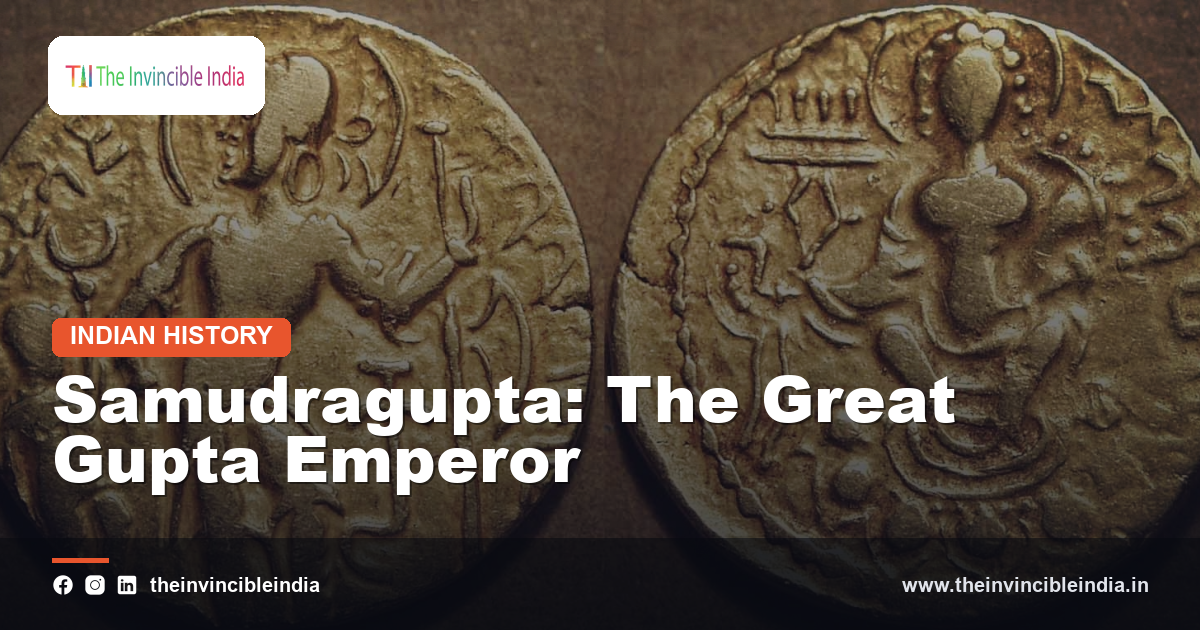
Coins issued during Samudragupta’s reign are notable for their variety and artistic quality, depicting the emperor in a range of poses including as an archer, a musician, and a performer of ritual sacrifice. These varied coin types served both economic and propagandistic purposes, circulating images of royal power, cultural accomplishment, and religious legitimacy throughout the empire. The high quality of Gupta coinage from this period reflects the wealth and technical skill available to the imperial mint, supported by the resources generated through conquest and administration. Such coinage provides valuable evidence for historians seeking to understand both the economic organization and the self-presentation of Gupta kingship. This numismatic legacy remains an important source for reconstructing the visual and ideological world of his reign.
Religious Outlook and Patronage
Samudragupta’s religious patronage reflected the broader Gupta pattern of supporting Brahmanical traditions while also maintaining a generally tolerant stance toward other faiths present within the empire. Inscriptions describe the performance of traditional royal rituals associated with Vedic kingship, reinforcing his legitimacy within established religious and political frameworks. At the same time, evidence suggests that other religious communities, including Buddhist institutions, continued to receive support and protection within Gupta territory during this period. This combination of personal religious observance and broader tolerance contributed to social stability across a diverse and expanding empire. His religious policy set a pattern that later Gupta rulers would largely continue to follow.
Legacy for Later Gupta Rulers
The territorial gains and administrative foundations established during Samudragupta’s reign provided the platform on which later Gupta rulers built the period often described as India’s classical golden age. His successors inherited not only an expanded territory but also the diplomatic relationships and administrative practices developed during his campaigns. The image of an ideal ruler combining military prowess, cultural refinement, and religious legitimacy that emerged during his reign continued to shape Gupta royal ideology for generations. Later achievements in science, literature, and art during the Gupta period owe much to the political stability and resources secured under his leadership. His reign is therefore often regarded as a crucial turning point in the dynasty’s rise to prominence.
Samudragupta Today
Today, Samudragupta is remembered as one of ancient India’s most accomplished rulers, his reign studied through the lens of the Allahabad pillar inscription and the coinage that survives from his court. Historians continue to examine his campaigns and administrative policies as a case study in the strategic combination of direct rule and tributary diplomacy across a vast and diverse territory. His association with music and literary patronage adds a distinctive cultural dimension to his historical reputation, complementing accounts of his military achievements. The pillar inscription itself remains a celebrated artifact of ancient Indian epigraphy, studied by scholars of history, language, and literature alike. Samudragupta’s legacy continues to inform broader understanding of the Gupta era’s political and cultural achievements.
Sources & Further Reading
- Archaeological Survey of India (asi.nic.in).
- Ministry of Culture, Government of India (indiaculture.gov.in).
Frequently Asked Questions
Who was Samudragupta?
Samudragupta was a fourth-century emperor of the Gupta dynasty, remembered for extensive military campaigns across the subcontinent and for his patronage of literature, music, and coinage.
What is Samudragupta best known for?
He is best known for wide-ranging military campaigns recorded in the Allahabad pillar inscription, as well as for his personal interest in music and support for Sanskrit learning.
What is the Allahabad pillar inscription?
It is a lengthy Sanskrit inscription, known as the Prayag Prashasti, carved on an ancient pillar, recording Samudragupta’s military campaigns, diplomatic ties, and personal accomplishments.
How did Samudragupta treat defeated southern rulers?
Unlike northern rulers whose territories were often annexed directly, defeated southern kings were generally reinstated as tributary allies who acknowledged Gupta overlordship.
Why is Samudragupta's reign considered significant?
His reign expanded Gupta territory and influence considerably, laying the political and cultural foundations for the era often described as ancient India’s classical golden age.


