

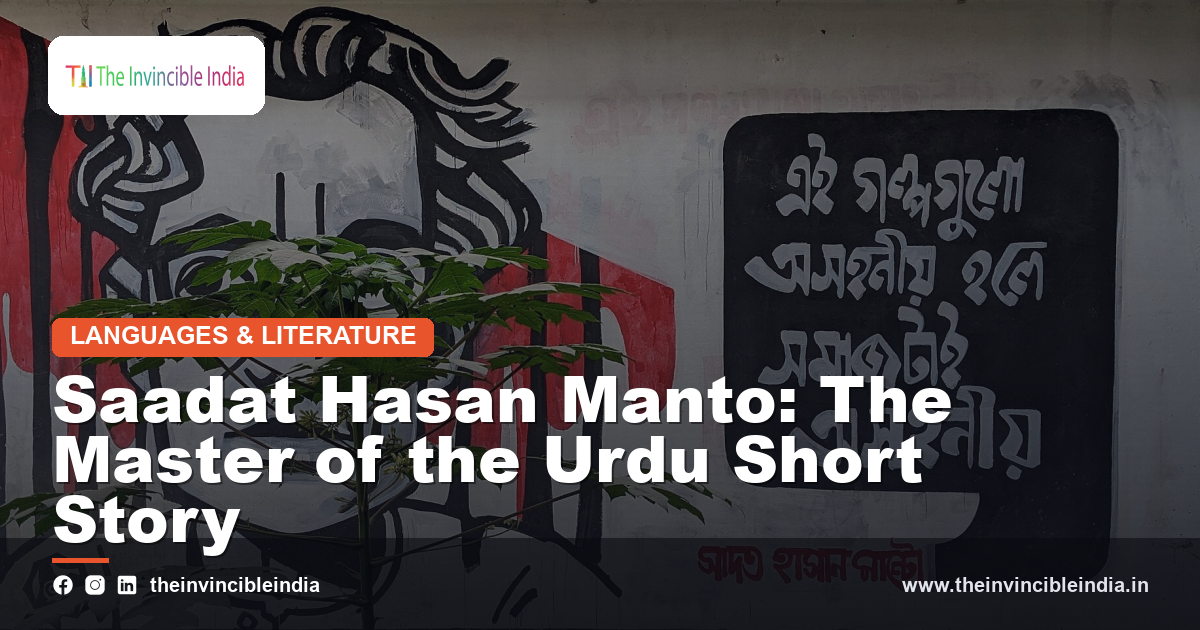
Saadat Hasan Manto stands among the most celebrated short story writers in the history of Urdu literature, a chronicler of ordinary lives caught amid extraordinary social upheaval. Writing within the broader tradition explored in this guide to Urdu literature, Manto built a career first in Bombay’s literary and film circles and later in Lahore, following his migration after the partition of India. His spare, unsentimental prose confronted subjects that many contemporaries approached cautiously, from the trauma of Partition to the lives of society’s marginalised, and it repeatedly drew him into public controversy and legal challenge. Decades after his death, Manto remains widely read, translated and taught across India and Pakistan, remembered as a writer whose fearless honesty continues to resonate with readers today.
Quick Facts
| Detail | Information |
|---|---|
| Literary Language | Urdu |
| Primary Forms | Short story, essays, radio plays |
| Literary Circle | Associated with the Progressive Writers’ Movement |
| Best-Known Story | Toba Tek Singh |
| Key Themes | Partition, social realism, marginalised lives |
| Later Life | Settled in Lahore after Partition |
Early Life and Background
Saadat Hasan Manto is remembered as one of the most significant short story writers in the Urdu language, a literary figure whose work continues to be read and studied across South Asia and beyond. Born into a Kashmiri family settled in Punjab in the early twentieth century, Manto grew up in a period of considerable social and political change across colonial India, an environment that would come to shape much of his later writing.
His early education exposed him to a range of literary influences, including translations of European and Russian writers, which broadened his sense of what short fiction could achieve. Even before establishing himself as a major literary figure, Manto displayed an interest in social observation and an unflinching curiosity about the lives of ordinary people, qualities that would define his mature work.
Entry into Urdu Literature
Manto began his literary career translating works from other languages into Urdu before turning increasingly to his own short fiction, a transition that allowed him to absorb narrative techniques from a range of literary traditions. His early stories quickly attracted attention for their directness and their willingness to address subjects that many contemporary Urdu writers approached more cautiously.
Over the course of his career, Manto became closely associated with the Progressive Writers’ Movement, a broader literary current in Urdu and other Indian languages emphasising social realism, although his relationship with organised literary movements was often independent and at times contentious. He wrote prolifically for decades, producing a large body of short stories alongside essays, radio plays and film-related writing.
Manto's Distinctive Literary Style
What set Manto apart from many of his contemporaries was a spare, direct prose style that avoided ornate language in favour of clarity and psychological precision. His stories often unfold with an economy of description, focusing tightly on character and incident rather than elaborate scene-setting, a technique that lends his fiction a sense of immediacy and urgency.
Manto frequently employed irony and understatement, allowing the implications of a story to emerge through action and dialogue rather than explicit authorial commentary. Critics and readers have long noted that this combination of stylistic economy and moral seriousness gives Manto’s short stories a lasting power, allowing them to be read as enduring explorations of human behaviour under extreme circumstances.
Bombay, Cinema and the Literary World
Before and during his most productive literary years, Manto spent significant time in Bombay, then a major centre of Urdu publishing, journalism and the Hindi-Urdu film industry. He worked in various capacities connected to cinema, an experience that brought him into contact with actors, directors and fellow writers and exposed him closely to the social world of the film industry.
This period placed Manto at the heart of a vibrant and cosmopolitan cultural milieu, one that mixed literary, journalistic and cinematic circles and provided rich material for his observational fiction. His time in the city sharpened his interest in the lives of people often overlooked by mainstream literature, and this Bombay period is widely regarded as formative for his development as a writer.
Migration and the Experience of Partition
The partition of India in 1947 marked a profound turning point in Manto’s life, as it did for millions of others across the subcontinent, prompting him eventually to relocate from Bombay to Lahore in the newly created Pakistan. This migration was, by most accounts, a deeply unsettling experience for Manto, who had built his literary career and social world in Bombay and who struggled with the disruption that accompanied the move.
The upheaval of Partition, with its widespread violence and displacement, left a lasting impression on Manto and became one of the central preoccupations of his later work. Rather than approaching this history through grand political narrative, Manto chose to focus on its human dimension, depicting the confusion and moral disorientation experienced by ordinary individuals.
'Toba Tek Singh' and Partition Literature
Among Manto’s best-known works is the short story widely known as ‘Toba Tek Singh’, which uses the setting of an exchange of inmates between mental asylums in India and Pakistan after Partition as a powerful allegory for the absurdity and human cost of the subcontinent’s division. Through the story’s central character, confused by the sudden imposition of new national boundaries, Manto captures the disorientation felt by many ordinary people during Partition.
The story is frequently cited as one of the most effective literary treatments of Partition precisely because of its indirect, almost absurdist approach. It has been widely translated, anthologised and studied, and it remains a touchstone text in discussions of Partition literature across Indian and Pakistani classrooms and academic scholarship alike.
Themes of Social Realism in Manto's Work
Manto’s fiction is closely associated with the broader current of social realism in Urdu literature, a mode of writing concerned with depicting everyday life, social inequality and human behaviour with unflinching honesty rather than idealisation. His stories frequently focus on the lives of the poor, the marginalised and the socially stigmatised, treating their experiences with a seriousness and empathy not always extended to such subjects in mainstream literature.
Rather than moralising directly, Manto typically presented situations and characters in a manner that invited readers to draw their own conclusions about the social conditions depicted, reflecting his broader conviction that literature should confront reality honestly, even when that reality was uncomfortable.
Manto's Portrayal of Women and Marginalised Lives
A recurring feature of Manto’s fiction is its attention to the lives of women, particularly those living on the margins of respectable society, including sex workers and others whose experiences were rarely given serious literary treatment by his contemporaries. Manto approached these characters with notable empathy, portraying them as complex individuals shaped by circumstance rather than reducing them to moral stereotypes.
This unflinching yet compassionate portrayal was, in its own time, considered provocative by some, even as others praised it as an important corrective to more sanitised literary depictions. This dimension of his writing continues to be a significant focus of literary and critical discussion about his broader contribution to South Asian fiction.
Controversy and Obscenity Trials
Manto’s frank treatment of sexuality and social taboos brought him into repeated conflict with the authorities, and he faced several obscenity trials over the course of his career, both before and after Partition, in relation to certain of his stories. These proceedings reflected broader tensions of the period over the boundaries of acceptable literary expression.
While such controversies caused Manto considerable personal difficulty, they have also come, with the passage of time, to be seen as evidence of his willingness to challenge social and literary conventions in pursuit of honest depiction. Later generations of readers and scholars have generally judged the stories at the centre of these controversies to be serious literary works.
Manto's Prose Style and Narrative Technique
Manto’s narrative technique frequently favours a compact structure, with stories that move quickly toward a decisive, often unsettling conclusion rather than unfolding through extended development. He made effective use of a close, almost reportorial narrative voice, which lent many of his stories a documentary quality even when their content was clearly shaped for maximum literary and emotional effect.
Dialogue in his stories tends to be sharp and naturalistic, capturing the rhythms of everyday speech among the varied social types he depicted. Manto also displayed a talent for the concise character sketch, an ability to suggest an entire personality through a few carefully chosen details, a technique frequently cited as a defining feature of his craft.
Manto's Essays and Non-Fiction Writing
Beyond his short stories, Manto produced a substantial body of essays and sketches, including reflective pieces on his own life, his contemporaries in the literary and film worlds, and the social and political events of his time. These essays are valued both for the light they shed on Manto’s own personality and for the vivid, often candid portraits they offer of figures from the circles in which he moved.
His non-fiction writing shares much of the directness and psychological insight found in his fiction. Manto also wrote extensively for radio during a period when radio drama was an important literary medium, further demonstrating his range and productivity across different forms of writing.
Life in Pakistan After Partition
After settling in Lahore following Partition, Manto continued to write prolifically, even as he faced financial difficulty and the personal strain of adjusting to life in a new country after leaving behind the literary and social world he had built in Bombay. This later period of his life produced some of his most acclaimed work, including much of his celebrated Partition-themed fiction.
Manto’s later years were marked by continued legal and social controversy connected to his writing, alongside recognition from segments of the literary community who regarded him as one of the most important Urdu writers of his generation. His relatively early death was widely felt as a significant loss to Urdu literature.
Manto's Legacy in Urdu Literature
In the decades since his death, Manto’s reputation has grown steadily, and he is now widely regarded as one of the most important short story writers in the history of Urdu literature. His unflinching engagement with difficult social realities, combined with his distinctive economical prose style, has influenced generations of subsequent Urdu writers.
Manto’s stories are widely taught in schools and universities across India and Pakistan, and his most celebrated works, particularly those dealing with Partition, are frequently cited as essential reading for understanding the human dimension of that historical event. There is broad consensus regarding his central importance to the development of the modern Urdu short story.
Translations and Manto's Global Readership
Manto’s stories have been translated extensively into English and numerous other languages, a process that has extended his readership well beyond the Urdu-speaking world and introduced his work to international audiences interested in Partition literature and South Asian fiction more broadly. These translations have helped cement Manto’s reputation as a writer of global significance.
His work is frequently included in anthologies of world literature and Partition writing. Adaptations of his life and work for stage, screen and other media have further broadened public awareness of Manto, introducing new generations of readers and viewers to his literary legacy.
Manto's Place in Indian and Pakistani Culture Today
Today, Saadat Hasan Manto occupies a central place in the literary heritage shared by India and Pakistan, remembered as a writer whose fearless engagement with uncomfortable social realities gave voice to experiences that many of his contemporaries preferred to leave unaddressed. His stories continue to be read, discussed, adapted and taught across both countries.
Contemporary readers often find in Manto’s work a striking relevance to ongoing conversations about social justice and freedom of expression. Literary festivals and publishing houses across South Asia continue to mark his contribution, ensuring that his work remains part of active literary conversation rather than being confined to historical study alone.
Sources & Further Reading
- Sahitya Akademi (sahitya-akademi.gov.in).
- National Council for Promotion of Urdu Language (urducouncil.nic.in).
Frequently Asked Questions
What is Saadat Hasan Manto best known for?
Manto is best known as a master of the Urdu short story, celebrated for his unflinching depictions of social reality, his stories about Partition, and his distinctive economical prose style.
What is Manto's most famous story?
‘Toba Tek Singh’ is widely regarded as Manto’s most famous story, using the setting of an asylum inmate exchange after Partition as a powerful allegory for the division of the subcontinent.
Why did Manto face obscenity trials?
Manto’s frank treatment of sexuality and social taboos in several of his stories led to obscenity trials both before and after Partition, reflecting broader debates of the period over the limits of literary expression.
Did Manto move to Pakistan after Partition?
Yes, Manto relocated from Bombay to Lahore following the partition of India in 1947, a migration that proved personally difficult but also shaped much of his later, celebrated writing.
Why is Manto still widely read today?
Manto remains widely read for the enduring honesty and craft of his prose, his insight into Partition and social marginalisation, and the continued relevance of the human themes his stories explore.


