

Among the reform movements that reshaped Hindu religious life in the nineteenth century, the Arya Samaj stands out for its call to return to the authority of the Vedas. Founded during a period of intense social and religious debate across colonial India, it challenged practices its founder viewed as later accretions rather than original Vedic teaching. The movement grew alongside other currents of renewal within Hinduism, sharing a broad concern with reform even as its specific emphases differed. Its founder combined scriptural scholarship with a program of social change, touching education, the status of women, and questions of caste. This overview traces its origins, core teachings, and continuing presence.
Quick Facts
| Detail | Information |
|---|---|
| Movement type | Hindu reform movement |
| Founded | 1875, Bombay |
| Founder | Swami Dayananda Saraswati |
| Core scripture | The Vedas |
| Key text | Satyarth Prakash |
| Notable work | Education, social reform, Shuddhi |
Origins and Founding
The Arya Samaj emerged in the second half of the nineteenth century, a period when many Indian thinkers were reexamining religious practice in light of both tradition and the changed circumstances of colonial rule. It was established in Bombay in 1875 by Swami Dayananda Saraswati, a wandering scholar-ascetic who had spent years studying Sanskrit texts and debating religious teachers across northern and western India. His purpose was to found a society dedicated to what he regarded as the pure teaching of the Vedas, stripped of what he saw as later ritual and social accretions. The organization spread quickly, particularly in Punjab and parts of northern India, where it found a receptive audience among communities open to reform. From its earliest days, the Samaj combined religious teaching with practical activity in education and social welfare, a pairing that would define its character. This dual focus on doctrine and reform distinguished it from purely devotional or purely political organizations of its time.
Swami Dayananda Saraswati
Swami Dayananda Saraswati, born in Gujarat, is remembered as one of the most influential religious reformers of colonial-era India. As a young man he left his family home to pursue a life of asceticism and study, eventually mastering Sanskrit grammar and the classical Vedic texts under different teachers. His travels exposed him to a wide range of religious practice across the subcontinent, and he grew increasingly convinced that many customs then associated with Hindu worship had little basis in the Vedas themselves. Rather than reject Hindu tradition outright, he sought to reform it from within, arguing for a return to what he considered its earliest and most authentic sources. He was also an energetic public debater, engaging religious leaders of many persuasions in open discussion. His reputation as a scholar and reformer, built through years of teaching and writing, gave the movement he founded both intellectual credibility and popular appeal in its formative years.
The Vedas as Supreme Authority
Central to Arya Samaj teaching is the conviction that the four Vedas represent the highest and most authoritative source of religious knowledge. Dayananda taught that these ancient texts, when properly understood, contained a coherent and rational system of belief and conduct that had been obscured over centuries by later commentary and popular custom. The Samaj therefore encourages members to study the Vedas directly, often through Hindi and other vernacular translations, rather than relying solely on intermediaries or later texts. This emphasis on scriptural study gave the movement an intellectual, almost academic character, with an insistence on argument and evidence alongside faith. Other later scriptures and popular narratives were treated as secondary, useful for moral instruction but not equal in authority to the Vedic corpus. This return to source texts was presented not as an innovation but as a recovery of what its founder believed to be the original and universal teaching underlying Hindu tradition.
Core Philosophy and Beliefs
The philosophical outlook of the Arya Samaj centers on belief in one formless, eternal, and omnipresent God, understood as the creator and sustainer of the universe. This monotheistic emphasis shaped its approach to worship, ethics, and its critique of practices it considered inconsistent with a rational, unified conception of the divine. The Samaj also affirms core ideas found across Hindu philosophy, including the soul’s journey and the moral law of cause and effect governing action, while interpreting them through its own reading of Vedic sources. Human effort, moral discipline, and knowledge are given great weight, with the movement teaching that individuals bear direct responsibility for their spiritual progress rather than depending solely on ritual intermediaries. This framework encouraged a personal, study-oriented approach to religion, in which understanding scripture and living ethically were seen as inseparable. The emphasis on reason alongside faith remains a defining feature of Arya Samaj thought.
Rejection of Idol Worship and Ritualism
One of the most distinctive and, in its time, most controversial positions of the Arya Samaj was its rejection of image worship as a means of approaching the divine. Dayananda argued that the formless nature of God, as he understood it from Vedic sources, made the veneration of physical images a departure from original teaching rather than a legitimate expression of devotion. The Samaj similarly questioned a number of customary rituals and intermediary practices that had become widespread in popular worship, viewing many of them as later additions without clear scriptural grounding. In their place, the movement promoted simpler forms of worship centered on prayer, scriptural recitation, and the fire ritual known as havan. This stance set the Arya Samaj apart from many other Hindu traditions and communities, and it generated considerable debate among contemporaries. Even so, the movement’s followers maintained that their aim was reform in continuity with, rather than rejection of, the broader Hindu heritage.
The Ten Niyams (Guiding Principles)
The Arya Samaj is organized around a set of ten guiding principles, known as the Niyams, which its founder articulated as a summary of the movement’s beliefs and obligations. These principles affirm God as the source of all true knowledge, describe the Vedas as scriptures of true knowledge, and call on members to be always ready to accept truth and abandon untruth. They further emphasize that all actions should be performed in accordance with dharma, understood broadly as righteous duty, and that the wellbeing of all beings should guide individual conduct rather than narrow self-interest. Additional principles address the importance of spreading knowledge and dispelling ignorance, treating the good of the community as inseparable from personal good, and following just and impartial laws in social life. Together, the Niyams function as both a creed and an ethical charter, recited and taught within Samaj institutions as a concise statement of what it means to live as an Arya Samaji.
Satyarth Prakash
Dayananda Saraswati set out his teachings systematically in a work commonly known as the Satyarth Prakash, which remains the foundational text of the Arya Samaj. In it, he explained his understanding of the Vedas, laid out his critique of practices he considered later distortions, and addressed a wide range of religious and social questions of his day. The book also engaged with other religious traditions present in India at the time, presenting the author’s comparative assessment of their teachings from his own doctrinal standpoint. Written originally in Hindi, it was intended to reach a broad audience beyond the small circle of Sanskrit scholars, reflecting the movement’s broader commitment to vernacular education and direct engagement with scripture. Generations of Arya Samaj members have studied the text as a guide to belief and practice, and it continues to be printed, translated, and discussed within the movement today, serving as a reference point for internal teaching and public explanation of Arya Samaj positions.
Social Reform and Caste
Alongside its religious teaching, the Arya Samaj pursued an active program of social reform, with particular attention to the rigidities of caste as practiced in its time. Dayananda argued that the Vedas described a division of society based on aptitude and occupation rather than birth, and he used this argument to challenge hereditary caste distinctions and the exclusion of certain communities from religious and social participation. The Samaj opened its schools, temples, and rituals to people across caste lines, a practical stance that distinguished it from many contemporary religious institutions. It also campaigned against untouchability, encouraging its followers to treat members of marginalized communities with dignity and to include them in religious and civic life. While the movement did not eliminate caste consciousness within its own ranks or in the wider society, its consistent public advocacy for a more open social order made it an influential voice in the broader nineteenth and twentieth century reform movements.
Advocacy for Women's Education
The Arya Samaj was an early and consistent advocate for the education of girls and women at a time when such opportunities were limited in much of Indian society. Dayananda taught that both men and women had an equal right to study the Vedas and pursue knowledge, a position that ran against many prevailing social norms of his era. The movement went on to establish schools and colleges specifically for girls, alongside its network of institutions for boys, and encouraged Arya Samaj families to prioritize the education of daughters as well as sons. It also spoke out against practices that restricted the choices and dignity of women, including child marriage and the denial of widow remarriage, positioning these as social customs rather than religious requirements. This emphasis on women’s education became one of the more lasting contributions of the movement, and Arya Samaj institutions for women continued to expand well into the twentieth century.
The Shuddhi Movement
Among the more distinctive initiatives associated with the Arya Samaj was the Shuddhi movement, a program of ritual purification through which individuals who had converted to other religions, or their descendants, could formally return to the Hindu fold. The Samaj framed this as a matter of religious equity, arguing that if conversion out of Hinduism was possible, then a structured path of return should exist as well. Shuddhi ceremonies typically involved a purification ritual followed by instruction in Arya Samaj beliefs and practices, after which the individual was recognized as a full member of the Hindu community without regard to caste origin. The movement’s activities in this area were sometimes a source of tension with other religious communities in colonial India, reflecting the wider religious competition of the period. Within Arya Samaj history, however, Shuddhi is generally presented as an expression of the movement’s broader commitment to an inclusive, non-hereditary understanding of religious identity.
Dayanand Anglo-Vedic (DAV) Institutions
Education occupied a central place in the practical work of the Arya Samaj, most visibly through the network of Dayanand Anglo-Vedic, or DAV, schools and colleges established in the founder’s memory. These institutions combined instruction in modern subjects such as science, mathematics, and English with study of Sanskrit and Vedic teaching, reflecting the Samaj’s belief that religious grounding and contemporary education were complementary rather than opposed. The DAV system grew into one of the largest private education networks in India, with schools and colleges established across many states and serving students from a wide range of backgrounds. This educational mission extended the Samaj’s influence well beyond its formal membership, shaping generations of students who passed through its classrooms regardless of their personal religious affiliation. The continuing operation of DAV institutions today stands as one of the most enduring and visible legacies of the movement’s founding vision.
Contribution to the Freedom Struggle
The Arya Samaj’s emphasis on self-reliance, education, and social reform placed many of its members and institutions in sympathy with the broader movement for Indian self-rule during the colonial period. Numerous individuals associated with the Samaj became active in nationalist politics, social organizing, and public life, drawing on the movement’s teachings about dignity, equality, and the capacity of Indians to govern their own affairs. Arya Samaj schools and colleges also served as sites where nationalist sentiment could be discussed and cultivated, alongside their formal curriculum. The movement’s earlier campaigns against untouchability and for the education of women additionally connected it to wider social reform currents that ran parallel to the political independence movement. While the Arya Samaj was primarily a religious and social organization rather than a political party, its historical association with reform-minded and nationalist circles is a recognized part of the broader story of social change in modern India.
Worship Practice: Havan and Yajna
Daily and ceremonial worship in the Arya Samaj centers on the havan, a fire ritual in which offerings are made into a consecrated fire while Vedic mantras are recited. This practice, rooted in the ancient yajna tradition, is treated by the Samaj as the primary form of collective and individual worship, replacing the image-centered rituals common in many other Hindu traditions. Havans are performed at Arya Samaj mandirs on a regular basis and are also central to important life events, including naming ceremonies, weddings, and memorial observances. Participants typically sit around the fire while a designated officiant leads the recitation, with members of the congregation joining in the responses and offerings. The simplicity and participatory nature of the havan is often highlighted by the Samaj as consistent with its broader philosophy of accessible, rational worship rooted directly in Vedic precedent rather than later ritual elaboration.
Arya Samaj Mandirs
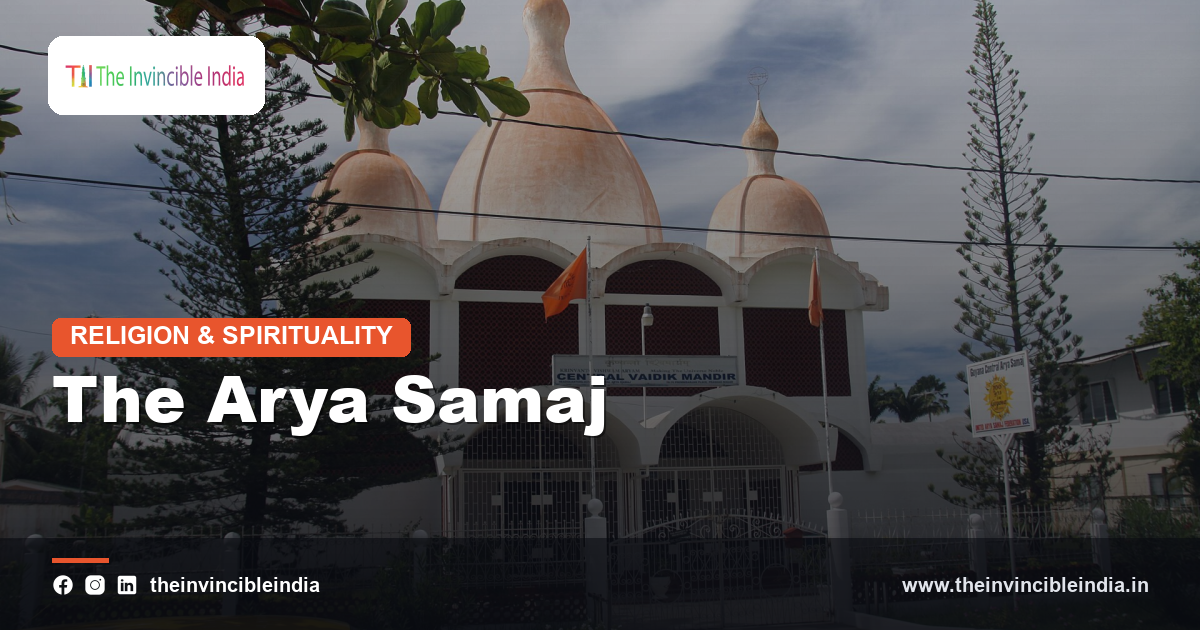
Arya Samaj mandirs differ visibly from many conventional Hindu temples, reflecting the movement’s distinctive theology and worship practice. Rather than housing images of deities, these mandirs are typically built around a central hall with a fire altar, or havan kund, where congregational worship takes place. The architecture tends toward simplicity and functionality, with an emphasis on space for communal gathering, scriptural teaching, and discourse rather than elaborate iconography. Many mandirs also incorporate libraries, schools, or community halls, reflecting the Samaj’s integration of religious, educational, and social activity within a single institutional space. These centers serve as hubs for regular worship, festival observances tied to the Arya Samaj calendar, and social functions such as weddings and Shuddhi ceremonies. Found throughout India and in Arya Samaj communities abroad, these mandirs continue to embody the movement’s founding emphasis on a Vedic-centered, image-free form of communal worship.
Spread Across India and Abroad
From its founding base in western India, the Arya Samaj expanded rapidly across the subcontinent, finding particularly strong followings in Punjab, Uttar Pradesh, and other parts of northern India. Local branches, known as Samajes, were established in towns and cities, each running its own schools, mandirs, and social programs while remaining connected to the wider movement through shared teachings and periodic gatherings. As Indian communities migrated abroad during the colonial period, the Arya Samaj traveled with them, establishing a presence in parts of East Africa, the Caribbean, Southeast Asia, and elsewhere that Indian laborers and traders settled. These overseas communities often maintained Arya Samaj institutions as a way of preserving religious and cultural identity far from the subcontinent. Today, Arya Samaj organizations continue to operate both within India and among diaspora communities worldwide, sustaining the movement’s distinctive blend of Vedic worship, education, and social service across very different social settings.
Legacy in Hindu Reform
The Arya Samaj is widely regarded as one of the most influential reform movements within nineteenth and twentieth century Hinduism, shaping debates about scripture, ritual, and social practice well beyond its own membership. Its insistence on returning to Vedic sources encouraged a broader climate of scriptural study and public religious debate in colonial India, while its social campaigns against caste discrimination and for women’s education influenced reform conversations across religious lines. The movement’s network of schools and colleges left a lasting institutional legacy that continues to educate students today, long after the immediate controversies of its founding era have faded. Historians of modern Hinduism frequently cite the Arya Samaj alongside other contemporary reform movements as evidence of the tradition’s capacity for internal renewal and self-examination in response to changing social and intellectual circumstances. Its emphasis on rational engagement with scripture remains an important reference point in discussions of religious reform in India.
Arya Samaj Today
The Arya Samaj remains an active religious and social organization in contemporary India, with mandirs, schools, and community associations operating in many states as well as among diaspora communities abroad. Its educational institutions, particularly the DAV network, continue to serve large numbers of students, carrying forward the founding conviction that modern and traditional learning can be pursued together. Havan-centered worship, the study of the Ten Niyams, and observance of the Arya Samaj calendar continue among its followers, alongside ongoing engagement in social welfare and community service activities. While the movement is smaller in scale than some other strands of contemporary Hinduism, its historical role in shaping debates about reform, education, and social equity is widely acknowledged. As a living tradition, the Arya Samaj continues to present itself as a bridge between ancient Vedic teaching and the practical concerns of modern life, sustaining the reformist vision articulated by its founder more than a century ago.
Sources & Further Reading
- Ministry of Culture, Government of India (indiaculture.gov.in).
- Sahitya Akademi (sahitya-akademi.gov.in).
Frequently Asked Questions
What is the Arya Samaj?
The Arya Samaj is a Hindu reform movement founded in 1875 that emphasizes the authority of the Vedas, promotes monotheistic worship, and advocates social reforms including education and the rejection of caste discrimination.
Who founded the Arya Samaj?
The Arya Samaj was founded by Swami Dayananda Saraswati, a Sanskrit scholar and ascetic who sought to reform Hindu practice by returning to what he considered the original teachings of the Vedas.
What are the Ten Principles of the Arya Samaj?
The Ten Niyams are a set of guiding principles covering belief in one God, the authority of the Vedas, truthfulness, righteous conduct, and concern for the welfare of all, forming the movement’s ethical and doctrinal foundation.
Does the Arya Samaj worship idols?
No. The Arya Samaj rejects image worship, teaching instead that God is formless, and it centers its worship on the havan fire ritual and recitation of Vedic mantras.
What role did the Arya Samaj play in Indian education?
The Arya Samaj established a large network of schools and colleges, including the Dayanand Anglo-Vedic institutions, which combined modern subjects with Vedic study and extended education to girls as well as boys.


